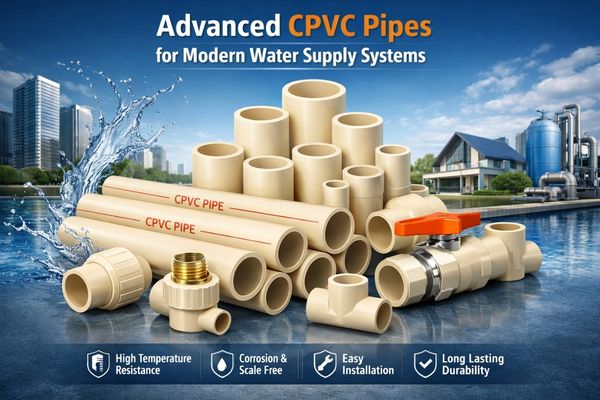
CPVC Pipes & Fittings — Built for Hot Water Lines That Can't Fail Twice
A hot water leak inside a wall doesn't announce itself the way a cold water leak does. By the time you see the damp patch or the dropped pressure, the pipe has usually been failing for weeks. That's the real argument for CPVC pipes and fittings, they're the only plastic piping material engineered to hold up under sustained heat and pressure without softening, and getting the material choice right the first time is a lot cheaper than opening a wall twice.
Trity Pipes manufactures a complete CPVC range, pipes and matching fittings, for hot and cold water distribution across residential, commercial, and institutional projects, built to IS 15778 and tested before every batch leaves our Delhi NCR facility.
Why CPVC, and Why It Has to Be Specified Correctly
CPVC, Chlorinated Polyvinyl Chloride, is created by adding chlorine to the PVC polymer structure. That chemical change is what lets it handle sustained temperatures up to roughly 93°C without deforming, which is well beyond what standard uPVC can take before it starts to soften. If you've ever seen a plumbing job where the wrong grade of pipe was used on a hot water line and the joint failed within a year, that's almost always a CPVC-vs-uPVC mix-up, not a manufacturing defect.
That distinction matters enough that we've written a full comparison if you're specifying materials across a mixed system: our CPVC vs uPVC guide breaks down exactly where each material belongs, and where substituting one for the other creates a callback six months later.
Non-toxic and NSF-aligned for potable water: CPVC doesn't react with water or leach compounds into it, which is why it's the standard choice for drinking water lines, not just hot water circulation.
Chemical resistance beyond standard PVC: CPVC holds up against a wider range of acids, alkalis, and industrial chemicals, which is part of why it's specified in chemical processing plants as well as ordinary residential plumbing.
Consistent pressure rating at temperature: Unlike metal pipe, which can develop scale and reduced flow over years of hot water service, CPVC's smooth bore keeps flow rates consistent for the life of the installation.
Where This Range Gets Specified
Residential hot water plumbing: Bathroom and kitchen hot water lines, geyser connections, and centralized hot water distribution in apartments and villas, wherever a copper alternative is needed without the cost or the risk of pinhole corrosion over time.
Hotels and hospitality: Continuous hot water circulation loops across guest floors, where consistent pressure and zero scaling directly affect guest experience and maintenance cost over the building's life.
Hospitals and healthcare facilities: Hot water systems where hygiene compliance and non-reactive piping material aren't optional, CPVC's non-toxic, non-corroding surface is part of why it's specified in these environments over metal.
Commercial and high-rise buildings: Multi-storey hot and cold water risers, where CPVC's ability to hold pressure rating even at elevated temperature matters more than in a single-storey residential run.
Industrial process piping: Chemical plants and processing facilities running fluids that would corrode standard PVC or metal over a shorter service life.
Product Range and Fittings
Our CPVC line covers the standard diameter range used across Indian plumbing installations, from smaller branch lines through larger risers, produced to consistent wall thickness and pressure class. Sizing follows the CTS (Copper Tube Size) system commonly used for CPVC in India, which is why it's a straightforward retrofit option on projects that were originally speced for copper.
| Nominal Size | Typical Use | Pressure Class Available |
|---|---|---|
| 15mm (1/2") | Fixture connections, branch lines | SDR 11, SDR 13.5 |
| 20mm (3/4") | Branch lines, bathroom feeds | SDR 11, SDR 13.5 |
| 25mm (1") | Sub-main distribution lines | SDR 11, SDR 13.5 |
| 32mm (1.25") | Sub-main and riser feeds | SDR 11, SDR 13.5 |
| 40mm (1.5") | Vertical risers, multi-unit feeds | SDR 11, SDR 13.5 |
| 50mm (2") | Main risers, high-demand systems | SDR 11, SDR 13.5 |
Exact wall thickness, OD tolerance, and current stock for each size and class are confirmed at the time of enquiry, since availability shifts with project demand across our distribution network.
Pressure class matters as much as diameter when you're specifying a riser versus a branch line. Higher pressure class pipe carries thicker walls, which means a smaller bore for the same outer diameter, a tradeoff that needs to be weighed against the actual flow demand at that point in the system rather than defaulted to the highest class available. Our team can walk through pressure class selection with you at the enquiry stage so you're not over-speccing (and over-paying for) sections of the system that don't need it.
Alongside the pipe range, we manufacture the matching fitting set: elbows, tees, couplers, reducers, unions, and end caps, produced to the same dimensional tolerance as the pipe line. That matching tolerance is what determines whether a solvent-welded joint seats cleanly and cures into a genuinely leak-proof connection, or fights the installer and creates a weak point that shows up as a failure years later.
Raw material matters here more than on most piping lines: We manufacture using high-grade, lead-free CPVC compound, not a blended or recycled feedstock. On a hot water line running at temperature for years, that raw material choice is the difference between a pipe that holds its rated pressure for decades and one that degrades early.
What Every Batch Is Tested For
CPVC pipe that looks correct on the shelf can still underperform once it's carrying hot water at pressure for years. That's why every production batch goes through testing before dispatch, not just a sample audit at certification renewal time.
Pressure testing at rated temperature: Samples are held under sustained pressure at elevated temperature to confirm the pipe performs at the conditions it's actually rated for, not just at room temperature.
Dimensional and wall thickness checks: Consistent wall thickness is what keeps pressure rating uniform along the full length of a pipe run, not just at the point where it happened to be measured.
Impact and crush resistance: Especially relevant for concealed installations where the pipe is embedded in a wall or slab and has to survive that installation process without weakening.
Full test documentation and our current certifications, including ISO 9001:2015, are available on our certifications page, and tender-specific documentation is available on request for institutional and government project bids.
Why Projects Are Moving Off Copper and GI for Hot Water Lines
Copper has been the default hot water material for decades, and GI still shows up on older specifications out of habit. Both come with cost problems that CPVC doesn't.
No corrosion or scaling: Copper and GI both scale internally over years of hot water service, which reduces flow and eventually restricts pressure at the fixture. CPVC's smooth bore doesn't scale, so flow rate on day one is close to flow rate at year twenty.
No galvanic corrosion risk: Where dissimilar metals meet in a plumbing system, copper and GI, you get galvanic corrosion at the joint over time. CPVC removes that failure mode entirely since it isn't a conductor and doesn't react with adjacent materials the way metal does.
Lower material and labour cost: CPVC costs meaningfully less than copper per metre, and it's far lighter, which means faster installation and lower labour cost on multi-storey projects with long riser runs.
No copper theft risk on site: Copper pipe gets stolen off construction sites in India often enough that some contractors have started specifying CPVC partly to remove that risk from the project entirely, alongside the performance case.
The one place metal still has an edge is in applications requiring extremely high pressure ratings beyond what any plastic pipe is rated for, but for standard residential, commercial, and institutional hot water distribution, that's not the deciding factor for most projects.
Installation Notes That Actually Prevent Callbacks
Most CPVC joint failures trace back to installation practice, not the pipe itself. A few things worth building into your site process:
Use CPVC-specific solvent cement, not a generic PVC cement. The chemistry is different, and using the wrong cement is one of the most common causes of a joint that looks sealed on installation day but fails under sustained heat months later.
Give joints full cure time before pressure testing the line: Rushing a pressure test before the solvent weld has fully cured is a common cause of joints that appear to fail the test even though the workmanship was correct, it just hadn't cured yet.
Avoid over-insertion during jointing: Pushing a pipe too far into a fitting before the cement sets can create stress at the joint that shows up as a crack years later, well outside any warranty window where the cause gets traced back correctly.
Support vertical risers at each floor level: CPVC is lighter than metal, which is an advantage during installation, but it still needs proper bracket support on long vertical runs so the weight of water in the line doesn't stress joints over time.
Sourcing in Bulk
We supply plumbing contractors, builders, and procurement teams sourcing for single sites and multi-project rollouts alike. Standard sizes are held in stock at our Delhi NCR facility with dispatch across 20+ states, and for larger or custom orders, our team confirms lead time upfront so it's factored into your project schedule rather than becoming a surprise midway through.
Sample batches are available for evaluation before you commit to a full order, and IS 15778 test reports plus ISO 9001:2015 certification are provided for tender and procurement documentation on request.
Frequently Asked Questions
What temperature can CPVC pipes handle?
Our CPVC pipes are rated for continuous service up to approximately 93°C, well above what standard uPVC can withstand, which is why CPVC is the correct choice for hot water lines and uPVC is not.
Is CPVC safe for drinking water?
Yes. CPVC is non-toxic and does not react with water, making it suitable for both hot water circulation and potable water supply lines.
Can CPVC and uPVC pipes be joined in the same system?
They shouldn't be solvent-welded directly to each other. Where a system needs both materials, for example CPVC on hot water lines and uPVC on cold or drainage lines, they're typically connected through the fixtures they both feed, not joined pipe-to-pipe. Our CPVC vs uPVC guide covers where each material belongs in a mixed system.
What's the expected service life of CPVC pipe?
Properly installed CPVC pipe typically delivers 40 to 50 years of service life, even under sustained hot water conditions, provided correct jointing practice was followed during installation.
Do you supply fittings matched to the pipe dimensions?
Yes, every fitting we manufacture is dimensionally matched to our own CPVC pipe line, which avoids the tolerance mismatch that can occur when mixing pipe and fittings from different manufacturers.
Is there a minimum order quantity?
We work with both single-site and multi-project orders. Share your project scale and timeline with our team and we'll confirm pricing and lead time.
Can I get documentation for a government or institutional tender?
Yes, IS 15778 test certificates and ISO 9001:2015 certification are available on request. See what's published on our certifications page, or contact us directly for tender-specific paperwork.
Ready to Order?
Whether you need a sample batch for evaluation, a bulk quote for an active project, or documentation for a tender submission, our team responds directly.
Call +91-9821030072 or 01204142307, email info@tritypipes.com, or send an enquiry and we'll confirm pricing and availability.
Need more than hot water plumbing for this project? Explore our uPVC electrical conduit pipes & fittings for wiring protection, or our SWR pipes & fittings for drainage, both manufactured to the same quality standard as our CPVC range.