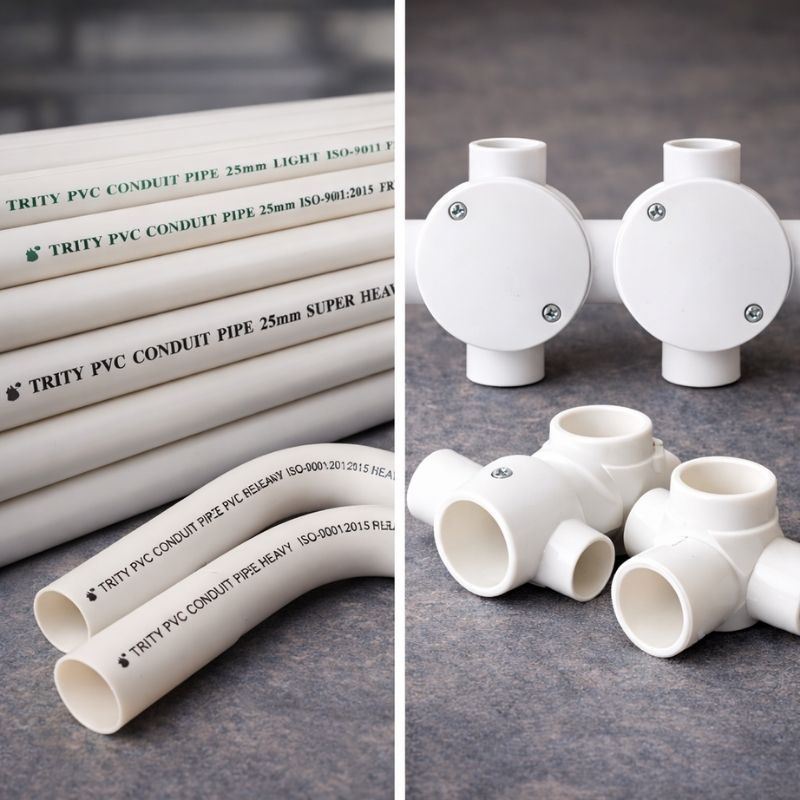
uPVC Electrical Conduit Pipes & Fittings — ISI Certified, Ready to Ship
Concrete gets poured once. If the conduit inside it fails, the fix means breaking a slab, not swapping a part. That's the real reason uPVC electrical conduit pipes and fittings from Trity Pipes are specified on repeat by contractors and MEP consultants across Delhi NCR and 20+ states: the pipe has to be right the first time, and we build every batch to be exactly that.
We manufacture the full system, rigid conduit pipes, bends, couplers, junction boxes, and saddles, to matching IS 9537 Part 3 tolerances, so there's no guesswork when fittings from one batch meet pipe from another.
Why Contractors Source Their Conduit From Us
Three things decide whether a conduit pipe performs after the walls close: the raw material, the wall thickness consistency, and whether the manufacturer actually tests every batch. We don't cut corners on any of the three.
Virgin uPVC resin only. No recycled or blended compound goes into our conduit line. That's what keeps wall thickness even and crush resistance predictable, batch after batch.
Precision extrusion. Our production line holds tight tolerances on outer diameter and wall thickness, which means fittings seat cleanly and cable pulls smoothly without snagging on internal ridges.
Tested before dispatch, not after complaints. Every batch is checked for impact resistance, dimensional accuracy, and fire propagation ahead of leaving the factory. You can review the underlying quality certifications and approvals directly.
If you're weighing whether uPVC is right for your specific site conditions, our CPVC vs uPVC comparison guide breaks down where each material fits.
Product Range and Specifications
Our conduit range covers 16mm to 50mm across three duty classifications, Light, Medium, and Heavy Mechanical Stress, so you're not forced into over-speccing a run just because it's what happens to be in stock, or under-speccing it and creating a site problem six months later. Wall thickness increases with each grade, which is what actually determines crush resistance once concrete is poured and compacted around the conduit. Full dimensional tables for each size and grade, tested to IS 9537 Part 3, are available on request when you get in touch, along with current stock positions.
Not sure which duty grade your project needs? Our LMS, MMS, HMS grading guide walks through the load conditions each grade is built for, with a decision framework, so you spec the right one instead of guessing.
Alongside the pipe range, we manufacture the complete set of matching fittings: bends and elbows, couplers, reducers, saddles and clips, junction and inspection boxes, and entry adaptors with locknuts. Every fitting is produced to the same dimensional standard as the pipe line, which is the detail that actually determines whether a joint seats cleanly on site or fights the installer.
How to Choose the Right Duty Grade
This is the specification decision that gets rushed most often, usually because whoever's ordering material that day is working off price, not load conditions. It's worth five minutes to get right, because reworking a slab after the conduit's already embedded is not a five-minute fix.
Light Mechanical Stress (LMS) is built for installations where the conduit isn't facing compression from concrete or structural load, think surface-mounted wiring, false ceilings, and partition walls. Using LMS here is the correct, cost-efficient choice.
Medium Mechanical Stress (MMS) covers moderate load conditions, typically wall chasing and internal block work, where there's some structural loading but nothing approaching a poured RCC slab.
Heavy Mechanical Stress (HMS) is the grade required for conduit embedded directly in RCC slabs, underground cable routing, and industrial floor installations, anywhere the pipe has to survive concrete compaction and long-term structural load without deforming.
The mistake we see most often on-site is LMS or MMS conduit substituted into an HMS application to save on material cost per metre. It's a false saving. The failure shows up as a crushed or oval conduit after the pour, at which point the fix means breaking concrete, not swapping a part.
Built for These Site Conditions
Residential concealed wiring
RCC slabs, brick walls, and columns across apartments, villas, and plotted developments. This is where LMS and MMS grades do most of the work, and where a smooth internal bore matters most, since concealed runs are the hardest to access again once the wall or slab is finished.
Commercial and institutional builds
Office towers, malls, hospitals, and hotels, where fire compliance has to be documented, not just claimed, and where the volume of wiring per floor means a dimensional mismatch between pipe and fittings turns into real installation delay across every floor plate.
Industrial installations
Factories and processing plants, where cables face chemical exposure, vibration, and mechanical stress that would corrode a metal conduit within a few seasons. HMS grade conduit is standard here, particularly on floor-embedded runs near heavy machinery.
Underground and infrastructure runs
Direct burial, metro and smart city projects, and government tenders that require ISI-marked, paper-trail-ready conduit with test certificates on file, not just a stamp on the pipe itself.
Agricultural and rural electrification
Pump houses, irrigation control panels, and rural feeder connections, where the conduit is often exposed to fertiliser runoff and moisture that would eat through unprotected metal conduit within a couple of monsoon seasons.
Why Project Teams Are Moving Off GI Conduit
If your default has been GI conduit out of habit, the switch to uPVC comes down to total cost, not just unit price.
No corrosion, full stop
GI rusts in humid basements, coastal zones, and any moisture-heavy environment. uPVC doesn't, so there's no anti-corrosion budget line to plan for later.
No earthing required
uPVC is a natural insulator, which removes a whole category of installation complexity and fault risk that metal conduit carries by design.
Lighter, faster to install
Less weight means faster labour on long horizontal runs and reduced structural load on high-rise projects, both of which show up directly in your installation budget.
No thermal expansion mismatch
GI conduit expands and contracts at a different rate than the concrete around it, which over years of temperature cycling can create micro-cracking at the interface. uPVC's expansion behaviour is closer to concrete, reducing that long-term stress point.
Add it up across a project lifecycle and uPVC wins on material cost, zero maintenance, and no mid-life replacement, even when the sticker price per metre looks close to GI.
Handling and Installation Notes
A conduit that meets every dimensional and mechanical spec on paper can still underperform if it's mishandled on site before it ever goes into a wall. A few practices worth building into your site process:
Store pipes flat and shaded Stacking conduit bundles on uneven ground or leaving them in direct sun for extended periods before installation can cause slight warping. It doesn't affect the pipe's rated performance once installed, but it makes handling and cutting less predictable on the day.
Use the correct solvent cement for jointing and give joints their full cure time before the run is disturbed or concrete is poured around it. A joint that hasn't cured is the single most common cause of a conduit run failing later, not the pipe material itself.
Support horizontal runs at regular intervals before the concrete pour, so the conduit doesn't sag or shift out of alignment during compaction. This matters more on longer HMS runs where the pipe is carrying more weight in fittings and cable.
Leave draw wire in place during the pour on any concealed or underground run. Retrofitting a draw wire into a set conduit that's lost its pull cord is avoidable downtime that a two-minute step at install prevents entirely.
What Every Batch Goes Through Before Dispatch
A pipe that looks fine on a showroom shelf can still fail once it's under a poured slab. That gap between "looks compliant" and "performs compliant" is exactly what IS 9537 Part 3 testing is designed to close, and it's why we run every production batch through it rather than treating certification as a one-time audit.
Crush and impact resistance
Samples are loaded until failure to confirm the pipe holds its cross-section under the compaction pressure of wet concrete, not just static weight.
Bend testing
A sample is bent to a defined radius and a mandrel is passed through afterward to confirm the bore stays clear, so cable pulling isn't compromised by a conduit that's deformed even slightly out of round.
Fire propagation
Conduit is exposed to a flame source and must self-extinguish once it's removed. This is the test behind the "non-flame propagating" rating that separates compliant conduit from an uncertified plastic tube.
Batches that don't clear these checks don't ship. That's a slower process than eyeballing a pipe and boxing it, but it's the difference between a supplier you can specify once and forget about, and one you have to double-check on every delivery.
Sourcing in Bulk
We supply electrical contractors, EPC firms, builders, and procurement teams sourcing anywhere from a single site to multi-project rollouts. Standard sizes ship from stock held at our Delhi NCR facility, with dispatch to project sites across 20+ states. For non-standard volumes or size combinations, our team confirms lead time upfront so it doesn't become a surprise mid-project.
For tender-stage documentation, IS 9537 Part 3 test reports and ISO 9001:2015 certification are available on request, alongside sample evaluation before you commit to a full order. If your specification requires deeper technical grounding before procurement sign-off, our guide on IS 9537 Part 3 compliance covers what the standard actually tests for and why it matters on government and institutional projects.
Frequently Asked Questions
What sizes of uPVC conduit pipe do you stock?
20mm through 50mm across Light, Medium, and Heavy duty grades, with matched fittings for each size. For bulk orders or non-standard sizes, contact our team directly for current availability.
Can this conduit go underground?
Yes. Our rigid conduit is rated for direct burial and resists soil chemicals, moisture, and sustained mechanical load without degrading over time.
Do you supply fittings that match the pipe dimensions exactly?
Yes, every bend, coupler, and junction box we manufacture is dimensionally matched to our own pipe line, which avoids the tolerance mismatch you can get when mixing pipe and fittings from two different manufacturers.
What documentation can you provide for a government tender?
IS 9537 Part 3 test certificates and ISO 9001:2015 certification are available on request. See our certifications page for what's published, or contact us for tender-specific documentation.
Is there a minimum order quantity for bulk supply?
We work with both single-site and multi-project orders. Reach out with your project scale and timeline and our team will confirm pricing and lead time.
Can I get a sample before committing to a full order?
Yes. For larger orders, we can arrange sample batches so your site or procurement team can evaluate dimensional accuracy and finish before the full order is placed.
What's the typical lead time for a bulk order?
Standard sizes and grades ship from stock, usually within a few working days of order confirmation. Larger custom orders take longer to schedule into the production run, our team will give you a firm date once we know your quantities and sizes.
Ready to Order?
Whether you need a sample batch for evaluation, a bulk quote for an ongoing project, or documentation for a tender submission, our team responds directly, not through a call centre queue.
Call +91-9821030072 or 01204142307, email info@tritypipes.com, or send an enquiry and we'll get back to you with pricing and availability.
Looking for other product lines? Explore our CPVC pipes & fittings for hot and cold water plumbing, or our SWR pipes & fittings for drainage systems, both manufactured to the same quality standard as our conduit range.





Specifications
The following table provides detailed technical specifications of our uPVC conduit pipes, including outer diameter (OD), inner diameter (ID), and wall thickness (W.T.) across Light, Medium, and Heavy duty classifications. These specifications are carefully maintained to ensure consistency, durability, and compliance with industry standards for electrical conduit systems. The variation in wall thickness across different duty types allows users to select the appropriate conduit based on load requirements, installation conditions, and level of protection required for electrical wiring applications. Designed for precision and reliability, these dimensions support efficient cable management, smooth wire pulling, and long-term structural performance in residential, commercial, and industrial environments.
Technical Specification of round conduits as per ISI:9537 :PART 3
| Size | OD Min (mm) | OD Max (mm) | Light ID (mm)-Min. | Medium ID (mm)-min | Heavy ID (mm)-min |
|---|---|---|---|---|---|
| 16mm | 15.7 | 16 | 13.7 | 13.0 | 12.2 |
| 20mm | 19.7 | 20 | 17.4 | 16.9 | 15.8 |
| 25mm | 24.6 | 25 | 22.1 | 21.4 | 20.6 |
| 32mm | 31.6 | 32 | 28.6 | 27.8 | 26.6 |
| 40mm | 39.6 | 40 | 35.8 | 35.4 | 34.4 |
| 50mm | 49.5 | 50 | 45.1 | 44.3 | 43.2 |