Choosing the right conduit pipe grade is one of those decisions that looks minor on the drawing sheet but has real consequences on the ground. Pick the wrong grade and you could end up with crushed pipes inside an RCC slab, blocked conduit routes that need chiselling out, or frustrated cable-pulling teams trying to fish wires through a flattened duct.
This is not an uncommon problem across construction sites in India. The pressure to reduce material costs often leads to the substitution of light-duty conduit in applications that demand medium or heavy-duty pipe. The result is increased maintenance costs, rewiring expenses, and in some cases, complete slab remediation.
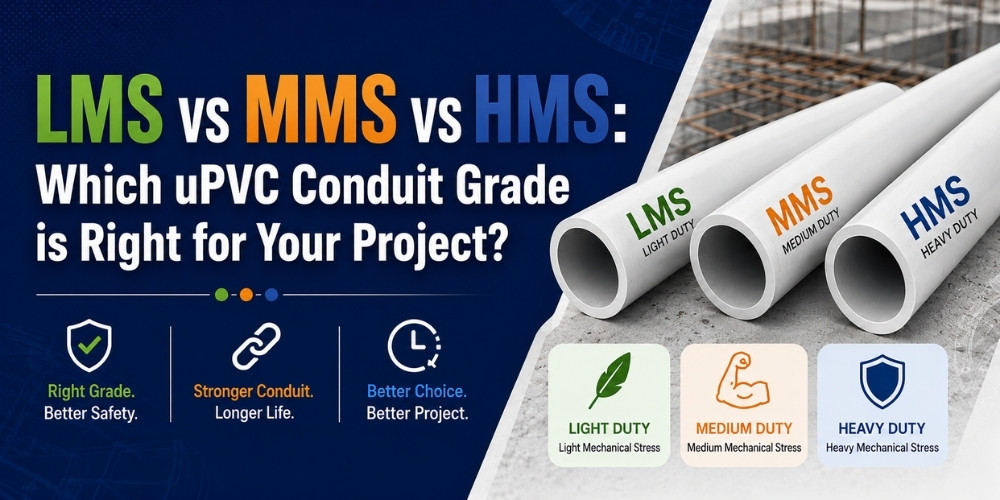
LMS, MMS, and HMS are the three mechanical stress classifications for rigid uPVC conduit pipes under IS 9537 Part 3. They define how much physical load a conduit can handle during installation, concrete pouring, and throughout the service life of the building. Understanding the LMS MMS HMS conduit pipe difference is the first step to specifying the right product for your project.
This guide breaks down each grade in detail, with comparison tables, application matrices, cost analysis, and a practical decision framework to help electricians, contractors, MEP consultants, and procurement teams make the correct choice.
What Do LMS, MMS, and HMS Mean?
The three classifications refer to the level of mechanical stress a conduit pipe is designed to withstand.
- LMS — Light Mechanical Stress. Designed for installations with minimal physical load. Suitable for surface-mounted wiring, false ceilings, and partition walls where the conduit will not face compression from concrete or heavy structural loads.
- MMS — Medium Mechanical Stress. Built for moderate load conditions. Used in wall chasing, internal block work, and light concrete applications.
- HMS — Heavy Mechanical Stress. Engineered for maximum strength. This is the grade required for conduit embedded in RCC slabs, underground cable routing, and industrial floor applications where the pipe must survive concrete compaction and long-term structural loads.
The concept of mechanical stress in conduit installation refers to the compressive, impact, and torsional forces a conduit faces during and after construction. When fresh concrete is poured over embedded conduits, the hydrostatic pressure and vibration from compaction equipment place enormous stress on the pipe wall. An undersized wall thickness simply cannot resist this load, and the conduit collapses.
Strength also matters throughout the building lifecycle. Thermal expansion, soil movement in underground applications, and accidental mechanical impact from maintenance work all demand a conduit that holds its circular cross-section over decades of service.
Understanding IS 9537 Part 3 Classification
IS 9537 Part 3 is the Bureau of Indian Standards specification that governs rigid plain conduits of insulating material. This standard defines the dimensional requirements, mechanical properties, electrical properties, and performance tests for uPVC conduit pipes and fittings used in electrical installations across India.
Under this standard, conduits are classified by their mechanical strength into three grades. Manufacturers who comply with IS 9537 Part 3 must test their products for crush resistance, impact resistance, and bending properties at specified temperature conditions. The ISI mark on a conduit pipe confirms that the product has been manufactured and tested to meet these requirements.
Buying IS-compliant conduit is not just a quality preference. On government projects, infrastructure work, and most commercial specifications, IS compliance is a contractual requirement. Using non-standard pipe on a certified project creates liability for contractors and can result in rejection during quality audits.
Beyond compliance, IS 9537 Part 3 grading provides a transparent performance benchmark. When you specify HMS conduit for slab wiring, you are working from a defined standard that every reputable manufacturer follows. You can verify Trity Pipes' quality certifications and approvals for full documentation of IS 9537 Part 3 and ISO compliance.
LMS vs MMS vs HMS Conduit Pipe Difference
The following table provides a detailed comparison across the key parameters that matter during specification, procurement, and installation.
| Parameter | LMS (Light) | MMS (Medium) | HMS (Heavy) |
|---|---|---|---|
| Mechanical Strength | Low | Medium | High |
| Wall Thickness | Thinnest | Intermediate | Thickest |
| Crush Resistance | Low (typ. 320 N/5 cm) | Medium (typ. 750 N/5 cm) | High (typ. 1250 N/5 cm) |
| Impact Resistance | Low | Medium | High |
| Pipe Weight | Lightest | Moderate | Heaviest |
| Relative Cost | Lowest | Moderate (+15–25%) | Highest (+30–50%) |
| Expected Service Life | 15–20 years (surface) | 25–30 years | 30–40+ years |
| Surface Wiring | Recommended | Acceptable | Acceptable |
| False Ceiling Wiring | Recommended | Acceptable | Acceptable |
| Wall Chasing | Acceptable | Recommended | Acceptable |
| RCC Slab Wiring | Not Recommended | Acceptable (light loads) | Recommended |
| Underground Installations | Not Recommended | Not Recommended | Recommended |
| Industrial Floor Wiring | Not Recommended | Not Recommended | Recommended |
| Contractor Recommendation | Surface / false ceiling only | Internal masonry work | Slab, underground, industrial |
Wall Thickness Comparison by Conduit Size
Wall thickness is the most direct indicator of mechanical performance. A thicker wall means higher crush resistance, better protection against impact, and longer service life under load. The following tables show typical minimum wall thickness values for each grade and size as per IS 9537 Part 3.
20 mm Conduit Wall Thickness
| Grade | Nominal Size | Min. Wall Thickness | Crush Resistance Class |
|---|---|---|---|
| LMS | 20 mm | 1.0 mm | Light |
| MMS | 20 mm | 1.4 mm | Medium |
| HMS | 20 mm | 1.8 mm | Heavy |
25 mm Conduit Wall Thickness
| Grade | Nominal Size | Min. Wall Thickness | Crush Resistance Class |
|---|---|---|---|
| LMS | 25 mm | 1.1 mm | Light |
| MMS | 25 mm | 1.5 mm | Medium |
| HMS | 25 mm | 1.9 mm | Heavy |
32 mm Conduit Wall Thickness
| Grade | Nominal Size | Min. Wall Thickness | Crush Resistance Class |
|---|---|---|---|
| LMS | 32 mm | 1.2 mm | Light |
| MMS | 32 mm | 1.6 mm | Medium |
| HMS | 32 mm | 2.1 mm | Heavy |
The difference in wall thickness between LMS and HMS may appear small in millimetres, but in structural terms it translates to a significant improvement in performance. A 0.8 mm increase in wall thickness on a 25 mm conduit roughly doubles the crush resistance load the pipe can sustain.
Thicker walls also benefit cable pulling. A pipe that maintains its circular cross-section under load allows the pull wire to move freely and reduces friction during cable installation. When LMS conduit is compressed inside a slab, even partially, it creates tight spots that make cable pulling extremely difficult or impossible.
For a full technical breakdown of OD, ID, and wall thickness values across all sizes, refer to Trity Pipes' uPVC conduit pipe specifications, which lists dimensional data for 16 mm through 50 mm conduit across all three grades.
Where Should Each Grade Be Used?
The table below serves as a site application matrix. Use this as a quick reference during specification and procurement.
| Application / Location | LMS | MMS | HMS |
|---|---|---|---|
| Surface wiring on walls | Recommended | Acceptable | Acceptable |
| False ceiling wiring | Recommended | Acceptable | Acceptable |
| Internal wall chasing (brick/block) | Acceptable | Recommended | Acceptable |
| Residential RCC slab wiring | Not Recommended | Acceptable | Recommended |
| Commercial RCC slab wiring | Not Recommended | Not Recommended | Recommended |
| Industrial RCC slab wiring | Not Recommended | Not Recommended | Recommended |
| Basement wiring | Not Recommended | Acceptable | Recommended |
| Parking area floor conduit | Not Recommended | Not Recommended | Recommended |
| Underground cable routing | Not Recommended | Not Recommended | Recommended |
| Outdoor surface installations | Not Recommended | Acceptable | Recommended |
| Factory and warehouse wiring | Not Recommended | Not Recommended | Recommended |
| Hospitals (slab embedded) | Not Recommended | Not Recommended | Recommended |
| Hotels and hospitality projects | Acceptable (surface) | Acceptable | Recommended (slab) |
| Schools and educational institutions | Acceptable (surface) | Acceptable | Recommended (slab) |
| High-rise residential buildings | Acceptable (partitions) | Acceptable | Recommended (slabs) |
| Infrastructure and government projects | Not Recommended | Not Recommended | Recommended |
The principle behind these recommendations is consistent: wherever the conduit will be encased in concrete, subjected to compressive loads, or installed underground, HMS is the appropriate choice. LMS should be confined to applications where it is accessible, protected from structural loads, and replaceable without major disruption to the structure.
If you are still evaluating whether uPVC is the right material for your project application altogether, the guide on which pipe is best for electrical wiring protection covers the full material comparison including GI, HDPE, and standard PVC.
Why LMS Conduit Is Often Misused in Slab Wiring
The misuse of LMS conduit in slab applications is one of the most common and costly errors in residential and small commercial construction in India. The root cause is almost always price-driven purchasing at the material procurement stage.
When project budgets are being squeezed and the site supervisor or builder purchases conduit without clear grade specifications, the lowest-priced option tends to get selected. LMS pipe can cost 30 to 50 percent less than HMS of the same nominal diameter, making it appear to be a significant saving.
The real cost becomes apparent after the slab is cast. Here is what typically happens on site when LMS conduit is embedded in RCC:
- Concrete vibration during compaction flattens the thin-walled LMS pipe partially or fully.
- The pull wire, if it was not pre-installed, cannot be pushed through the deformed conduit.
- Cable pulling becomes extremely difficult, requiring excessive force that risks cable jacket damage.
- In severe cases, the conduit route is completely blocked and the cable cannot be installed at all.
- The only remediation is to chisel or break open the slab to reroute the wiring, causing construction delays and significant additional cost.
A site engineer from a mid-scale residential project in Pune described an instance where LMS conduit was used throughout three slab levels. After casting, roughly 40 percent of the conduit runs were unusable. The project team spent over three weeks drilling, rerouting, and re-casting chased sections. The remediation cost far exceeded any saving from using lighter-grade pipe.
On high-rise projects in Mumbai and Bengaluru, MEP consultants have increasingly included specific clauses prohibiting LMS conduit in slab applications after experiencing similar issues. This kind of structural failure is also often linked to inconsistencies in raw material and wall thickness, which is why sourcing from an IS 9537-compliant manufacturer like Trity Pipes matters even when grade is correctly specified.
Cost Difference Between LMS, MMS, and HMS
The price variation between conduit grades is directly tied to raw material usage. A heavier wall thickness means more uPVC compound per metre of pipe, which increases manufacturing cost. HMS conduit requires significantly more material than LMS of the same nominal size.
As an approximate guide based on prevailing market prices in India:
- MMS conduit typically costs 15 to 25 percent more than equivalent LMS conduit.
- HMS conduit typically costs 30 to 50 percent more than equivalent LMS conduit.
- The cost differential narrows when purchasing at scale. Bulk procurement of HMS conduit from a reliable manufacturer reduces the per-metre premium significantly.
For a typical mid-size residential project using 5,000 metres of 25 mm conduit in slab applications, the additional cost of specifying HMS over LMS might represent an increase of Rs. 40,000 to Rs. 80,000 in the conduit budget. Against the total project cost, this is a negligible figure. Against the cost of slab remediation if the conduit fails, it is an extremely sound investment.
Procurement teams should also factor in that HMS conduit has lower wastage on site. Its rigidity makes it easier to handle, cut cleanly, and install accurately, reducing material scrap during fitting.
Is HMS Worth the Extra Cost?
This is the question that site engineers and contractors ask most frequently, and the answer is almost always yes when the application involves embedded or underground conduit.
Consider the ROI analysis for a commercial office project:
| Cost Factor | Using LMS in Slab | Using HMS in Slab |
|---|---|---|
| Initial conduit material cost (5,000 m) | Rs. 1,00,000 (approx.) | Rs. 1,45,000 (approx.) |
| Risk of blocked conduit routes | High (30–50% failure risk) | Very Low (<2% risk) |
| Remediation cost if conduit fails | Rs. 3,00,000 to Rs. 8,00,000 | Nil |
| Project delay risk | High (2–6 weeks) | Minimal |
| Future rewiring complexity | High | Low |
| Expected conduit service life | Compromised after damage | 30–40+ years |
| Total risk-adjusted project cost | Significantly Higher | Lower |
The numbers clearly show that HMS conduit delivers a lower total cost of ownership on embedded and underground applications. The material premium is recovered many times over by avoiding even a single remediation event.
Beyond slab applications, HMS conduit also delivers lifecycle benefits in surface installations. Its superior impact resistance handles accidental damage from maintenance teams, shifting furniture, and vibration better than LMS. In industrial environments particularly, this durability difference has a direct effect on maintenance frequency.
Understanding why conduit pipes fail prematurely is also important. The detailed analysis on why uPVC electrical conduit pipes break covers both grade selection errors and raw material quality issues that lead to structural failure.
How to Choose the Right Conduit Grade for Your Project
Use the following decision framework to guide your conduit grade selection at the specification stage.
Residential Projects
For low-rise residential construction with standard RCC slabs, HMS is the correct specification for all slab-embedded conduit. For surface wiring and false ceiling runs, LMS is adequate. Do not compromise on slab conduit grade regardless of the project scale.
Commercial Projects
Commercial projects including office buildings, retail spaces, and mixed-use developments should specify HMS for all embedded and underground conduit. The higher occupant density and longer building service life justify the investment. MMS is acceptable for internal wall chasing only.
Industrial Projects
HMS is non-negotiable for industrial applications. Factory floors, warehouses, and processing facilities subject conduit to mechanical impact, vibration, thermal cycling, and in some environments, chemical exposure. Only HMS-grade uPVC conduit provides the structural integrity needed for these conditions.
Government and Infrastructure Projects
Government specifications almost universally require IS-compliant conduit, and infrastructure project specifications typically mandate HMS for all embedded and direct burial applications. This is a contractual requirement, not just a recommendation. Procurement teams must ensure grade compliance is documented and verifiable. Review Trity Pipes' certifications to confirm IS 9537 Part 3 and ISO 9001:2015 compliance for project tender documentation.
High-Rise Buildings
High-rise residential and commercial towers require HMS for all slab conduit without exception. The sheer volume of structural loads, the difficulty of remediation on upper floors, and the extended service life expected from a high-rise structure all make HMS the only appropriate choice.
Hospitals, Hotels, and Institutional Projects
These building types combine complex electrical systems with extremely high remediation costs. The cost of disrupting a functioning hospital ward or a fully operational hotel floor to repair failed conduit is enormous. HMS conduit is the only rational specification for any embedded or concealed installation in these building types.
Frequently Asked Questions
1. Which conduit grade is best for slab wiring?
HMS (Heavy Mechanical Stress) conduit is the correct grade for slab wiring. Concrete pouring and vibration during compaction place significant compressive loads on embedded conduit, and only HMS pipe has the wall thickness and crush resistance to maintain its circular cross-section under those conditions.
2. Can LMS conduit be used in RCC slabs?
LMS conduit should not be used in RCC slabs. Its thin wall does not provide adequate crush resistance against the pressure of fresh concrete and compaction equipment. Using LMS in slabs is one of the most common causes of blocked conduit routes and cable pulling failures on construction sites.
3. What is the difference between LMS and MMS conduit?
The primary difference is wall thickness and mechanical strength. MMS conduit has a thicker wall than LMS, providing higher crush resistance and impact strength. MMS is suitable for internal wall chasing and moderate-load applications where LMS would be inadequate, but it still falls short of the performance required for concrete-embedded installations.
4. Is HMS conduit mandatory for commercial buildings?
For all slab-embedded and underground conduit in commercial buildings, HMS is the recommended and often specified grade. While IS 9537 Part 3 does not mandate a specific grade for a specific application, project specifications, MEP consultant drawings, and building authority requirements increasingly call out HMS explicitly for embedded work.
5. Which conduit grade lasts the longest?
HMS conduit has the longest service life across all installation types. Its greater wall thickness and higher impact resistance mean it better withstands physical stress, thermal movement, and accidental damage over decades of service. Well-installed HMS conduit in a protected location can last 40 years or more. For a broader guide on conduit selection and longevity, read Best uPVC Electrical Conduit Pipes in India.
6. What conduit should be used underground?
Only HMS conduit is appropriate for direct underground burial or underground cable routing applications. Soil pressure, moisture cycling, and the risk of mechanical impact from excavation work all require the structural integrity of heavy-duty pipe. LMS and MMS pipe are not rated for sustained underground use.
7. Does wall thickness really matter that much?
Yes. Even a 0.7 to 0.9 mm difference in wall thickness between LMS and HMS has a dramatic effect on crush resistance. The relationship is not linear because the resistance to compression is a function of the wall thickness-to-diameter ratio. Small increases in wall thickness produce large improvements in load-bearing capacity. The effect of raw material composition on conduit strength is also worth understanding, since material quality affects performance independently of grade specification.
8. How do I verify if a conduit pipe is genuinely IS 9537 Part 3 compliant?
Look for the ISI mark on the pipe and the manufacturer's batch documentation. Reputable manufacturers can provide test certificates showing crush resistance and impact test results for each production batch. When procuring in bulk, request third-party test reports from a NABL-accredited laboratory for additional assurance. Trity Pipes' certifications page provides full documentation of its IS 9537 and ISO 9001:2015 certifications.
9. Can HMS conduit be used everywhere instead of LMS?
Yes, HMS conduit can be used in any application where LMS or MMS would be specified. It is never a wrong choice from a performance standpoint. The only consideration is cost: using HMS for simple surface wiring is technically fine but represents an unnecessary material cost premium. Match the grade to the application for the most efficient specification.
10. Is there a conduit grade above HMS for extreme applications?
Within the IS 9537 Part 3 classification, HMS is the highest grade. For extreme applications such as direct burial in heavy industrial areas with vibration machinery or road crossings, HDPE conduit or GI conduit pipes are typically specified as an alternative rather than using a higher uPVC grade.
Why Contractors Prefer High-Quality uPVC Conduit Systems
Experienced electrical contractors who have worked through enough slab failures and blocked conduit remediation jobs eventually stop specifying light-duty pipe for embedded applications. The pattern repeats itself too predictably: the cost saving on pipe is trivial compared to the labour, delay, and structural disruption of fixing problems after casting.
Beyond avoiding failures, high-quality HMS conduit delivers practical advantages at every stage of installation:
- Cable pulling is smoother. A pipe that holds its shape allows pull wires and draw tapes to move freely, reducing installation time and the risk of cable jacket damage.
- Fitting connections are more reliable. Premium-grade conduit maintains consistent outer diameter tolerances, ensuring that couplers, bends, and junction boxes fit cleanly without gaps that could allow concrete ingress.
- Rigidity speeds up installation. HMS pipe is stiffer and easier to route accurately across a slab reinforcement layout, reducing the time needed to secure and fix the conduit before casting.
- IS compliance simplifies project documentation. Using certified HMS conduit eliminates grade-related queries during quality inspections and client audits.
- Long-term maintenance is simpler. A conduit system that maintains its integrity over decades means future cabling or rewiring upgrades can be executed by simply pulling new cables through existing routes, without any need to open the structure.
The best contractors treat conduit grade selection as part of their professional standard, not an optional specification detail. The small premium for HMS pipe pays for itself many times over across the service life of a building.
For a broader understanding of how conduit manufacturing quality affects field performance, the article on how manufacturers maintain uniform thickness in uPVC conduit pipe production provides useful technical context for procurement teams evaluating suppliers.
5 Key Takeaways
- LMS conduit is suitable only for surface wiring and false ceiling applications where it is not embedded in concrete or soil.
- HMS conduit is the correct and recommended grade for all RCC slab wiring, underground cable routing, and industrial floor installations.
- The LMS MMS HMS conduit pipe difference comes down to wall thickness and crush resistance, both of which are defined under IS 9537 Part 3.
- The cost premium for HMS over LMS is typically 30 to 50 percent per metre, but this figure is negligible against the cost of conduit failure and remediation.
- Specifying the correct conduit grade at the procurement stage is the single most effective step a contractor or builder can take to prevent expensive post-cast electrical problems.
Get the Right Conduit Grade for Your Project
Trity Pipes supplies IS 9537 Part 3 certified uPVC conduit pipes and fittings across LMS, MMS, and HMS grades for residential, commercial, industrial, and infrastructure projects across India.
Whether you are an electrical contractor finalising a bulk purchase, an MEP consultant working on project specifications, a builder sourcing for a multi-storey development, or a procurement team managing a large-scale industrial project, Trity Pipes can support your requirements.
Reach out to Trity Pipes for:
- Bulk conduit pricing across all grades and sizes
- Project-specific technical consultation on grade selection
- Custom quantity supply and scheduled delivery
- IS certification documentation for project compliance
- Technical support for MEP consultants and site engineers
Use the correct grade. Build with confidence. Contact Trity Pipes for your project requirements today.
Related Reading:
- Which Pipe is Best for Electrical Wiring Protection? A Complete Guide
- Best uPVC Electrical Conduit Pipes in India (Complete Guide)
- uPVC Electrical Conduit Pipes & Fittings: The Ultimate Solution for Safe and Durable Wiring
- Why uPVC Electrical Conduit Pipes Break: A Complete Analysis
- Effect of Resin and Calcium Percentage on Strength of uPVC Conduit Pipes