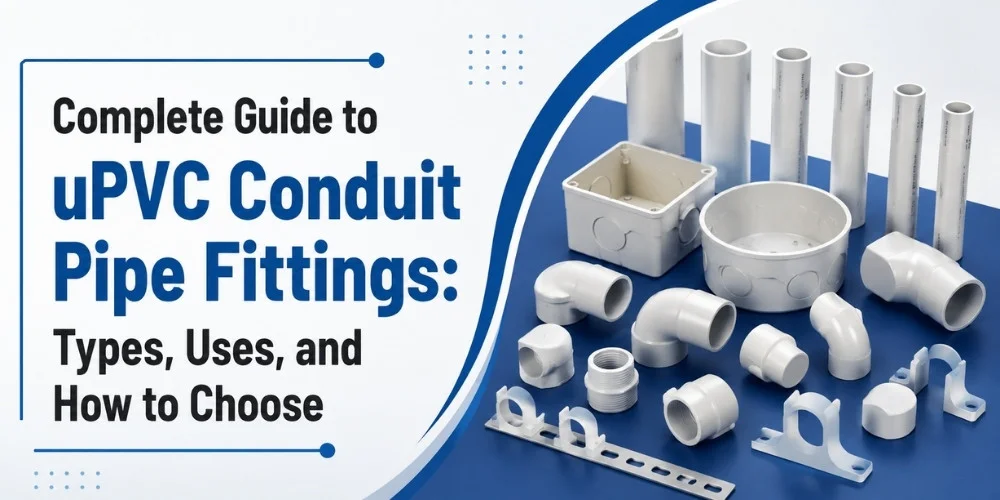
Most electricians and contractors put a lot of thought into selecting the right conduit pipe. The fittings, however, often get treated as an afterthought — ordered in whatever is available at the supplier's counter, or sourced from whichever brand is cheapest on the day.
This is one of the most expensive mistakes you can make on an electrical installation.
Conduit fittings determine whether cables can be routed cleanly around corners, whether pipes stay aligned and secured to walls, whether wiring remains accessible for future maintenance, and ultimately whether the entire conduit system holds up over decades of use. A wrong fitting creates rework. A low-quality fitting creates risk. And a missing fitting category means someone on-site improvises — which is never good in an electrical system.
This guide covers every major type of uPVC conduit pipe fittings, what each one does, where it gets used, how to identify it, how to estimate quantities, and what to look for when you are sourcing them. Whether you are an electrician wiring a single housing unit, or a project engineer managing the electrical package on a 500-bed hospital, the principles are the same.
What Are uPVC Conduit Pipe Fittings?
uPVC conduit pipe fittings are purpose-designed accessories that connect, route, support, terminate, and access uPVC conduit pipes within an electrical wiring system.
The conduit pipe is the protective enclosure for cables. The fittings are everything that makes that enclosure functional: they join pipe lengths together, change the direction of cable runs, secure pipes to surfaces, allow wires to be pulled through at intermediate points, and protect the open ends of the conduit from damage and debris.
In a properly installed electrical conduit system, the pipe and fittings together form a complete mechanical and protective system. Neither works without the other.
uPVC (unplasticised Polyvinyl Chloride) is the material of choice for electrical conduit in India because it combines high mechanical strength, chemical inertness, excellent electrical insulation, fire-retardant properties, and zero corrosion risk. These same properties apply to all uPVC conduit accessories manufactured to IS 9537 and BIS standards.
Why Conduit Fittings Are Critical in Electrical Installations
Experienced electrical contractors rarely think about conduit fittings as optional. Here is why they matter more than most buyers realise.
Cable protection at transition points: The most vulnerable part of any conduit run is where it changes direction, joins another pipe, or terminates at a panel or junction. Poorly fitted joints allow moisture ingress, expose cable insulation to edges, and create mechanical stress. The right fitting eliminates all three risks.
Mechanical strength of the system: A uPVC conduit buried in concrete or plastered into a wall must maintain its shape under compressive load. Couplers and bends that fit correctly preserve the dimensional integrity of the pipe at every joint. Loose or mismatched fittings create weak points that collapse under load.
Safe and clean cable routing: A well-planned conduit system with the correct bends and junction boxes allows electricians to pull cables through smoothly. Without the right fittings, cable-pulling becomes difficult and can damage insulation, particularly on long runs through multiple bends.
Ease of maintenance and future upgrades: Buildings are rewired. Cables are replaced. Additional circuits are added. Junction boxes and inspection elbows are what make this possible without breaking open walls. Leave them out during installation and you pay for it during every future intervention.
Compliance with CPWD and BIS specifications: Government projects, institutional buildings, and large commercial developments are subject to CPWD specifications and electrical safety codes that mandate specific conduit accessories. Using the correct fittings is a documentation and compliance requirement, not just a quality preference.
Long-term reliability: A conduit system installed with correct, quality fittings will outlast the building it serves. One installed with mismatched or substandard fittings typically shows problems within five to ten years.
Overview of Common uPVC Conduit Pipe Fittings
Table 1: Conduit Fittings Overview
| Fitting Type | Primary Function | Common Application |
|---|---|---|
| Plain Coupler | Joins two pipe lengths end-to-end | All conduit runs; every 3m or 4m |
| Threaded Coupler | Secure threaded joint for panels and boxes | Panel entry, inspection boxes |
| 90° Elbow | Sharp directional change at 90 degrees | Wall corners, slab entry |
| Inspection Elbow | 90° turn with removable inspection cover | Accessible corners in long runs |
| 15° Bend | Gentle angle correction | Minor course adjustments |
| 30° Bend | Moderate directional change | Sloped runs, angled routing |
| 45° Bend | Standard offset bend | Cabinet entry, surface changes |
| 90° Bend | Full right-angle sweep bend | Long-radius 90° cable routing |
| Circular Junction Box | Cable junction and branching point | All installation types |
| Rectangular Junction Box | Multi-cable junction with larger capacity | Heavy cable concentrations |
| End Cap | Seals open conduit end | Pipe termination points |
| Bushing | Smooth cable entry into equipment | Panel, motor, and DB entries |
| Saddle Clamp | Surface-mounted pipe support | All exposed surface conduit |
| Spacer Bar Saddle | Elevated surface support with spacing | Industrial and outdoor runs |
| Reducer / Adaptor | Connects conduit of different diameters | Mixed-size conduit transitions |
Conduit Couplers
Couplers are the most frequently used fitting in any conduit installation. Every standard pipe length — typically 3 metres — needs a coupler at each joint. On a project with 500 metres of conduit, that is well over 150 couplers before you add any special requirements.
Plain Couplers
A plain PVC conduit coupler is a short cylindrical sleeve that slides over the plain ends of two adjoining conduit pipes, joining them into a continuous run.
The internal diameter of the coupler matches the external diameter of the pipe precisely. When manufactured to IS 9537 dimensional standards, a quality plain coupler provides a snug, concentric joint that keeps the bore aligned and prevents the cables from snagging at the junction.
Plain couplers are used in concealed wiring applications — embedded in RCC slabs, routed through brick walls, and laid underground — where the joint does not need to be reopened after installation. In residential apartments across Delhi NCR, plain couplers account for the majority of all coupler usage.
Advantages of plain couplers:
- Fast to install; no threading required
- Completely sealed joint when used with adhesive
- Low profile, suitable for concrete embedding
- Lowest cost per joint in the system
Threaded Couplers
A threaded coupler has internal threading on both ends that engages with threaded conduit or accessory ends. This creates a mechanically secure, repositionable joint.
Threaded couplers are used wherever a conduit terminates at an enclosure, panel, junction box, or inspection point. In industrial facilities, control rooms, and switchgear installations across India, threaded couplers appear at every panel entry point to maintain IP ratings and prevent cable pull-out at the termination.
They are also preferred in applications where the conduit must be disconnected and reconnected — during equipment replacement or panel upgrades — without cutting and re-laying the pipe.
Installation scenarios for threaded couplers:
- Conduit entry into distribution boards and MCB panels
- Connection to inspection boxes and pull boxes
- Entry into motor control centres in industrial plants
- Cable entry into SCADA panels in smart city projects
Conduit Elbows
Standard 90-Degree Elbows
A standard 90-degree conduit elbow bend makes a sharp right-angle turn in a conduit run. The internal radius is tight, making it suitable for situations where space is constrained: at a wall corner, where a conduit turns from a horizontal run into a vertical drop, or where a surface-mounted conduit needs to turn a column.
In residential and commercial buildings, 90-degree elbows appear at virtually every wall corner, particularly in surface wiring installations where the conduit is visible and must follow the building geometry precisely.
The fitting is moulded in one piece, with the same wall thickness and material quality as the pipe it connects. A well-manufactured elbow maintains the pipe's bore through the turn without flattening or narrowing, which is critical for cable pulling.
Inspection Elbows
An inspection elbow performs the same directional change as a standard elbow, but includes a removable cover at the outer radius of the bend. This access point is the key difference.
When cables need to be pulled through a conduit that includes one or more 90-degree turns, the friction and cable management become significantly harder. An inspection elbow at the corner allows electricians to feed cables from the bend point itself, rather than trying to push them around multiple bends from a distant end.
For long cable runs in commercial buildings, warehouses, or industrial plants — particularly when pulling multicore armoured cables through conduit — inspection elbows at corners are not optional. They are a practical requirement for a clean, damage-free cable installation.
Typical applications:
- Long horizontal runs with multiple turns in office buildings
- Surface conduit in warehouses and manufacturing plants
- Any run exceeding 15 metres with 90-degree changes in direction
- Electrical risers in multi-storey commercial buildings
Conduit Bends
Bends differ from elbows in that they provide a longer sweep radius. This is important: a tighter elbow creates more friction during cable pulling and creates a sharper stress point on the cable. A sweep bend distributes the directional change over a longer arc, reducing both problems.
uPVC conduit bends are available in four standard angles. Each has specific applications.
15-Degree Bend
The 15-degree bend provides a small course correction. It is used when the conduit run needs to deviate slightly to avoid an obstruction or to align with a different routing axis. In concealed wiring through RCC structures, where pipes must follow rebar layouts and avoid beam positions, 15-degree bends are invaluable. They are rarely needed in simple residential wiring but appear frequently in complex structural slabs.
30-Degree Bend
The 30-degree bend handles moderate direction changes. It appears where conduit transitions between two planes that are not perpendicular — running along a sloped ceiling in a warehouse, angling from a wall run into a floor trench, or routing through a building that has irregular geometry. Infrastructure projects and industrial installations use 30-degree bends more frequently than residential applications.
45-Degree Bend
The 45-degree bend is the most versatile standard bend. It is used for offsets — routing a conduit past an obstruction by bending once at 45 degrees, running parallel to the obstacle, and bending back at 45 degrees in the opposite direction. This technique appears constantly in commercial electrical installations, particularly around beams, columns, and ductwork. Cabinet entries and panel connections also frequently use 45-degree bends to bring conduit into the enclosure from an angled approach.
90-Degree Bend
The 90-degree sweep bend makes a full right-angle turn but with a much longer radius than a 90-degree elbow. This is the fitting of choice wherever a 90-degree change in direction is required AND there is adequate space for the longer sweep. The longer radius dramatically reduces cable-pulling force and eliminates the sharp stress on cable insulation at the bend.
In industrial cable routing, power distribution in hospitals, and large commercial buildings, 90-degree sweep bends are standard practice on major cable routes. They are also required by CPWD specifications on government projects for cables above a certain cross-section.
Table 2: Conduit Bend Comparison
| Bend Angle | Radius | Best Application | Cable Pulling Effort |
|---|---|---|---|
| 15° | Short sweep | Minor corrections, RCC routing | Very low |
| 30° | Medium sweep | Sloped runs, angled surfaces | Low |
| 45° | Medium sweep | Offsets, cabinet entries | Low |
| 90° | Long sweep | Main right-angle routing | Moderate |
| 90° Elbow | Tight radius | Space-constrained corners | High |
Conduit Junction Boxes
Junction boxes are arguably the most critical fitting category for long-term maintenance. A conduit system without adequate junction boxes will require wall-breaking during every future cable intervention.
Circular Junction Boxes
Circular conduit junction boxes are the standard choice for most residential and light commercial installations. They are available in standard diameters of 60mm, 75mm, and 100mm, with knockout entries on all sides for conduit entry from multiple directions.
A circular junction box serves several functions: it provides a point where cables from two or more conduit runs can be joined with connectors or wire nuts; it gives electricians access to pull cables through from an intermediate point; and it acts as the mounting point for switches, socket outlets, and light fittings when a cover plate is fitted.
In a standard 2BHK apartment, circular junction boxes appear at every switch point, every socket, every ceiling rose, and at least one intermediate point on long cable runs. CPWD specifications for government housing require junction boxes at defined spacing intervals.
Rectangular Junction Boxes
Rectangular junction boxes provide greater internal volume and are used where more cables need to be terminated or joined at a single point. They are common in:
- Distribution points in commercial office floors
- Cable termination points in hospital electrical installations, where multiple branch circuits converge
- Intermediate pull boxes in large warehouse wiring projects
- Multi-circuit junction points in industrial plants
Rectangular boxes are also used as the base for MCB enclosures, and in some installations as surface-mounted switch and socket enclosures. In educational institutions and government buildings where conduit is surface-mounted and visible, rectangular junction boxes provide a neater appearance at junction points.
Both box types should be sourced from the same manufacturer as your conduit to ensure the knockout dimensions and wall thickness match the conduit pipe being used. Explore the complete range of uPVC conduit pipes and fittings from Trity Pipes to see how the system components are matched.
End Caps and Bushings
End Caps
An end cap is exactly what the name suggests: a cap that fits over the open end of a conduit pipe to seal it.
End caps serve several practical purposes during an electrical installation. Before cables are pulled through, end caps protect the open conduit ends from concrete slurry, plaster, mud, and debris entering the bore. On construction sites across India, conduit that is laid without end caps during the plastering phase frequently arrives at the installation stage with blocked bores, requiring cleaning or replacement.
After cable installation, end caps are used to seal unused conduit ends against moisture, insects, and rodents, particularly in underground and outdoor installations. In smart city projects and highway infrastructure, where conduits are laid in advance of cable installation, end caps protect the conduit bores for months or years before use.
Bushings
A bushing is a smooth, flanged insert that fits into the threaded end of a conduit at the point where it enters an enclosure, panel, or piece of equipment. Its purpose is to prevent the sharp threaded end of the conduit from cutting into cable insulation as cables are pulled through the entry point.
Without a bushing, repeated cable movement at a panel entry — particularly during installation or recabling — will abrade the outer sheath of the cable. Over time, this creates an insulation failure at a point that is difficult to detect and nearly impossible to access for repair.
Bushings are mandatory at every panel and DB entry in a properly installed system. They are cheap, easy to fit, and prevent a failure mode that costs far more to fix than the bushing itself.
Saddle Clips and Spacer Bar Saddles
Surface-mounted conduit must be securely fixed to the wall, ceiling, or structural surface at regular intervals. Without adequate support, conduit sags, pulls joints apart, and looks unprofessional. The two main fixing accessories are saddle clips and spacer bar saddles.
Saddle Clamps
A conduit saddle clamp (also called a pipe clip or conduit clip) is a simple semicircular clip with a flat base and screw holes for wall mounting. The clip wraps around the conduit and is secured with screws or plugs.
Standard IS practice and CPWD specifications require saddle clamps at maximum 500mm spacing on horizontal runs and 1000mm on vertical runs for surface conduit. In practice, many contractors use 600mm spacing on horizontal runs.
Single saddles are the standard fitting for most surface conduit work in residential and commercial buildings. They are available in sizes matching each conduit diameter from 20mm to 50mm, and the size must match the pipe diameter to grip correctly without cracking the pipe.
Spacer Bar Saddles
Spacer bar saddles (also called distance saddles or standoff saddles) fix the conduit to the surface while holding it at a set distance above the surface — typically 6mm to 10mm. This gap serves several purposes.
- It prevents moisture accumulation between the conduit and wall surface, reducing the risk of corrosion on metal fixings
- It allows surface cleaning underneath the conduit
- It gives a neater appearance when multiple conduits run in parallel
- In outdoor installations, it reduces thermal stress from surface temperature variations
Spacer bar saddles are standard in industrial installations, outdoor wiring, chemical plants, water treatment facilities, and anywhere that the wall surface is frequently cleaned or exposed to wet conditions. On metro rail infrastructure and airport electrical installations in India, spacer bar saddles are specified as standard for all surface conduit.
Best practice for saddle installation:
- Always use the correct saddle size for the conduit diameter
- Fix to structural surfaces, not to plaster or board finishes alone
- Install a saddle within 150mm of each coupler or fitting
- On outdoor runs, prefer saddles with UV-resistant fixing screws
Reducers and Adaptors
Conduit systems in complex installations rarely run in a single size. A main cable trunk route might use 40mm or 50mm conduit, branching into 25mm or 32mm runs to individual panels, and then into 20mm conduit at the final circuit level. Reducers and adaptors make these transitions possible without breaking the continuity of the conduit system.
A reducer is a short sleeve fitting with a larger diameter bore at one end and a smaller bore at the other. It connects conduit of two different sizes cleanly and securely.
An adaptor performs a similar function but may also handle a transition between threaded and plain conduit, or between metric and legacy conduit dimensions. Adaptors are particularly relevant on renovation and upgrade projects in older buildings where existing conduit may not conform to current IS sizes.
Common applications in Indian projects:
- Transition from 40mm trunk conduit to 25mm branch conduit in commercial office buildings
- Size reduction from feeder conduit to final circuit conduit at sub-distribution boards
- Connections between new uPVC conduit and existing installations in government building retrofits
- Metro rail and infrastructure projects where different conduit sizes serve different cable types
Visual Identification Guide for Conduit Fittings
Table 3: Visual Identification Guide
| Fitting | Appearance Description | Function | Typical Location |
|---|---|---|---|
| Plain Coupler | Short smooth cylinder, same colour as pipe, no threads | Joins two pipe lengths | Every pipe joint in concealed wiring |
| Threaded Coupler | Short cylinder with visible threads inside both ends | Secure threaded joint | Panel entries, inspection boxes |
| 90° Elbow | L-shaped fitting, short and compact at the corner | Sharp right-angle turn | Wall corners, slab penetrations |
| Inspection Elbow | L-shaped with rectangular removable cover on outer curve | Right-angle with access | Long runs with corners |
| 15° Bend | Slightly curved elongated tube, barely noticeable angle | Minor course correction | RCC slabs, complex routing |
| 30° Bend | Moderately curved tube, one third of a right angle | Moderate directional change | Sloped surfaces, angled routing |
| 45° Bend | Visibly angled curved tube, halfway to a right angle | Offset bends | Cabinet entries, obstacle bypass |
| 90° Bend | Deeply curved long-radius tube, full right angle over longer arc | Low-friction right-angle turn | Industrial and hospital main routes |
| Circular Junction Box | Round flat box with knockouts on sides and back, flanged lid | Cable junction, switch mounting | Every switch, socket, branch point |
| Rectangular Junction Box | Rectangular box with multiple knockouts on all faces | Multi-cable junction | Distribution points, panels |
| End Cap | Small dome or flat cap that fits over pipe end | Seals open conduit end | Unused ends, before cable pulling |
| Bushing | Flanged smooth insert, fits inside threaded conduit end | Protects cable from sharp edges | All panel and DB entries |
| Saddle Clamp | Semicircular clip with flat base and two screw holes | Surface fixing | All exposed conduit |
| Spacer Bar Saddle | Saddle on raised legs holding conduit off surface | Surface fixing with standoff | Industrial, outdoor, wet areas |
| Reducer / Adaptor | Short sleeve with visibly different diameters at each end | Connects conduit of two sizes | Size transitions anywhere in run |
Why Matching Pipe and Fitting Brands Matters
This is a point that experienced project engineers understand but that often gets lost in procurement decisions made purely on price.
uPVC conduit pipes and fittings are manufactured to IS 9537 Part 3 dimensional tolerances, but those tolerances allow for a range, not a single exact dimension. Two different manufacturers can both be IS 9537 compliant while having slightly different actual dimensions within the permitted tolerance band. When you mix pipes from one manufacturer with fittings from another, you are gambling on whether their respective tolerance choices are compatible.
What happens when they are not:
- Couplers are too tight and crack when forced on
- Couplers are too loose and create gaps that let concrete in during casting
- Bends connect but are not flush, creating cable snagging points
- Junction box knockouts do not match the conduit OD, requiring modification
- The overall installation looks mismatched and inspection-ready documentation is harder to produce
What happens when they are compatible:
- Every fitting slides on cleanly and seats correctly
- Joints are consistently tight throughout the installation
- Cable pulling is smooth because bore alignment is maintained
- The installation passes inspection without snagging points or rework
Trity Pipes manufactures both conduit pipes and the complete range of conduit fittings to matched dimensional standards, which is why project managers who have used our products across multiple sites continue to specify both together. Read about our quality certifications to understand the manufacturing standards that make this consistency possible.
How to Calculate Conduit Fittings for a Project
Estimating conduit fittings accurately avoids material shortages during installation and prevents over-procurement that ties up working capital. Here is how to approach it by project type.
Residential Projects
A standard 2BHK apartment (approximately 1,000 sq ft) typically uses:
- 80 to 120 metres of 20mm conduit
- 25 to 35 plain couplers (one per 3m pipe length)
- 15 to 25 circular junction boxes (for switches, sockets, lighting points)
- 20 to 30 bends and elbows (corners, wall transitions)
- 40 to 60 saddle clamps (for any surface wiring, typically in common areas)
- 8 to 12 end caps (temporary during construction)
Rule of thumb: Budget one coupler per 3m of conduit, one junction box per 4 to 5 electrical points, and one saddle per 500mm of exposed conduit.
Commercial Buildings
A 10,000 sq ft commercial floor plate with structured wiring requires significantly more planning. A sample estimation framework:
Table 5: Project Estimation Example (Commercial Floor, 10,000 sq ft)
| Fitting | Basis of Estimation | Estimated Quantity |
|---|---|---|
| Plain Couplers | 1 per 3m of conduit (assume 800m total) | 267 |
| Threaded Couplers | 1 per panel entry (assume 40 panels/DBs) | 40 |
| 90° Bends/Elbows | 1 per 5m of conduit (avg) | 160 |
| 45° Bends | 10% of 90° quantity | 16 |
| Circular Junction Boxes | 1 per 3 electrical points | 120 |
| Rectangular Junction Boxes | 1 per sub-DB and major junction | 12 |
| Saddle Clamps | 1 per 500mm of surface conduit (assume 200m surface) | 400 |
| Spacer Bar Saddles | Replace 30% of saddles in exposed areas | 120 |
| End Caps | 1 per open conduit end | 50 |
| Bushings | 1 per panel entry | 40 |
Industrial Installations
Industrial conduit estimation must account for heavier conduit (32mm to 50mm), longer runs, more inspection elbows for maintenance access, and higher saddle density due to vibration loads. Add a 15% wastage factor to all fitting quantities for industrial projects compared to 5 to 10% for residential.
Common Mistakes Contractors Make When Selecting Conduit Fittings
These are mistakes that appear repeatedly on sites across India, from small residential jobs to large infrastructure projects.
Mixing brands from different manufacturers: As discussed above, dimensional incompatibility between conduit and fittings from different sources creates fitment problems, leaking joints, and increased cable installation effort.
Using 90-degree elbows where sweep bends are needed: On cable runs that carry large-section cables or multiple cables in parallel, tight elbow bends create pulling force that damages insulation. The rule of thumb: any conduit carrying cable above 10 sq mm cross-section should use sweep bends, not elbows, at 90-degree turns.
Insufficient support spacing: Saddles placed too far apart allow conduit to sag, particularly in hot Indian summers when uPVC softens slightly. Sagging conduit puts stress on couplers and fittings and eventually pulls joints apart.
Inadequate junction box planning: Not providing enough junction boxes on long cable runs means cables cannot be pulled through after concrete is set. The standard maximum straight run between pull points is 15 metres. Add a junction box or inspection elbow at every point where the run exceeds this, or where there are more than two 90-degree changes in direction.
Ordering fittings in wrong sizes: Conduit fittings must match the pipe diameter exactly. A 25mm coupler will not seat correctly on a 20mm pipe, and forcing it creates a gap that allows concrete ingress. Always verify the conduit diameter before ordering.
Ignoring bushing at panel entries: This is consistently the most neglected fitting on Indian sites. Forgetting bushings at every DB and panel entry is a cable insulation failure waiting to happen.
Using non-IS certified fittings to save cost: Cheaper, non-certified fittings often have thinner walls, inconsistent dimensions, and substandard uPVC compound. They crack during installation, fail under load, and create compliance documentation problems on government and institutional projects.
How to Choose Quality uPVC Conduit Pipe Fittings
Table 4: Quality Selection Checklist
| Selection Criterion | What to Look For |
|---|---|
| IS 9537 Part 3 compliance | ISI mark visible on product or packaging |
| Material quality | Virgin uPVC resin, not recycled compound |
| Dimensional accuracy | Fits the same-size pipe smoothly without forcing or looseness |
| Wall thickness | Consistent, not thin at edges or corners |
| Colour consistency | Uniform grey throughout, not mottled or streaky |
| Impact resistance | Does not crack or split when tapped firmly |
| Fire retardancy | Self-extinguishing; look for FR specification |
| UV resistance | Required for outdoor or exposed installations |
| Manufacturer reputation | Known brand with verifiable supply history |
| Product availability | Consistent stock of all fitting types in all sizes |
| Documentation | BIS test reports and quality documentation available on request |
For those evaluating conduit pipe grades alongside fittings, our detailed post on LMS vs MMS vs HMS conduit pipe differences explains how wall thickness classification works under IS 9537 Part 3 and helps you match the right pipe grade to the right project requirement.
Questions to Ask Your Conduit Fittings Supplier
Before finalising a supplier, get clear answers to these questions:
- Are your fittings manufactured in compliance with IS 9537 Part 3?
- Can you provide BIS test reports or ISI certification documentation?
- Are your fittings dimensionally matched to your own conduit pipes?
- What is the raw material specification: virgin uPVC or recycled compound?
- Do you supply the complete range including inspection elbows, spacer bar saddles, reducers, and bushings?
- What is the minimum order quantity and what is your standard lead time?
- Do you have a technical team that can help with project estimation?
- Is your product available through distributors in our project location?
A supplier who cannot answer these questions clearly should not be your first choice on any project where quality documentation matters. Reach out to Trity Pipes if you need answers to any of these for our product range.
Applications of uPVC Conduit Pipe Fittings
Residential Buildings
Concealed wiring in RCC slabs uses plain couplers, 90-degree elbows, and circular junction boxes as the core fittings. Surface wiring in service areas uses saddle clamps and plain couplers. Every apartment project in India from a small developer to a large township consumes significant quantities of conduit fittings.
Commercial Buildings
Office towers, retail malls, and hotels use the full range of fittings including inspection elbows for accessible long runs, rectangular junction boxes at distribution points, and threaded couplers at every panel entry. Structured cabling systems in IT parks require conduit systems designed with future rewiring in mind, making junction box placement especially important.
Hospitals
Hospital electrical systems are among the most complex in any building type. Multiple circuit categories — critical power, UPS circuits, normal power, medical gas alarms — run through separate conduit systems. The need for total reliability and ease of maintenance makes inspection elbows, properly spaced junction boxes, and high-quality fittings non-negotiable. Hospitals also typically require detailed as-built documentation where ISI-marked, traceable fittings are essential.
Educational Institutions
Schools and colleges are built to last. Conduit systems in educational buildings are typically designed for a 30 to 50 year service life. Using quality IS-certified fittings and providing adequate maintenance access through correctly placed junction boxes is not a luxury on institutional projects; it is the baseline requirement.
Warehouses
Large warehouse electrical installations involve long cable runs, heavy cables for high-bay lighting and power circuits, and the need for all wiring to be surface-mounted and accessible. Spacer bar saddles, inspection elbows, and rectangular junction boxes are heavily used. The scale of warehousing in logistics parks across Delhi NCR and UP means these projects consume fittings in large volumes.
Industrial Plants
Factories and processing plants add additional demands: chemical exposure, vibration, high ambient temperatures, and the need for zone-specific wiring standards. Heavy-duty fittings, higher saddle densities, and larger conduit sizes are standard. IS 9537 compliance and BIS documentation are frequently required for factory approvals. For a deeper understanding of why uPVC outperforms other materials in these conditions, read our guide on which pipe is best for electrical wiring protection.
Infrastructure Projects
Metro rail, highway lighting, smart city projects, airports, and government buildings represent the most demanding conduit applications in India. These projects require ISI-marked fittings, documented supply chains, detailed test reports, and often third-party inspection of materials. CPWD specifications apply to central government projects. Every fitting on these projects must be traceable to a quality-certified manufacturer.
Benefits of Using High-Quality Conduit Fittings
Safety: Properly rated and installed fittings prevent cable damage, moisture ingress, and fault conditions. Electrical fires in India frequently originate from damaged cable insulation, often at poorly made conduit joints and panel entry points.
Reliability: A conduit system built with matched, quality fittings delivers decades of trouble-free performance. Rework and emergency repairs in inaccessible conduit are expensive; prevention is always cheaper.
Faster installation: Fittings that fit correctly the first time reduce on-site adjustment and rework. On large projects, this translates directly to labour cost savings. Experienced contractors confirm that matched, quality fittings consistently speed up installation versus cheaper alternatives.
Reduced maintenance: Adequate junction boxes mean future cable access does not require breaking walls. Good quality saddle clamps mean conduit stays fixed without periodic retightening. End caps and bushings prevent debris and insulation damage that would require intervention later.
Long-term cost savings: On a 25-year building lifecycle, the incremental cost of quality conduit fittings over substandard alternatives is negligible. The cost of a single rework — opening plastered walls to fix a failed conduit joint — exceeds the savings from a cheaper fitting many times over.
Frequently Asked Questions
What is a conduit coupler used for?
A conduit coupler is used to join two lengths of conduit pipe end-to-end, creating a continuous conduit run. Plain couplers are used for concealed joints; threaded couplers are used at panel entries and inspection points. One coupler is required at every pipe joint, typically every 3 metres on a standard conduit run.
What is the difference between an elbow and a bend in conduit?
A conduit elbow makes a tight-radius directional change, typically 90 degrees, in a compact form. A conduit bend makes the same angular change but over a longer sweep radius. Sweep bends reduce cable-pulling friction significantly and are preferred for large cables or long runs. Elbows are used where space is restricted. For heavy cables, IS practice and CPWD specifications generally require sweep bends rather than sharp elbows.
How many saddle clamps are required per conduit length?
For horizontal surface conduit, IS practice recommends one saddle clamp at a maximum of 500mm spacing. For a standard 3-metre pipe length, this means at least 5 to 6 saddle clamps per pipe. Vertical runs allow slightly wider spacing up to 1,000mm. Always install a saddle within 150mm of any coupler or fitting to support the joint.
Which junction box should I use: circular or rectangular?
Circular junction boxes are suitable for standard switch, socket, and lighting points in residential and light commercial installations. Rectangular junction boxes provide more internal volume and are used where multiple cables converge, at sub-distribution points, or for larger cable cross-sections. When in doubt, use the larger rectangular box; it is far easier to provide excess space during installation than to add capacity later.
Can conduit pipes and fittings from different brands be mixed?
Technically yes, but it is not recommended. Both products must conform to IS 9537 Part 3, but manufacturers choose different actual dimensions within the permitted tolerance band. Mixing brands frequently results in loose joints, over-tight fittings, or dimensional mismatches at junction boxes. For a reliable, rework-free installation, source pipes and fittings from the same manufacturer.
What are the standard sizes of uPVC conduit and fittings in India?
Under IS 9537 Part 3, standard conduit sizes are 16mm, 20mm, 25mm, 32mm, 40mm, and 50mm outer diameter. Fittings are available to match each size. The most commonly used sizes in Indian residential and commercial construction are 20mm and 25mm, with 32mm and 40mm used for heavier cable routes.
Are conduit fittings covered under IS 9537?
Yes. IS 9537 Part 3 covers rigid plain conduits of insulating material for electrical installations, including dimensional and performance requirements for conduit accessories such as couplers, bends, boxes, and caps. BIS certification for conduit fittings should be verified before procurement, particularly for government and institutional projects.
What is a bushing and is it mandatory?
A bushing is a smooth flanged insert fitted at the threaded end of a conduit where it enters a panel, DB, or equipment enclosure. It protects cable insulation from the sharp threaded edge. While not always enforced on smaller projects, it is mandatory under sound electrical installation practice and is required on all CPWD-governed projects. Skipping bushings is a common cause of insulation failure at panel entries.
How do I know if a conduit fitting is genuine IS 9537 quality?
Look for the ISI mark on the product or packaging, which confirms BIS certification. Ask the supplier for a copy of the BIS test report. Physically check the fitting: it should be uniform in colour (typically grey), have consistent wall thickness without thin spots, and fit the matching conduit pipe without force or excessive play. Quality uPVC fittings do not crack or split under normal installation handling.
How many bends are allowed in a single conduit run without a junction box?
Standard electrical installation practice limits a conduit run to a maximum of two 90-degree bends (or equivalent) between accessible points. Beyond this, cable-pulling forces become impractical and risk damaging cable insulation. For longer or more complex runs, a junction box, inspection elbow, or pull box must be provided to allow cable feeding from an intermediate point.
What is the maximum straight run length for conduit without a pull point?
The generally accepted maximum is 15 metres of straight conduit without a junction box or pull box. In practice, experienced contractors often reduce this to 10 metres on runs involving heavier cables or multiple circuits to keep cable installation manageable and damage-free.
What size of conduit fittings should I use for a hospital project?
Hospital electrical installations typically require 25mm to 50mm conduit, depending on the circuit. Critical circuits, UPS feeders, and main distribution runs use 40mm or 50mm conduit with corresponding fittings. Branch wiring to outlets and equipment typically uses 25mm. All fittings for hospital projects should carry valid ISI certification and the supply documentation should be retained for the project record.
Conclusion
Conduit fittings are not accessories. They are structural and functional components of an electrical wiring system, and the quality and correctness of the fittings determine how well that system performs over its lifetime.
The key learnings from this guide:
- Every fitting has a specific purpose; selecting the right type for each situation is as important as selecting the right pipe
- Mixing brands creates compatibility risks; matched pipe and fitting systems are always preferable
- Adequate junction boxes and inspection elbows are an investment in future maintenance, not an unnecessary cost
- IS 9537 Part 3 is the relevant BIS standard; ISI-marked fittings should be the baseline requirement on any project
- Correct quantity estimation prevents both shortages and excess procurement
If you are planning a project and want guidance on which conduit fittings are right for your specific application, the team at Trity Pipes is ready to assist. We manufacture a complete range of IS 9537-compliant uPVC conduit pipes and fittings, with matched dimensional standards across pipes and accessories.
You can also explore our technical guides on conduit pipe grade selection and electrical wiring protection materials to support your project specification decisions.
To request our complete product catalogue or speak with our technical team, contact us here.
Trity Pipes is an ISO 9001:2015 certified manufacturer of uPVC conduit pipes and fittings in India, supplying contractors, electricians, builders, and infrastructure project teams across Delhi NCR and 20+ states pan India.