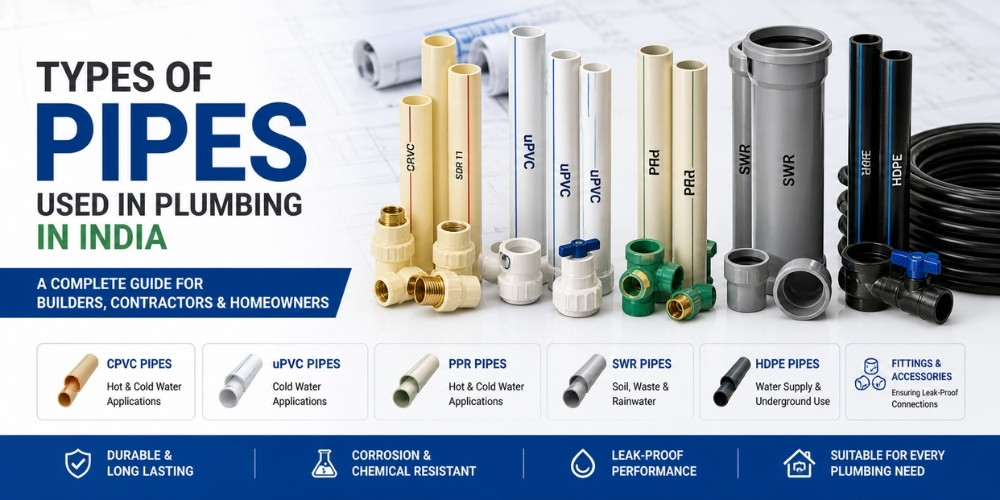
The Plumbing Reality Across Indian Construction
Walk through any construction site in Delhi NCR, Pune, or Hyderabad today and you will find one thing in common — arguments about which pipe to use. The plumber wants GI because that is what he has always fitted. The contractor wants uPVC because it is cheaper to transport. The building owner has heard CPVC is better for hot water. Everyone has an opinion, and most of them are partially right.
India's construction sector has expanded dramatically over the past two decades, but pipe selection still happens largely on habit, price, and word-of-mouth rather than informed decision-making. The wrong pipe in the wrong application does not just fail — it fails expensively. Leaks inside walls, contaminated drinking water, drainage blockages in new buildings, borewell casings collapsing within three years — these are real problems that stem from one avoidable mistake: choosing the wrong plumbing pipe type.
This guide covers every pipe type used in Indian plumbing, what each one is actually good for, where it falls short, and how to make the right call for your specific project.
Not sure which pipe suits your project? Talk to an Expert at Trity Pipes or call +91-9821030072.
Why Pipe Selection Matters More Than Most Builders Realise
Most contractors will tell you that pipe is pipe — just buy what fits the budget. That thinking works fine until the building is three years old and internal walls need breaking because the water supply line has corroded from the inside. Different pipe materials behave very differently under heat, pressure, soil conditions, and water chemistry.
In India specifically, groundwater in many regions carries high iron content, dissolved salts, or mildly acidic pH levels that destroy certain pipe materials within years. Urban water supply in cities like Mumbai and Chennai runs at pressures that cheaper pipe grades simply cannot sustain over a 20-year period. Choosing the right pipe is not about spending more — it is about spending smart.
Types of Pipes Used in Plumbing in India
1. uPVC Pipes — The Most Widely Used Pipe in Indian Construction
uPVC, or Unplasticized Polyvinyl Chloride, has become the default choice for cold water supply lines, borewell casing, and agricultural irrigation across India. Unlike standard PVC, uPVC contains no plasticizers, making it harder, more dimensionally stable, and resistant to the chemical aggression common in Indian groundwater. It is available in pressure classes PN 4 through PN 10, covering everything from light agricultural use to high-pressure municipal supply lines.
Where it is used most: cold water distribution in residential buildings, underground supply lines, borewell casing, and irrigation networks in agricultural belts across Punjab, Haryana, Maharashtra, and Andhra Pradesh.
Advantages:
- Completely corrosion-resistant — does not rust, scale, or react with dissolved salts and iron compounds in groundwater
- Lightweight and easy to handle on site; approximately one-fifth the weight of equivalent GI pipe
- Long service life of 25–50 years under typical Indian operating conditions
- Food-grade safe when BIS-certified — no leaching of chemicals into drinking water
Limitations:
- Not suitable for hot water above 60°C — use CPVC for hot water lines
- Needs UV protection if used in exposed outdoor runs
For borewell applications specifically, uPVC casing pipes are the standard choice across deep borewells in India, replacing galvanized iron and mild steel that corrode rapidly in aggressive groundwater zones.
2. CPVC Pipes — The Right Choice for Hot Water Lines
CPVC, or Chlorinated Polyvinyl Chloride, is engineered to handle temperatures up to 93°C continuously — something uPVC and standard PVC cannot do. It became widely adopted in Indian residential and commercial construction after builders and plumbers realised that GI pipes used for hot water lines were corroding, staining water, and developing pinhole leaks within 8 to 10 years in hard water areas.
CPVC is now the preferred material for overhead hot water supply in apartments, hotels, hospitals, and residential villas across India. It meets IS 15778 standards and is compatible with both hot and cold water in the same piping system, making it ideal for combined plumbing networks.
Advantages:
- Handles hot water up to 93°C, making it superior to uPVC for hot water distribution
- Smooth bore maintains flow rates over the pipe's life — no scale buildup like in metal pipes
- Chemical-resistant and non-toxic — suitable for potable hot water supply
- Significantly longer life than GI alternatives in hot water applications
Limitations:
- Higher material cost than uPVC — not required where only cold water runs
- Needs proper solvent cement jointing technique; incorrect jointing leads to leaks
Trity Pipes' CPVC pipes and fittings are manufactured for residential and commercial hot-cold water distribution, covering the full range of sizes needed for multi-storey building plumbing systems.
3. PVC Pipes — The Workhorse of Low-Pressure Applications
Standard PVC pipes are softer and more flexible than uPVC, thanks to the plasticizers added during manufacturing. This makes them lighter and easier to work with, but also less suitable for high-pressure water supply. In Indian construction, PVC pipes are used extensively for low-pressure water distribution, irrigation, electrical conduit, and drainage — essentially wherever high structural strength is not the primary requirement.
Advantages:
- Very economical — lowest cost among plastic pipe options
- Widely available across all Indian cities, towns, and semi-urban markets
- Easy to cut, join, and install without specialised tools
Limitations:
- Not suitable for hot water — softens at temperatures above 60°C
- Lower pressure rating than uPVC — avoid for high-pressure main supply lines
- Plasticizers may leach over time; not recommended for direct drinking water contact in all grades
4. GI (Galvanized Iron) Pipes — Declining but Still Present
Galvanized iron pipes were the default plumbing material in India for decades, and you will still find them in buildings constructed before the 1990s and in some rural areas where local plumbers default to what they know. GI pipes are strong and can handle significant mechanical load, but they have a fundamental problem: they corrode from the inside out, especially in areas with hard water or acidic groundwater.
Advantages:
- High mechanical strength — handles physical impact and pressure well
- Suitable for outdoor exposed runs where UV resistance is needed
- Widely understood jointing and fitting system
Limitations:
- Corrodes progressively in hard water, acidic, or high-TDS water conditions — a major issue across most of India
- Rust stains drinking water over time
- Heavy and labour-intensive to install compared to plastic alternatives
- Replacement cycle of 10–15 years in aggressive water conditions, versus 25–50 years for uPVC
Most experienced contractors in Delhi NCR, UP, and Gujarat have shifted away from GI for water supply and replaced it with uPVC or CPVC depending on the water temperature requirement.
5. HDPE Pipes — Underground and Large-Diameter Applications
High-Density Polyethylene pipes are used in India primarily for underground water mains, sewerage trunk lines, gas distribution networks, and industrial fluid transfer. HDPE's flexibility is its defining characteristic — it can be bent to accommodate terrain changes without fittings, which makes it particularly valuable for long-distance underground piping across uneven ground.
Advantages:
- Excellent flexibility — handles soil movement and seismic activity without cracking
- Strong chemical resistance across a wide pH range
- Available in large diameters — suitable for municipal mains and industrial pipelines
- Long service life; butt-fusion welded joints are stronger than the pipe itself
Limitations:
- Not suitable for indoor plumbing — too large and unwieldy for residential water supply
- Requires specialised fusion welding equipment for jointing
- Higher installed cost than uPVC for equivalent pressure ratings
6. PPR Pipes — Growing Adoption in Premium Residential Projects
Polypropylene Random Copolymer pipes are becoming increasingly popular in premium apartment projects, hospitals, and commercial complexes across India's metro cities. PPR pipes are heat-welded using a fusion jointing system that creates a monolithic, leak-free connection — a significant advantage over solvent-cemented or threaded joints in high-rise buildings where access for maintenance is difficult.
Advantages:
- Handles both hot and cold water — operating temperature range up to 95°C
- Heat-fusion joints create zero-leak connections — no chemical solvents required
- Excellent pressure ratings for multi-storey supply systems
- Hygienic and non-toxic — widely used in hospital and food processing plumbing
Limitations:
- Higher material and installation cost than uPVC or CPVC
- Requires trained installers with proper fusion welding tools
- Less widely stocked outside metro cities and large contractor supply chains
7. Copper Pipes — Premium Choice for Specific Applications
Copper piping is used selectively in India for medical gas lines in hospitals, high-end residential projects, HVAC refrigerant lines, and solar water heating systems. Copper is bacteriostatic — it naturally inhibits microbial growth — which makes it a preferred material in healthcare environments. However, cost is a significant barrier to wider adoption.
Advantages:
- Bacteriostatic properties — inhibits bacteria and biofilm formation in water lines
- Handles high temperatures and pressures reliably
- Very long service life — copper plumbing in old British-era buildings in Mumbai and Kolkata still functions after 70+ years
Limitations:
- Very high material cost — typically 5 to 10 times more expensive than CPVC or uPVC on a per-metre basis
- Requires skilled brazing or compression fitting for jointing
- Susceptible to pitting corrosion in water with low pH — requires water quality assessment before specifying
8. Cast Iron Pipes — Legacy Material Still Found in Old Stock
Cast iron pipes were the standard drainage material in Indian construction before SWR pipes took over. You will find them in government buildings, old residential colonies, and industrial facilities built before the 1980s. They are extremely strong and have good sound-dampening properties, which is why some architects still specify cast iron for drainage stacks in high-end residential projects where acoustic performance matters.
Advantages:
- Exceptional compressive strength — handles heavy load applications
- Natural sound attenuation in drainage stacks — quieter than PVC drainage
- Very long physical life when protected from surface corrosion
Limitations:
- Extremely heavy — labour-intensive and expensive to transport and install
- Susceptible to external corrosion in wet or saline soil conditions
- Jointing with lead caulking is a specialised skill that fewer plumbers have today
- High material cost compared to SWR alternatives
9. SWR Pipes — The Standard for Building Drainage in India
SWR, or Soil, Waste, and Rain pipe systems, are the most widely used drainage piping in Indian residential and commercial construction today. Manufactured from uPVC, SWR pipes are designed specifically for above-ground drainage — carrying soil waste from toilets, waste water from kitchen and bathroom, and rainwater from terrace drains — all in a single, coordinated pipe system with dedicated fittings.
SWR pipes and fittings are available in standard sizes of 75 mm, 110 mm, and 160 mm, covering everything from single-floor residential drainage to multi-storey commercial building waste systems. For a detailed comparison of SWR against standard PVC drainage, see SWR Pipes vs PVC Pipes.
Advantages:
- Purpose-engineered for drainage — fittings designed to prevent blockages and maintain self-cleaning velocity
- Lightweight and easy to install at height — significant labour advantage over cast iron
- Chemical resistant — handles drain water carrying household chemicals, detergents, and organic waste
- Long service life with minimal maintenance
Limitations:
- Not rated for pressure service — drainage only
- Requires proper slope calculation during installation to avoid blockages
Best Pipes for Different Plumbing Applications
Getting this right saves money, avoids failures, and keeps maintenance to a minimum over the building's lifetime.
Home plumbing (cold water supply): uPVC pressure pipes are the most practical choice for underground and internal cold water distribution in residential buildings. For hot water lines inside the building, CPVC is the correct specification.
Industrial use: HDPE for large-diameter underground mains and chemical transfer lines; CPVC or PPR for process water inside facilities where temperature control is needed.
Drainage (above-ground): SWR pipes and fittings are the correct choice for all above-ground soil, waste, and rainwater drainage in Indian residential and commercial buildings, regardless of height.
Borewell: uPVC casing pipes for borehole lining and uPVC column pipes for the submersible pump delivery assembly. For a detailed guide on selecting the right column pipe for your borewell depth and pump capacity, read Best uPVC Column Pipe for Borewell in India.
Common Mistakes Contractors and Builders Make While Choosing Pipes
These mistakes show up repeatedly across Indian construction projects of all sizes — and most of them are entirely avoidable.
- Using PVC where uPVC is needed — standard PVC and uPVC are not the same material, but they often look identical on site. Using standard PVC on a pressurised main supply line is a latent failure waiting to happen.
- Specifying uPVC for hot water lines — uPVC softens above 60°C. Any hot water run above that threshold needs CPVC, not uPVC.
- Buying non-BIS-certified pipes on price — non-certified pipes may have inconsistent wall thickness, sub-standard resin, or restricted additives. The Rs. 5 per metre saved on pipe cost can translate into Rs. 50,000 in repair costs inside walls three years later.
- Using GI pipes in hard water areas — in cities and districts with high TDS or iron-rich groundwater, GI pipes corrode from the inside within a decade. Switching to uPVC or CPVC at project stage costs a fraction of what replacement inside an occupied building costs.
- Skipping proper slope on SWR drainage — SWR pipes must be laid at the correct slope (typically 1:60 to 1:80) to maintain self-cleaning velocity. Flat runs block repeatedly regardless of pipe quality.
Why Trity Pipes Is a Trusted Choice Across India
Trity Pipes manufactures and supplies a complete range of plastic piping solutions — CPVC pipes and fittings, SWR pipes and fittings, uPVC casing pipes, uPVC column pipes, and uPVC pressure pipes — from a BIS-certified manufacturing facility serving contractors, builders, and infrastructure projects across 20+ states in India.
Every product is manufactured using virgin raw materials, lead-free stabiliser formulations, and precision extrusion technology with in-process quality checks against IS standards. With a network of 250+ distributors and 1,500+ dealers across Delhi NCR, UP, Maharashtra, Rajasthan, Gujarat, and beyond, Trity Pipes provides consistent product availability and technical support where projects actually happen.
Get the right pipe for your project. Contact Trity Pipes | +91-9821030072 | 01204142307 | info@tritypipes.com
FAQs — Types of Plumbing Pipes in India
Which pipe is best for drinking water supply in Indian homes?
For cold drinking water lines, BIS-certified uPVC pipes are the most practical and cost-effective option in Indian residential plumbing. Where hot water lines are involved — such as kitchen supply or bathroom hot water — CPVC pipes are the correct specification. Both materials are non-toxic, do not corrode, and maintain water quality over decades of service. Always verify that the pipes carry IS marking before purchase.
Can uPVC pipes be used for hot water lines?
uPVC pipes should not be used for continuous hot water service above 60°C. At higher temperatures, uPVC begins to soften and deform, eventually leading to joint failures and pipe distortion. CPVC is the correct material for hot water supply lines inside buildings. For overhead tanks and cold distribution, uPVC is perfectly adequate and significantly more economical than CPVC.
What is the difference between PVC and uPVC pipes?
PVC (Polyvinyl Chloride) contains plasticizer additives that make it softer and more flexible but reduce its pressure rating and temperature resistance. uPVC (Unplasticized PVC) contains no plasticizers, making it harder, more dimensionally stable, and suitable for higher-pressure water supply applications. On a construction site, the two materials often look similar — always check the IS marking and pressure rating stamped on the pipe before installation.
Which pipe type lasts the longest in Indian borewell conditions?
uPVC casing pipes outperform all metallic alternatives in Indian borewell applications. Galvanised iron and mild steel corrode progressively in groundwater carrying dissolved iron, sulphates, and chlorides — common in alluvial plains and coastal aquifer zones across India. Certified uPVC casing pipes deliver service lives of 25 to 50 years under typical borewell operating conditions, compared to 8 to 15 years for GI and as little as 5 years for uncoated mild steel in aggressive groundwater.
What pipes are used for building drainage in India?
SWR (Soil, Waste, and Rain) uPVC pipes are the standard for above-ground drainage in Indian residential and commercial buildings. They are purpose-designed for drainage applications with fittings engineered to prevent blockages and maintain flow velocity. For underground drainage mains and external sewerage, HDPE pipes are commonly used at larger diameters in municipal and infrastructure projects.
Conclusion — Choose Right, Build Right
Every pipe material covered in this guide has a legitimate role in Indian plumbing — the real skill is matching the right material to the right application. uPVC for cold water supply and borewell. CPVC for hot water lines. SWR for drainage. HDPE for large-diameter underground mains. Getting this right at the specification stage costs nothing extra; fixing it inside a finished building costs a great deal.
If you are working on a residential project, commercial development, borewell installation, or industrial facility and want guidance on pipe selection from a manufacturer who actually understands Indian site conditions — speak with the team at Trity Pipes.
Ready to source the right pipes for your project? Contact Trity Pipes — ISO 9001:2015 certified manufacturer of uPVC, CPVC, and SWR piping solutions across India.
Call: +91-9821030072 | 01204142307 Email: info@tritypipes.com Get Best Price Now — Our technical team will help you select the right pipe specification, grade, and size for your exact application.