Introduction
Wiring is the nervous system of any building and just like a nervous system, it needs the right protection to function safely and reliably for years. Whether you're wiring a new home, upgrading a commercial space, or setting up a large industrial facility, the conduit you choose can make all the difference.
That's whereuPVC electrical conduit pipes and fittings step in as a reliable solution.
Over the past decade, uPVC conduits have largely replaced conventional metal conduits across India in residential, commercial, and industrial projects and for good reason. They're lighter, safer, corrosion-resistant, and far more cost-effective in the long run. But not all conduits are built the same. Choosing a quality product from a trusted conduit pipe manufacturer in India is what truly separates a safe electrical installation from a risky one.
In this guide, we break down everything you need to know about uPVC conduit pipes from their key benefits and types to how to choose the right one for your project.
What Are uPVC Electrical Conduit Pipes?
uPVC stands for Unplasticised Polyvinyl Chloride a rigid, high-strength form of PVC that does not contain plasticisers. This makes it harder, more chemically stable, and significantly more durable than regular PVC.
An electrical conduit pipe is essentially a protective tube or sleeve through which electrical wiring is routed. It shields cables from physical damage, moisture, rodents, dust, and environmental exposure all of which can degrade insulation and lead to short circuits or electrical fires.
uPVC conduit pipes are manufactured in rigid form and are available in various sizes and wall thicknesses to suit different installation environments. They comply with IS 9537 Part 3, the Indian Standard governing round conduits for electrical installations, making them a reliable and certified cable protection system for residential, commercial, and industrial projects.
Unlike metallic conduits, uPVC pipes are non-conductive, so they add an extra layer of electrical insulation around your wiring. That's a safety advantage you simply can't overlook.
Key Benefits of uPVC Conduit Pipes
High Mechanical Strength
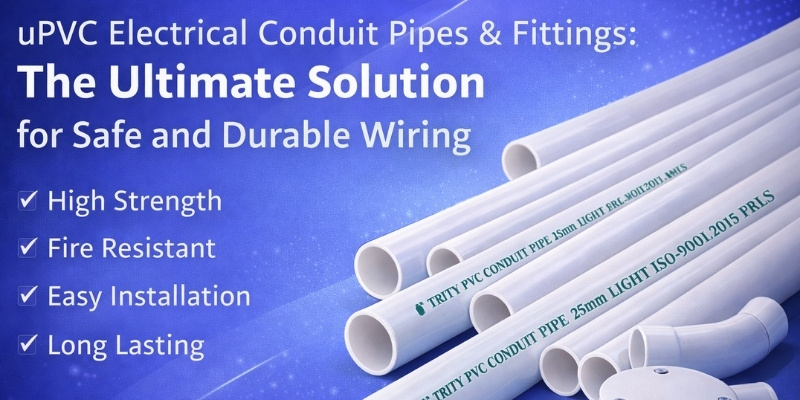
Despite being lightweight, uPVC conduit pipes are remarkably strong. They resist impact, crushing, and deformation under pressure — making them well-suited for concealed wiring inside walls, floors, and ceilings. Their structural rigidity ensures cables remain protected even when subjected to the loads typical in construction environments.
Fire Resistance
One of the most critical properties of any electrical wiring safety solution is how it behaves in the presence of heat or flame. uPVC conduit pipes are inherently fire-retardant, making them ideal for safe electrical installations they do not actively support combustion and self-extinguish once the ignition source is removed. This quality makes fire resistant conduit pipes a non-negotiable choice in both residential and industrial electrical safety applications.
Corrosion Resistance
Unlike steel or aluminium conduits, uPVC does not rust. In environments with high humidity, chemical exposure, or coastal air all conditions that rapidly corrode metal corrosion-resistant uPVC conduit pipes continue to perform without degradation. This is especially valuable in chemical plants, coastal buildings, and underground installations.
Superior Electrical Insulation
Because uPVC conduit pipes are non-conductive, providing an additional safety layer of electricity, it provides an additional insulating barrier around cables. This reduces the risk of accidental electrocution or electrical faults due to conduit contact with live wiring a safety edge that metal conduits cannot offer.
Lightweight and Easy to Install
A PVC conduit pipe for wiring is significantly lighter than its metal counterpart, making it far easier to handle, cut, and route through tight spaces. The smooth inner bore ensures that easy installation conduit truly lives up to its name — wire-pulling is smoother, quicker, and less labour-intensive. This directly reduces installation time and overall project costs.
Long-Lasting and Low Maintenance
uPVC conduit pipes don't require painting, galvanising, or any form of surface treatment over their lifetime. They are long-lasting wiring solutions in India that resist UV degradation, chemical attack, and biological growth. Once installed correctly, they can last for decades with virtually zero maintenance a significant advantage for builders and project owners alike.
Cost-Effective Performance
When you factor in the durability, low maintenance requirements, and faster installation times, uPVC conduits offer exceptional value for money. They may cost slightly more than low-grade alternatives upfront, but the long-term savings are substantial especially on large-scale projects.
Applications of uPVC Electrical Conduit Pipes in India
Residential Wiring
For house wiring, the best conduit pipe for house wiring in India needs to be safe, compact, and easy to route through walls and ceilings. uPVC conduits check all these boxes. They're widely used in concealed wiring systems in homes, apartments, and housing societies, providing a clean, safe route for all power and data cables.
Commercial Buildings
Offices, malls, hotels, and hospitals require extensive and organised wiring systems. uPVC conduit pipes allow for neat, structured cable runs throughout large commercial buildings, making future maintenance and modifications significantly easier.
Industrial Applications
Heavy manufacturing environments demand robust electrical conduit pipes for industrial applications that can handle mechanical stress, chemical exposure, and temperature variations. Heavy-duty uPVC conduits are engineered for exactly these conditions. Their fire-retardant and corrosion-resistant nature makes them a go-to solution for factories, warehouses, and processing plants where industrial electrical safety is paramount.
Infrastructure and Government Projects
Large-scale infrastructure projects in India roads, airports, metro stations, public utilities involves complex underground and surface-level cable management. ISI-certified uPVC conduits meet the quality standards mandated by government and infrastructure bodies, making them a reliable choice for these high-stakes projects.
Agricultural and Rural Electrification
In areas where moisture, chemicals from fertilisers, and soil movement are concerns, uPVC conduits offer unmatched protection for electrical cables used in pumps, irrigation systems, and rural electrification networks.
Types of uPVC Conduit Pipes: LMS, MMS & HMS
uPVC conduit pipes are classified into three grades based on wall thickness and mechanical strength:
- Light Duty (LMS): Designed for concealed wiring in walls and ceilings where the conduit is well-protected by the surrounding structure. Suitable for domestic and light commercial installations.
- Medium Duty (MMS): Offers greater wall thickness and impact resistance. Ideal for semi-exposed wiring in commercial buildings and light industrial environments where moderate mechanical stress is expected.
- Heavy Duty (HMS): The strongest classification, featuring the thickest walls and highest impact resistance. Best suited for industrial applications, underground installations, and locations with significant mechanical exposure.
All three grades are available in standard sizes from 16mm to 50mm, in compliance with IS 9537 Part 3 — the Indian standard that governs the dimensional and performance requirements for ISI standard conduit pipes.
How to Choose the Right Conduit Pipe
Selecting the right uPVC conduit pipe for your project comes down to a few key factors:
- Installation environment: Is the wiring concealed, surface-mounted, or underground? Concealed wiring in walls typically needs LMS, while underground or exposed wiring calls for HMS.
- Load and mechanical stress: In industrial or high-traffic areas, always opt for heavy-duty variants to ensure the cable protection system isn't compromised by physical impact.
- Moisture and chemical exposure: For areas prone to dampness or chemical contact, prioritise uPVC conduits with proven corrosion resistance.
- Size requirements: Match the conduit size to the number and diameter of cables it needs to carry. Avoid undersizing — cables should be pulled through with ease, not forced.
- Compliance standards: Always insist on ISI marked uPVC conduit pipes that conform to IS 9537 Part 3. This ensures the product has been independently verified for safety and performance.
If you're unsure which grade or size to choose, exploring the full Trity Pipes product range is a good starting point.
Why Choose Trity Pipes?
When it comes to conduit pipe manufacturers in India, Trity Pipes has built a reputation that stands on more than 14 years of consistent quality and manufacturing excellence.
Here's what sets Trity Pipes apart:
- ISI & ISO Certified Manufacturing: Every uPVC electrical conduit pipe and fitting produced by Trity Pipes conforms to IS 9537 Part 3 and is backed by ISO 9001:2015 certification so you know you're buying a product that has been independently verified for safety and performance.
- Premium Raw Materials: Trity Pipes uses 100% lead-free, high-grade virgin raw materials in every product. No recycled compounds, no compromise on quality.
- Precision Engineering: Advanced extrusion technology ensures tight dimensional tolerances, smooth inner bores, and consistent wall thickness across every batch critical for reliable electrical conduit solutions at scale.
- Nationwide Reach: With 250+ distributors and 1,500+ dealers across 20+ states, finding a Trity Pipes stockist near you is never a challenge.
- End-to-End Support: From technical specification guidance to after-sales support, the team at Trity Pipes is available to help you choose the right product for your project. You can explore their complete electrical conduit solutions online or reach out directly for a custom quote.
Whether you're a contractor sourcing materials for a housing project or a procurement manager at a large industrial facility, Trity Pipes delivers consistent quality at competitive pricing backed by a brand that takes electrical safety as seriously as you do.
Choosing the right electrical conduit is not just about installation—it's about long-term safety and performance. Investing in high-quality uPVC conduit pipes ensures reliable protection for your wiring system.
Conclusion
Electrical safety isn't an area where corners should ever be cut. The conduit protecting your cables is the first line of defence against fire, moisture, corrosion, and mechanical damage and choosing the right one has long-term consequences.
uPVC electrical conduit pipes and fittings in India have proven themselves as the modern standard for safe, durable, and cost-efficient wiring systems across residential, commercial, and industrial sectors in India. Their combination of fire resistance, corrosion resistance, electrical insulation, and ease of installation make them the clear choice for any serious electrical project.
For projects where quality, compliance, and long-term performance matter, Trity Pipes is a manufacturer you can trust — with 14+ years of experience, ISI-certified products, and a nationwide supply network built to serve the needs of modern India's infrastructure.
Ready to get started? Contact Trity Pipes a trusted uPVC conduit pipe manufacturer in India, for product specifications