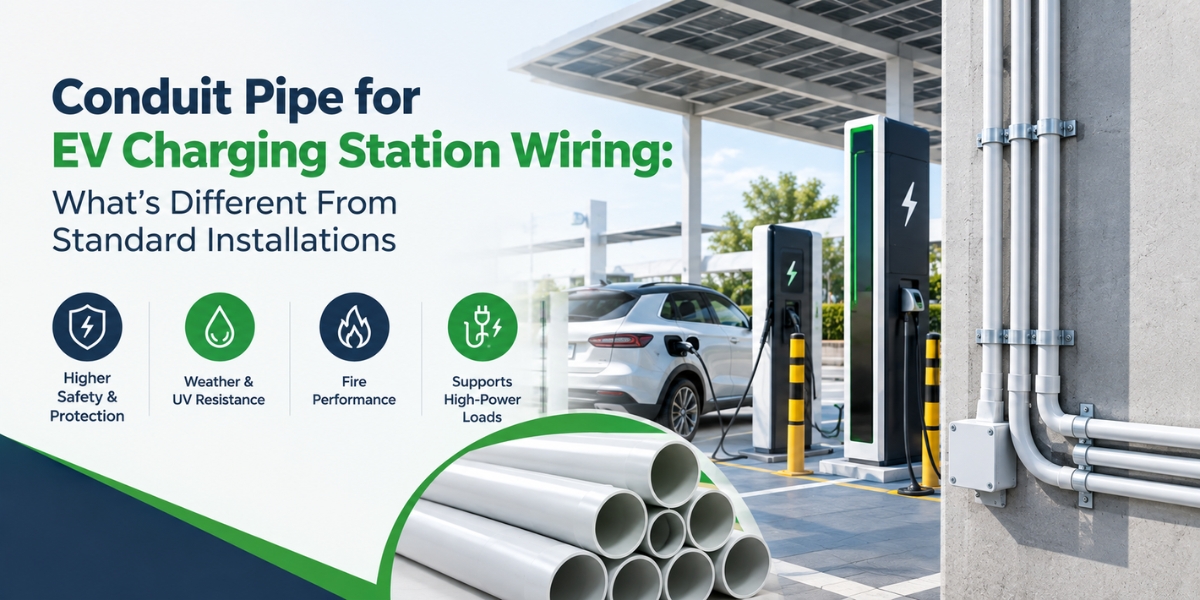
An EV charger doesn't behave like a typical electrical load. A geyser cycles on and off. An air conditioner ramps up and down with the compressor. An EV charger, once a vehicle plugs in, draws a steady, continuous current for hours at a stretch, often overnight or across a full workday for fleet and commercial installations. That single difference, sustained continuous load instead of intermittent demand, changes several things about how the circuit feeding it, and the conduit protecting that circuit, needs to be specified.
This guide covers what's genuinely different about EV charging station wiring compared to a standard electrical installation: the regulatory framework specific to EV charging in India, the outdoor and semi-outdoor exposure most charging points face, underground routing to charging bays, and the safety margin that sustained heavy load demands.
Why EV charging circuits need dedicated treatment
IS 732:2019, the BIS code of practice for electrical wiring installations up to 650V, sets out a specific requirement for EV charger circuits: a dedicated circuit with its own MCB and residual current protection, not sharing a circuit with any other heavy appliance. This isn't a formality. A charger drawing continuous current for hours puts sustained thermal load on everything in that circuit, wiring, conduit, and connection points alike, in a way that a typical home or office circuit, designed around brief, intermittent peaks, was never built to handle.
At a regulatory level, two bodies shape how EV charging infrastructure gets wired in India. The Ministry of Power sets the overall framework covering deployment, grid connections, and public charging infrastructure norms. The Central Electricity Authority focuses specifically on electrical safety, governing how charging stations connect to the network, protection systems, earthing, and equipment installation requirements under the CEA (Measures Relating to Safety and Electric Supply) Regulations, 2010, as amended for EV charging provisions.
What the regulations actually require of the installation
A few specific requirements from this framework directly affect conduit and wiring specification, beyond the charger hardware itself.
Earthing and protection
Both IS 732 and CEA safety regulations require proper earthing, residual current protection, and interlock protection on EV charging circuits, treating this as baseline rather than optional. For conduit specifically, this means routing and connection points need to support reliable, continuous earth continuity, since a charging circuit running for extended hours has more opportunity for a developing earth fault to go undetected than a briefly-used circuit would.
Fire safety and enclosure material
CEA's safety provisions for charging stations require enclosures to be made of fire-retardant material with self-extinguishing properties, free from halogen content, alongside fire detection and alarm provisions appropriate to the installation. This standard for the charging equipment enclosure is a useful benchmark for the conduit feeding it too: flame-retardant, low-smoke conduit is the sensible default for EV charging infrastructure, not just the charger housing itself.
Feeder capacity margin
Building bye-law guidance associated with EV charging infrastructure recommends maintaining meaningful spare capacity, commonly cited around a 1.25 times margin, on feeder capacity supplying charging points. This matters directly for conduit sizing, since a feeder run sized with only the bare minimum capacity for today's charger count leaves no room for the additional chargers most sites end up adding as EV adoption grows.
Outdoor and semi-outdoor exposure
Most EV charging points in India, whether at homes, offices, apartment complexes, or public charging stations, sit in covered or open parking areas rather than fully enclosed indoor spaces. This puts the conduit feeding them in the same outdoor exposure category as any other weather-exposed electrical installation.
What this means for conduit specification
- UV-stabilised conduit is essential, not optional, for any run exposed to direct or indirect sunlight in a parking area. Our guide to UV-resistant conduit for outdoor installations covers what UV stabilisation actually involves and how to confirm a product is genuinely rated for outdoor duty, which applies directly to charging point wiring in covered or open parking.
- IP55 or higher rated fittings and enclosures are the practical standard for charging point wiring exposed to dust and moisture in a parking environment, consistent with the ingress protection expectations already common for outdoor electrical equipment.
- Semi-covered parking structures (multi-level car parks with open sides, canopy-covered surface parking) still see wind-driven rain and significant temperature swings, and conduit here should be treated as outdoor-rated even where a roof provides partial protection.
Underground runs to charging bays
Larger sites, apartment complexes, commercial parking, and public charging stations, often need to route power from a main distribution point to charging bays some distance away, frequently underground beneath a parking surface or across a site.
Sizing for voltage drop over distance
A continuous, heavy load run over a long underground conduit run is more sensitive to voltage drop than a typical intermittent load, since the current is sustained rather than momentary. Undersized conductor and conduit combinations over a long run can result in a genuine voltage drop at the charger end, reducing charging efficiency and, in more severe cases, creating a heat buildup risk at connection points. Sizing the conduit and conductor together for the actual run length, not just the charger's rated current, is a detail worth getting right at the design stage rather than discovering as a complaint after installation.
Practical underground routing considerations
- Plan underground conduit routes for charging infrastructure with the same mechanical protection considerations as any underground electrical run: adequate depth, warning tape or marker above the conduit line, and protection at any point where the route crosses vehicle traffic areas
- Where a site plans to add charging points progressively as demand grows, laying spare conduit capacity underground during initial site works avoids the cost and disruption of excavating a finished parking surface later
- Coordinate underground charging infrastructure routing with the site's broader electrical distribution plan, since charging bays are often added to sites designed originally without EV infrastructure in mind, and retrofitting underground runs into an existing parking layout is considerably more expensive than planning for it during initial construction
The safety margin for sustained heavy load
This is the concept that ties the whole specification together. A domestic or commercial circuit sized for typical intermittent appliance use is not automatically adequate for a continuous EV charging load of the same rated current, because continuous duty and intermittent duty put genuinely different thermal stress on wiring and conduit over time.
What a sustained-load safety margin looks like in practice
- Don't size conduit and conductors to the bare minimum for the charger's rated current. Building in genuine spare capacity accounts for the sustained nature of the load and the near-certainty that charging demand at most sites grows over time as EV adoption increases.
- Avoid conduit fill ratios that work for intermittent circuits but are tight for continuous ones. A conduit packed close to its fill limit dissipates heat less effectively, which matters more for a circuit under sustained load than one that's only briefly active.
- Treat fast chargers and multi-charger installations as a materially different load profile from a single home wallbox. Commercial and fleet charging installations, where multiple vehicles may charge simultaneously for extended periods, need feeder and conduit sizing that reflects that cumulative continuous demand, not a simple multiplication of a single charger's rating.
Specifying conduit for your EV charging project
EV charging infrastructure asks more of its wiring than most standard installations because the load itself behaves differently, continuous rather than intermittent, and because the regulatory framework around it, from IS 732's dedicated circuit requirement to CEA's safety provisions, reflects that reality. Outdoor exposure, underground routing over meaningful distances, and a genuine safety margin for sustained load are the details that separate a charging installation built to last from one that becomes a maintenance problem within a year or two. Our conduit pipe size chart is a useful starting reference for matching conduit size to circuit load, though EV charging circuits' continuous-duty nature warrants sizing with extra margin beyond the chart's general guidance.
Trity Pipes manufactures ISI-certified, UV-stabilised uPVC conduit across LMS, MMS, and HMS grades suited to both the outdoor exposure and the sustained load demands of EV charging infrastructure. You can review our full uPVC conduit pipes and fittings range for the sizes and grades that fit your installation.
Installing EV charging infrastructure? Talk to our team about conduit sizing for continuous high-load circuits, and we'll help you plan for both current demand and future charger expansion.
Frequently asked questions
Why does an EV charger need its own dedicated circuit?
IS 732:2019 requires EV chargers to run on a dedicated circuit with their own MCB and residual current protection because the charger draws continuous high current for extended periods, unlike most other appliances that cycle on and off. Sharing a circuit with other heavy loads under this kind of sustained demand increases the risk of overheating and nuisance tripping.
Does EV charging conduit need to be UV-resistant?
Yes, if any part of the run is exposed to direct or indirect sunlight, which is the case for most parking area installations in India, whether covered or open. UV-stabilised conduit resists the surface degradation and brittleness that unprotected compound develops under sustained sun exposure over the charging installation's working life.
What IP rating should EV charging point fittings have?
IP55 or higher is the practical standard for fittings and enclosures in a typical outdoor or semi-covered parking environment, consistent with general outdoor electrical equipment expectations and aligned with the fire-retardant, weatherproof enclosure standards set out in CEA's safety provisions for charging stations.
Why does conduit sizing matter more for EV charging than for a typical circuit?
Because EV charging is a continuous load rather than an intermittent one, undersized conduit and conductors face more sustained thermal stress and are more prone to voltage drop over long runs than the same sizing would experience under typical, brief-duration appliance use. Building in genuine spare capacity, both in conductor size and conduit fill ratio, is a more important safety margin here than for standard wiring.
Should I plan for more charging points than I currently need?
Generally yes, particularly for commercial, residential complex, or public charging sites. Laying spare underground conduit capacity during initial installation is considerably cheaper than excavating a finished parking area later to add capacity, and EV charging demand at most sites has been growing steadily as adoption increases.
What's the difference in wiring requirements between a home charger and a commercial fast-charging installation?
A single home wallbox is a meaningful continuous load on its own, but a commercial or fleet charging installation with multiple simultaneous chargers represents a much larger cumulative continuous demand. Feeder and conduit sizing for multi-charger sites needs to reflect that combined load profile, not a simple per-charger calculation, and should be planned with input from an electrical engineer familiar with EV infrastructure load calculations.