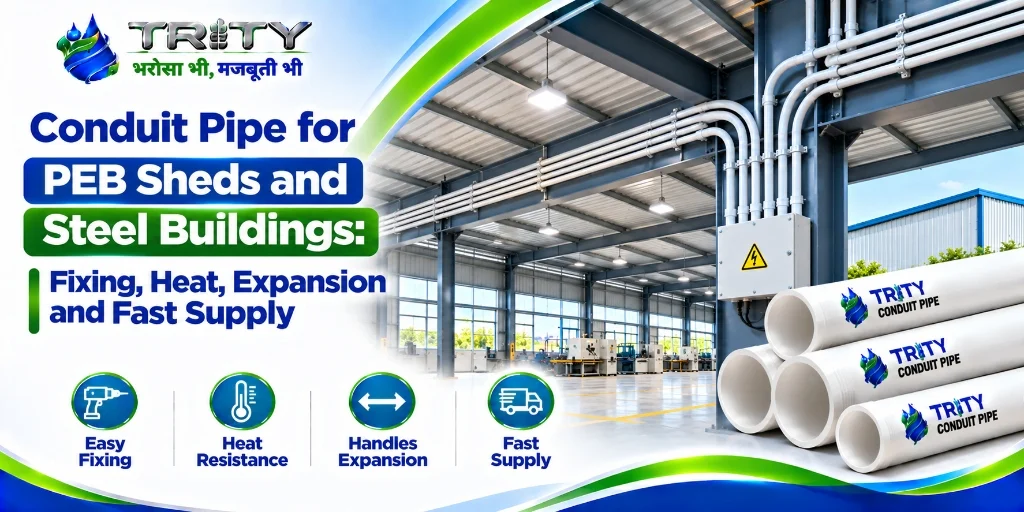
Pre-engineered buildings, or PEBs, have changed how factories, warehouses, cold stores, showrooms and workshops get built. A steel frame is fabricated off-site, erected in weeks and clad in metal sheets, and the owner can start fitting out almost immediately. The electrical contractor then arrives to a building with no masonry to chase, no slab to embed conduit in and a roof that gets very hot in summer.
That changes how conduit is specified and installed. This guide explains the differences: how to route and fix conduit on a steel structure without damaging it, which grade to use, how to handle roof heat, condensation and expansion, how to plan high-bay lighting and equipment circuits, what to coordinate with the PEB supplier, and how to plan supply so that wiring keeps pace with a fast build. For factory wiring in general, read our guide on industrial conduit pipe for factories, and for storage buildings, our guide on conduit pipe for warehouses and logistics parks. This post is about the steel-structure specifics.
How a PEB differs from a masonry building
- Everything is surface-mounted. There are no concrete walls or slabs to embed conduit in, apart from the floor.
- The structure is steel. Columns, rafters, purlins and girts carry the load, and drilling or welding on them is usually not allowed without approval.
- The roof is thin metal. It heats up quickly in sun and cools quickly at night, so temperatures inside the building vary a lot.
- Spans are large. Conduit runs are long and open, with few places to hide.
- Speed matters. PEB projects are sold on short build times, so wiring must not become the bottleneck.
Surface conduit is the norm
In a steel building, conduit runs on the surface, along columns, rafters and walls, and above equipment. Neat, well-supported surface conduit is the standard method, and it has advantages: it is easy to install and inspect, and changes are easy to make as the plant grows. Our guide on concealed and surface wiring explains the trade-offs, and for PEBs, surface is the practical default.
Choosing grade
HMS grade is the sensible default for exposed conduit in industrial sheds, because of mechanical risk from equipment, forklifts, cranes and maintenance work, and because of heat. MMS can suit protected runs in offices, mezzanine rooms and above false ceilings inside the building. Our LMS, MMS and HMS guide explains the grades.
Choosing size
Branch circuits for lighting and small power commonly use 20mm to 25mm, feeders to machines and sub-panels use 32mm to 50mm, and larger sizes serve main distribution. Check cable fill for each run and leave capacity for growth. Our conduit pipe size chart helps match size to cable fill.
Fixing conduit to steel without damaging the structure
This is the main practical difference, and it is worth agreeing with the PEB supplier early.
- Do not drill, cut or weld on structural members unless the PEB manufacturer approves it. Drilling can reduce the strength of a purlin or rafter and may void the structure's warranty.
- Use clamp-on fixings that grip the steel flange without holes, such as purlin or beam clamps, together with saddles or clips sized for the conduit.
- Use secondary supports where there is no convenient steel to clamp onto, such as cable trays or light steel brackets, and have them approved.
- Check fixings for corrosion resistance, especially in humid or coastal sites, because bare steel fixings rust.
- Fix at suitable spacing, closer on long horizontal runs and on vertical drops, so that the conduit does not sag or rattle.
- Keep conduit clear of sprinkler pipes, ducts, lighting fixtures and crane tracks.
Roof heat and expansion
A metal roof can get very hot, and the air under it can reach high temperatures in summer. uPVC expands with heat, and a long conduit run in a hot shed moves noticeably.
- Add expansion couplers on long straight runs, at intervals the manufacturer recommends
- Do not fix every point rigidly on a long run, so that the conduit can move
- Keep conduit away from the roof sheets where possible, because the sheets are the hottest part
- Use closer saddle spacing on horizontal runs in hot spaces to prevent sagging
- Store pipe in shade on site before installation
In very hot regions, discuss the specification with our technical team before ordering. Our regional guide on conduit pipe in Rajasthan explains how desert heat affects conduit.
Condensation and moisture
Metal roofs sweat when warm, humid air meets a cool surface, and condensation can drip onto equipment. Use sealed junction and terminal boxes with proper glands, enter boxes from the side or bottom, and avoid routing conduit directly under likely drip points. Many PEB roofs have insulation or a liner to reduce condensation, but sealed fittings are still sensible.
High-bay lighting and equipment circuits
PEB sheds have high roofs and large floors.
- High-bay lighting is mounted on rafters or suspended from them. Run conduit along the rafters to the fixtures, group circuits by zone, and plan access for maintenance at height, since changing a fixture 8 to 12 metres up is a job that needs a lift.
- Equipment circuits to machines, compressors, cranes and conveyors need robust, accessible routes. Use HMS grade and fix securely.
- Crane and hoist supply often uses dedicated systems, which should follow the crane supplier's specification.
- Separate power and control cabling into different conduits.
Earthing and bonding
A steel building needs a proper earthing system, and the steel frame is typically bonded to it. Uninterrupted earth continuity matters for safety, and the design should follow the electrical consultant's specification. uPVC conduit is non-conductive, so conductors inside still need their own earth, and any metal fittings, boxes or supports should be bonded as the specification requires.
Fire safety
Industrial sheds hold equipment and stock of high value, and fires spread fast in a large open space.
- Use flame retardant conduit. Our guide on fire resistant conduit pipe explains how this is judged
- Fire stop penetrations through fire-rated walls and floors
- Follow the applicable code. Our guide on NBCS 2026 and conduit pipe explains which rules apply and why local requirements still decide
Outdoor sections and roofs
PEB projects often include outdoor lighting, yard circuits, gatehouse supply and roof-mounted solar. Exposed outdoor runs need conduit suited to sun and weather. Trity offers UV-stabilised variants for outdoor applications, and our team can confirm the grade and specification for your site. See our guide on UV resistant conduit for outdoor wiring and our guide on conduit pipe for rooftop solar for related considerations.
Coordinate with the PEB supplier
A short list of questions avoids rework.
- Where can fixings be clamped, and where are drilling or welding not allowed?
- Where are service routes planned, and are cable trays or supports included in the PEB scope?
- What are the roof and cladding details that affect penetrations and sealing?
- What is the erection schedule, and when does the electrical contractor get access?
- Who is responsible for earthing of the structure?
Planning supply for a fast build
PEB buildings are erected quickly, and the electrical trade needs material on time.
- Finalise the specification early, so that approvals do not delay installation. Our guide on material approval submittals for conduit pipe explains what to prepare
- Estimate quantities by bay or zone. Our guide on estimating conduit pipe for a BOQ explains the method
- Order matching material in single batches where possible
- Phase delivery to follow erection, with spares of common sizes
- Order fittings and fixings with the pipe, including saddles, clamps, couplers and boxes
Why PEB contractors and owners choose Trity Pipes
Trity Pipes is a manufacturer of uPVC conduit pipes and fittings made from lead-free, high-grade virgin raw materials, certified to IS 9537 Part 3 with ISO certification. For PEB and steel-building projects, we offer:
- LMS, MMS and HMS grades with matching fittings and saddles from one manufacturer
- Technical guidance on grade, spacing and expansion for hot, exposed sheds
- Project quotations with rate validity and phased delivery to match erection
- Certification documents on our certifications page and on request
- A Delhi NCR factory, close to major industrial belts, with dispatch to 20-plus states
See the uPVC conduit pipes and fittings range, and ask our team for the Trity Pipes price list or a quotation for your shed.
Frequently Asked Questions
Which conduit grade is best for a PEB shed?
HMS grade is the usual choice for exposed conduit in industrial sheds because of mechanical risk and heat. MMS can suit protected runs in offices and mezzanine rooms.
How do I fix conduit to a PEB without drilling the steel?
Use clamp-on fixings such as purlin or beam clamps with saddles, or approved secondary supports. Do not drill, cut or weld on structural members unless the PEB manufacturer approves it.
Does roof heat affect uPVC conduit in a metal shed?
Heat makes uPVC expand and can soften it on very hot runs. Use expansion couplers, closer saddle spacing, avoid fixing every point rigidly, keep conduit away from roof sheets and store pipe in shade.
How do I handle condensation in a metal-roofed shed?
Use sealed boxes and glands, enter boxes from the side or bottom, and avoid routing conduit under likely drip points.
Can Trity Pipes supply conduit in phases for a PEB project?
Yes. Share your sizes, grades, quantities and erection schedule, and our team will prepare a quotation with rate validity and phased delivery from our Delhi NCR factory.
Does Trity Pipes offer conduit suitable for outdoor yard lighting?
Trity offers UV-stabilised variants for outdoor applications. Share your site details with our team, and we will confirm the grade and specification for your project.
Building a PEB shed or steel structure? Contact Trity Pipes on +91-9821030072 or +91-9319984755 for a project quotation, certification documents and phased supply of ISO-certified uPVC conduit pipe from our Delhi NCR factory.