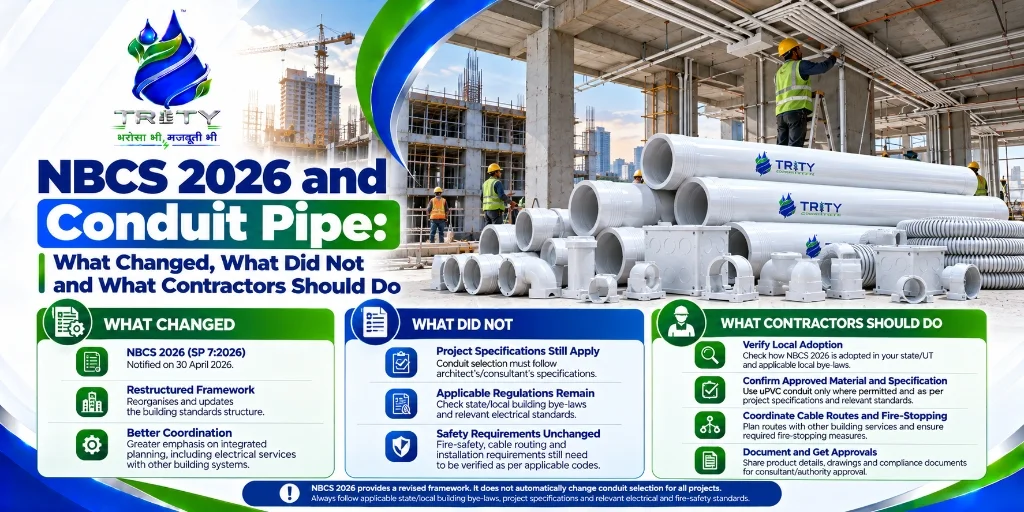
In 2026 India's national building rulebook changed. The Bureau of Indian Standards notified the National Building Construction Standards 2026 (SP 7:2026), commonly called NBCS 2026, on 30 April 2026, and it replaces the National Building Code 2016. Since then, electrical contractors, consultants and developers have been asking the same question: does this change how we specify and install conduit?
The honest answer has two parts. Some things did change, mainly in fire and life safety and in how the rules are framed. Many things that matter for conduit did not change at all. This guide explains both, clears up the confusion around the new height threshold, explains why your state's rules still decide what binds you, and gives a practical checklist. It is general information, and your fire consultant and local authority are the final word for your project.
What NBCS 2026 is
NBCS 2026 is a full replacement of NBC 2016, not an amendment. Key points:
- It was renamed from a "Code" to "Standards," and reorganised into a new structure of volumes and parts.
- Fire and life safety moved to Part F, which replaces Part 4 of NBC 2016.
- Building services, including electrical, EV charging and solar PV, are covered in Part D.
- Much of the language moved from "shall" to "should," making many provisions advisory rather than mandatory.
- New annexures cover areas such as data centres and car parking, including EV parking.
Why state rules still matter
Building regulation in India works through state laws, municipal bye-laws and fire service acts. The national document is a model that states adopt, adapt or ignore. NBCS 2026 is described as advisory, so it becomes binding only where a state or municipality adopts it through its own rules, and until then, local bye-laws that reference NBC 2016 may continue to apply. This varies from state to state and changes over time.
For a contractor, this means one simple habit: ask the consultant or the local authority which edition and which rules apply to the project, and get it in writing.
The high-rise threshold: what it does and does not mean
The most widely discussed change is the height at which a building is treated as high-rise for fire safety.
- Under NBC 2016, buildings of 15 metres or more were treated as high-rise.
- Under NBCS 2026, a high-rise building is defined as 24 metres or above, and for residential occupancy, the fire provisions apply from 24 metres height or 750 square metres floor area.
Two cautions help avoid errors.
- Do not assume the 24-metre figure applies to every occupancy. Several summaries report that all mandatory provisions now begin at 24 metres, but the thresholds in the document differ by occupancy. Educational, institutional, business, assembly, mercantile and industrial buildings have their own thresholds, and some are lower than 24 metres. Check the applicability clause for the specific occupancy.
- Buildings between 15 and 24 metres fall to state rules. Mid-rise residential buildings, roughly five to eight storeys, are no longer high-rise under the national document, so what applies to them depends on state and local rules, which may keep the older, stricter treatment.
When in doubt, follow the stricter requirement. The cost of extra safety in a mid-rise building is small compared with the cost of a fire.
What did not change for conduit
For electrical contractors, the core of conduit practice stays the same.
- IS 9537 (Part 3) still governs rigid uPVC conduit, covering dimensions, mechanical strength, heat resistance and flame behaviour. Our guide on IS 9537 Part 3 explains the standard.
- IS 732 and the National Electrical Code (SP 30) still guide wiring practice, including earthing, circuit protection and installation methods.
- IS 1646, the standard for fire safety of buildings, electrical installations, is referenced in the new fire safety part and continues to guide electrical fire safety.
- Grade selection still follows the application. LMS, MMS and HMS are chosen by mechanical risk, not by edition of the code. See our LMS, MMS and HMS guide.
- Good practice for fire stopping, flame retardant material and earthing is unchanged. Whether a provision is written as "shall" or "should," the risk it addresses has not gone away.
What changed in ways that touch electrical work
- Fire and life safety provisions are now in Part F, with a new structure, so references in specifications and checklists need updating.
- Building services are in Part D, with provisions that include EV charging and solar PV, which matters for the many projects adding these. See our guides on conduit pipe for EV charging stations and conduit pipe for rooftop solar.
- New annexures address data centres and car parking, which affects how those projects are designed. See our guide on conduit pipe for data centres.
- Fire alarm and detection provisions include requirements on how panels and cables are arranged, for example redundant routes in different shafts, which makes coordinated cable routing more important.
- Performance-based design options give designers more flexibility, and with flexibility comes more responsibility to document how the design meets the goal.
What this means in practice for conduit
Specify certified, flame retardant conduit regardless
Whichever code binds you, specifying conduit made to IS 9537 Part 3, with flame retardant, low-smoke performance suited to the building, is a safe and defensible choice. Our guide on fire resistant conduit pipe explains how to check this.
Keep fire stopping at penetrations
Compartmentation depends on sealing every penetration. Our guide on riser shaft conduit for multi-storey buildings explains fire stopping and expansion in vertical shafts.
Document your decisions
Where a provision is advisory, record which edition you used, what you chose and why. A short compliance note in the project file protects you if a question comes up later.
Pay attention to occupancy types
Hospitals, schools, hotels and similar high-occupancy buildings carry higher expectations regardless of height. See our guides on hospitals, schools and hotels and resorts.
A practical checklist for contractors and developers
- Confirm which code and edition apply to your project and state, in writing.
- Check the applicability clause for your building's occupancy, height and area.
- Follow the stricter requirement where the national and state rules differ.
- Specify conduit to IS 9537 Part 3, with grade chosen by application.
- Require flame retardant, low-smoke performance and fire stopping at penetrations.
- Update your specification templates to the new part numbers.
- Collect certification documents and batch records for the material you use. Our guide on material approval submittals explains the package.
- Record your compliance decisions in the project file.
- Ask your consultant about any provision you do not understand.
For government and institutional projects
Public buyers often reference specific codes in their tender documents, and some continue to refer to NBC 2016 and the Indian Standards in their specifications. Follow the tender document, and check any clarifications issued. Our guide on conduit pipe for government infrastructure projects explains compliance and approvals.
Why contractors and developers choose Trity Pipes
Trity Pipes is a manufacturer of uPVC conduit pipes and fittings made from lead-free, high-grade virgin raw materials, certified to IS 9537 Part 3 with ISO certification. Whichever edition your project follows, you need certified material and documents to prove it. We offer:
- LMS, MMS and HMS grades with matching fittings
- Certification documents, on our certifications page and on request
- Technical guidance on grade, sizing and fire-related questions for your application
- Project quotations with rate validity and phased delivery
- A Delhi NCR factory with dispatch to 20-plus states
See the uPVC conduit pipes and fittings range and ask our team for the documents your consultant needs.
What to ask your conduit supplier about NBCS 2026
Since the new document is advisory in many places, the supplier's documentation matters more, not less. Ask your conduit supplier for the BIS licence details and the standard the product is made to, for flame retardant and low-smoke performance information, for test records and batch documents, and for confirmation that the product in each delivery matches the approved sample. A supplier who can answer these quickly and in writing makes your compliance file easier to complete.
How Trity Pipes supports compliance files
Trity Pipes manufactures uPVC conduit to IS 9537 Part 3 with ISO 9001:2015 certification, and our team can discuss the certification details, datasheets and test records that your consultant may ask for. We do not interpret the building code for your project, and your fire consultant and local authority decide what applies, but we can make sure that the material side of your compliance file is complete and consistent. For developers and contractors working across several states with different local rules, we can discuss a single certified specification that meets the stricter requirement, so that you do not need to change products from one project to the next.
A note on staying updated
Interpretations of the new standards are still developing, and states are issuing their own notifications at different speeds. Check your state's urban development and fire services notifications, follow circulars from the Bureau of Indian Standards and keep your consultant informed of any change that affects the specification. This guide reflects the position as understood at the time of writing and is not legal or regulatory advice.
Frequently Asked Questions
What is NBCS 2026?
NBCS 2026 (SP 7:2026) is the National Building Construction Standards notified by the Bureau of Indian Standards on 30 April 2026, replacing the National Building Code 2016. Fire and life safety moved from Part 4 to Part F, and building services are covered in Part D.
Is NBCS 2026 mandatory for my project?
It is described as advisory, and it becomes binding only where a state or municipality adopts it through its own rules. Confirm with your consultant and local authority which edition and rules apply.
Did the high-rise threshold change from 15 to 24 metres for every building?
The 24-metre figure defines a high-rise building and is the residential applicability threshold, but other occupancies have their own thresholds, some lower. Buildings between 15 and 24 metres fall under state and local rules, so check the applicable provisions.
Does NBCS 2026 change the conduit standard I should use?
IS 9537 (Part 3) continues to govern rigid uPVC conduit, and IS 732, the National Electrical Code and IS 1646 continue to guide wiring and electrical fire safety. Grade selection still follows the application.
Should I still use flame retardant conduit if a provision is now advisory?
Yes. The risk that flame retardant, low-smoke wiring addresses has not changed, and it is a safe and defensible specification choice. Follow the stricter requirement where national and state rules differ.
Can Trity Pipes provide documents for code compliance?
Our team can discuss certification details, datasheets and test records for your consultant's review. Contact us with your specification, and we will confirm what is available.
Updating your specifications for NBCS 2026? Contact Trity Pipes on +91-9821030072 or +91-9319984755 for certification documents and a quotation for ISO-certified uPVC conduit pipe from our Delhi NCR factory.