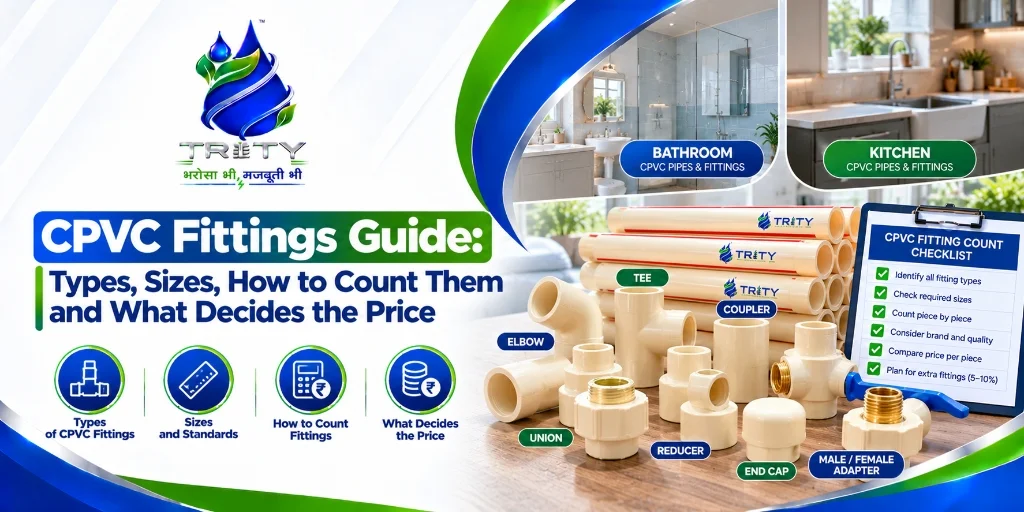
A CPVC plumbing system is made of pipe and fittings, and the fittings do most of the work. Every turn, branch, joint and connection to a fixture is a fitting. On many jobs the fittings cost as much as the pipe, or more, and they are where leaks happen, because a joint is always a weaker point than a straight length of pipe.
Yet fittings are the part most often under-ordered. Plumbers send someone back to the shop for "two more elbows", the job stops, and a mismatched fitting from another brand goes in to save time. This guide explains each CPVC fitting, where it is used, how to count what you need from a plan, what decides the price, how to check fittings before use, and how to order a complete set from Trity Pipes. If you are still working out the pipe side, read our guides on CPVC system design and CPVC pipe for bathroom and kitchen.
Why fittings deserve as much attention as pipe
- Joints are where systems fail. A hot water leak inside a wall usually starts at a fitting, not along a pipe.
- Fittings must match the pipe. CPVC pipe and fittings are made to specific dimensions, and a socket that is slightly too loose or too tight gives a poor solvent joint.
- Fittings are a large share of the cost. A quote for pipe alone understates the project.
- Running short stops the job. A missing fitting costs more in lost time than the fitting itself.
The main CPVC fitting types
Trity's CPVC range includes elbows, tees, couplers, reducers, unions and end caps, made to the same dimensional tolerance as our pipe so that solvent joints seat cleanly. Here is what each one does.
Elbows
An elbow changes the direction of a line, most often by 90 degrees, and sometimes by 45 degrees. You need one at every turn. In a typical bathroom with several fixtures, elbows are usually the largest group of fittings.
Tees
A tee splits a line into a branch. Use a tee wherever a line feeds a second fixture or a branch to another room. An equal tee has the same size on all three ends, and a reducing tee has a smaller branch.
Couplers
A coupler joins two lengths of pipe in a straight line. You use couplers to join cut lengths, to extend a run and to repair a damaged section.
Reducers
A reducer connects a larger pipe to a smaller one, for example 25mm to 20mm, or 20mm to 15mm. You use reducers where a main steps down to a branch, and where a line steps down to a fixture.
Unions
A union lets you disconnect a joint without cutting the pipe. Place unions where equipment needs to be removed for service, such as at a geyser or a pump. Without a union, replacing the equipment means cutting and rejoining pipe.
End caps
An end cap closes the end of a line. Use caps on lines left for future connections and on test sections.
Threaded adaptors, valves and brass-insert fittings
Taps, mixers, valves and some equipment have threaded connections, so a CPVC system also needs fittings that convert from solvent socket to thread, such as female and male threaded adaptors and brass-insert fittings, and valves that suit CPVC. These items are not always part of the same range, so ask our team which of them are available with our pipe, and how to match them.
Sizes
Trity's CPVC pipes and fittings are made in 15mm to 50mm sizes in the CTS (copper tube size) system. In a home, you will mostly use 15mm for the last connection to a tap or mixer, 20mm for bathroom feed lines and the geyser outlet, and 25mm for a sub-main feeding several fixtures. Larger homes, villas and multi-bathroom risers use 32mm and above. Fittings must match the CTS size of the pipe, and reducing fittings should be ordered by both sizes.
How to count fittings from a plan
A simple method gives a reliable list.
- Mark every fixture and the geyser on a sketch of the layout.
- Trace each pipe run from the source to each fixture.
- Add an elbow at every change of direction.
- Add a tee at every branch.
- Add a reducer wherever the pipe size steps down.
- Add couplers where one length of pipe will not reach, using the standard pipe length to decide.
- Add a union at each piece of equipment that will need servicing.
- Add threaded adaptors at each tap, mixer and valve connection.
- Add end caps for any lines left for future use.
- Add a few spares of the most used fittings, usually elbows, tees and couplers.
Then compare your list with the plumber's list. If they differ by a lot, find out why before you order.
What decides CPVC fittings price
Size
Larger fittings use more compound, and price rises with size.
Fitting type
Simple fittings, such as couplers and end caps, cost less. Elbows and tees cost more, and unions and threaded adaptors cost more again because they have more parts and tighter tolerances.
Raw material
Fittings carry the same hot water stress as pipe, and the compound matters. A good CPVC compound is lead-free and not blended with recycled material. Trity makes CPVC pipes and fittings from high-grade, lead-free CPVC compound.
Dimensional accuracy
Moulding fittings to tight tolerances needs good tooling and quality checks, and it costs more than loose production. It also gives you joints that seat properly.
Certification and testing
Fittings made by a certified manufacturer under quality control cost more than uncertified ones, and they are worth the difference. Trity's manufacturing is certified to ISO 9001:2015, and our certification details are on the certifications page.
Quantity
Larger orders earn better rates. Plumbers and dealers who buy regularly can discuss volume terms with our team.
GST
Plastic pipes and fittings fall under HSN 3917 and attract 18 percent GST, so check whether a rate includes it.
Our guide on CPVC pipe price explains the cost factors for the pipe, and the same thinking applies to fittings.
How to check CPVC fittings before you use them
- Look at the marking on the fitting for the manufacturer and size.
- Check the colour and finish. The colour should be even, with a clean surface, and no flash, burrs or short-shot areas.
- Dry fit the fitting on the pipe. The pipe should enter smoothly to a firm stop without forcing, and without wobble.
- Make a test joint with CPVC solvent cement, let it cure fully and try to separate it by hand.
- Do not mix brands blindly. Fittings and pipe from different makers may differ slightly in size.
- Ask for documents, such as test reports and the ISO certificate.
Our guide on how to check CPVC pipe quality covers these checks in detail.
Solvent cement and jointing
CPVC joints need CPVC-specific solvent cement. Ordinary PVC cement is not suitable and can give joints that look sealed but fail under sustained heat. For a good joint, cut the pipe square, remove burrs, clean and dry the pipe and socket, apply cement evenly, insert the pipe to the stop, hold briefly and allow full cure time before pressure testing. Test the system before closing the wall.
Common mistakes with CPVC fittings
- Ordering pipe without a fittings count
- Under-ordering elbows and tees, which are used the most
- Forgetting unions at the geyser and equipment
- Forgetting threaded adaptors for taps and valves
- Mixing brands of pipe, fittings and cement
- Using PVC cement on CPVC
- Not leaving cure time before testing
- Skipping spares
Order the complete set from one source
Trity Pipes makes CPVC pipes and matching fittings in 15mm to 50mm sizes, in SDR 11 and SDR 13.5 classes for the pipe, to IS 15778, with ISO 9001:2015 certification. When you send us your layout or fittings count, our team prepares a quotation for the full set, so that the pipe and fittings come together and match. IS 15778 test reports are available on request, and sample batches can be arranged for evaluation. You can see the CPVC pipes and fittings range.
Plumbing contractors and builders can ask for bulk or phased supply, and dealers can ask about stocking the range. Our guide on the CPVC and plumbing pipe dealership explains how.
A worked example: counting fittings for one bathroom
Take a bathroom with a geyser, a basin, a shower and a WC cistern. Suppose the hot line runs 20mm from the geyser to the shower and then steps down to 15mm for the basin, and the cold line runs 20mm with a 15mm drop to the cistern. Walking along the lines, you might count a union at the geyser outlet, six or seven elbows for the turns in the walls, three tees for the branches, two reducers where the size steps down, two or three couplers where cut lengths join, threaded adaptors at the shower mixer, basin tap and cistern inlet, and two end caps for lines left for a future bidet or washing machine. Add spares and the total is easy to check against the plumber's list. Do this for each bathroom and the kitchen, and you have a list you can send to us for a quotation.
Why plumbers and dealers choose Trity CPVC fittings
Plumbers tell us they want fittings that fit the pipe, arrive in full sets and do not leak after the wall is closed. Trity makes CPVC fittings to the same dimensional tolerance as our pipe, from high-grade, lead-free CPVC compound, in our own plant in Ghaziabad. Our team can help you turn a layout into a complete pipe and fittings list, share IS 15778 test reports and ISO 9001:2015 documentation, and arrange sample batches so that you can test fit before you order the full quantity. Dealers can ask about stocking a full spread of fittings in the common sizes, so that plumbers find everything at the counter.
Frequently Asked Questions
What fittings do I need for a CPVC plumbing system?
Typically elbows, tees, couplers, reducers, unions, end caps, threaded adaptors for taps and valves, and CPVC solvent cement. Count them from your layout and add a few spares.
Are CPVC fittings more expensive than the pipe?
Often yes, per piece, and in total they can equal or exceed the cost of the pipe on a job with many bends and branches. Always quote pipe and fittings together.
Can I use fittings from a different brand than my CPVC pipe?
It is best to use fittings made to match the pipe. Different makers can have slightly different dimensions, which can cause loose or over-tight solvent joints. If you must mix, test fit first.
Do I need a union in a CPVC system?
Place unions wherever equipment may need to be removed, such as at a geyser or pump, so you can disconnect without cutting pipe.
Can I use PVC cement on CPVC fittings?
No. CPVC fittings need CPVC-specific solvent cement. PVC cement is not suitable and can cause joints that fail under sustained heat.
Can Trity Pipes quote a complete CPVC pipe and fittings set?
Yes. Send us your layout or fittings count, sizes and quantities, and our team will prepare a quotation for the full set, and tell you which threaded adaptors and valves are available to match.
Need a complete CPVC set? Contact Trity Pipes on +91-9821030072 or +91-9319984755 with your fittings list for a quotation on CPVC pipes and matching fittings from our Delhi NCR factory.