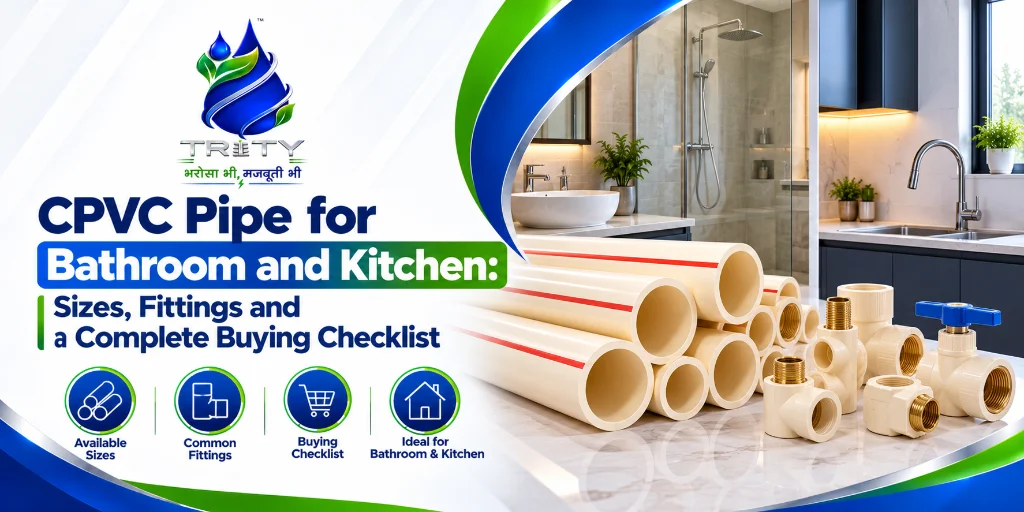
A bathroom or kitchen renovation is the moment most homeowners and small contractors buy CPVC for the first time. The plumber says "we need CPVC for the hot line", someone writes a rough list, and the shop supplies whatever is in stock. Often the result is the wrong size, too few fittings, or a long wait while the job stops because one elbow ran out.
This guide gives you a practical way to plan. It explains which sizes suit which fixtures, how to deal with the geyser connection, what fittings a typical room needs, how to estimate quantity without over-buying, and how to check that what you receive is what you should have bought. It also shows where Trity Pipes CPVC fits if you want a single supplier for pipe and fittings.
Why CPVC for bathroom and kitchen hot water
Hot water lines are where ordinary plastic pipe fails. Standard uPVC softens at hot water temperatures, while CPVC is made for it. Our product page rates Trity CPVC at up to about 93\u00b0C, and IS 15778 pipe is pressure tested at temperature. CPVC also does not corrode or scale like GI and copper, its smooth bore keeps flow steady, and it is light and quick to install. If you are still deciding between materials, our guide to CPVC vs uPVC pipes explains where each belongs.
For a typical home, the usual split is CPVC for hot water and for cold supply where the plumber wants one material, and uPVC for drainage lines. Drainage is a different system, covered by SWR pipes, and you can see our SWR pipes and fittings if you need them too.
Choosing pipe sizes for fixtures
Trity CPVC is available from 15mm to 50mm in the CTS system. For a house, the common sizes and uses are:
| Size | Typical use in a home |
|---|---|
| 15mm (1/2 inch) | Final connections to taps, mixers and basins |
| 20mm (3/4 inch) | Bathroom feed lines, geyser outlet, shower lines |
| 25mm (1 inch) | Sub-main feeding several fixtures, kitchen main |
| 32mm and above | Larger homes, multi-bathroom risers, villas |
This is a general guide. Final sizes depend on the number of fixtures supplied, the distance from the heater and the water pressure, and your plumber or consultant should confirm them for your layout. Choosing a line that is too small gives weak flow at the last tap, and a line that is far too large wastes money and water in the pipe.
Pressure class for a home
CPVC under IS 15778 comes in SDR 11 and SDR 13.5. For most home branch lines either may be suitable, and the choice depends on the pressure in your system. SDR 11 has a thicker wall and a higher rating. If your supply comes from a pump or a tall building's riser, ask your plumber which class suits each section. Our guide on CPVC system design explains how to choose without over-specifying.
The geyser connection deserves extra care
The pipe next to the geyser sees the highest temperature and the most thermal cycling. Pay attention to these points.
- Use CPVC, not uPVC, on the hot outlet line from the geyser
- Consider the thicker SDR 11 class for the short run at the geyser
- Allow for expansion with bends or an offset, and do not fix the pipe rigidly in a long straight line
- Use a union or approved connector at the geyser so it can be serviced
- Follow the geyser manufacturer's instructions for connections, valves and any safety devices
Solar water heaters can reach higher temperatures than an electric geyser in stagnation, so check the solar system's rating with its supplier before you use CPVC on that loop.
A fittings list for a typical bathroom
Pipe is only half of the list. For a typical bathroom with a basin, a shower and a WC, with a hot and cold supply, expect to need:
- Elbows at every change of direction, usually 90 degree
- Tees where the line branches to another fixture
- Couplers to join lengths and repair cuts
- Reducers where the line steps down in size toward the fixture
- Unions at the geyser and at any equipment that may need removing
- End caps for lines left for future connections
- Threaded adaptors (female and male) to connect to taps, mixers and valves
- Brackets and clips to support the pipe
- CPVC solvent cement and, for hot lines in cold areas, insulation
Brass-threaded adaptors are common at tap connections, so ask your plumber what the fixtures need. The Trity range includes the matching fitting set, made to the same dimensional tolerance as the pipe, so it seats cleanly. Details are on our CPVC pipes and fittings page.
Kitchen specifics
A kitchen usually has fewer fixtures than a bathroom but its own needs.
- Sink hot and cold lines in 15mm to 20mm, depending on distance from the main
- Dishwasher or washing machine connections, which need valves and sometimes dedicated outlets
- A water purifier line, which usually takes cold water only
- Longer runs if the kitchen is far from the geyser, where an insulated hot line saves wasted water and waiting time
How to estimate quantity without over-buying
Use a simple method.
- Sketch the layout showing the geyser, each fixture and the route the pipe will take
- Measure each run, adding vertical drops and rises
- Group by size, such as 25mm main, 20mm branches and 15mm drops
- Add 10 to 15 percent for cuts and mistakes, or the allowance your plumber recommends
- Count fittings by walking along each run: an elbow at each turn, a tee at each branch, a coupler where lengths join
- Add a few spares of the most used fittings, as running out halts the job
- Add solvent cement, brackets and adaptors
A supplier can check your list. Sending it to our team with your layout lets us suggest sizes and quantities and quote the complete set.
How to check what you receive
Before work starts, run basic checks. They only take a few minutes and can prevent a callback.
- Pipe marking shows IS 15778, size, class, manufacturer and batch
- Colour and surface are even
- Pipe and fittings dry fit without force or looseness
- The supplier has provided a written quotation and the documents you asked for
Our guide on how to check CPVC pipe quality goes through each check in detail, including how to verify the BIS licence and judge wall thickness.
Installation tips that avoid callbacks
- Use CPVC solvent cement only. Ordinary PVC cement is not suitable
- Clean and dry the pipe and fitting before applying cement
- Do not over-insert the pipe beyond the socket stop
- Allow full cure time before pressure testing
- Support the pipe properly with clips at suitable spacing, closer on hot lines
- Pressure test the system before closing the wall, and look for any drop
- Keep the plumber's drawing so you know where every pipe is behind the tiles
Cost planning for a bathroom or kitchen
The cost depends on size, class, the number of fittings and the labour in your city. Pipe is often a smaller share of the total than fittings, taps, labour and tiling, so a small saving on pipe quality is rarely worth the risk of a leak behind finished tiles. For an explanation of what drives CPVC rates, read our guide on CPVC pipe price in India.
Get everything from one source with Trity Pipes
Trity Pipes manufactures CPVC pipes and matching fittings from high-grade, lead-free CPVC compound to IS 15778 at our Delhi NCR facility. For homeowners, plumbers and builders we offer a complete set from one place, IS 15778 test reports and ISO 9001:2015 certification on request, sample batches for evaluation, and quotations that state sizes, rates and terms. Builders and contractors can ask for bulk or phased supply for multi-bathroom and multi-unit projects. Dealers can also stock our range. Cold water and pressure lines can come from our uPVC pressure pipes range, and our guide to pressure pipe sizing helps you pick the class and diameter.
A sample materials list for one bathroom
This table shows the kinds of items to list, without quantities, since every layout is different. Fill in your own counts.
| Item | Where it is used | Your quantity |
|---|---|---|
| 20mm CPVC pipe | Feed lines to shower and geyser outlet | |
| 15mm CPVC pipe | Drops to taps and mixers | |
| 90 degree elbows | Every change of direction | |
| Tees | Branches to other fixtures | |
| Couplers | Joining lengths and repairs | |
| Reducers | Stepping from 20mm to 15mm | |
| Unions | At the geyser | |
| Threaded adaptors | At taps, mixers and valves | |
| End caps | Lines left for future use | |
| Brackets or clips | Along every run | |
| CPVC solvent cement | All joints |
Take this list to your plumber, fill in the quantities from your layout, and send it to us for a quotation.
Questions to ask your plumber
- Which pipe size and pressure class will you use for each line, and why?
- Will the whole hot and cold system use CPVC, or will cold lines use another pipe?
- How will you handle expansion on long hot water runs?
- Which solvent cement will you use, and is it for CPVC?
- Will you pressure test the lines before the wall is closed?
- Can you give me a drawing showing where every pipe runs?
Clear answers tell you the job has been planned. Vague answers are worth questioning before the tiles go on.
Why homeowners and plumbers ask Trity Pipes for CPVC
Trity Pipes makes CPVC pipes and fittings in our own factory, with IS 15778 test documentation and ISO 9001:2015 certification available on request. We supply plumbing contractors, builders and dealers across 20-plus states, and our team can help you turn a layout into a complete pipe and fittings list. Many buyers start with a sample batch to check dimensions and joints, then place the full order once they are satisfied. If you are a plumber or hardware dealer who regularly handles bathroom jobs, ask us about supply and dealership terms.
Frequently Asked Questions
What size CPVC pipe is used for a bathroom?
Final connections to taps and mixers usually use 15mm, bathroom feed lines and the geyser outlet commonly use 20mm, and a sub-main feeding several fixtures may use 25mm. Your plumber should confirm sizes for your layout and pressure.
Do I need CPVC for both hot and cold lines?
CPVC is required on hot lines. Many plumbers also use it for cold lines in the same room for a single material and matching fittings. Cold supply and drainage can also use uPVC pressure pipes and SWR pipes.
What fittings do I need for a CPVC bathroom installation?
Typically elbows, tees, couplers, reducers, unions, end caps, threaded adaptors for taps and valves, brackets, and CPVC solvent cement. Count fittings along each run and add a few spares.
How much extra CPVC pipe should I buy?
Allow roughly 10 to 15 percent for cuts and mistakes, or the allowance your plumber recommends for the complexity of your layout. Buying a small buffer is cheaper than stopping the job for a missing length.
Can I use CPVC for a solar water heater line?
Solar water heaters can reach higher temperatures than electric geysers when there is no water draw, so confirm the maximum temperature with the solar supplier before using CPVC on that loop and choose the thicker class for the hot sections.
Can Trity Pipes supply the whole CPVC set for my project?
Yes. Share your layout, sizes and approximate quantities, and our team will prepare a quotation for pipe and matching fittings, discuss pressure class and arrange delivery. Sample batches and IS 15778 documents are available on request.
Planning a bathroom or kitchen plumbing job? Contact Trity Pipes on +91-9821030072 or +91-9319984755 with your layout to get a complete CPVC pipe and fittings quotation from our Delhi NCR factory.