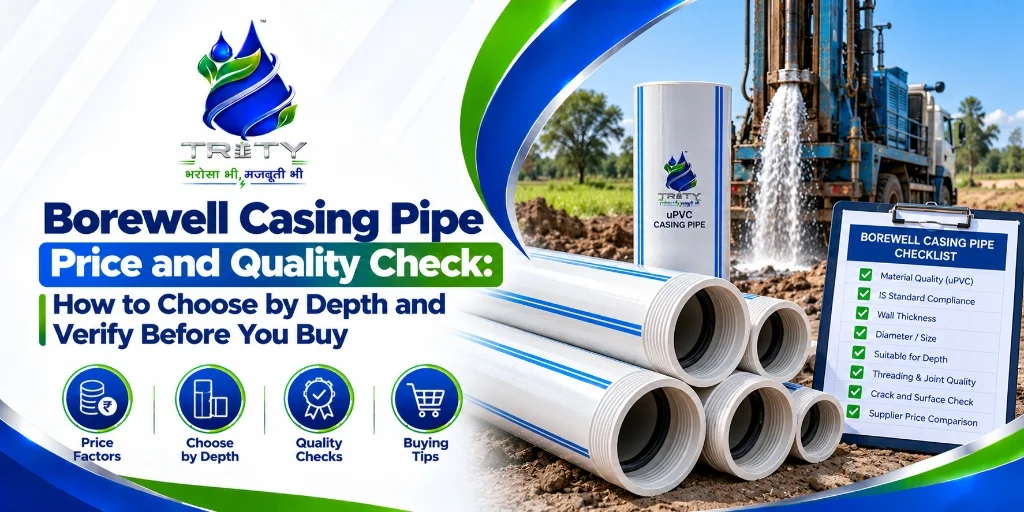
A casing pipe is the one borewell component you cannot afford to get wrong. It lines the bore, holds back the soil and keeps the well open for decades. If it collapses at depth, the pump cannot be saved by repair, the well is lost, and the cost of redrilling is many times the price of the pipe you tried to save money on.
Yet casing pipe is often bought like any other pipe, on a rate per metre. This guide explains what decides borewell casing pipe price, how the CS, CM and CD grades match depth, which quality checks protect you from weak or mislabelled pipe, and how to get a clear quotation from Trity Pipes. If you want the broader background on casing, read our guide to uPVC casing pipes.
We do not print fixed rates here, because resin cost, freight and demand change, and a number printed today may be wrong by the time you read it.
What the casing pipe does
Casing keeps the borehole from caving in, stops loose soil, sand and silt from entering, and gives the pump and column pipe a clean path to the water. It works against soil pressure that grows with depth. A casing built for a shallow well pushed into a deep one deforms or collapses under a load it was never designed for. This is why casing is graded by depth, and why price per metre is only part of the decision.
Casing grades by depth
Trity manufactures uPVC casing pipes to IS 12818, the Indian Standard for unplasticized PVC screen and casing pipes for bore and tubewells, in grades that match the pressure at depth.
| Class | Depth range | Typical application |
|---|---|---|
| CS (Casing Shallow) | Up to about 80 metres | Domestic and small agricultural borewells |
| CM (Casing Medium) | About 80 to 250 metres | Standard agricultural and residential installations |
| CD (Casing Deep) | Beyond about 250 metres | Industrial, municipal and deep agricultural installations |
| SC (Screen Casing) | At the aquifer interval | Water inflow with sand and silt filtration, any depth class |
These are general bands used across the industry. Two borewells at the same depth can face different pressure depending on the geology, so confirm your grade with our technical team using your depth, soil and drilling method.
The main factors that decide borewell casing pipe price
Grade
CS, CM and CD have progressively thicker walls, so cost rises from shallow to deep. Specifying CD where CS would do wastes money, and specifying CS where CM is needed risks collapse. Match the grade to the measured depth.
Diameter
Larger diameters use far more compound. Sizes range from small domestic and agricultural installations to larger diameters for industrial and municipal supply. Exact size, class and stock are confirmed at enquiry.
Plain or screen casing
Screen casing carries precision-cut slots at the aquifer section. The slotting is an extra operation, and quality matters. Poorly executed slotting, especially along the length of the pipe, weakens the body where it needs strength. Trity's slotting is engineered to hold structural strength while allowing inflow.
Threads
A casing string is only as strong as its weakest joint. Trity cuts threads on CNC machines to a trapezoidal profile, which seats more securely under load and reduces the risk of slipping during lowering. Precision threading adds cost and prevents expensive failures.
Raw material
Casing under soil pressure needs consistent wall strength along its full length. Virgin uPVC compound gives that, while recycled or blended compound introduces weak spots you cannot detect until the pipe is downhole. Trity uses virgin uPVC compound.
Testing
Batch testing costs money and matters more here than on almost any other pipe, because a failure at depth is not repairable. Trity tests batches for tensile strength and hoop stress, impact resistance, Vicat softening temperature and dimensional accuracy on threaded joints.
Certification
IS 12818 compliance, BIS certification and ISO 9001:2015 mean audits and documentation. Government and PHED tenders usually require IS 12818 compliance and batch documentation, so uncertified pipe is not an option for them. See our certifications page.
Quantity and minimum order
Large and multi-site orders earn better rates, and some suppliers set minimums. Ask where the rate improves.
Freight
Casing pipe is long, heavy and awkward to move, so freight is a real part of landed cost. Trity ships from our Delhi NCR facility to 20-plus states, and delivery time is confirmed with each quotation.
GST
Plastic pipes and fittings fall under HSN 3917 and attract 18 percent GST. Check whether a rate includes it.
How to check borewell casing pipe quality before you buy
Price comparison only works when you know the pipe is what it claims to be. These checks take little time.
Check 1: Class marking
The pipe should show its class, CS, CM or CD, along with the standard and manufacturer. If the class is missing, or the supplier cannot say which class the pipe is, do not buy it for a deep well.
Check 2: IS 12818 and the licence
Ask for the BIS licence number and verify it on the BIS database. Confirm that the licence covers casing pipes under the relevant standard, that it is current and that the manufacturer named matches the one on the pipe. Our guide on how to identify fake or substandard conduit pipe explains the licence check, which works the same way for casing.
Check 3: Wall thickness
Measure the wall at several points around a cut end with a vernier caliper, and compare with the minimum for the class and diameter in IS 12818. Uneven wall around the circumference points to poor extrusion. Check more than one length from the delivery.
Check 4: Weight and finish
Weigh a length and compare it with the manufacturer's published weight for that class and size. A noticeably lighter pipe usually has a thinner wall. The surface should be smooth and the colour uniform, without specks, streaks or rough patches.
Check 5: Threads
Look at the thread profile and consistency across several pipes. Threads should be clean, with uniform pitch and depth, and a dry assembly of two pipes should seat smoothly without wobble or looseness. Inconsistent threads cause joints that slip or leak under load.
Check 6: Screen slots
For screen casing, check that slots are clean, evenly spaced and cut across the pipe rather than weakening it along its length.
Check 7: Test reports
Ask for IS 12818 test reports for the batch, covering tensile and hoop stress, impact, Vicat softening and dimensional checks, and for the ISO 9001:2015 certificate. A manufacturer confident in its product provides these without fuss. Trity provides IS 12818 test reports and ISO 9001:2015 documentation on request for tender and procurement files.
Why casing is usually blue
Blue is the industry convention for technical-grade casing pipe in India. It visually distinguishes casing from ordinary plumbing pipe at the drill site. Colour alone proves nothing about quality, so use the checks above.
Red flags in a casing pipe quote
- No class stated, or a vague "heavy" with no depth rating
- A rate far below others for the same stated class
- No test reports or licence number
- Per-kilogram pricing with no weight or wall thickness
- A verbal quote with no validity period
- Pipe and threads from different sources with no compatibility check
How to compare casing quotations
- Check the class, diameter and standard on each line.
- Convert the unit to a rate per metre, noting piece length.
- Add what is excluded, such as couplers, rings, GST and freight.
- Compare the same class only.
- Check terms and documents.
A quotation should state the class, diameter, plain or screen, thread type, rate, inclusions, delivery basis and validity.
Installation habits that protect the well
- Match the class to measured depth, not an estimate. Under-speccing is the most common cause of collapse
- Control lowering speed to avoid shock on the joints, and use a properly rated tripod and tackle on deep wells
- Position the screen against the productive aquifer, and verify assembled length against measured depth
- Treat gravel packing as a performance step, not a finishing step
Our guide on column pipe price covers the other part of the borewell, the pipe that carries the pump, and our column pipe guide explains how it differs from casing.
What a Trity Pipes casing quotation includes
Trity Pipes manufactures uPVC casing pipes to IS 12818 in CS, CM, CD and screen grades, from virgin uPVC compound, with CNC trapezoidal threads and tested batches. When you send us your depth, diameter, soil or geology details and quantity, our team recommends a grade and prepares a quotation stating the class, size, rate, inclusions, delivery basis and validity. We can share IS 12818 test reports and ISO documentation with it, and we can discuss casing and column pipes together so the threads match. See the uPVC casing pipes range. Drilling contractors, PHED project teams and agricultural dealers can ask about bulk supply.
Frequently Asked Questions
What is the price of borewell casing pipe in India?
It varies with class, diameter, plain or screen type, brand and the date of the quotation, so a single number would mislead. Request a written quotation with your depth and diameter.
How do I choose between CS, CM and CD casing?
Choose by measured depth: CS for shallow wells up to about 80 metres, CM for roughly 80 to 250 metres and CD beyond about 250 metres. Geology can change this, so confirm with our technical team.
What Indian Standard covers casing pipe?
IS 12818 covers unplasticized PVC screen and casing pipes for bore and tubewells, including material, dimensions, mechanical properties and testing. It is generally required for government and PHED tenders.
How can I check if casing pipe is genuine?
Check the class marking, verify the BIS licence number, measure wall thickness, compare weight, inspect threads and finish, and ask for IS 12818 test reports for the batch.
Can I buy casing and column pipe from the same supplier?
Yes, and it is a good idea, since thread and coupler compatibility is then confirmed together. Trity makes both and our team can check compatibility before you order.
Can Trity Pipes supply casing pipe in bulk?
Yes. Send us your depth, diameter and quantity, and our team will prepare a quotation and discuss delivery from our Delhi NCR facility to 20-plus states.
Planning a borewell? Contact Trity Pipes on +91-9821030072 or +91-9319984755 with your depth and diameter for a casing pipe quotation, grade guidance and IS 12818 documents from our Delhi NCR factory.