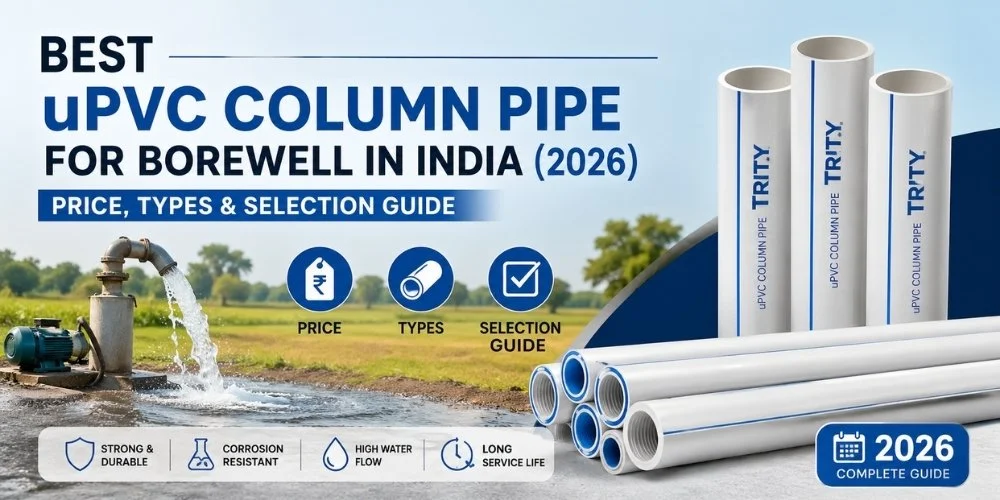
uPVC Column Pipes for Borewell: A Complete Guide for Indian Homes and Industries
For millions of homes, farms, and industries across India, borewells are the lifeline that keeps water flowing.
But here is something most people overlook: no matter how powerful your submersible pump is, the quality of your column pipe decides how efficiently water actually reaches the surface.
If you are planning a new borewell, upgrading an aging system, or replacing pipes that failed too soon, this guide is for you.
What Are uPVC Column Pipes?
uPVC stands for Unplasticized Polyvinyl Chloride. Unlike regular PVC, uPVC contains no plasticizers, which makes it harder, more rigid, and far more durable under constant pressure.
A uPVC column pipe is the vertical pipe that connects your submersible pump at the bottom of the borewell to the surface outlet above. These pipes are also called riser pipes or drop pipes in the field.
They come in standard 3-metre lengths with precision-threaded ends on both sides. Each section is joined to the next as the pump is lowered deeper.
For a 200-foot borewell, you are joining and lowering around 20 pipe sections. This is exactly why thread quality and coupling strength matter so much.
Why uPVC Column Pipes Are Preferred for Borewells
India's groundwater conditions are tough. In many states, water is hard, saline, or carries dissolved iron and fluoride.
In Rajasthan and parts of Gujarat, borewells go beyond 500 feet to reach the water table. These are conditions that destroy metal pipes within a few years.
Here is why uPVC column pipes have become the standard across Indian borewells:
Corrosion Resistance
uPVC does not react with water, acids, salts, or minerals. The pipe maintains its full structural integrity for decades.
There is no rust, no scaling on the inner wall, and no metallic contamination of your drinking water.
Lead-Free and Heavy-Metal-Free Compound
Quality uPVC column pipes are made from virgin-grade uPVC compound that is completely free of lead and heavy metals.
Lead-based stabilizers, which cheaper pipes still use, slowly leach into the water they carry. For a borewell supplying drinking water, this is a serious health risk.
Always verify that your pipe is manufactured using a lead-free compound before purchase.
Lightweight Yet Strong
A 3-metre GI pipe section can weigh 12 to 18 kg, while the equivalent uPVC column pipe weighs just 3 to 5 kg.
This matters enormously for deep borewells where 50 to 80 pipe sections must be carefully lowered. Lighter pipes reduce labor cost and make pump retrieval much safer.
Smooth Inner Surface and Power Savings
The smooth inner bore of uPVC generates far less friction than metal pipes.
Industry data shows uPVC column pipes can deliver 10 to 30 percent more water output compared to GI pipes under identical pumping conditions.
Your submersible pump works less hard, consumes less electricity, and lasts longer. Over 5 years, the electricity savings alone can justify the price difference.
Long Service Life
When sourced from a reliable borewell pipe supplier, quality uPVC column pipes last 25 to 50 years under standard borewell conditions.
That is three to five times the practical lifespan of GI or mild steel alternatives.
No Bacterial Buildup or Scaling
uPVC's smooth, non-porous surface does not encourage biofilm formation or mineral scaling on the inside.
This keeps water hygiene high throughout the pipe's entire life.
The Part Most Guides Skip: Pipe Grades and Depth-Based Selection
This is where most buyers make an expensive mistake, and where most guides stay completely silent.
Not all uPVC column pipes handle the same depth. A pipe that works perfectly at 100 feet will fail structurally at 400 feet under the same load.
Why? Because the deeper your borewell, the heavier the total load the pipe column must bear.
uPVC column pipes are manufactured in multiple grades or series to address this. Here is how they break down:
Standard Series
Designed for borewells up to 100 to 150 feet deep.
Suitable for shallow domestic borewells in high water table areas such as parts of Punjab, Uttar Pradesh, and West Bengal.
Medium Series
Built for depths from 150 to 300 feet. Wall thickness and thread strength are significantly higher than the standard grade.
This is the most commonly used grade for residential and light agricultural borewells across peninsular India.
Heavy Series
Engineered for depths between 300 and 600 feet.
You will need this grade in regions like interior Karnataka, Tamil Nadu, Rajasthan, and Maharashtra where groundwater levels have been falling steadily.
Super Heavy Series
Handles depths beyond 600 feet, sometimes up to 1200 feet.
Typically specified for deep agricultural borewells, municipal schemes, and industrial water supply projects.
Using the right series is not optional. A Standard-grade pipe in a 400-foot borewell is one of the most common reasons for pipe failure in India.
The pipe does not break all at once. It gradually deforms at the thread joints, causing leaks and eventually joint separation at depth, where recovery is costly.
If you are unsure which grade suits your borewell, explore the borewell piping solutions and column pipe range at Trity Pipes for clear depth-to-grade guidance.
Advanced Insight: How to Calculate the Total Column Load Your Pipe Must Handle
This is a calculation almost no supplier or blog explains, yet it is the engineering foundation of every column pipe selection decision.
Your uPVC column pipe does not just carry water pressure. It bears three simultaneous forces:
1. Tensile Load (Weight of the Pipe String)
Every 3-metre section of pipe plus the water inside it adds weight to the section above it.
At 300 feet of depth, you have roughly 30 pipe sections hanging below your clamp. The combined weight can easily reach 200 to 400 kg depending on pipe diameter.
2. Pump and Motor Weight
Your submersible pump and motor assembly, typically 10 to 30 kg, hangs at the very bottom of the pipe string.
This adds to the tensile load on every pipe joint above it.
3. Pump Delivery Pressure
Your pump generates internal pressure as it pushes water upward. A pump rated for 25 kg/cm2 creates radial stress on the pipe wall throughout its entire length.
This is separate from the tensile load and must stay within the pipe's pressure rating.
For a 300-foot borewell with a 40mm pipe and a 5 HP pump, the combined load can easily exceed 600 kg. A Standard-grade pipe with a breaking load of 400 kg will fail. A Heavy-grade pipe rated at 1000 kg or more will hold safely.
This is why pipe grade selection must be based on a proper load calculation, not just borewell depth alone.
Always ask your supplier for the pipe's tensile breaking load and compare it to your installation's expected load with a suitable safety margin.
The Hidden Threat: Water Hammer and Why Pipe Quality Matters
Almost no blog explains this, yet it is a significant cause of joint failure in low-quality borewell pipe systems.
Water hammer is the sudden pressure surge that occurs when the pump switches off.
When the pump stops, the water column inside the pipe briefly continues moving upward due to inertia, then rapidly reverses and drops back down.
This creates an intense pressure spike, sometimes two to three times the normal operating pressure, which radiates through every joint in the pipe string.
In a well-made uPVC column pipe with quality EPDM rubber ring couplers and a non-return valve at the top adapter, this surge is absorbed and harmless.
In a cheap pipe with poorly fitted couplers and no rubber sealing ring, repeated water hammer events gradually loosen the couplings.
The result is slow leaks or, worse, the pump dropping to the borewell bottom.
Expert Tip: Always install a non-return valve at the top of the pipe string, just before the surface outlet.
This single fitting prevents water column reversal on pump shutdown and eliminates water hammer almost entirely. It costs just Rs. 200 to Rs. 500 and can protect your Rs. 30,000 pump from repeated stress damage.
Key Features and Benefits of uPVC Column Pipes
Square Threads Machined on CNC Equipment
The thread profile on quality uPVC column pipes is square-shaped, not V-shaped like plumbing pipes.
Square threads distribute tensile load across a much larger surface area, allowing them to carry the full weight of the pipe string without stripping under vibration or pump torque.
When threads are cut on CNC machines, they achieve precise geometry every time. Manually threaded pipes often cause slight misalignment when joined, leading to micro-leaks and accelerated thread wear.
EPDM Rubber Sealing Ring Couplers
Quality column pipe couplers include a rubber sealing ring that creates a hydraulic seal at the joint without any adhesive.
It also absorbs the shock of pump startup and shutdown torque, one of the highest-stress moments for joint integrity.
Always verify the coupler includes an EPDM rubber ring, not a cheaper compound that stiffens and cracks underground.
Virgin-Grade uPVC Raw Material
The difference between a pipe that lasts 30 years and one that cracks in 8 years often comes down entirely to raw material.
Pipes made from recycled or blended material look identical on the outside but have significantly lower tensile strength and impact resistance.
There is no easy visual test for this. Your protection is to source from manufacturers who provide raw material certification.
Standard Sizes Available
uPVC column pipes are commonly available in 25mm, 32mm, 40mm, 50mm, 63mm, 75mm, and 100mm outer diameters to match all standard submersible pump outlets.
Choosing high-quality pipes ensures certified material, proper threading, and the right grade from a single trusted source. You can also explore the complete piping solutions range to find the right fit for your overall project.
Real-World Scenario: A Farmer in Rajasthan Learns the Hard Way
Rajan, a wheat farmer in Nagaur district, Rajasthan, drilled a borewell to 480 feet in 2019.
His contractor sourced pipes from a local hardware store at Rs. 15 per metre cheaper than the standard market price. The pipes had no BIS marking and no rubber sealing rings in the couplers.
Within 14 months, Rajan noticed his water yield dropping steadily. By month 18, the pump was barely delivering a trickle.
A technician identified joint separation at approximately the 350-foot mark. The cheaply threaded couplings had loosened under the pump's start-stop torque cycle.
Water was recirculating through the open joint instead of rising to the surface.
Recovering the pump cost Rs. 8,000 in labor. Replacing the bottom 15 pipe sections with proper Heavy-grade pipes added another Rs. 12,000.
His initial saving of Rs. 3,600 on cheaper pipes cost him Rs. 20,000 in repairs, three weeks without water supply during Rabi season, and a full crop delay.
This scenario repeats itself thousands of times across India every year. Long-term cost versus short-term price is the most important calculation any borewell owner can make.
Applications: Where uPVC Column Pipes Are Used
Residential Borewells
Most urban and semi-urban households with personal borewells use uPVC column pipes for clean, reliable drinking and utility water.
Agricultural Irrigation
Farmers across Maharashtra, Punjab, Karnataka, Rajasthan, and Andhra Pradesh depend on deep borewells for irrigation.
uPVC column pipes handle continuous high-duty pumping cycles efficiently without fatigue failure.
Industrial Water Supply
Factories, food processing units, and manufacturing plants often source water through private borewells.
The chemical resistance of uPVC and its zero-contamination profile make it ideal for these environments.
Municipal and Government Schemes
Government water supply schemes in rural areas frequently specify uPVC column pipes due to IS 12818 compliance and proven long-term field performance.
Commercial Establishments
Hotels, hospitals, housing societies, and commercial buildings increasingly specify uPVC for its reliability and minimal maintenance burden.
uPVC Column Pipes vs Traditional Pipes: The Real Comparison
The comparison is not just about corrosion resistance. The more important comparison is total lifecycle cost, pump health, and water quality.
Against GI Pipes
Galvanized Iron pipes rust from the inside out. The iron oxide that forms reduces the effective internal diameter over time, cutting your water delivery.
It also contaminates your water with dissolved iron. In hard-water areas, scale buildup and iron oxide together can reduce a GI pipe's usable bore by 20 to 30 percent within 10 years.
That means your pump is working harder for less water, every single day.
Against HDPE Pipes
HDPE is sometimes proposed as an alternative. It is excellent for casing pipe applications but its flexibility is a drawback for deep column pipe use.
Under high tensile loads at depth, HDPE pipes can elongate and cause joint stress. uPVC's rigidity maintains consistent joint geometry throughout the depth.
This is why uPVC remains the preferred material for submersible column pipe applications.
The practical conclusion: GI fails faster and contaminates water. HDPE has its place but not as a column pipe for deep installations. Quality uPVC is the technically and economically superior choice.
How to Choose the Right uPVC Column Pipe for Your Borewell
Step 1: Know Your Borewell Depth Precisely
This single number determines your pipe grade. Do not estimate. Get the actual drilled depth from your borewell contractor.
Step 2: Match Pipe Diameter to Your Pump Outlet
Undersizing creates backpressure that reduces yield and strains the pump motor. Oversizing wastes money.
Common matchings: 32mm or 40mm for 0.5 to 1 HP pumps, 50mm for 2 HP, and 63mm or 75mm for 3 HP and above.
Step 3: Calculate Your Total Column Load
Use the method described in the advanced section above. If unsure, ask your supplier to do it and show you the numbers in writing.
Step 4: Verify BIS Certification
Look for the IS 12818 mark embossed on the pipe body. It is a necessary baseline. Source only from manufacturers you can verify.
Step 5: Inspect Thread and Coupler Quality
Square threads should be clean, well-defined, and consistent from pipe to pipe. The rubber sealing ring should be present, properly seated, and resilient when pressed.
Step 6: Ask About Raw Material
Ask specifically whether the pipe uses virgin-grade uPVC resin and a lead-free stabilizer system. A quality manufacturer will have this documented and ready to share.
Step 7: Factor in Long-Term Cost, Not Just Purchase Price
A cheaper pipe that lasts 8 years and requires pump retrieval once costs far more than a quality pipe that lasts 30 years without intervention.
What to Check Before You Buy: Red Flags of Substandard Pipes
- Brittle feel when tapped indicates recycled or under-formulated material. Quality uPVC has a distinct rigidity without being fragile.
- Inconsistent wall thickness along the pipe length suggests poor extrusion control. Run your hand along the pipe and feel for any variation.
- Couplers that slide on loosely without snug rubber ring contact are an immediate warning. A properly made coupler requires deliberate force to thread on.
- Inconsistent thread profiles from one end of the pipe to the other indicate manual threading rather than CNC machining.
- No BIS mark or a printed mark instead of an embossed one is a serious concern. Reputable manufacturers emboss the mark, pipe class, and batch details directly into the pipe body during manufacturing.
Why Choosing the Right Manufacturer Matters
Your borewell will operate unattended for thousands of hours over the next 20 to 30 years.
The pipe inside it will never be seen again after installation. No amount of monitoring can compensate for a bad pipe buried 300 feet underground.
A reliable manufacturer brings consistent raw material quality, in-house batch testing, CNC thread precision, and IS 12818 compliance as a minimum standard.
What separates a good manufacturer from an average one is consistency across 10,000 pipes, not just the sample you inspected at the dealer's shop.
Trity Pipes has built its reputation in the Indian piping industry on exactly this kind of manufacturing discipline. You can explore our uPVC casing pipes and column pipe range built to handle the demanding groundwater conditions found across Indian states.
When you invest in quality pipes from a manufacturer who stands behind their product, you are not just buying a pipe. You are buying decades of uninterrupted water supply.
Common Mistakes to Avoid When Installing uPVC Column Pipes
- Using the wrong pipe grade for depth is the single most expensive mistake. Always match the series to your actual drilled depth plus a safety margin.
- Cross-threading the coupler during assembly is extremely common when pipes are being lowered quickly.Cross-threading creates a false sense of tightness while leaving the joint structurally weak and prone to leaking. Always start threading by hand and only use tools for the final tightening.
- Forgetting the rubber ring is a critical oversight. The coupler's rubber ring should never be removed or substituted. A missing ring means no hydraulic seal and gradual water loss at depth.
- Buying on price alone without verifying grade, BIS marking, or thread quality will almost always cost more in the long run.Replacement and pump recovery from a failed deep borewell is expensive, disruptive, and sometimes impossible without specialized equipment.
- Ignoring inclined borewells is a technical oversight. uPVC column pipes are not recommended for borewells that are not perfectly vertical.
Inclined borewells create lateral bending stress that uPVC's rigid material cannot absorb safely. Consult a borewell engineer if your borewell deviates from vertical.
Maintenance Tips for uPVC Column Pipes
uPVC column pipes are genuinely low-maintenance. But a few simple practices protect your investment over the long term.
- Check above-ground connections annually. These are the only visible parts of the system. Look for early signs of joint wear, UV degradation, or accidental mechanical damage.
- Monitor your water yield every monsoon season. A persistent year-on-year decline can indicate partial joint separation or pipe deformation inside the bore.
- Service your pump on schedule. A pump that vibrates abnormally transmits those forces directly to the pipe joints. A healthy pump protects the entire pipe system.
- Protect the borewell head. Physical impact from farm equipment or construction near the borewell is a common cause of above-ground pipe damage. Use a proper cap and casing cover.
- Install a non-return valve if you have not already. This single step eliminates water hammer and protects both the pipe joints and the pump on every shutdown cycle.
Conclusion: Make the Right Choice for Your Borewell
Your borewell is only as reliable as the pipes inside it.
Choosing the right uPVC column pipe means knowing your depth, calculating your total load, matching the right pipe grade, and sourcing from a manufacturer who guarantees the material and thread quality you cannot test at the point of purchase.
The most expensive borewell decision is not the cost of a good pipe. It is the cost of replacing a bad one.
If you are ready to get the right pipe for your borewell, contact Trity Pipes today for product selection guidance, specifications, and pricing tailored to your borewell depth and pump requirement.
Get the right pipe the first time and let your borewell deliver clean, consistent water for the next 30 years.
Frequently Asked Questions (FAQ)
Q1. How do I know which uPVC column pipe series is right for my borewell depth?
The series selection depends on borewell depth, pump horsepower, and pump delivery pressure combined.
As a general rule: Standard series up to 150 feet, Medium series for 150 to 300 feet, Heavy series for 300 to 600 feet, and Super Heavy beyond 600 feet.
A proper load calculation is always more reliable than depth alone. When in doubt, go one grade higher.
Q2. What is the typical uPVC column pipe price in India and why does it vary so much?
Prices typically range from Rs. 80 to Rs. 350 per metre depending on diameter, wall thickness, pipe series, and manufacturer.
The variation is almost entirely driven by raw material quality and manufacturing precision.
A pipe at Rs. 90 using recycled material and a pipe at Rs. 160 using virgin-grade uPVC may look identical in a dealer's shop. The difference shows up 18 months into your borewell. Always ask for material certification before deciding on price.
Q3. Can I buy uPVC column pipes online or should I source from a local dealer?
Both options work. For large projects, buying directly from a manufacturer ensures consistency across the entire pipe string.
For small residential installations, a verified local dealer stocking from a named manufacturer is practical.
What matters most is confirming the pipe series, BIS certification, and raw material specification regardless of where you buy.
Q4. Are uPVC column pipes safe for drinking water supply from a borewell?
Yes, provided the pipe is manufactured using a lead-free, heavy-metal-free uPVC compound.
The risk comes from cheaper pipes that still use lead-based stabilizer compounds during manufacturing.
Always verify that your pipe is explicitly certified as lead-free. Quality manufacturers will have this information embossed on the pipe body itself.
Q5. What causes uPVC column pipes to fail inside a borewell, and how can I prevent it?
The most common failure causes are wrong pipe grade for the depth, cross-threaded joints, water hammer stress on improperly sealed couplers, and substandard raw material.
Prevention is straightforward: select the correct grade based on load calculation, assemble joints carefully by hand before tool-tightening, and install a non-return valve at the surface.
Always source from a manufacturer who uses virgin-grade lead-free uPVC with CNC-machined square threads and EPDM rubber ring couplers.