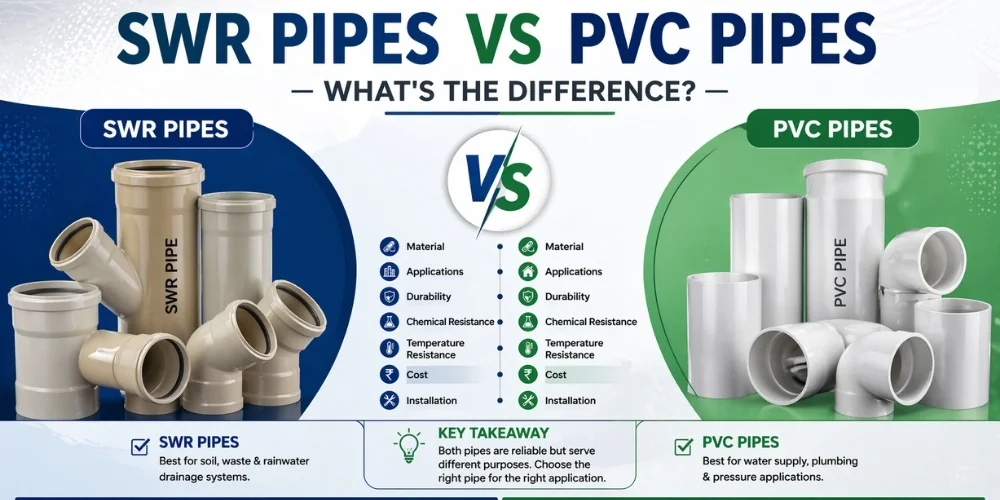
SWR Pipe vs PVC Pipe: The Core Difference in One Line
SWR pipes carry waste away from a building: drainage, toilets, and rainwater. PVC pipes carry clean water into a building: supply lines, taps, and tanks. They are built for opposite jobs and can never be used in place of each other.
The difference between SWR and PVC pipes in India is one of the most searched plumbing questions, because the confusion is genuinely common, even among experienced contractors. This guide settles it clearly.
Walk into any hardware shop in India and ask for pipes. The shopkeeper will almost always ask back: "SWR or PVC?"
If you don't know the difference, you might walk out with the wrong pipe for the job. That mistake gets very expensive, especially once the walls are closed after construction. Redoing buried plumbing isn't just disruptive, it can cost lakhs.
This guide is here to clear that confusion, once and for all.
What Are PVC Pipes?
PVC stands for Polyvinyl Chloride.
In the Indian plumbing industry, PVC pipes refer to pressurised water supply pipes. These are pipes that carry water under pressure from one point to another, from an underground sump to an overhead tank, or from a tank to your taps.
These pipes are manufactured under IS 4985 and are rated from Class 1 to Class 5 based on the pressure they can handle.
Where PVC pipes are used:
- Internal water supply lines inside walls and under floors
- Overhead tank connections
- Borewell to pump lines
- Garden irrigation
From Lucknow and Kanpur to Chennai and Ahmedabad, PVC pressure pipes are the backbone of water supply in residential projects across India.
Important: PVC pipes are not suitable for hot water (above 60°C). For hot water lines, always use CPVC pipes.
What Are SWR Pipes?
SWR stands for Soil, Waste & Rain.
The name tells you everything. These pipes are designed specifically for drainage systems. Toilet waste, kitchen grey water, bathroom floor traps, and rooftop rainwater are all handled by SWR pipes.
They operate on gravity flow, not pressure. That is why their walls are thicker and their colour is typically grey, making them easy to distinguish on-site. This is also a key point when comparing SWR vs uPVC pipes: both are made from uPVC material, but their formulation and application are completely different.
In India, SWR pipes are manufactured under IS 13592.
Where SWR pipes are used:
- Bathroom and toilet drain lines
- Vertical soil stacks (floor to floor)
- Rooftop rainwater downpipes
- Underground drainage to inspection chambers and septic tanks
You can explore Trity Pipes' complete SWR pipes and fittings range for available sizes and specifications.
SWR vs PVC Pipes – Key Differences at a Glance
| Feature | SWR Pipes | PVC Pressure Pipes |
|---|---|---|
| Full Form | Soil, Waste & Rain | Polyvinyl Chloride |
| Primary Use | Drainage & waste discharge | Pressurised water supply |
| System Type | Gravity flow (non-pressure) | Pressure system |
| Indian Standard | IS 13592 | IS 4985 |
| Colour | Grey / dark grey | Off-white / cream |
| Diameter Range | 75mm to 250mm | 15mm to 315mm |
| Joint Type | Rubber ring push-fit | Solvent cement |
| Pressure Handling | Not pressure-rated | Rated Class 1 to 5 |
| Wall Thickness | Thicker (impact-modified) | Pressure-grade formulation |
| Cost (approx.) | Slightly higher per metre | Lower for small diameters |
| Lifespan | 50+ years | 25 to 50 years |
Quick rule: Water coming in? Use PVC. Waste going out? Use SWR.
Real-Life Applications: Which Pipe Goes Where?
Residential Building (G+3)
| Application | Pipe Specification |
|---|---|
| Sump to overhead tank | uPVC Pressure Pipe Class 3 or 4 |
| Bathroom drain to soil stack | SWR 110mm or 160mm |
| Rooftop rainwater downpipe | SWR 110mm |
| Kitchen water supply line | uPVC Pressure Pipe 25mm or 32mm |
| Toilet soil stack | SWR 160mm |
Commercial Building or Mall
| Application | Pipe Specification |
|---|---|
| Fire hydrant supply lines | uPVC or CPVC pressure pipe |
| Basement parking drainage | SWR 160mm to 250mm |
| AC condensate drainage | SWR 50mm or 75mm |
| Washroom water supply | uPVC Pressure Pipe |
High-rises in Delhi NCR, towers in Mumbai, IT park buildings in Bangalore. These specifications are standard across commercial construction in India.
Independent Villa or Bungalow
| Application | Pipe Specification |
|---|---|
| Garden irrigation | uPVC Pressure Pipe |
| Bathroom drainage | SWR with floor trap |
| Septic tank connection | SWR 160mm or 200mm |
In Kerala, where heavy monsoon rainfall is a reality, properly sized SWR rainwater downpipes are not optional. They directly prevent waterlogging and wall seepage. In Rajasthan, where borewell pressure is often inconsistent, high-class PVC supply pipes are essential.
On most projects, you will need both types. They are complementary systems, not alternatives.
SWR & PVC Pipes – Demand Across India's States and Cities
Construction activity spans every state in India, and piping requirements vary based on local climate, soil conditions, building typology, and municipal water supply.
North India – Delhi NCR, Uttar Pradesh, Haryana, Rajasthan
In Gurugram, Noida, and Faridabad, high-rise apartments are the norm. The standard specification here is 160mm to 200mm SWR soil stacks and Class 4 or 5 uPVC supply pipes.
In Uttar Pradesh, PMAY housing projects require strict IS compliance at every stage. Trity Pipes is manufactured in UP and supplies across the region. Verify our certifications here.
West India – Maharashtra, Gujarat
Mumbai, Thane, and Navi Mumbai's 20 to 40 storey buildings demand impact-modified uPVC SWR stacks. Coastal humidity adds the requirement for superior chemical resistance. Pune's large township developments in Hinjewadi and Wagholi now routinely specify premium SWR systems.
In Gujarat, industrial and textile facilities in Ahmedabad and Surat require chemically resistant SWR drainage for factory applications, alongside standard residential drainage.
South India – Karnataka, Telangana, Tamil Nadu, Kerala
Bangalore's IT corridor (Whitefield, Electronic City, Sarjapur Road) has some of the most quality-conscious builders in India, with strict plumbing specifications. In Hyderabad's Gachibowli and Cyberabad zones, large-bore SWR stacks and high-class uPVC supply pipes are the norm on every new commercial project.
Chennai's high water table makes ring-fit SWR joints the preferred choice for their flexibility and water-tightness in shifting soil conditions. In Kerala, heavy monsoons make proper SWR rainwater downpipes a structural necessity. Buildings without them face waterlogging every season.
East India – West Bengal, Odisha
Kolkata's expanding outskirts (Rajarhat New Town and Salt Lake) combine new construction with renovation projects replacing older cast iron drainage with modern SWR systems. Bhubaneswar's Smart City Mission projects mandate IS-certified pipes across all infrastructure work.
Central India – Madhya Pradesh, Chhattisgarh
Indore, consistently India's cleanest city, maintains high drainage infrastructure standards, driving strong demand for quality SWR systems. Bhopal and Jabalpur see steady growth in both government and residential construction, with demand for both pipe types.
Trity Pipes supplies across 20+ states. See the full product range for what's available in your region.
Performance Comparison: Strength, Durability, and Pressure
Impact Resistance
Waste falling from several floors above creates significant force at every bend and junction. SWR pipes are specifically impact-modified to absorb this. Standard PVC pressure pipes are not built for this kind of physical shock. Joints crack over time under repeated impact.
A common field problem: a contractor uses a PVC pressure pipe for a drainage soil stack, and within 2 to 3 years a crack appears at the first-floor junction. By that point, floor tiles need to be removed just to access the pipe. It is an avoidable problem that comes entirely from the wrong pipe in the wrong place.
Durability
Used correctly, both pipe types last 25 to 50+ years. Used incorrectly, in the wrong application, either pipe can fail within 2 to 3 years. Durability is not just about the pipe itself. It is about the match between the pipe and the system it is placed in.
Pressure Handling
PVC pressure pipes are tested and certified for internal pressure. SWR pipes are not designed for pressurised flow at all. They operate entirely on gravity. Forcing pressurised water through an SWR pipe will cause joint blow-outs.
On sites where a pump pushes water through what turns out to be an SWR pipe (a mistake that happens more often than it should), the joints typically fail at the first elbow or tee. The result is a flooded wall cavity and structural water damage that takes weeks to dry out and repair.
Hot Water
Neither SWR nor PVC pipes are suitable for hot water above 60°C. For any hot water application, only CPVC pipes should be used.
Cost vs Long-Term Value
SWR pipes appear slightly more expensive per metre than standard PVC pressure pipes. But this is not an apples-to-apples comparison. They serve different diameter ranges and entirely different systems.
The real question is long-term cost of ownership.
A mis-specified pipe that fails in 3 to 5 years means breaking open walls, paying for labour, and replacing the pipe. These costs far exceed any initial price saving. SWR ring-fit joints also allow future disassembly if needed, unlike permanently solvent-welded PVC joints.
At Trity Pipes, the belief is straightforward: compromising on quality always costs more in the end, even if it looks cheaper at the point of purchase.
Which Pipe Should You Choose?
Choose SWR Pipes if you need to:
- Carry drainage, waste, or rainwater
- Build a soil stack in a multi-floor building
- Connect to a septic tank or underground inspection chamber
Choose uPVC Pressure Pipes if you need to:
- Supply water to taps, tanks, or pumps
- Build any pressurised water system
- Set up garden irrigation or borewell lines
When in doubt, consult a qualified plumber before buying. That conversation is free. Installing the wrong pipe in a 10-storey building is not.
Common Mistakes Buyers Make
1. Using PVC pressure pipes for drainage to "save money" PVC pressure pipes have smaller bores and are not designed for gravity-flow drainage volume. Blockages and joint failures follow within months. This mistake is especially common in Tier 2 cities like Meerut, Nashik, Coimbatore, and Patna where procurement decisions are purely price-driven.
2. Mixing joint types on the same drainage stack Ring-fit and solvent-welded joints have different thermal expansion tolerances. Mixing them on the same stack creates stress points that crack over time.
3. Not verifying ISI compliance at purchase A printed IS number does not equal certification. Always check for the ISI mark and batch number. Trity Pipes' certifications are publicly available and verifiable.
4. Undersizing the drainage pipe diameter Using 75mm SWR where 110mm or 160mm is specified leads to frequent blockages in high-usage bathrooms and commercial kitchens.
5. Relying solely on the shopkeeper's advice Always work from a proper plumbing drawing or consult a qualified plumber before specifying pipe type and size.
Why Pipe Quality Matters More Than You Think
An open truth about the Indian market: many pipes are sold with IS numbers but manufactured below specification. Wall thicknesses are thinner than rated. The uPVC compound contains too much recycled material. Joints don't meet dimensional tolerances.
These problems only appear 5 to 7 years later, by which time walls, flooring, and structural elements are all in the way.
Getting access, making repairs, and rectifying water damage adds up to far more than the original saving on the pipe. It is one of those costs that nobody sees coming until it arrives.
Regardless of project location, whether Haryana, MP, Gujarat, Telangana, or West Bengal, always verify the manufacturer's ISI certification, material quality, and track record before buying.
For product queries, the FAQ section covers common questions, or you can reach the team directly.
Conclusion: Get It Right Before the Walls Close
SWR pipes and PVC pipes are not competing products. They work together, each doing a job the other cannot.
To summarise:
- uPVC Pressure Pipe: water supply, pressurised systems, IS 4985
- SWR Pipe: drainage, waste, rainwater, gravity flow, IS 13592
Whether you are building in Delhi NCR, Mumbai, Bangalore, Hyderabad, Chennai, Kolkata, or anywhere else in India, the specification logic is the same. Every building needs both. Using one in place of the other is never a shortcut. It is always a future problem.
Get the right pipe on day one. Fixing it later, with walls already closed, costs far more than anyone budgets for.
Choose the Right Pipes for Your Project – We Can Help
Trity Pipes manufactures both SWR pipes and fittings and uPVC pressure pipes to Indian Standards, with consistent quality across every production batch and supply across 20+ states.
We don't just sell pipes. We help contractors, builders, and homeowners specify the right product for the right application, so nothing goes wrong after the walls are closed.
Before you buy, it is worth spending five minutes with someone who knows the specification. Wrong pipe choices are far more common than they should be, and the fix is always more expensive than the pipe itself.
Explore the complete product range →
Have a project coming up? Talk to our team before you finalise specifications. It is a free conversation that can save you from a very expensive mistake.
Frequently Asked Questions (FAQs)
Q1. What is the main difference between SWR pipes and PVC pipes?
SWR pipes are designed for drainage. They work on gravity flow and carry waste, soil, and rainwater away from a building. PVC pressure pipes are designed for water supply. They carry water under pressure to taps, tanks, and fixtures. The two systems are entirely different and never interchangeable.
Q2. Can SWR pipes be used for water supply?
No. SWR pipes are not pressure-rated. If water pressure is applied, joints will fail and the pipe can blow out. Always use IS 4985-rated uPVC pressure pipes for any water supply application.
Q3. What is the difference between SWR and uPVC pipes?
Both are made from uPVC material, which causes common confusion. SWR pipes use an impact-modified uPVC formulation designed for drainage (IS 13592). uPVC pressure pipes use a pressure-grade formulation for water supply (IS 4985). Same material family, completely different design, wall structure, and application.
Q4. What is the Indian standard for SWR pipes?
SWR pipes in India are manufactured under IS 13592. Always check for the ISI mark and batch number when purchasing. A printed IS number alone does not confirm certification.
Q5. How many types of pipes does a typical home need?
At minimum, three. uPVC pressure pipes for water supply, SWR pipes for drainage, and CPVC pipes for hot water lines. Each has a distinct function. All three are required for a complete, correctly specified plumbing system.
Trity Pipes — Built for India's Infrastructure.