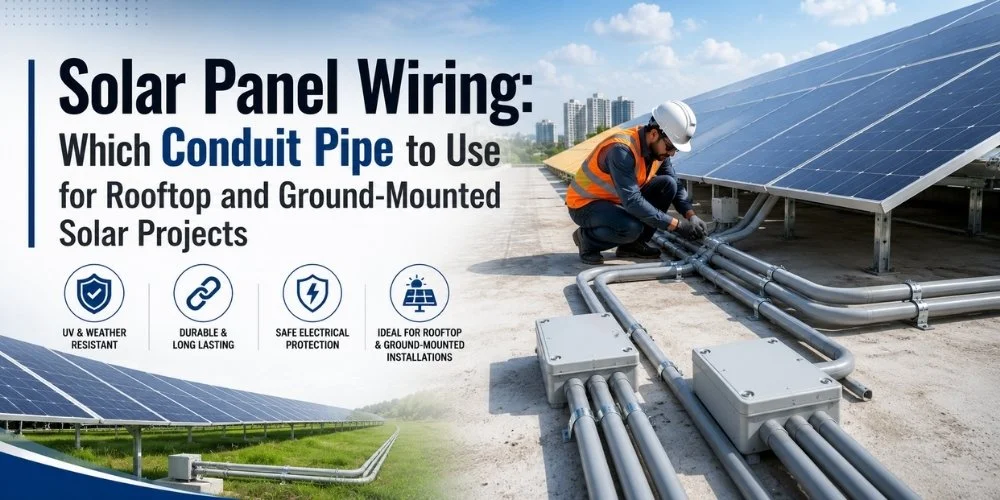
India's solar capacity has been climbing fast, and with it, a lot of EPC contractors and rooftop installers are learning the hard way that solar wiring is not the same job as building wiring. A solar plant sits outdoors for 25 years, exposed to sun, rain, and temperature swings that would degrade an ordinary indoor conduit pipe within a few seasons.
Choosing the right conduit pipe for solar panel wiring India projects isn't just a compliance checkbox. Get it wrong and you're looking at cracked conduit, water ingress into junction boxes, and cable damage that shows up two or three years into a system that was supposed to run maintenance-free for two and a half decades.
This post covers what actually matters when specifying conduit pipe for solar installation work, from UV resistance to DC wiring requirements to IP ratings, whether the project is rooftop or ground-mounted.
Why Solar Wiring Needs UV-Stabilised Conduit
A standard 25-year solar project lifespan is the single biggest reason solar conduit specification is different from every other electrical wiring job. Most building wiring runs concealed inside walls or above false ceilings, shielded from sunlight entirely. Solar conduit does the opposite. Rooftop runs sit in direct sun for the life of the plant, and ground-mounted arrays often have exposed sections too, running from panel rows to combiner boxes and inverters.
Unprotected PVC degrades under UV exposure. The plasticisers and polymer chains break down, the pipe turns brittle, and cracks start to appear along the length exposed to sun, usually the top surface first. Once a crack forms, water finds its way in, and from there it's a short path to cable insulation damage or a short circuit at a junction box.
UV resistant conduit pipe solves this with stabiliser additives mixed into the compound during manufacturing. HALS (hindered amine light stabilisers) and UV absorbers are the two main categories used in outdoor-grade conduit, and they work by either scavenging the free radicals that UV exposure creates in the polymer or absorbing UV energy before it can break polymer bonds. We've written more about how these additives get formulated into conduit in our guide on chemicals used in uPVC conduit pipe manufacturing, if you want the material science behind it.
A practical point worth flagging: black conduit generally handles UV exposure better than grey, since carbon black itself acts as a UV absorber. For any exposed solar run, black UV-stabilised conduit is usually the safer default over standard grey electrical conduit.
DC vs AC Wiring Conduit Requirements on Solar Projects
A solar installation has two very different wiring zones, and the conduit requirements aren't identical across both.
DC side (panel to inverter). This is the wiring that runs from individual panels, through string combiners, down to the inverter. DC cabling in solar systems typically operates at higher voltages than AC branch circuits, sometimes 600V to 1000V or more depending on string configuration, and it carries this voltage continuously whenever the sun is up. Conduit for DC wiring solar runs needs to handle this sustained voltage without any risk of insulation breakdown, and because DC arc faults are harder to interrupt than AC faults, cable protection and proper conduit sealing matter more here than on a typical AC circuit.
AC side (inverter to grid connection). Once power is inverted, wiring from the inverter to the AC distribution board and grid connection point behaves more like standard commercial electrical wiring, though it should still be run in weather-appropriate conduit if any part of the route is outdoors.
Segregating DC and AC conduit runs is standard practice, and most solar EPC specifications call for it explicitly. Mixing them in a shared conduit or trunking run isn't just poor practice, it also complicates fault-finding later, since a technician troubleshooting a DC ground fault doesn't want to be working next to live AC conductors in the same enclosure.
Rooftop Solar: Exposed Surface Conduit and Weather Resistance
Rooftop installations are almost entirely exposed conduit runs, which is exactly where outdoor conduit for solar wiring earns its keep. The conduit sits on the roof surface, clipped along mounting structures, running between panel rows and down to the inverter, usually with zero shielding from sun or rain.
A few things matter specifically for rooftop work:
- UV stabilisation is non-negotiable. Every exposed run on a rooftop should use UV-stabilised conduit, not standard indoor-grade pipe. This is the single most common shortcut that causes early failures.
- Thermal expansion allowance. Rooftop surfaces get hot, and conduit expands and contracts with daily temperature swings far more than concealed indoor conduit does. Expansion couplers or slightly looser fixing at intervals prevent the conduit from buckling over repeated heat cycles.
- Secure clipping, not adhesive mounting. Rooftop wind loads, especially on metal roof sheeting, can lift poorly secured conduit. Saddle clips fixed to structural mounting rails hold up far better than adhesive-based fixing over years of weather exposure.
- Sealed entry points. Every point where conduit enters a junction box or inverter enclosure needs a proper cable gland or sealed adaptor. An open or loosely fitted entry point is where most rooftop water ingress problems start.
Ground-Mounted Solar: Underground Conduit Requirements
Ground-mounted solar farms and larger rooftop-adjacent ground arrays typically run a good portion of their cabling underground, connecting panel rows, combiner boxes, and the central inverter or transformer.
Underground conduit for solar has a different set of demands than exposed rooftop runs:
- Direct burial rating. Conduit intended for underground duct use should be rated for direct burial or used inside a proper duct bank with adequate cover depth, not just buried standard conduit that happens to be UV stabilised.
- Soil chemical resistance. Depending on soil composition, buried conduit can face exposure to varying pH levels and moisture content over years. Conduit material needs to hold up to this without degrading.
- Ground movement tolerance. Soil settles and shifts, especially in the first year or two after trenching. Conduit and joints need enough flexibility, or correctly placed expansion joints, to avoid cracking under this movement.
- Rodent and root resistance. Agricultural land used for ground-mounted solar often has burrowing animals and root systems nearby. Wall thickness and burial depth both play a role in avoiding damage from this.
For underground runs specifically, many solar EPC contractors also evaluate HDPE conduit as an alternative to uPVC, since HDPE's flexibility handles ground movement well. Whichever material is chosen, the conduit still needs adequate wall thickness and a burial-rated classification, not a repurposed exposed-run product.
Which Conduit Grade Suits Inter-Panel Wiring vs Main Cable Runs
Not every run on a solar site carries the same load or faces the same mechanical stress, so grading conduit by function makes more sense than using one size and grade throughout.
Inter-panel and string wiring typically carries lower current per run and doesn't need the heaviest conduit grade, but it does need full UV stabilisation since these runs are almost always exposed along the mounting structure.
Main DC combiner-to-inverter runs and AC main runs carry significantly higher current and often need a heavier wall thickness conduit grade, both for mechanical protection during installation and to handle the higher cable bulk. This is similar to the load-based grading logic used on any commercial project, where main riser runs get a heavier conduit class than branch circuits. Our comparison of LMS, MMS, and HMS conduit grades explains the wall thickness and strength differences if you're sizing conduit across a mixed-load solar site.
For sites where conduit will be walked on, driven over during construction, or embedded near structural mounting points, stepping up to a heavier grade avoids the cracked-conduit problems that show up later during O&M inspections.
IP Rating Requirements for Outdoor Solar Conduit and Enclosures
IP (Ingress Protection) ratings matter throughout a solar installation, not just at the conduit level but at every junction box, combiner box, and enclosure the conduit connects to.
For outdoor solar work, IP65 is generally treated as the practical minimum for enclosures and entry points exposed to rain and dust, with IP66 or IP67 sometimes specified for junction boxes in higher rainfall regions or exposed rooftop locations. The conduit itself needs to maintain this protection at every connection point, which means:
- Threaded or push-fit conduit couplers should form a proper seal, not just a mechanical connection
- Cable glands at box entries need the correct IP rating to match the enclosure, since a low-rated gland undermines an otherwise well-rated box
- Any conduit penetration into an inverter or combiner box enclosure should preserve the enclosure's original IP rating, which is easy to compromise with a poorly matched gland or an oversized drilled entry hole
A solar site with a fully IP66-rated combiner box and a cheap, unsealed conduit entry into it is effectively only as protected as its weakest connection point.
Common Failures: Wrong Conduit on Rooftop Solar
A few patterns show up repeatedly on solar sites that used the wrong conduit or grade, and most of them trace back to treating solar wiring like standard building wiring:
Standard grey PVC conduit used on an exposed rooftop run. Within one or two monsoon seasons, the conduit shows visible fading and surface chalking, and cracks start to appear along the sun-facing side. By year three or four, water ingress at cracked sections has damaged cable insulation underneath.
Conduit undersized for cable bundling at combiner points. Multiple string cables converging at a combiner box get crammed into an undersized conduit run, leading to heat buildup and, in some cases, insulation damage from constant thermal stress.
No thermal expansion allowance on long rooftop runs. Rigidly fixed conduit over long straight rooftop sections buckles or pulls loose from fittings after repeated heat cycling, eventually exposing cable at the joint.
Poor sealing at inverter and combiner box entry points. Even good-quality conduit fails to protect the system if the entry point into the box isn't properly glanded, since this is where most water finds its way into otherwise well-protected enclosures.
Every one of these failures is preventable at the specification stage. The cost difference between UV-stabilised, correctly graded solar conduit and standard indoor conduit is small compared to the cost of re-cabling a live rooftop array three years into a 25-year project.
What This Means for Solar EPC Procurement
Solar EPC companies and installers buying conduit at project scale need more than a general-purpose electrical conduit supplier. The conduit needs documented UV stabilisation, correct wall thickness for the grade required, and consistency across large bulk orders, since a solar project can involve conduit runs across dozens or hundreds of panel rows.
We manufacture uPVC conduit pipes and fittings with UV-stabilised formulations suited to outdoor and rooftop applications, along with the wall thickness options needed for main DC and AC runs on larger installations. As solar cable conduit India demand keeps growing with the country's rooftop and utility-scale solar push, having a supplier who understands the difference between indoor and outdoor-grade conduit matters more than ever.
Solar project contractor? Talk to us about bulk conduit supply for your next rooftop or ground-mounted installation.