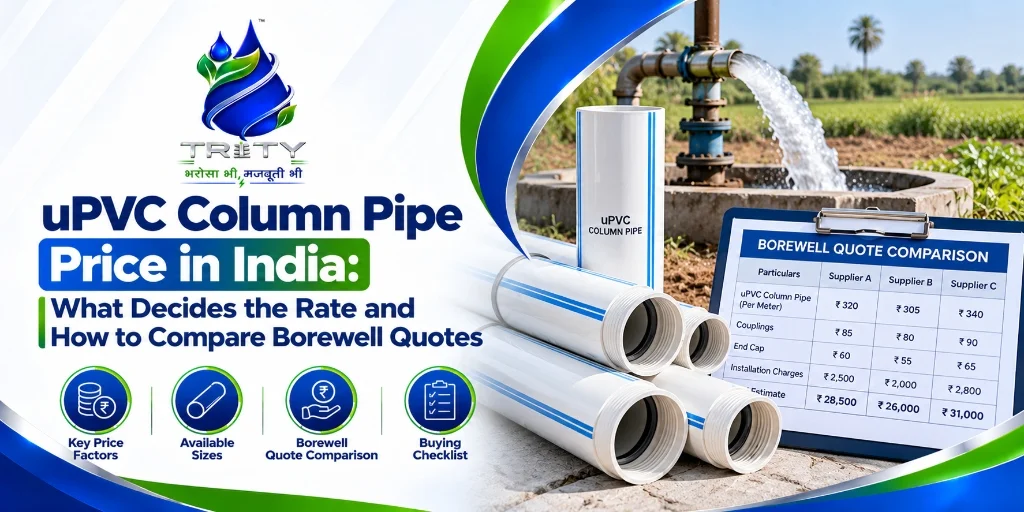
Search for uPVC column pipe price and you will find listings that run from under a hundred rupees to several thousand, quoted per piece, per metre or per kilogram, with no mention of the class, the wall thickness, the piece length or whether the coupler and sealing ring are included. A farmer, a borewell contractor or a pump dealer cannot choose on numbers like that.
Column pipe is also one of the few borewell components where a cheap mistake becomes very expensive. If a joint fails deep in the borewell, you are not repairing a leak, you are retrieving the pump and the whole string. This guide explains what decides column pipe price, how quotes are written, how to compare them on equal terms, how to match the class to your borewell, and how to get a clear quotation from Trity Pipes. If you want the general picture first, read our guide to uPVC column pipes for borewells.
We do not print fixed rates here, because resin cost, freight and demand change, and a number published today may be wrong when you read it.
What a column pipe actually carries
A column pipe, also called a riser or drop pipe, connects the submersible pump at the bottom of the borewell to the surface. It carries the water on its way up, and it also carries the weight of the pump, the water column and the pipe string itself, all hanging from threaded joints. Pipe, thread and sealing ring work as one system, and the weakest of the three decides how long it lasts.
That is why price per metre alone is a poor guide. The cost of the pipe is small next to the cost of pulling a pump from a deep borewell, so the aim is to pay for the right class and a sound joint, not the lowest number.
The main factors that decide uPVC column pipe price
Class or duty grade
Column pipe is made in classes that carry different loads. Trity makes Standard, Medium, Heavy and Super Heavy grades. Each step up has a thicker wall for the same diameter, which means more material, higher pressure and load capacity, and a higher price. Manufacturers usually publish a table giving the safe hydrostatic pressure and safe pump delivery head for each class, and these are the figures to use when you match a class to a borewell.
Diameter
Larger diameters use more compound per piece. Sizes in Indian borewells run from small agricultural and residential sizes up to larger diameters for industrial and high-capacity irrigation. Choose the size your pump outlet and flow rate need.
Piece length
Column pipe is commonly supplied in lengths of around 3 metres per piece, though some suppliers use other lengths. A price per piece is meaningless until you know the length, and two suppliers can look equally priced when one piece is shorter.
Wall thickness and weight
Thicker walls weigh more and cost more. This matters when a quote is per kilogram, because a thinner pipe weighs less and therefore costs less at the same rate per kilogram. Always ask for the weight and wall thickness of the class you are buying.
Threads and joint design
The thread is where column pipe usually fails. A well-cut thread spreads load evenly across the joint, while a poorly cut thread concentrates stress at one point. Trity's pipes have a belled socket thread on one end and a matching male thread on the other, with couplers available separately for configurations that need them. Thread quality adds cost in tooling and checking, and it is worth paying for.
Sealing ring
A matched rubber sealing ring is part of the joint. A mismatched or low-grade ring is a common cause of a joint that looks tight on installation day and weeps within a season. Check whether the ring is included in the quote.
Couplers and accessories
Couplers, bottom connectors and clamps may be quoted separately. For a project that already has pump adaptors from another supplier, confirm thread compatibility before ordering, because column pipe threads are not universal across manufacturers.
Raw material
Column pipe under sustained load needs consistent tensile strength along its whole length. Virgin uPVC compound gives that. Recycled or blended compound introduces weak spots you cannot see until the pipe is hundreds of feet down. Trity makes column pipe from high-tensile virgin uPVC compound.
Testing and certification
Batches that are tested for tensile strength, thread accuracy and impact resistance cost more to produce than untested ones. Trity's manufacturing is backed by ISO 9001:2015, and documents are available on our certifications page and on request for tenders and procurement files.
Quantity and minimum order
Larger and phased orders earn better rates, and some suppliers set minimum order quantities. Ask about the quantity at which the rate improves.
Freight and location
Column pipe is long, bulky and heavy to move. Distance adds to the landed cost, so buying from a manufacturer in your region lowers freight. Trity ships from our Delhi NCR facility to 20-plus states, and delivery time is confirmed with each quotation.
GST
Plastic pipes and fittings fall under HSN 3917 and attract 18 percent GST. Check whether a rate includes it.
Why online column pipe prices cannot be compared
The directory listings you see online show the problem clearly. One supplier lists a rate per piece, another per metre, a third per kilogram. Some state a class, many do not. Some include the coupler, some do not. Rates for pipes with the same name differ by many times, because the products inside the name differ by many times. A single figure tells you nothing until it is tied to a class, a diameter, a piece length, a weight and a list of inclusions.
How column pipe quotations are written
You will see three common forms.
- Per piece: a price for one length, so you must know the length
- Per metre: a price for each metre, which makes comparison easier
- Per kilogram: a price by weight, which needs the weight per piece to compare
A complete quotation should also state the class, diameter, thread type, whether the coupler and sealing ring are included, packing, GST treatment, freight, delivery period, payment terms and validity.
A table to compare column pipe quotes
| Item | Supplier A | Supplier B | Supplier C |
|---|---|---|---|
| Class (Standard, Medium, Heavy, Super Heavy) | |||
| Diameter | |||
| Piece length | |||
| Weight and wall thickness | |||
| Pricing unit and rate | |||
| Coupler included? | |||
| Sealing ring included? | |||
| Thread type | |||
| GST included? | |||
| Freight and delivery | |||
| Test reports and certificates | |||
| Validity and payment terms |
Fill every row, even if you have to call the supplier, and then convert each quote into a cost per metre of installed column.
How to convert quotes to cost per metre
- Convert the unit. Divide a per-piece price by the piece length. For a per-kilogram price, multiply by the weight of one piece and then divide by its length.
- Add what is excluded, such as couplers, sealing rings and GST
- Add freight to your site
- Compare only the same class and diameter
- Note the terms, including delivery period, payment terms and validity
The result is a cost per metre you can compare fairly.
Matching the class to your borewell
Choosing the right class matters more than chasing the lowest rate. Several factors decide it.
- Depth of the pump setting, since the lowest pipe in the string carries the cumulative weight of everything below the surface
- Pump size and weight, as larger pumps add dead weight
- Delivery head and working pressure that the pump generates
- The weight of the water column in the pipe
- Vibration from repeated start-stop cycles
Use the manufacturer's class table, which lists safe pressure and delivery head, and give your pump specification and setting depth to your supplier. Our team can recommend a class when you share your depth and pump details. Under-speccing the class to save on material is one of the most common causes of column pipe failure in the field, and the price gap between classes is small next to the cost of a pump retrieval.
Estimating how many pieces you need
A simple method gives you the quantity.
- Convert the pump setting depth to metres. For example, a setting depth of about 300 feet is roughly 91 metres.
- Divide by the piece length. With 3-metre pieces, 91 metres needs about 31 pieces.
- Round up and add one or two spares.
- Add couplers or sealing rings according to your joint design.
- Add accessories, such as clamps and a bottom connector.
Share your depth and pump specification with your supplier, and ask them to check the quantity.
Red flags in a column pipe quote
- No class stated, or a vague "heavy" with no pressure or head figure
- A per-kilogram rate with no weight or wall thickness
- A rate far below others for the same stated class
- No mention of the sealing ring or coupler
- No test reports or certificates, or a refusal to share them
- Verbal quotes only, with no validity period
- Claims that sound too good, such as very long warranties with no written terms
Installation habits that protect your investment
- Do not over-tighten threaded joints, because it can crack the thread under load
- Inspect each sealing ring before every joint, not only the first
- Lower the string with proper clamps so a single joint never takes shock load
- Match the class to depth and pump weight, not to the budget alone
Our guide to uPVC casing pipes covers the casing side of the borewell, which is a different component with different requirements.
What a Trity Pipes column pipe quotation includes
Trity Pipes manufactures uPVC column pipes and riser pipes from high-tensile virgin uPVC compound, with threaded joints designed to hold under sustained hydrostatic pressure and the weight of a loaded pump string. Our range covers Standard, Medium, Heavy and Super Heavy grades. Every batch is tested for tensile strength, thread dimensional accuracy and impact resistance before dispatch.
When you send us your depth, pump specification, diameter and quantity, our team prepares a quotation that states the class, size, rate, what is included, the delivery basis and the validity. We confirm thread compatibility with your existing pump adaptors before you order, and sample lengths are available for evaluation on larger orders. You can see the full uPVC column pipes range, and borewell contractors, pump dealers and agricultural equipment dealers can ask about bulk supply and dealership. Our guide on buying in bulk explains how order size and phasing affect rates.
Frequently Asked Questions
What is the price of uPVC column pipe in India?
It varies with class, diameter, piece length, brand, quantity and the date of the quotation, so one number would mislead. The reliable way to find the current rate is to request a written quotation for your depth, pump and quantity.
Why do column pipe prices differ so much between suppliers?
Products named column pipe differ in class, wall thickness, weight, thread quality, sealing ring and raw material, and quotes are written per piece, per metre or per kilogram with different inclusions. A very low rate often reflects thinner walls or recycled compound.
Which column pipe class should I choose?
It depends on pump setting depth, pump weight, delivery head and working pressure. Use the manufacturer's class table and share your details with our team, who can recommend a class for your borewell.
Is the coupler or sealing ring included in the column pipe price?
Not always. Some quotations include them and some list them separately, so ask the supplier to state it clearly and compare quotes on the same basis.
Can I get a bulk quotation for column pipes from Trity Pipes?
Yes. Send us your depth, pump specification, diameter and approximate quantity, and our team will prepare a quotation and discuss delivery. Dispatch is from our Delhi NCR facility to 20-plus states.
Does Trity Pipes check thread compatibility before I order?
Yes, our team will confirm thread compatibility with your existing pump adaptors and bottom connectors before you place an order, so you avoid delays on site.
Planning a borewell project? Contact Trity Pipes on +91-9821030072 or +91-9319984755 with your depth and pump details for a column pipe quotation, sample lengths and documentation from our Delhi NCR factory.