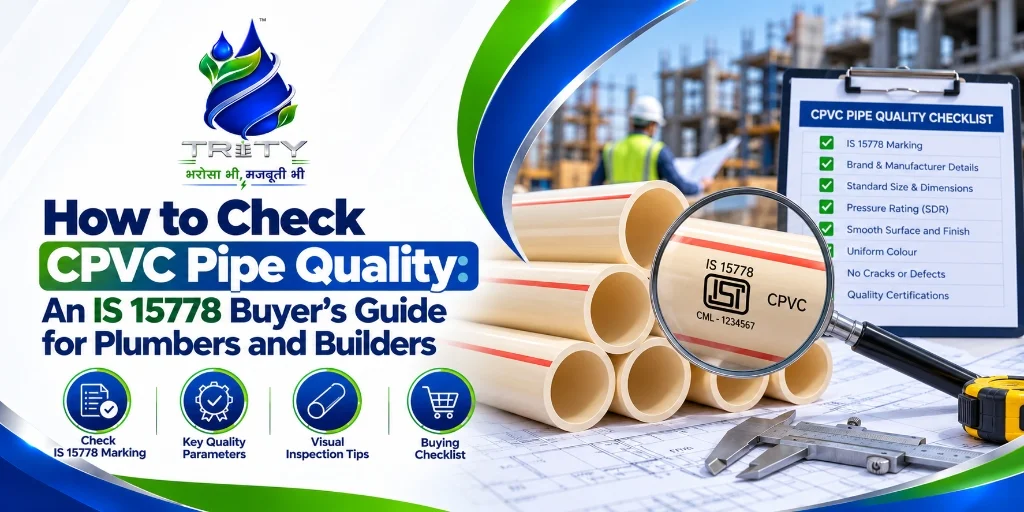
A CPVC pipe is meant to run hot water for decades inside a wall, where nobody will see it again. That is exactly why quality matters, and why poor-quality pipe is so costly. A hot water leak inside a wall rarely announces itself. By the time you see a damp patch or lost pressure, the pipe has often been failing for weeks, and the repair means opening a finished wall.
The trouble is that a weak CPVC pipe can look identical to a good one. This guide gives you practical checks you can run at the shop or on site: how to read the marking, how to verify the BIS licence, how to judge wall thickness using SDR, how to test fittings and solvent joints, what documents to ask for and which price and supplier red flags to watch. It follows the same trust-building approach as our guide on identifying fake or substandard conduit pipe, applied to CPVC.
Why CPVC quality is harder to judge than other pipes
CPVC is a chlorinated compound, and its performance depends on the raw material and on how the pipe is extruded and tested. Two pipes of the same size and colour can differ greatly in wall thickness, compound quality and heat performance. A pipe made from poor or blended compound may pass a casual look and a short cold test, then soften, warp or crack after months of hot water. Problems rarely appear on day one, which makes verification at purchase even more important.
Know the standard: IS 15778
CPVC pipes for hot and cold potable water in India are made to IS 15778. The standard covers material, dimensions, pressure classes, testing and marking. Pipes are classified into pressure classes by SDR, with SDR 11 and SDR 13.5 being the common classes for the 15mm to 50mm range. Hydrostatic pressure testing under the standard is carried out at room temperature and at an elevated temperature, so that a pipe is proven at the conditions it will actually face.
A pipe sold as CPVC for hot water should carry the marking that shows it meets this standard. If a pipe does not mention IS 15778 at all, ask why.
Check 1: Read the marking on the pipe
Genuine pipe carries a printed marking along its length. Look for:
- The standard designation, IS 15778
- Nominal size
- SDR or pressure class
- The manufacturer's name or trademark
- A batch or production code
- The ISI mark with the BIS licence number
Missing or faded marking, vague phrases such as "ISI quality" without a licence number, or print that rubs off easily should make you cautious. A manufacturer that stands behind its product prints clear, permanent information.
Check 2: Verify the BIS licence number
A printed ISI mark costs nothing. A valid licence does. Take the licence number from the pipe or the supplier and check it on the BIS database for these points.
- The licence exists and the number is valid
- It is issued for CPVC pipes under the relevant standard, not some unrelated product
- It is current, not suspended or cancelled
- The manufacturer named on the licence matches the name on the pipe
A supplier who is reluctant to share the licence number is giving you information. Our certifications page shows Trity's credentials, including ISO 9001:2015, and you can verify any licence number yourself.
Check 3: Judge wall thickness using SDR
SDR, or standard dimension ratio, is the pipe's outside diameter divided by its minimum wall thickness. A lower SDR means a thicker wall. This gives you a simple way to test a claim.
- Measure the outside diameter and the wall thickness with a vernier caliper, at several points around a cut end of the pipe
- Divide the outside diameter by the wall thickness to get the SDR the pipe actually has
- Compare it with the class marked on the pipe, and with the minimum wall thickness listed in IS 15778 for that size and class
If a pipe marked SDR 11 measures like a thinner pipe, the marking is not true. Also look for uneven wall thickness around the circumference, which points to poor extrusion control. Check more than one length from the delivery, not just the sample you were shown.
Trity publishes the sizes and pressure classes we make, SDR 11 and SDR 13.5 from 15mm to 50mm, and confirms exact wall thickness and tolerances for each size at the time of enquiry. You can see the range on the CPVC pipes and fittings page.
Check 4: Look at colour, surface and finish
CPVC pipe is typically a cream or light beige colour, though shades vary between manufacturers. Quality shows up in consistency.
- Uniform colour along the length, without streaks, patches or dark specks
- A smooth, clean surface inside and outside, with no rough patches or visible bubbles
- A clean cut end, with an even, dense cross-section and no voids
- No chalky residue when you rub the surface
Specks, uneven colour and a rough finish can point to mixed or recycled material. None is conclusive alone, but several together should make you cautious.
Check 5: Weight and feel
For a given size and class, pipe within specification has a predictable weight per metre. Weigh a one-metre length and compare it with the manufacturer's published figure. A pipe that is noticeably lighter than the figure for its marked class often has a thinner wall or a poorer compound. Ask the supplier for the weight per metre of the size and class you are buying.
Check 6: Test the fittings and the joint
A CPVC system fails at joints more often than along the pipe, so test them before you commit to a large order.
- Dry fit the pipe into the fitting. It should enter smoothly to a firm stop without forcing, and without excessive looseness.
- Check that fittings come from the same manufacturer as the pipe, or at least that they are dimensionally matched, since mixed tolerances create weak joints
- Make a test joint with CPVC-specific solvent cement, let it cure fully, and then try to separate it by hand. A good joint will not come apart
- Never use ordinary PVC cement, as it is not suitable for CPVC
Trity manufactures fittings, including elbows, tees, couplers, reducers, unions and end caps, to the same dimensional tolerance as our pipe, so joints seat properly. Our guide on CPVC system design also covers jointing practice and expansion allowance.
Check 7: Ask for test reports and certificates
A reliable manufacturer will give you documents without fuss. Ask for:
- The BIS licence details for CPVC pipes
- The ISO 9001:2015 certificate
- IS 15778 test reports for the product and batch, including pressure testing at temperature
- A datasheet listing sizes, classes and dimensions
- A batch record or production code that matches your delivery
Trity provides IS 15778 test reports and ISO 9001:2015 certification on request for tender and procurement files. Reports should relate to the same size and class you are buying, not a different product.
Price and supplier red flags
- A rate far below other suppliers for the same stated class. Our guide on what decides CPVC pipe price explains why unusually low rates are usually explained by thin walls, poor compound or missing certification.
- No marking, or marking without a licence number
- Reluctance to share documents or test reports
- A verbal promise instead of a written quotation
- Mixed brands of pipe and fittings offered as one system
- No batch information, which makes any later claim impossible to trace
- Claims that sound too good, such as unlimited service life with no terms
A quick on-site checklist
- Marking shows IS 15778, size, class, manufacturer and batch
- BIS licence number verified
- Wall thickness measured and matched to the marked SDR
- Colour and surface uniform
- Weight per metre matches the published figure
- Dry fit and a test joint with CPVC cement succeed
- Test reports and certificates received
- Written quotation with terms in hand
Why plumbers and builders choose Trity Pipes CPVC
Trity Pipes manufactures CPVC pipes and fittings from high-grade, lead-free CPVC compound, not blended or recycled feedstock, to IS 15778 at our Delhi NCR facility. Every production batch goes through pressure testing at elevated temperature, dimensional and wall thickness checks and impact checks before dispatch. We support buyers with documents, sample batches for evaluation and a quotation that states the terms clearly. If you want to check us the way this guide suggests, you are welcome to visit our factory or ask for samples and test reports before you place an order. Our full CPVC pipes and fittings range is listed with sizes and classes.
Common mistakes buyers make when verifying CPVC
- Trusting the carton instead of the pipe. Packaging can be copied. Check the marking on the pipe itself.
- Checking only the sample. Inspect pipes from the actual delivery, from more than one bundle.
- Skipping the licence check because the ISI logo looks convincing
- Testing joints before they cure, then blaming the pipe when they leak
- Mixing brands of pipe, fittings and cement and assuming they will match
- Relying on a verbal assurance about test reports instead of asking for the documents
- Choosing on rate alone, without comparing class, wall thickness and terms
What a genuine factory visit shows you
If your order is large, a visit tells you more than any brochure. Look at how CPVC compound is stored and labelled, how the extrusion line is monitored, how often wall thickness is checked, how finished pipe is marked and bundled, and where test samples are kept. Ask to see pressure test records and how batch codes link to them. A manufacturer that is confident in its process will welcome the visit and answer detailed questions. Trity's factory is in Ghaziabad, Delhi NCR, and you can arrange a visit through our team before placing an order.
Frequently Asked Questions
How can I tell if a CPVC pipe is genuine?
Check the marking for IS 15778, size, class, manufacturer and batch, verify the BIS licence number on the BIS database, measure wall thickness against the marked SDR, check colour and surface consistency, and ask for test reports. Several checks together are far more reliable than any one.
What does SDR mean on a CPVC pipe?
SDR is the standard dimension ratio, the outside diameter divided by the minimum wall thickness. A lower SDR such as SDR 11 means a thicker wall and a higher pressure rating than SDR 13.5 for the same size.
Can I use PVC solvent cement on CPVC pipe?
No. CPVC needs CPVC-specific solvent cement. Ordinary PVC cement is not suitable and can produce joints that look sealed but fail under sustained heat.
Which documents should I ask a CPVC supplier for?
Ask for the BIS licence details, the ISO certificate, IS 15778 test reports for the batch, a datasheet with sizes and classes, and a batch code that matches your delivery.
Does Trity Pipes provide test reports for CPVC pipes?
Yes. IS 15778 test reports and ISO 9001:2015 certification are available on request, and sample batches can be arranged for evaluation. Contact our team with your requirement.
Why is very cheap CPVC pipe risky?
A very low rate often reflects thinner walls, lower-grade or recycled compound or missing certification. Those faults may not show for months, and a failed hot water line inside a wall is expensive to repair.
Want CPVC pipe you can verify? Contact Trity Pipes on +91-9821030072 for samples, IS 15778 test reports and a written quotation for ISO-certified CPVC pipes and fittings from our Delhi NCR factory.