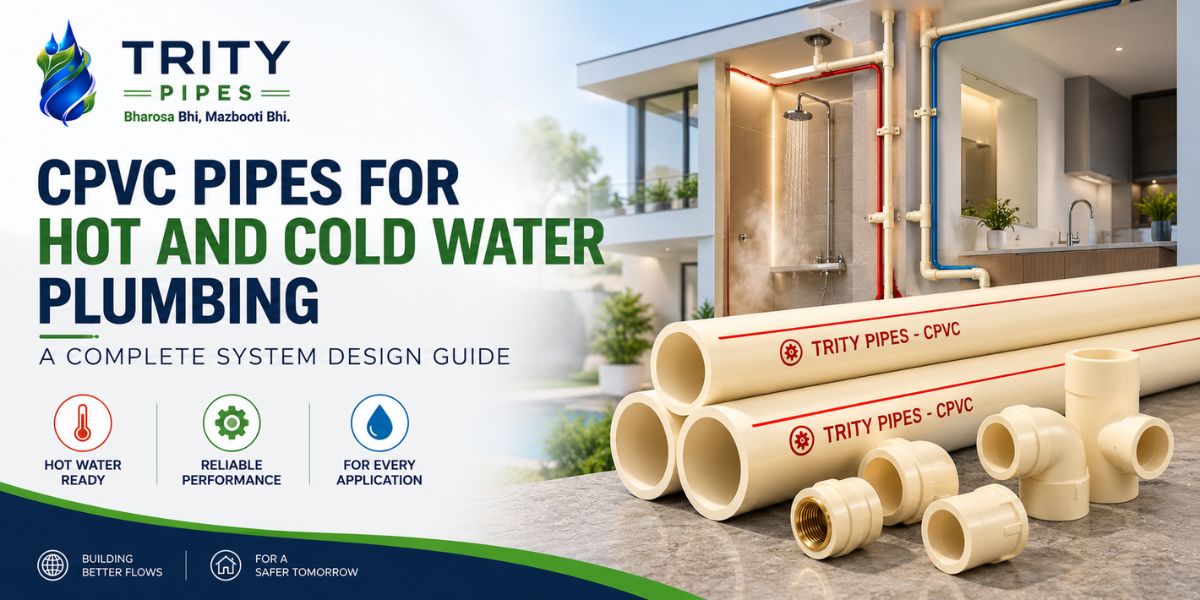
Once CPVC has been chosen for a home or building's hot water lines, the next set of decisions matters just as much as the material choice itself. Which pressure class goes where. How to size the geyser or solar water heater line correctly. How to account for the pipe's own thermal expansion as hot water cycles through it daily for years. And how to think about the plumbing as one connected system rather than a series of individual pipe runs decided one at a time.
This guide assumes CPVC is already the material of choice and focuses entirely on designing and sizing the system around it. If you're still deciding between CPVC and uPVC for your project, our comparison of CPVC and uPVC pipes covers that decision in detail. This post picks up from there.
CPVC's temperature and pressure ratings under IS 15778
CPVC pipe for potable hot and cold water distribution in India is governed by IS 15778, the Bureau of Indian Standards specification covering material composition, dimensional tolerances, pressure testing, and marking requirements. Understanding what this standard actually certifies is the starting point for any system design decision.
Temperature rating
CPVC pipe compliant with IS 15778 is rated for continuous water service up to 82°C, verified through hydrostatic pressure testing conducted at both 27°C and 82°C to confirm the pipe holds its pressure rating across that full temperature range, not just at room temperature. This is the property that separates CPVC from ordinary uPVC, which softens and deforms well before reaching typical hot water system temperatures.
Pressure class and SDR system
IS 15778 classifies CPVC pipe into pressure classes tied to Standard Dimension Ratio (SDR), which is essentially the relationship between a pipe's diameter and its wall thickness:
| Pressure Class | SDR | Typical size range | Relative pressure rating |
|---|---|---|---|
| Class 1 | SDR 11 | 15–50mm | Highest of the three, thicker wall for a given diameter |
| Class 2 | SDR 13.5 | 15–50mm | Moderate, thinner wall than Class 1 |
| Class 3 | SDR 17 | 65–150mm | Lower pressure rating, larger diameter range |
A lower SDR number means a thicker wall relative to the pipe's outer diameter, which is why SDR 11 (Class 1) carries the highest pressure rating of the three. Many manufacturers colour-code pipe by class for quick identification on site, commonly a tan or beige body with a red stripe for SDR 11 and a brown stripe for SDR 13.5, though it's worth confirming a specific manufacturer's colour convention rather than assuming it's universal.
What this means for design
Every pipe should be clearly marked with its size, SDR/pressure class, and BIS licence details at regular intervals along its length. When designing a system, this marking is what lets you and your plumber confirm, even mid-installation, that the correct class of pipe is going into each part of the system, which matters because different parts of a hot water system genuinely need different classes.
Choosing the right class for different parts of the system
A common mistake in CPVC system design is treating the whole hot water system as needing one uniform pipe class, when in practice the pressure and temperature demands vary meaningfully between the geyser or water heater connection point and the branch lines further downstream.
Near the heat source
The section closest to a geyser, solar water heater, or central hot water plant sees the highest sustained temperatures and, in many building designs, the highest static pressure. Class 1 (SDR 11) is generally the appropriate choice here, given its higher pressure rating and thicker wall section for the same nominal diameter.
Branch lines to fixtures
Once hot water branches off toward individual bathroom or kitchen fixtures, both pressure and continuous temperature exposure typically drop somewhat compared to the main riser. Class 2 (SDR 13.5) is often adequate for these branch runs, offering a reasonable balance of cost and performance for typical residential and light commercial fixture connections.
Larger commercial and multi-storey buildings
Where a hot water system serves multiple floors or a larger commercial space, riser sizing needs its own calculation based on the building's plumbing design cascade: cold water rising mains sized separately (commonly in uPVC under a different Indian standard, IS 4985, for the cold-water side), hot water risers sized in CPVC to the appropriate class for the pressure the riser will see, and any recirculation loop, covered further below, sized and insulated as its own design element.
Sizing for geyser and solar water heater lines specifically
Geyser and solar water heater connections deserve particular attention because they represent the highest-stress point in a typical residential CPVC system.
Geyser lines
A standard electric geyser cycles water to a set temperature, typically well within CPVC's rated range, but the line connecting it sees repeated heating and cooling cycles daily over the water heater's operating life. Sizing this line correctly for the geyser's flow rate, and using Class 1 pipe for the short run immediately at the geyser connection, gives the best margin against the combined thermal and pressure stress this specific section experiences.
Solar water heater lines
Solar water heating systems introduce a specific consideration that a standard electric geyser doesn't: stagnation temperature. On a hot, sunny day with no water draw, a solar collector loop can reach temperatures meaningfully higher than a typical geyser's thermostat-controlled output, particularly in the collector loop itself before any mixing occurs. Confirm with the solar system manufacturer what stagnation temperatures the collector loop can reach, and ensure any CPVC used in that specific loop is rated with adequate margin above that peak, using Class 1 pipe and giving this section of the system particular attention during design rather than treating it identically to a standard geyser connection.
Expansion allowance for thermal cycling
CPVC has a meaningfully higher coefficient of thermal expansion than metal piping, and a hot water system, by its nature, puts the pipe through daily heating and cooling cycles for its entire service life. Designing for this movement properly is what separates a CPVC system that performs reliably for decades from one that develops stress cracks and joint failures within a few years.
Why this matters more in CPVC than in cold-water-only uPVC
A cold water line sees relatively stable temperature and correspondingly little thermal movement. A hot water CPVC line cycles between ambient and up to 82°C potentially multiple times a day, and that repeated expansion and contraction, if not accommodated in the pipe run's design, transfers stress to the nearest fixed point, typically a joint or a bracket.
Practical expansion allowance measures
- Use offsets and changes in direction rather than long, perfectly straight rigid runs wherever the layout allows, since a run with natural direction changes has some inherent flexibility to absorb thermal movement without needing a dedicated expansion device.
- Follow the manufacturer's recommended support spacing for hot water applications specifically, which is typically closer than the spacing recommended for cold water CPVC or PVC, since a hot line needs more frequent support to manage both the pipe's own weight when heated and its expansion movement.
- Allow for expansion loops on long straight hot water runs where the layout doesn't naturally provide direction changes, calculated based on the specific run length and the temperature differential the line will see.
- Use only CPVC-specific solvent cement, matched to the correct ASTM specification for CPVC jointing, since PVC solvent cement is not interchangeable with CPVC cement and using the wrong cement compromises joint integrity under the thermal cycling a hot water joint experiences.
Sizing a full system, not just individual runs
The most common design mistake in residential and small commercial CPVC installations is sizing each pipe run in isolation, fixture by fixture, rather than designing the system as a connected whole.
A practical system design sequence
- Establish total hot water demand for the building or home, based on fixture count and expected simultaneous use, which determines the water heater or geyser capacity needed in the first place.
- Size the main hot water riser or trunk line to carry that total demand with acceptable pressure loss, generally in Class 1 CPVC for the higher-pressure main run.
- Size branch lines to individual fixture groups based on each branch's actual flow requirement, typically stepping down in diameter as the system branches away from the main line, similar to how any distribution system tapers with reducing demand.
- Decide whether a recirculation loop is needed. Larger homes and most commercial or hospitality buildings benefit from a hot water recirculation loop that keeps water in the pipe network warm even when a fixture hasn't been used recently, avoiding a long wait for hot water at distant fixtures. A recirculation loop needs its own sizing calculation and should be insulated along its length to limit heat loss.
- Confirm every transition point uses compatible fittings, sized and classed to match the pipe on both sides of the joint, since a system with pipe from one source and fittings from another risks dimensional mismatch exactly where reliability matters most.
Getting your CPVC system design right
A CPVC hot water system performs reliably for decades when pressure class is matched to where it's actually needed, geyser and solar connections get the extra margin their higher stress demands, thermal expansion is designed for rather than discovered as a cracked joint years later, and the whole system is sized as one connected design rather than assembled fixture by fixture. These decisions, not just the choice of CPVC over another material, are what determine whether a plumbing system is trouble-free or a recurring maintenance headache.
Trity Pipes manufactures CPVC pipes and fittings compliant with IS 15778 across the standard pressure classes, suited to everything from a single geyser connection to a full multi-storey building's hot water riser and branch design. You can review our full CPVC pipes and fittings range for the classes and sizes that fit your system design.
Check CPVC pipe specifications and sizes for your plumbing system design. Get in touch with our team for support sizing your project correctly from the geyser connection through to the last fixture.
Frequently asked questions
What's the difference between CPVC Class 1 and Class 2 pipe?
Class 1 (SDR 11) has a thicker wall relative to its outer diameter and carries a higher pressure rating than Class 2 (SDR 13.5). Class 1 is generally used for higher-pressure sections like the main riser or the connection immediately at a geyser or water heater, while Class 2 is often adequate for branch lines to individual fixtures where pressure and continuous temperature exposure are typically lower.
What temperature can CPVC pipe actually handle?
CPVC pipe compliant with IS 15778 is rated for continuous water service up to 82°C, tested through hydrostatic pressure testing at both room temperature and 82°C to confirm the pressure rating holds across that range. This comfortably covers standard geyser output temperatures, though solar water heater stagnation temperatures should be checked separately since they can exceed typical geyser output.
Do I need expansion loops on every CPVC hot water run?
Not necessarily every run, but any long, straight section without natural direction changes should be assessed for expansion allowance, since CPVC's thermal expansion under daily heating and cooling cycles needs to go somewhere. Runs with bends and offsets often have enough inherent flexibility, while long straight sections may need a dedicated expansion loop calculated for that run's length and temperature range.
Can I use the same solvent cement for CPVC and uPVC pipes?
No. CPVC requires its own specific solvent cement, matched to the correct specification for CPVC jointing, and this is not interchangeable with standard PVC solvent cement. Using the wrong cement compromises the joint's integrity, particularly under the thermal cycling a hot water CPVC joint experiences over its service life.
Does a home really need a hot water recirculation loop?
It depends on the size of the home or building and how far fixtures are from the water heater. Larger homes and most commercial or hospitality buildings benefit from a recirculation loop that keeps hot water available quickly at distant fixtures rather than requiring a long wait, but a small home with the water heater close to most fixtures may not need one. It's worth evaluating during initial system design rather than deciding after the plumbing is already installed.
How do I know which pipe class to use if I'm not doing the calculations myself?
Your plumber or MEP consultant should be doing the pressure and flow calculations for your specific system, but it's worth confirming with them which class is specified for each section and why, particularly for the geyser or water heater connection point where the margin matters most. A reasonable, verifiable answer, not just "we always use this class," is a good sign the design has actually been thought through for your system.