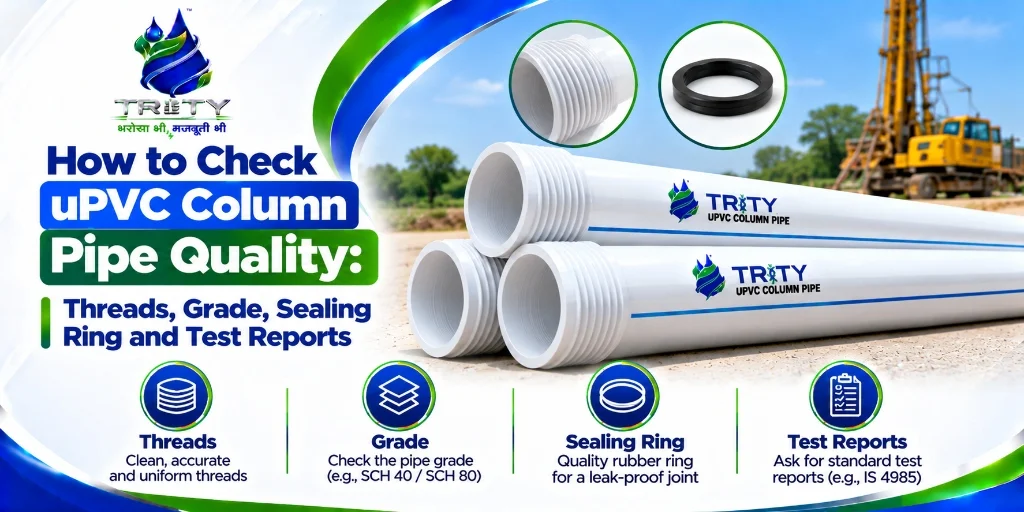
A column pipe hangs a submersible pump hundreds of feet below the ground and carries water back to the surface. Everything depends on a string of pipes joined by threads, and on every joint holding for years. When one fails, the pump drops, the water stops and the whole string has to be pulled out, often with a rig and a crew, in the middle of the season.
That is why column pipe quality is worth checking before you buy, and why the checks are different from ordinary plumbing pipe. The things that fail are the threads, the sealing rings, the walls under tension and the couplers, and most of them can be checked with a caliper, a scale and a careful eye. This guide shows you how. It follows the trust-building approach of our guides on checking pressure pipe, SWR pipe and CPVC pipe, applied to borewell column pipe. If you want the background on how column pipes are used, read our guide to uPVC column pipes for borewells.
What a column pipe has to survive
A column pipe is not just carrying water. It is working under several loads at once.
- The weight of the pump, the water column and the pipes below it, all hanging from the joints
- Hydrostatic pressure from the pump's discharge
- Vibration each time the pump starts and stops
- Handling stress during lowering and raising the string
- Years of immersion in groundwater
A pipe that is only strong enough for the steady load fails at start-up or during lowering. That is why the class, the wall and the threads matter so much.
Check 1: The grade marking
Trity makes column pipes in four grades: Standard, Medium, Heavy and Super Heavy. Each step up has a thicker wall for the same diameter, which gives a higher safe pressure and load capacity. The grade should be marked on the pipe, together with the size, the manufacturer's name or trademark and a batch code.
Be careful if the pipe has no grade marking, or if the supplier says only "heavy pipe" without naming a grade. You cannot hold a supplier to a description that is not on the pipe. Ask for the manufacturer's table that lists, for each grade, the safe hydrostatic pressure, the safe pulling load and the safe pump delivery head, and use it to confirm the grade suits your setting depth and pump. Our guide on column pipe price explains how to match grade to depth.
Check 2: Wall thickness
Wall thickness decides how much load a pipe can carry.
- Measure the outside diameter and the wall at four or more points around a cut end, using a vernier caliper.
- Compare the reading with the manufacturer's table for that diameter and grade.
- Check for uneven walls. A wall that is much thicker on one side than the other is a sign of poor extrusion.
- Measure more than one pipe, from more than one bundle.
A pipe marked Heavy that measures like Standard is mislabelled, and it should not go into your borewell.
Check 3: Weight per piece
For a given diameter, length and grade, pipe within specification has a predictable weight. Weigh a pipe and compare it with the manufacturer's published weight. A noticeably lighter pipe usually has a thinner wall or a poorer compound. Ask the supplier for the weight per piece of each grade, and note the piece length, which is commonly around three metres, so that you compare like with like.
Check 4: The threads
The thread is where column pipe most often fails, so spend the most time here. Trity's column pipes have a belled socket thread on one end and a matching male thread on the other, designed to hold under the weight of a loaded pump string.
- Look at the thread form. It should be clean and regular, with even pitch and depth along its whole length, and no burrs, torn edges or flats.
- Check both ends. The male and female threads should look consistent from pipe to pipe.
- Dry assemble two pipes. They should thread together smoothly by hand for several turns, without wobble, without forcing and without cross-threading.
- Feel for play. A joint that rocks side to side when hand-tight points to a loose thread.
- Check the thread length and shoulder, so that the joint seats fully.
- Look for damage. Thread damage from poor handling or poor cutting weakens the joint.
Trity checks thread dimensional accuracy as part of batch testing, and our column pipes are made so that threads from different pipes in the same grade fit together properly. If a supplier's threads vary from pipe to pipe, expect trouble in the borewell.
Check 5: The sealing ring
A matched rubber sealing ring is part of the joint. A poor or mismatched ring is a common cause of a joint that seems tight on installation day and weeps later.
- Check that a ring is supplied with the joint design you are buying, or ask what ring is to be used
- Check that the ring fits its groove without twisting or sitting loose
- Check the rubber. It should be flexible, smooth and free of cracks, not hard or brittle
- Check the ring size against the pipe diameter and thread
Inspect every ring before every joint during installation, not just the first one.
Check 6: Couplers and accessories
Couplers, bottom connectors and clamps join the pipe string to the pump and the delivery line. They must match the pipe's thread and diameter.
- Confirm thread compatibility between pipe, couplers and your pump adaptor before you order, because column pipe threads are not universal across manufacturers
- Match the coupler's grade to the pipe's grade
- Check the coupler's wall and thread, using the same checks as for pipe
Our team can confirm thread compatibility with your existing pump adaptors and bottom connectors before you place an order, which avoids delays on the rig.
Check 7: Raw material and finish
Column pipe under load needs consistent tensile strength along its whole length. Virgin uPVC compound gives that, while recycled or blended compound can leave weak spots that you cannot see until the pipe is deep underground. Trity makes column pipe from high-tensile virgin uPVC compound. Ask any supplier to confirm the raw material in writing.
Finish tells you something too. The colour should be even, the surface smooth, the cut face dense, and the pipe should lie straight. A pipe with a visible bow, twist, streaks, specks or voids deserves a closer look.
Check 8: Test reports and certificates
A reliable manufacturer provides test documents without fuss. Ask for:
- Tensile strength test results for the grade
- Thread dimensional accuracy records
- Impact resistance results
- The ISO 9001:2015 certificate
- A datasheet with diameters, grades and dimensions
- A batch code that matches your delivery
Trity tests column pipe batches for tensile strength, thread dimensional accuracy and impact resistance before dispatch, and documents are available on request for tenders and procurement files. See our certifications page.
Check 9: A sample for larger orders
For larger orders, ask for a sample length and test it yourself: measure the wall, weigh it, assemble two pipes with their threads and rings, and look at the finish. Trity makes sample lengths available for evaluation on larger orders, and you are welcome to visit our factory to see the process.
Price and supplier red flags
- No grade marking, or a vague description such as "heavy" with no table
- A rate far below others for the same stated grade. Our guide on column pipe price explains why unusually low rates usually mean thin walls or poor compound
- Pricing per kilogram with no weight or wall thickness
- Threads that vary from pipe to pipe
- No ring supplied, or a ring that does not fit
- No test reports, or a refusal to share them
- Verbal quotes with no validity period
- No batch information, which makes any claim impossible to trace
Installation habits that protect a good pipe
Good pipe can still fail if it is installed badly.
- Do not over-tighten threaded joints, because it can crack the thread under load
- Clean and inspect each thread and ring before every joint
- Lower the string with proper clamps so that no single joint takes shock load
- Match the grade to depth and pump weight, not to the budget
- Protect threads during transport and storage, and keep pipes flat and supported, out of direct sun
Our guide on uPVC casing pipes covers the casing, which is a different component, and our guide on borewell casing pipe price and quality check explains how to verify it.
A quick checklist for the store
- Grade, size, manufacturer and batch marked on the pipe
- Wall thickness measured and matched to the grade table
- Weight per piece matches the published figure
- Threads clean, regular and consistent
- Dry assembly threads smoothly without wobble
- Sealing ring supplied, fitting and flexible
- Couplers and accessories checked for thread compatibility
- Raw material confirmed in writing
- Test reports and certificates received
- Written quotation with validity in hand
Why farmers, contractors and dealers choose Trity column pipes
Trity Pipes manufactures uPVC column pipes and riser pipes from high-tensile virgin uPVC compound, in Standard, Medium, Heavy and Super Heavy grades, with threaded joints designed to hold under the weight of a loaded pump string and sustained hydrostatic pressure. Every batch is tested before dispatch, and our manufacturing is certified to ISO 9001:2015. Our team can help you choose the grade for your depth and pump, confirm thread compatibility and prepare a written quotation, and we dispatch from our Delhi NCR facility to 20-plus states. See the uPVC column pipes range. Borewell contractors, pump dealers and agricultural dealers can ask about bulk supply and dealership.
Frequently Asked Questions
How can I tell if a column pipe is good quality?
Check the grade marking, measure the wall against the manufacturer's table, weigh a pipe, inspect the threads and sealing ring, dry assemble two pipes and ask for test reports. Several checks together are far more reliable than any one.
Why do column pipe threads fail?
Threads fail when they are poorly cut, over-tightened, damaged in handling, or mismatched with the coupler. Inconsistent threads, poor sealing rings and a grade too low for the load are the most common causes.
How do I check that threads are good?
Look for clean, regular threads with no burrs or flats, and dry assemble two pipes. They should thread smoothly by hand for several turns without wobble, forcing or cross-threading.
Which documents should I ask a column pipe supplier for?
Tensile, thread accuracy and impact test results, the ISO 9001:2015 certificate, a datasheet with grades and dimensions, and a batch code that matches your delivery.
Can I get a sample column pipe from Trity Pipes?
Sample lengths are available for evaluation on larger orders. Contact our team with your requirement and we will discuss samples, documents and a quotation.
Will Trity check thread compatibility with my pump adaptor?
Yes. Share your pump and adaptor details, and our team will confirm thread compatibility before you place an order.
Want column pipe you can verify? Contact Trity Pipes on +91-9821030072 or +91-9319984755 for grade guidance, test documents, sample lengths and a quotation for uPVC column pipes from our Delhi NCR factory.