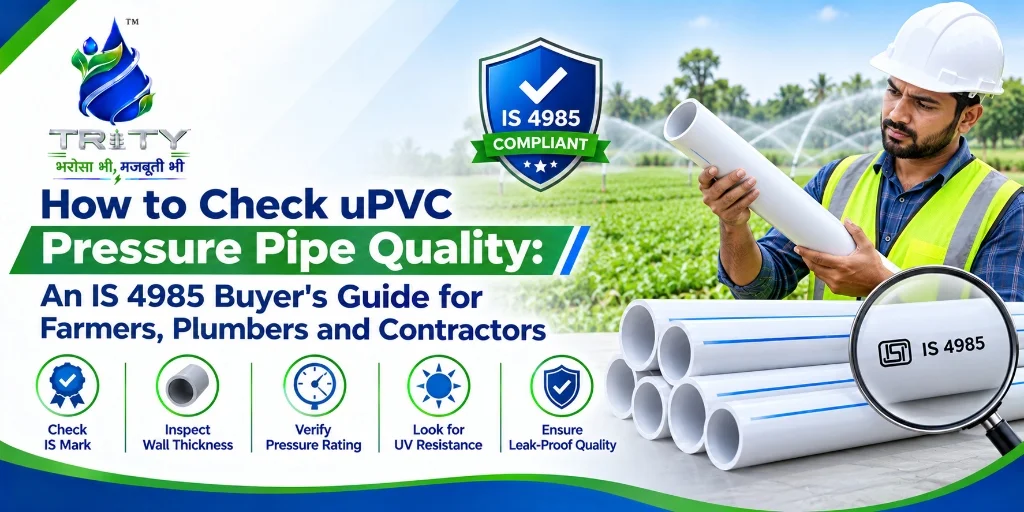
A pressure pipe has one job: to hold water at pressure without failing. Most of the time that is easy. The test comes when a pump starts, a valve closes quickly or a line sits in the sun for a season. That is when thin walls, poor compound and weak joints show up, usually as a burst in the middle of a field or a leak behind a finished wall.
The difficulty for a buyer is that weak pipe looks exactly like strong pipe. This guide gives you practical checks you can run before you buy and before you install: how to read the class marking, how to verify the BIS licence, how to judge wall thickness, what finish and weight tell you, which documents to ask for, how to test joints, and which price and supplier warnings to watch. It uses the same trust-building approach as our guides on checking conduit pipe, CPVC pipe and SWR pipe, applied to pressure pipe.
Know the standard: IS 4985
uPVC pressure pipe for water supply in India is made to IS 4985. The standard classifies pipe by working pressure at 27\u00b0C, from Class 1 to Class 6. Trity makes the full range.
| Class | Working pressure |
|---|---|
| Class 1 | 2.5 kgf/cm\u00b2 |
| Class 2 | 4.0 kgf/cm\u00b2 |
| Class 3 | 6.0 kgf/cm\u00b2 |
| Class 4 | 8.0 kgf/cm\u00b2 |
| Class 5 | 10.0 kgf/cm\u00b2 |
| Class 6 | 12.5 kgf/cm\u00b2 |
A higher class has a thicker wall for the same diameter. The class marked on the pipe tells you what pressure it is meant to hold, so a pipe marked Class 4 that behaves like Class 2 is a serious problem. Under the standard, pipe is hydrostatically tested at a multiple of its rated working pressure and must hold without bursting or leaking. Trity tests batches to that requirement before dispatch, along with wall thickness checks and reversion testing.
Check 1: Read the marking on the pipe
Genuine pressure pipe carries printed information along its length. Look for:
- The standard, IS 4985
- Nominal size
- Pressure class
- The manufacturer's name or trademark
- A batch or production code
- The ISI mark with a BIS licence number
A pipe with no class marking, or a supplier who says "heavy" or "medium" without a class number, gives you nothing to hold them to. Marking that rubs off with a thumb is another warning.
Check 2: Verify the BIS licence number
A printed ISI logo costs nothing. A valid licence does. Take the licence number from the pipe or the supplier and check it on the BIS database.
- The number exists and is valid
- It covers the relevant product, uPVC pipes for water supply
- It is current, not suspended or cancelled
- The manufacturer on the licence matches the name on the pipe
Our certifications page shows Trity's credentials, including ISO 9001:2015.
Check 3: Measure wall thickness
Wall thickness is what turns a pipe from Class 3 into Class 5, and it is where cheap pipe saves compound.
- Cut a clean cross-section and measure the wall at four or more points around the circumference with a vernier caliper
- Compare the reading with the minimum wall thickness for that diameter and class in IS 4985
- Look at consistency. A wall much thicker on one side than the other points to poor extrusion, even if the average looks right
- Measure more than one length, from more than one bundle
If you measure a wall that fits a lower class than the one marked, the pipe is mislabelled, and you should not use it for the pressure you planned.
Check 4: Weight per metre
For a given diameter and class, pipe within the standard has a predictable weight per metre. Weigh a measured length and compare it with the manufacturer's published figure. A pipe that is clearly lighter usually has a thinner wall or a poorer compound. Ask your supplier for weight per metre for the diameters and classes you are buying, and keep the figures at your store.
Check 5: Colour, surface and finish
Good pressure pipe has an even colour, a smooth inner and outer surface and a clean, dense cut face. Warning signs include streaks or patches of different colour, specks, bubbles or voids in the wall, a rough or pitted bore and a chalky residue when you rub the surface. A smooth bore matters for flow. Trity's pressure pipes carry a Hazen-Williams coefficient of C=150, which means low friction loss and lower pumping energy, and a rough bore from poor extrusion works against that.
Check 6: Raw material and potable water
Pipe that carries drinking water should be made from lead-free virgin compound. Recycled or blended material can introduce inconsistent strength and unwanted contaminants. Trity's pressure pipes are made from lead-free virgin uPVC compound. Ask any supplier to confirm the raw material in writing, particularly for drinking water lines.
Check 7: Reversion and stress
Extrusion leaves stresses in a pipe. If the pipe is not properly made, those stresses release over time as shrinkage or distortion, and joints can open. Reversion testing, which heats a sample and measures how much it shrinks, checks for this. You cannot run that test at a shop, but you can ask the manufacturer for reversion test results, and you can notice warning signs such as a pipe that is visibly bowed or twisted when it should be straight.
Check 8: UV exposure for surface pipes
Pipe that stays above ground in sun needs UV-stabilised compound. Our product page describes Trity's pressure pipes as UV stabilised for surface installations. If your line will run above ground, ask the supplier to confirm UV stabilisation in writing, and support the pipe properly with allowance for expansion.
Check 9: Test the joint
Most pressure pipe failures are joint failures. Test before you commit to a large order.
- Dry fit a pipe into a fitting. It should enter to a firm stop without forcing or looseness
- Make a test joint with the correct solvent cement, let it cure fully and try to separate it by hand
- Make sure fittings match the pipe class and size, and that they come from the same manufacturer where possible
- Use only suitable solvent cement, applied evenly, with surfaces cleaned and dried
Trity's pressure pipes are built for solvent cement jointing, and matching fittings, including elbows, tees, couplers, reducers and unions, are available. For larger sizes, ask our team about the jointing method that suits your installation.
Check 10: Ask for the documents
A reliable manufacturer provides documents without fuss. Ask for:
- The BIS licence details
- The ISO 9001:2015 certificate
- IS 4985 test reports for the product and batch, including pressure and reversion testing
- A datasheet with diameters, classes and dimensions
- A batch code that matches your delivery
Trity provides these on request for tenders and procurement files.
Price and supplier red flags
- A rate far below other suppliers for the same stated class. Our guide on uPVC pressure pipe price explains why unusually low rates usually mean thin walls or poor compound.
- No class marking or a vague description such as "heavy pipe"
- No licence number, or reluctance to share it
- No test reports or refusal to provide them
- Verbal quotes with no validity period
- Pipe sold per kilogram with no weight per metre, which hides thin walls
- Mixed brands of pipe, fittings and cement offered as one system
- No batch information, which makes a later claim impossible to trace
Test the line before you backfill
Quality checks do not stop at purchase. Before you bury or conceal a pressure line, pressure test it. Fill the line slowly, release air, bring it up to test pressure gradually and hold it, then check every joint. A test is cheap compared with digging up a buried main. Our guide on uPVC pipe for irrigation mainlines explains air valves, thrust blocks and burial, and our guide on pressure pipe sizing explains how to choose class and diameter.
A quick checklist for the store
- Marking shows IS 4985, size, class, manufacturer and batch
- BIS licence number checked on the database
- Wall thickness measured and matched to the class
- Weight per metre matches the published figure
- Colour even, surface smooth, bore clean
- Dry fit and test joint succeed
- Raw material confirmed, UV stabilisation confirmed for surface pipe
- Test reports and certificates received
- Written quotation with validity in hand
Why farmers, plumbers and contractors choose Trity pressure pipes
Trity Pipes manufactures uPVC pressure pipes to IS 4985 in Class 1 to Class 6, from lead-free virgin compound, with matching fittings and ISO 9001:2015 certification. Every batch is tested before dispatch, and our team can help you choose the class and diameter for your pump and layout, share test reports and arrange a written quotation. You are welcome to ask for documents, samples and a factory visit before placing a large order. See the full uPVC pressure pipes range.
Irrigation contractors, builders and plumbing contractors can ask for bulk and phased supply, and dealers can ask about stocking the range. For borewell projects, we also make column pipes and casing pipes.
Frequently Asked Questions
How can I tell if a uPVC pressure pipe is genuine?
Check the marking for IS 4985, size, class and batch, verify the BIS licence number, measure wall thickness against the class, compare weight per metre, inspect finish and test a joint. Ask for test reports as well.
How do I know the pressure class of a uPVC pipe?
The class should be printed on the pipe, from Class 1 to Class 6, and the wall thickness should match the class in IS 4985. If the class is missing or the measured wall does not match, do not use the pipe for the planned pressure.
Is cheap uPVC pipe safe for drinking water?
Not necessarily. Pipe for drinking water should be made from lead-free virgin compound and carry certification. A very low rate often reflects thin walls or poor compound, so ask for the raw material and test reports in writing.
What is a reversion test?
It heats a pipe sample and measures how much it shrinks, which shows whether extrusion left residual stress. A pipe that fails can distort or open joints over time, so ask the manufacturer for results.
Can Trity Pipes provide IS 4985 test reports?
Yes. Contact our team with your requirement, and we will discuss test reports, certification documents and sample lengths for evaluation, along with a written quotation.
Do I need UV-stabilised pipe for surface lines?
Yes, pipe that stays above ground in sunlight needs UV-stabilised compound. Ask the supplier to confirm it in writing, and support the pipe properly.
Want pressure pipe you can verify? Contact Trity Pipes on +91-9821030072 or +91-9319984755 for class guidance, IS 4985 documents and a quotation for ISO-certified uPVC pressure pipes from our Delhi NCR factory.