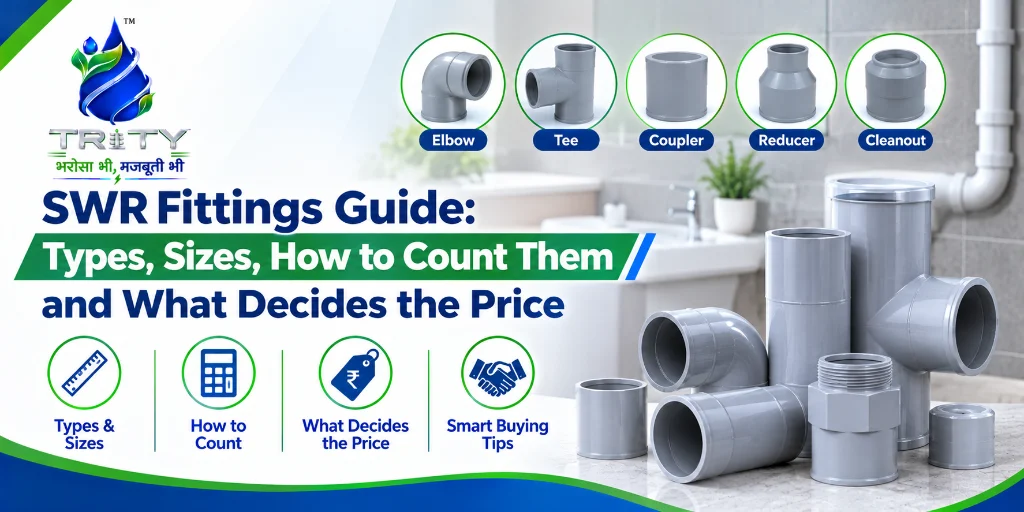
Look at a drainage plan for a bathroom block and you will see how much of it is not pipe. Every change of direction needs a bend, every branch needs a tee or junction, every fixture needs a trap or a connection, and every access point needs a cleaning fitting. On a typical job the fittings outnumber the lengths of pipe, and they cost more per piece. They are also where most leaks, smells and blockages start.
Yet fittings are the part that gets ordered last and counted least. This guide explains the main SWR fitting types and what they do, how to count them from a plan, how sizes work, what decides price, how to check fittings before use and how to order a complete set from Trity Pipes. For the pipe side, read our guides on Ringfit vs Selfit, SWR pipe price and sizing for multi-storey buildings.
Why SWR fittings deserve attention
- Fittings carry the flow changes. Water and waste slow down, turn and meet at fittings, so their shape affects blockages and noise.
- Joints are the weak points. A leak usually starts at a joint, not along a pipe.
- Fittings must match the pipe. Diameter, pipe type and joint system all have to line up.
- Fittings are a large share of the cost. A quote for pipe alone understates the project.
The main SWR fitting types
Trity makes SWR fittings to match its pipes in both Ringfit and Selfit systems. The exact list of fittings and sizes in our current range is confirmed with each enquiry, so use this section to understand what each fitting does, and ask our team what is available for your diameters.
Bends
A bend changes the direction of a line. Common angles are 87.5 or 90 degrees, and 45 degrees. A pair of 45-degree bends gives a smoother turn than one sharp 90-degree bend, which helps flow and reduces the chance of blockage on horizontal runs. Use gentler angles where you can, particularly where a line changes from vertical to horizontal.
Tees and junctions
A tee joins a branch to a main line at a right angle. A junction does the same at an angle, usually 45 degrees, which lets the branch flow into the main line smoothly. For drainage, angled junctions are generally preferred over square tees on horizontal lines, because they guide the flow and cut down turbulence. Single and double versions exist, depending on whether one or two branches join.
Reducers
A reducer connects a larger diameter to a smaller one. It is used where a main line steps down or where a branch of a different size joins. Note that, in drainage, you should not reduce the diameter in the direction of flow on a line that carries soil, because that invites blockage. Follow the design drawing.
Couplers and repair couplers
A coupler joins two lengths of pipe in a straight line. A repair or sliding coupler lets you fit a new section into an existing line without moving the pipe ends.
Traps
A trap holds a seal of water that blocks sewer gas from entering the building, and it is fitted below sinks, basins and floor outlets. Common types include floor traps, P traps and bottle traps. Our guide on SWR pipe sizing for multi-storey buildings explains how venting protects trap seals.
Access and cleaning fittings
Access doors, cleaning eyes and inspection tees let you reach a line for clearing blockages. Fit them at changes of direction, at the foot of stacks and at regular intervals on long horizontal runs, because a drainage line without access is a problem waiting to happen.
Vent fittings and caps
Vent pipes need terminals such as vent cowls, and unused openings need end caps. Rainwater lines may use specific outlet and shoe fittings.
Offsets and door bends
Door bends and offset fittings help a line pass around obstacles and structure. Use them sparingly, since every offset is an additional change in the flow path.
Sizes
SWR pipes and fittings come in diameters from 40mm to 315mm. In homes and apartments you will mostly meet 40mm and 50mm for basins, sinks and showers, 75mm and 90mm for floor traps and waste branches, and 110mm for soil stacks and WC connections. Larger diameters such as 160mm and 200mm appear in commercial buildings, basements and external drains. Fittings must match the pipe's diameter, type and joint system exactly, so order them by diameter, angle and joint type.
Ringfit and Selfit fittings
Ringfit fittings carry a rubber ring in a groove, and they push onto the pipe. Selfit fittings have plain sockets and are joined with solvent cement. A system can use both, with the right transition fittings, but each joint must be consistent with the pipe it connects. When you order, state the joint system for each line. Our guide on Ringfit vs Selfit explains where each is used.
How to count SWR fittings from a plan
A methodical count prevents shortages.
- Mark every fixture and outlet on the plan, such as WC, basin, shower, floor trap and kitchen sink.
- Trace each drainage line from the fixture to the stack or sewer.
- Add a bend at every change of direction, noting the angle.
- Add a junction or tee at every branch.
- Add a trap at each fixture that needs one.
- Add reducers where the diameter changes.
- Add couplers where one length will not reach, using the pipe length to decide.
- Add access fittings at stack bases, direction changes and long runs.
- Add vent terminals and caps for vent stacks and spare openings.
- Add rings or solvent cement according to the joint system.
- Add a few spares of the most used fittings, usually bends and junctions.
Walk the list against the plumber's own count. If they differ by a lot, find out why before ordering.
A worked example: one bathroom
Take a bathroom with a WC, a basin, a shower and a floor trap, connecting to a soil stack in a shaft behind the WC. You might count a 110mm WC connector or bend from the pan to the stack, a 110mm single junction where the waste branch meets the stack, a 50mm trap and a short 50mm pipe for the basin, a 75mm floor trap with a 75mm pipe for the shower and floor, two or three 45-degree bends where the waste line turns toward the stack, a reducer where the 75mm waste line joins the stack, a cleaning access fitting at the foot of the stack, and a couple of couplers where cut lengths join. Add the vent terminal at the top of the stack. Repeat the count for each bathroom and the kitchen, and you have a list you can send to us for a quotation.
What decides SWR fittings price
- Diameter: larger fittings use much more compound
- Type of fitting: simple couplers cost less, while junctions, traps and access fittings cost more
- Joint system: Ringfit fittings include rings and grooved sockets, Selfit fittings need solvent cement
- Wall thickness and raw material: a thicker wall and better compound cost more, and give a stronger fitting
- Dimensional accuracy: well-made tooling gives joints that seat properly
- Certification and testing: certified manufacturing under quality control costs more than uncertified
- Quantity: larger orders earn better rates
- Freight: fittings are bulky for their weight
- GST: plastic pipes and fittings attract 18 percent GST under HSN 3917
Always quote pipe and fittings together, so that you compare the full cost. Our guide on reading and comparing quotations explains the method.
How to check SWR fittings before use
- Look at the marking for the manufacturer, size and standard
- Check the finish. The surface should be smooth, with no flash, burrs, voids or short-shot areas
- Check wall thickness at bends and sockets, where thin spots hide
- For Ringfit, check that the groove is clean and the ring sits properly
- Dry fit the fitting on the pipe, and check that it seats without forcing or wobble
- Make a test joint for Selfit with the correct cement and let it cure
- Ask for documents such as test reports and the ISO certificate
Our guide on how to check SWR pipe quality covers these checks in more detail.
Common mistakes with SWR fittings
- Ordering pipe without a fittings count
- Using sharp 90-degree bends where two 45-degree bends would flow better
- Using square tees on horizontal soil lines
- Forgetting access fittings, so that lines cannot be cleared
- Mixing Ringfit and Selfit without the right transition fittings
- Mixing brands with different socket dimensions
- Skipping the water test before concealing the line
- Not leaving spares
Order the complete set from one source
Trity Pipes manufactures SWR pipes and fittings from 40mm to 315mm in Ringfit and Selfit systems, to IS 13592, with ISO 9001:2015 certification. When you send us your plan or fittings count, our team prepares a quotation for pipe and fittings together, tells you which fittings are available in your diameters and helps you choose between Ringfit and Selfit for each zone. We can share test reports and certification documents, and builders can ask for bulk or phased supply. See the SWR pipes and fittings range.
Dealers who serve plumbers can ask about stocking a full spread of fittings in the common diameters, so that plumbers find everything in one visit. Our guide on the CPVC and plumbing range dealership explains how.
Why plumbers and builders ask Trity Pipes for SWR fittings
Plumbers tell us they want fittings that match the pipe, arrive in full sets and do not leak after the floor is closed. Trity makes SWR pipes and fittings in our own plant in Ghaziabad, so the people quoting you can speak about the product and the production directly. We offer both joint systems, share certification documents and test reports on request, and can plan phased delivery for multi-unit projects. If you are a dealer, ask our team about stocking the common bends, junctions, traps and access fittings in the diameters your plumbers use most, and about how Trity Pipes supports dealers with product guidance.
Frequently Asked Questions
What fittings do I need for a bathroom drainage system?
Typically bends, junctions or tees, traps, reducers, couplers, access fittings and vent terminals, plus rubber rings or solvent cement. Count them from your plan and add a few spares.
Should I use 45-degree or 90-degree bends in drainage?
Use 45-degree bends in pairs where you can, because they give a smoother flow path than a single sharp 90-degree bend, and reduce the chance of blockage on horizontal lines.
Why use a junction instead of a tee on a drainage line?
An angled junction guides the branch flow into the main line smoothly, while a square tee creates more turbulence. Junctions are generally preferred on horizontal soil and waste lines.
Can I use Ringfit and Selfit fittings together?
Yes, with the right transition fittings. Keep one joint system within each zone, and ask your supplier which fittings you need at each transition.
Where should access fittings go?
At changes of direction, at the foot of stacks and at regular intervals on long horizontal runs, so that blockages can be cleared without cutting the line.
Can Trity Pipes quote pipe and fittings together for SWR?
Yes. Share your plan, diameters and fittings count, and our team will prepare a single quotation for the matched set and tell you which fittings are available for your project.
Need a complete drainage set? Contact Trity Pipes on +91-9821030072 or +91-9319984755 with your plan for an SWR pipes and fittings quotation from our Delhi NCR factory.