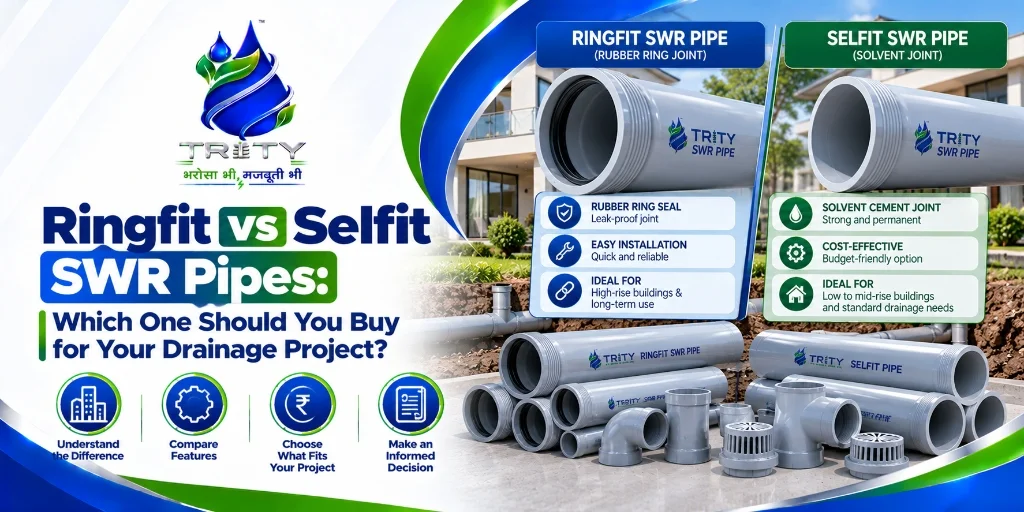
When you order SWR drainage pipe, one of the first questions a supplier asks is whether you want Ringfit or Selfit. Many buyers answer "whichever is cheaper" and discover later that the choice affects how fast the job goes, how the joints cope with building movement, whether a section can be changed later and how much the whole system really costs.
This guide is about the buying decision, not the installation steps, which our SWR installation guide covers in detail. Here you will see how the two systems differ, where each one makes sense, what each costs once you count all the parts, the mistakes that cause leaks, and how to ask Trity Pipes for a quotation that matches your project.
The short answer
Both systems are good when installed correctly, and both are made to the same standard. Trity's SWR pipes comply with IS 13592 (Parts 1 and 2). The difference is the joint.
- Ringfit uses a rubber ring in the socket. You push the pipe in, and the ring makes the seal. There is no cure time, and the joint can flex a little and be taken apart.
- Selfit uses solvent cement. The pipe and socket are chemically welded into one permanent joint.
If you want speed, flexibility and the option to change things later, Ringfit is the usual choice. If you want a permanent, rigid joint at low cost on shorter and concealed runs, Selfit is the usual choice. Most buildings use both in different places.
How the two systems differ
| Feature | Ringfit | Selfit |
|---|---|---|
| Joint | Rubber ring in a groove, pushed together | Solvent cement, chemically welded |
| Cure time | None | Needs time to cure before use |
| Flexibility | Absorbs thermal and building movement | Rigid, permanent bond |
| Disassembly | Possible without damaging parts | Not possible without cutting |
| Extra items needed | Rubber lubricant | Solvent cement |
| Typical use | Vertical stacks, underground, areas needing future change | Concealed and shorter runs, static installations |
| Skill sensitivity | Clean, square cut and correct insertion | Clean surfaces, correct cement and cure |
Trity makes both systems in diameters from 40mm to 315mm, in Type A and Type B pipe, with single and double socket options on Selfit pipes. Type A is used for ventilation and rainwater, and Type B for soil and waste discharge.
Where Ringfit makes the most sense
Vertical stacks in multi-storey buildings
A tall stack moves with temperature and building settlement. A rubber ring joint flexes slightly, so it does not take the stress that a rigid bonded joint might. Our guide on SWR pipe sizing for multi-storey buildings explains how stacks are sized and vented, and Ringfit is a common choice for the stack itself.
Underground and buried lines
Buried drainage sees ground movement and thermal cycling. A flexible joint copes with both, and Ringfit lines can be tested as soon as a section is laid, since there is no cement to cure.
Larger diameters
At larger diameters, solvent welding is harder to do well, because bigger sockets need more cement and more care. Rubber ring joints avoid that problem, and many manufacturers supply the largest sizes only in ring joint form.
Work that may change later
Because Ringfit joints can be taken apart, they suit installations where lines may be modified, such as commercial buildings with changing layouts.
Where Selfit makes the most sense
Concealed horizontal runs
For horizontal wastewater lines inside walls and floors, a permanent bonded joint is a sound choice, and the solvent cement system keeps the cost of fittings low.
Shorter connections inside bathrooms and kitchens
Final connections to fixtures, short branches and floor trap connections are often Selfit, where the layout is fixed and no one will need to take the joint apart.
Budget-sensitive projects
Selfit fittings usually cost less than Ringfit fittings because they do not need a rubber ring, so on a large housing project with many repeated bathrooms, Selfit can reduce the material cost of the branches.
The cost question: count all the parts
A Ringfit pipe costs more than a Selfit pipe of the same diameter, because the ring and the grooved socket add to the product. But the cost of a complete system includes more than the pipe.
- Ringfit: pipe, rubber rings (often supplied in the socket), lubricant and, on some systems, a higher fitting cost
- Selfit: pipe, solvent cement, cleaning cloths, and labour time to apply cement and wait for the cure
Ringfit saves labour time on site, since there is no cement to apply and no wait. Selfit saves on fitting cost. The better value depends on your labour cost, schedule and layout. Our guide on what decides SWR pipe price lists every cost factor, and it shows how to compare quotes on the same basis.
Can you mix Ringfit and Selfit in one system?
Yes, with the right fittings. A common approach is Ringfit for stacks and underground lines, and Selfit for branches. Mixing works when the pipe and fittings at each transition are designed for it, so ask your supplier which transition fittings you need. For each zone of the building, keep one system, rather than alternating joint types along a single run.
Mistakes that cause leaks
With Ringfit
- A rough or angled cut. The pipe must be cut square and the spigot end chamfered, or the ring can roll or cut during insertion.
- Dirty sockets and rings. Dirt, grease or moisture stops the ring from seating.
- No lubricant. Rubber lubricant helps the pipe go in smoothly. Without it, the ring can twist.
- Pushing the pipe fully home. Leave a small gap for thermal expansion, as the manufacturer instructs.
With Selfit
- Not cleaning and drying the surfaces, or not roughening lightly where needed
- Too little cement or uneven cement
- Not holding the joint briefly while it sets
- Using the drain before the joint has cured
- Using the wrong cement for the pipe material
Whichever system you choose, test the lines before concealing them, and keep the installation records.
How to choose for your project
Use these questions.
- Is the line vertical, horizontal or underground? Vertical and underground favour Ringfit, concealed horizontal favours Selfit.
- What diameter is it? Larger diameters favour Ringfit.
- Will the layout change? If yes, choose Ringfit.
- What is the labour and schedule situation? Tight schedules favour Ringfit, while tight budgets on repeated layouts favour Selfit.
- What does the consultant or specification say? Follow it, and ask for approval if you want to propose a change.
A simple plan for many buildings: Ringfit Type B for the soil stack, Ringfit Type A for ventilation and rainwater stacks, Selfit for concealed branches and fixture connections.
What to ask for in an SWR quotation
Whichever system you choose, specify the following so that every quote is comparable.
- Diameter, Type A or Type B, and the joint system for each line
- Whether rubber rings or lubricant are included, or whether solvent cement is included
- The fittings you need, with quantities, such as bends, tees, junctions, traps and access fittings
- Standard and certification, with the BIS licence number
- Delivery location, schedule and any phasing
- Validity of the rate and payment terms
Our guide on how to read and compare quotations uses conduit as its example, but the same method works for SWR.
What Trity Pipes offers
Trity Pipes manufactures SWR pipes and fittings in both Ringfit and Selfit systems, from 40mm to 315mm, made to IS 13592, with ISO 9001:2015 certification and high-grade raw materials. Our product page describes our SWR pipes as UV stabilised, with smooth bores for steady flow, and our team can help you decide where each system fits in your drainage plan. We supply matching fittings, so that the whole system can come from one manufacturer, and we can share certification documents with your quotation. See the full SWR pipes and fittings range.
Builders and contractors can ask for bulk or phased supply for multi-unit projects, and plumbing dealers can ask about stocking both systems. If your project also needs water supply lines, we make CPVC pipes and fittings and uPVC pressure pipes.
A simple example: choosing for a ten-storey apartment block
Imagine a ten-storey residential block with four flats per floor. The soil and waste stacks run the full height of the building, the bathrooms have short branches to the stack, and the building has a ground-level drain to the sewer. A practical plan could use Ringfit Type B for the soil stack, so that movement and expansion over the height are absorbed by the rubber rings, Ringfit Type A for the ventilation and rainwater stacks, Selfit for the concealed bathroom branches where the layout is fixed, and Ringfit for the underground drain at ground level. This kind of split uses each system where it works best and keeps the cost of fittings under control across forty identical bathrooms.
Ordering Ringfit and Selfit from Trity Pipes
Trity Pipes makes both systems in our own plant, so one conversation with our team covers the whole drainage plan. Send us your stack and branch layout, and we will suggest where Ringfit and Selfit fit, list the pipe types and fittings, and prepare a single quotation. Contractors can ask about phased supply floor by floor, and dealers can ask about stocking both systems so that plumbers get what they need in one visit. Delivery from our Delhi NCR facility reaches 20-plus states, with timing confirmed in each quotation.
Frequently Asked Questions
What is the difference between Ringfit and Selfit SWR pipes?
Ringfit pipes are joined with a rubber ring pushed into a grooved socket, while Selfit pipes are joined with solvent cement into a permanent bond. Ringfit is flexible and can be taken apart, and Selfit is rigid and permanent.
Which is better for a multi-storey building stack?
Ringfit is commonly used for vertical stacks, because the rubber ring joint absorbs thermal movement and building settlement. Confirm against your specification and consultant's requirements.
Is Selfit cheaper than Ringfit?
Selfit fittings usually cost less, since there is no rubber ring, but Selfit needs solvent cement and cure time. Compare the cost of the whole system, including labour and schedule, not just the pipe.
Can I use Ringfit and Selfit together?
Yes, with the right transition fittings. A common plan is Ringfit for stacks and underground lines, and Selfit for concealed branches. Keep one system within each zone.
What is the difference between Type A and Type B SWR pipe?
Type A is for ventilation and rainwater lines, and Type B is for soil and waste discharge. They differ in wall thickness and application, so check the type on every line of a quotation.
Does Trity Pipes supply both Ringfit and Selfit SWR pipes?
Yes. We manufacture both systems from 40mm to 315mm with matching fittings. Share your drainage plan with our team and we will recommend where to use each one and prepare a quotation.
Planning a drainage project? Contact Trity Pipes on +91-9821030072 or +91-9319984755 for an SWR pipes and fittings quotation, with Ringfit or Selfit as your project needs, from our Delhi NCR factory.