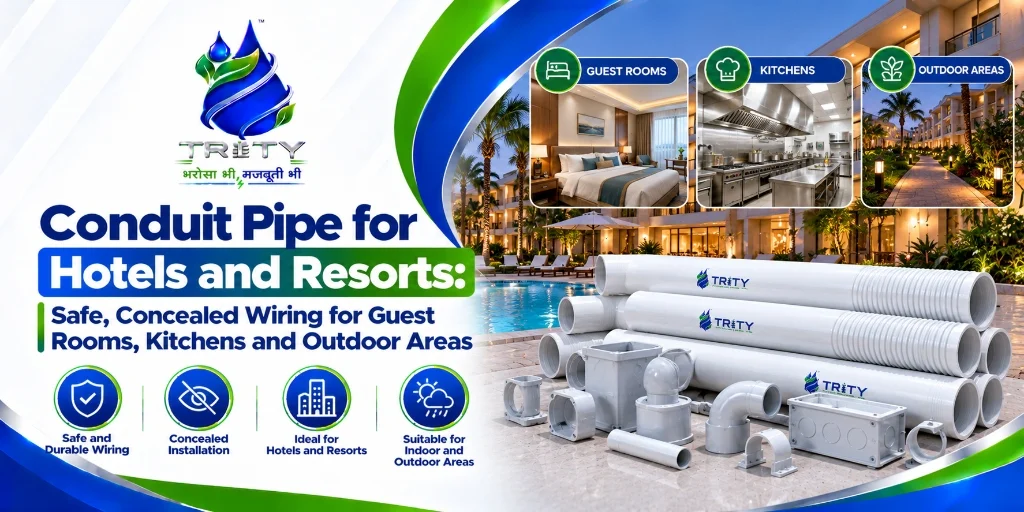
A hotel is a building that has to look effortless and work perfectly, all day and all night. Guests expect lighting that responds, air conditioning that holds, sockets where they need them and no sign of the wiring behind it. Behind that comfort is a dense electrical system: hundreds of repeated guest-room circuits, heavy loads in kitchens and laundries, large public areas with decorative lighting, outdoor landscape and pool circuits, and a fire safety design that must not fail.
Conduit pipe is the first layer of protection for all of this wiring. This guide explains how conduit should be specified across a hotel or resort: which grade and size suit guest rooms, corridors, kitchens, banquet halls and outdoor areas, how to handle fire safety, how to plan refurbishment room by room, how to deal with heritage properties, and how to organise supply for a hospitality project.
What makes hotel wiring different
- Many identical rooms. A specification mistake is repeated in every room, so getting it right once is worth a great deal.
- High occupancy around the clock. Guests sleep, cook, bathe and work in the building, so safety standards are high and downtime is costly.
- Heavy and varied loads. Air conditioning, lighting, in-room electronics, kitchens, laundries and pools put very different demands on circuits.
- Visible finish. Wiring has to be concealed so that rooms look clean, and surface conduit has to be neat where it cannot be hidden.
- Frequent refurbishment. Hotels refresh rooms every few years, so wiring must be accessible and changes must be easy to make.
- Climate and location. Resorts in hot, humid or coastal places, and hotels in hills, face different conditions.
Concealed wiring in guest rooms and corridors
Guest rooms and corridors are almost always wired with conduit concealed inside walls and above false ceilings, which keeps cables hidden, protected and out of reach. For new construction, concealed MMS grade conduit is the usual choice for walls and slabs, with HMS where the conduit passes through areas of heavier mechanical risk. Our guide on concealed and surface wiring explains the trade-offs.
Planning the guest room circuits
A modern guest room typically needs separate circuits for lighting, sockets, air conditioning, the bathroom and any in-room controls. Plan conduit sizing with spare capacity, because guest expectations grow, and rooms get extra sockets, USB points and smart controls over time. Our conduit pipe size chart helps you match conduit size to cable fill.
Corridors and service areas
Corridors carry feeders and branch circuits to many rooms, and they are often above false ceilings, where access for maintenance matters. Keep conduit routes organised, label them and leave enough clearance for future work.
Kitchens, laundries and back-of-house
Back-of-house areas are harder on wiring than guest areas.
- Heat and steam in kitchens and laundries
- Washdown and moisture, which calls for sealed boxes and fittings
- Mechanical damage from carts, trolleys and equipment
- Heavy appliance loads that need dedicated circuits
Use HMS grade conduit, fixed securely, with sealed boxes in wet or washed areas. Surface mounting is often practical in back-of-house, because it is easier to inspect and repair, and finish matters less than in guest areas. Keep conduit away from direct heat sources.
Banquet halls, lobbies and public areas
Large public spaces have decorative and architectural lighting, audio-visual systems and many circuits. Plan conduit capacity for future lighting changes and add separate conduits for low-voltage and data cabling so that power and signal are kept apart. High ceilings and decorative features can make access difficult, so plan routes with maintenance in mind.
Outdoor lighting, pools and landscape
Resorts have extensive outdoor circuits for pathways, gardens, pools, driveways and facades. Outdoor conduit faces sun, moisture and soil.
- Underground runs should have adequate depth, mechanical protection and a marker above the line. See our guide on underground conduit pipe for cable protection.
- Exposed runs need UV stabilised conduit, sealed boxes and secure fixing. See our guide on UV resistant conduit for outdoor wiring.
- Pool areas have strict safety needs for wiring and earthing, so follow the specification and your consultant's advice closely.
- Coastal and humid resorts need sealed fittings and attention to corrosion on metal items. Salt-laden air attacks metal boxes and fixings, while uPVC conduit itself does not corrode.
Fire safety in hotels
Hotels are high-occupancy buildings where guests may be asleep and unfamiliar with the layout, so fire safety is a major part of the design. Fire safety requirements in India sit within NBC 2016 Part 4, which most states still apply, while NBCS 2026 Part F is advisory until a state adopts it. Confirm which one applies to your project with your consultant and fire authority.
In practice, for conduit this means:
- Flame retardant, low-smoke conduit and cables as the baseline. Our guide on fire resistant conduit pipe explains how this performance is judged.
- Fire stopping at every penetration through fire-rated floors and walls, so that conduit runs do not provide a path for fire and smoke. Our guide on riser shaft conduit for multi-storey buildings covers fire stopping and expansion in vertical shafts.
- Separate circuits for life-safety systems such as emergency lighting and fire alarms, with routing that protects them
- Documentation that shows the material meets the specification
Heritage hotels and refurbishment
Many Indian hotels are in heritage buildings or in old structures being converted. Chasing walls in old masonry can cause damage, so surface-mounted conduit is often the practical choice, laid neatly in corners, along cornices and in concealed channels. In refurbishment projects, plan the work room by room or floor by floor, so that the hotel can keep some rooms open. Our guide on rewiring an old house explains the same thinking for retrofits, including phasing and earthing.
Sizing and grade by area
| Area | Wiring method | Suggested grade |
|---|---|---|
| Guest rooms | Concealed in wall and slab | MMS |
| Corridors and false ceilings | Concealed or protected | MMS, HMS where exposed |
| Kitchens, laundries, back-of-house | Surface or concealed | HMS |
| Banquet halls and lobbies | Concealed | MMS |
| Basements, plant rooms, parking | Surface, exposed | HMS |
| Outdoor, landscape, underground | Exposed or buried | HMS, UV stabilised where exposed |
| Rooftop solar | Exposed | HMS, UV stabilised |
This is a starting point, and your specification and consultant's requirements take priority. Our LMS, MMS and HMS guide explains the grades.
Rooftop solar and efficiency upgrades
Many hotels now add rooftop solar to cut energy costs. Our guide on conduit pipe for solar panel wiring explains how to protect DC and AC cabling on roofs, which fits well into a hotel's upgrade plan.
Planning supply for a hospitality project
Hotel projects are phased, and delays on the electrical side can hold up the opening.
- Finalise the conduit specification early so approvals do not hold up the programme
- Order for repeated rooms in one batch where possible, so pipe and finish match across floors
- Plan phased delivery that follows floor-by-floor progress
- Order fittings with the pipe, including bends, couplers, boxes and saddles
- Keep a buffer of common sizes for changes during fit-out
Consultants and owners often require documentation before material is installed. Our guide on material approval submittals for conduit pipe explains what to prepare, and our guide on estimating conduit pipe in a BOQ explains how to measure and price conduit for a project of this kind.
Why hotels and resorts choose Trity Pipes
Trity Pipes is a manufacturer of uPVC conduit pipes and fittings made from lead-free, high-grade virgin raw materials, certified to IS 9537 Part 3 with ISO certification. For hospitality projects, we offer:
- LMS, MMS and HMS grades so each area of the property gets the right strength
- Matching fittings, from one manufacturer, so joints fit properly across hundreds of rooms
- Certification documents and technical data for owner and consultant approvals, on our certifications page and on request
- Project quotations with clear rate validity and phased delivery for floor-by-floor programmes
- Technical guidance on grade, sizing and installation for kitchens, outdoor areas and heritage buildings
- A plant in Delhi NCR and a network of more than 250 distributors and 1,500 dealers across 20-plus states for supply near your property
View the full uPVC conduit pipes and fittings range and ask our team for the Trity Pipes price list or a quotation for your project.
A phased plan for a hotel refurbishment
A common refurbishment plan runs floor by floor so that the hotel can keep earning. Start by surveying the existing wiring and recording what stays and what goes. Agree the conduit specification and have it approved before work starts. Take one floor out of service at a time, install new conduit, test and close up, then move to the next floor. Keep a small stock of common sizes and fittings on site, and keep batch records for each floor. Trity can supply matching material for every phase from one batch where possible, so that pipe and fittings look and fit the same across the building.
Working with Trity Pipes on a hospitality project
Hotel owners, interior and MEP consultants and electrical contractors can approach us at the design stage or at procurement. Share the room count, the areas to be wired, the conduit sizes and grades you expect and the programme. Our team will discuss grade selection for guest rooms, kitchens, outdoor areas and heritage structures, prepare a written quotation with rate validity and delivery basis, and share certification documents for approvals. For group projects with several properties, we can discuss a standard specification and repeat supply, so that every property gets the same product. Hospitality dealers and contractors who serve hotels regularly can also ask about a dealership or distribution arrangement.
Frequently Asked Questions
Which conduit grade is best for hotel guest rooms?
MMS (Medium Mechanical Stress) grade is the usual choice for concealed wiring in guest rooms and corridors. Use HMS in kitchens, laundries, basements, plant rooms and outdoor areas where mechanical risk is higher.
Should hotel wiring be concealed or surface mounted?
Guest areas are normally concealed for a clean finish and safety. Back-of-house areas and heritage buildings often use surface mounting, because it is easier to inspect and causes less damage to old walls.
Does hotel conduit need to be fire resistant?
Hotels are high-occupancy buildings, and flame retardant, low-smoke wiring and fire stopping at penetrations are generally expected. Confirm the exact requirements for your state and project with your consultant and fire authority.
How do I plan conduit for a room-by-room hotel renovation?
Plan the work floor by floor or room by room so that part of the property can stay open, order matching material in one batch, and use surface conduit where chasing old walls is not practical.
What conduit is suitable for resort landscape and pool lighting?
Underground runs need adequate depth and mechanical protection, and exposed runs need UV stabilised conduit and sealed boxes. Pool areas have strict safety requirements, so follow your consultant's specification.
Can Trity Pipes supply conduit for a hotel project in phases?
Yes. Share your sizes, grades, quantities and programme, and our team will prepare a quotation with the rate validity and a phased delivery plan that matches your construction schedule.
Planning a hotel or resort project? Contact Trity Pipes on +91-9821030072 or +91-9319984755 for a project quotation, certification documents and a phased supply plan for ISO-certified uPVC conduit pipe from our Delhi NCR factory.