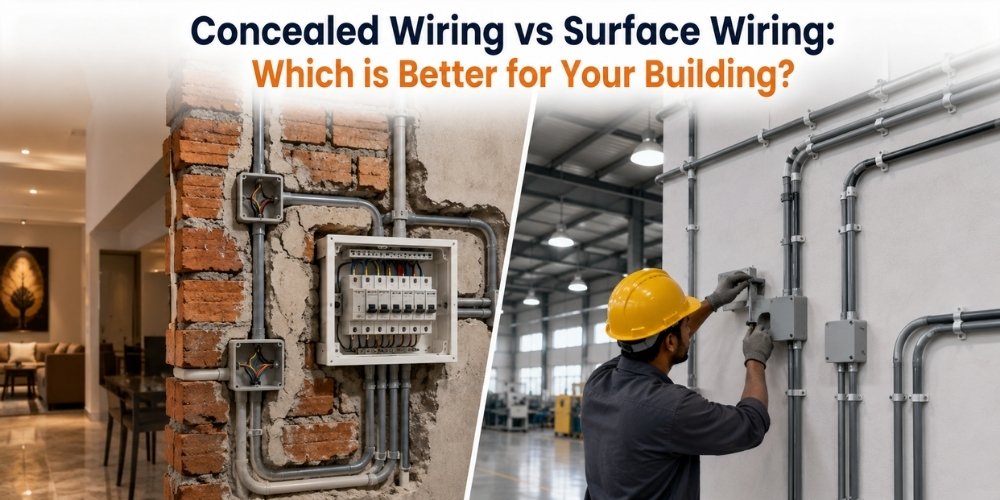
Introduction: The Wiring Decision That Affects Your Building for Decades
Every builder, homeowner, and electrical contractor in India faces the same question at the start of a project: should you go with concealed wiring or surface wiring?
It sounds like a simple choice, but the decision you make during construction will affect your building's safety, appearance, maintenance costs, and resale value for the next 25–30 years. Get it right and you never think about it again. Get it wrong and it becomes an expensive problem buried inside your walls.
This guide breaks down both wiring methods in full detail — how each works, where each wins, what it will cost you in India in 2026, and which conduit pipe you must use for each application.
What is Concealed Wiring?
Concealed wiring, also called hidden wiring or internal wiring, is an electrical installation method where insulated cables run through rigid conduit pipes that are embedded inside walls, ceilings, floors, or RCC slabs. Once construction is complete, the conduit and wiring are completely hidden behind plaster, paint, or false ceilings.
This is the default wiring method for all modern residential buildings, apartments, villas, offices, hospitals, hotels, and commercial complexes across India. When you look at a finished room with switchboards on the wall and no pipes in sight — that is concealed wiring at work.
How Concealed Wiring Works
The conduit pipes are laid inside wall chases (cut grooves in masonry), embedded in RCC slabs during concrete pouring, or run through hollow false ceiling cavities. Insulated cables are then pulled through these pipes after the civil work is complete. Junction boxes are installed at switching points and outlet positions. The pipes remain permanently embedded. Only the switch plates, sockets, and distribution board are visible.
Step-by-Step Installation Process for Concealed Wiring
Step 1 — Layout Planning: Electrician marks the complete wiring layout on walls and ceilings, identifying routes for conduit runs, junction box positions, switch and socket locations, and DB (distribution board) placement.
Step 2 — Chasing: Walls are chased (grooved) using a chasing machine or angle grinder to a depth and width that accommodates the conduit pipe diameter, typically 20mm, 25mm, or 32mm.
Step 3 — Conduit Laying: ISI-marked uPVC conduit pipes are laid in the chases and secured with conduit clips. Bends and elbows are used at direction changes. Junction boxes are fitted at connection points.
Step 4 — Concrete and Plastering: For slab conduits, pipes are tied to reinforcement bars before concrete is poured. Wall conduits are plastered over once laid and inspected.
Step 5 — Cable Pulling: After plastering is cured, electricians pull insulated cables through the embedded conduit using a fish wire or cable-pulling lubricant.
Step 6 — Termination and Testing: Cables are terminated at switch boxes, sockets, and the DB. The entire circuit is tested for continuity, insulation resistance, and earthing before switchgear is connected.
What is Surface Wiring?
Surface wiring, also called open wiring or surface conduit wiring, is an electrical installation method where conduit pipes carrying insulated cables are mounted on the outer surface of walls, ceilings, or structural columns — fully visible and accessible at all times.
Surface wiring is commonly used in factories, warehouses, industrial plants, commercial kitchens, server rooms, old buildings undergoing electrical upgrades, and any project where cutting into walls is not practical or cost-effective.
How Surface Wiring Works
Conduit pipes are fixed to wall or ceiling surfaces using saddle clamps, pipe clips, or conduit straps at regular intervals (typically every 600mm to 1000mm). Conduit fittings — bends, junction boxes, inspection bends — are used at routing changes and inspection points. The cables run inside the conduit, which is fully accessible without any civil work.
Step-by-Step Installation Process for Surface Wiring
Step 1 — Route Planning: Electrician marks the conduit route on walls and ceiling, keeping lines straight, parallel to building edges, and away from water pipelines or heat sources.
Step 2 — Saddle Fixing: Conduit saddles or clips are drilled and fixed to the wall surface at the required spacing.
Step 3 — Conduit Assembly: Rigid uPVC conduit pipes are cut to length, assembled with bends and couplers as required, and clipped into the saddles.
Step 4 — Junction Box Installation: Surface-mount junction boxes are fixed at all branching points, bends exceeding the conduit's pull capacity, and inspection access points.
Step 5 — Cable Pulling: Cables are pulled through the assembled conduit system and terminated at junction boxes, MCBs, sockets, and equipment panels.
Step 6 — Testing: Circuit testing is carried out as per IS 732 — Indian Standard for electrical installation — before the system is commissioned.
Concealed Wiring: Advantages and Disadvantages
Advantages
- Superior aesthetics: Walls are completely clean, no pipes or clips visible. This is critical for residential projects, hotels, hospitals, and any space where interior design matters.
- Better protection: Cables embedded inside walls and slabs are protected from physical damage, accidental impact, rodents, and UV degradation.
- Fire safety: A properly installed concealed conduit system using fire-retardant uPVC pipes significantly slows the spread of fire along cable runs.
- Longer lifespan: Concealed systems, when installed correctly with ISI-marked conduit, can last 25–40 years without intervention.
- Higher property value: Buyers and tenants consistently prefer and pay more for properties with concealed wiring.
- Reduced maintenance: Once installed, a correctly done concealed system requires virtually no ongoing maintenance.
Disadvantages
- Higher initial cost: Chasing, extra civil work, plastering, and higher-quality conduit increase upfront costs.
- Difficult repairs: Locating and accessing a fault inside a wall requires controlled wall-breaking. Without accurate as-built drawings, this can be destructive and costly.
- Not suitable for retrofits: Adding new circuits in an existing fully plastered building is expensive and messy.
- Installation quality is critical: Mistakes during concealed installation are hidden and cannot be corrected without major civil work.
Surface Wiring: Advantages and Disadvantages
Advantages
- Lower installation cost: No chasing, no additional plastering. Labour time is significantly reduced.
- Easy access for repairs: Any fault can be located and fixed quickly without touching walls or ceilings.
- Ideal for retrofits: Adding circuits to an existing building is straightforward and low-cost.
- Fast installation: Surface conduit can be installed and commissioned much faster than concealed wiring.
- Easy expansion: New circuits can be added at any time by extending surface conduit runs.
Disadvantages
- Aesthetics: Pipes and clips on walls are not acceptable in most residential or hospitality settings.
- Physical vulnerability: Surface conduit can be damaged by accidental impact in busy industrial or public areas if not properly protected.
- Dust accumulation: Horizontal surface conduit runs accumulate dust, a maintenance concern in food processing and pharmaceutical facilities.
- Lower property value: Residential buyers in India typically discount properties with surface wiring.
Detailed Comparison: Concealed Wiring vs Surface Wiring
| Parameter | Concealed Wiring | Surface Wiring |
|---|---|---|
| Appearance | Clean, invisible, premium finish | Pipes visible on walls and ceilings |
| Safety | High — cables fully enclosed and protected | Moderate — pipes exposed to physical damage |
| Installation Difficulty | High — requires chasing, civil coordination | Low — clip and run on finished surface |
| Initial Cost | Higher | Lower |
| Long-Term Maintenance | Very low | Low to moderate |
| Durability | 25–40 years | 15–25 years (UV exposure in outdoor areas) |
| Fire Protection | Excellent with fire-retardant conduit | Good with fire-retardant conduit |
| Moisture Resistance | Excellent — fully sealed in wall | Good — but condensation risk in humid areas |
| Expansion Possibilities | Limited — requires civil work | Easy — extend surface runs anytime |
| Repair Accessibility | Difficult — wall breaking required | Easy — open conduit access |
| Property Value | Significantly higher | No positive impact, possible negative |
| Lifespan | 25–40 years | 15–25 years |
| Best Applications | Residential, hospitality, hospitals, offices | Industrial, warehouses, retrofits, temporary |
Concealed Conduit Wiring: Practical Advantages with Indian Examples
In a 3BHK apartment in Noida or Gurugram: The entire wiring system — from the main DB at the entrance to every bedroom, kitchen, and bathroom — runs through 20mm and 25mm ISI-marked uPVC conduit pipes embedded in the RCC slab and masonry walls. The finished flat looks completely clean. No pipe, no clip, no junction box is visible. The buyer pays ₹70–90 lakh and expects exactly this.
In a hospital in Delhi NCR: Concealed wiring through proper conduit in patient areas keeps cables away from moisture, chemicals, and the risk of physical damage from medical equipment. The National Building Code of India (NBC 2016) recommends this for all patient care areas.
In a 5-star hotel in Mumbai or Bengaluru: Fire-retardant uPVC conduit in concealed wiring slows fire propagation and protects the cable insulation. This is non-negotiable for NFPA and NBC compliance in the hospitality sector.
For detailed specifications of the conduit pipes used in these installations, refer to our uPVC Electrical Conduit Pipes & Fittings product page.
When Surface Conduit Wiring is the Better Choice
Surface wiring is not a compromise — in the right setting, it is the most practical and cost-efficient solution available.
Factories and manufacturing plants: In an automotive component factory in Manesar or a textile mill in Ludhiana, production layouts change frequently. Surface conduit allows electricians to extend, reroute, or add circuits without shutting down production lines or breaking floors.
Warehouses and logistics centres: Large-span warehouse roofs use surface conduit to run lighting and power circuits. The exposed structure makes surface mounting the only viable approach.
Retrofit projects: An old residential building in Delhi's Lajpat Nagar being converted to a commercial office cannot have its brick walls chased without compromising structural integrity. Surface conduit is the answer.
Commercial kitchens and food processing units: Moisture, steam, and regular high-pressure cleaning make concealed systems impractical. Surface conduit with IP-rated junction boxes is the standard here.
Temporary structures and site offices: Construction site offices, event pavilions, and temporary commercial structures use surface wiring because the installation must be reversible.
Rental properties requiring quick turnaround: Surface wiring reduces installation time significantly, allowing faster tenanting.
Which Conduit Grade is Right for Your Application?
Conduit pipes are classified as Light Duty, Medium Duty, and Heavy Duty under IS 9537 Part 3. Understanding which grade to use prevents both under-specification (safety risk) and over-specification (unnecessary cost).
| Conduit Grade | Wall Thickness | Best For |
|---|---|---|
| Light Duty | Thinnest | False ceiling runs, dry surface wiring in offices and homes where pipes are not exposed to impact |
| Medium Duty | Standard | Concealed wiring in residential and commercial buildings — the most commonly specified grade in India |
| Heavy Duty | Thickest | Industrial surface wiring, underground conduit, exposed outdoor runs, factory floors subject to mechanical stress |
For detailed sizing guidance, our Conduit Pipe Size Chart covers every standard diameter from 20mm to 50mm with application-specific recommendations.
Why IS 9537 Part 3 Compliance is Non-Negotiable for Concealed Wiring
IS 9537 Part 3 is the Bureau of Indian Standards specification for rigid plain conduits made of insulating material used in electrical installations. It defines the minimum requirements for dimensional accuracy, wall thickness, impact resistance, heat resistance, fire propagation performance, and bending capacity of uPVC conduit pipes.
For concealed wiring specifically, IS 9537 Part 3 compliance is not optional for three reasons:
1. You cannot inspect it once the walls are sealed. A substandard conduit embedded in RCC can crack, deform, or collapse under load — trapping cables and causing insulation damage that is invisible until an electrical fault or fire occurs.
2. Central Electricity Authority (CEA) regulations require it. The CEA Regulations on Measures Relating to Safety and Electric Supply specify that all fixed wiring installations must use materials conforming to relevant BIS standards.
3. Insurance and liability. Buildings wired with non-ISI conduit face complications in fire insurance claims and electrical inspection sign-offs from municipal authorities across India.
All Trity Pipes uPVC conduit pipes are manufactured in full compliance with IS 9537 Part 3 and carry ISI certification. Our full certification documentation is available on our Certifications page.
For a deep-dive on what IS 9537 Part 3 actually tests and why it matters for every electrician in India, read our detailed guide: What is IS 9537 Part 3?
Realistic Cost Comparison for a 1,000 Sq Ft Home in India (2026)
The following estimates are indicative for a standard 2BHK/3BHK apartment or independent house of approximately 1,000 sq ft in a Tier-1 city in India (Delhi NCR, Mumbai, Bengaluru) in 2026. Actual costs vary significantly based on city, contractor, conduit brand, electrical load, number of points, panel capacity, and project complexity.
| Cost Component | Concealed Wiring | Surface Wiring |
|---|---|---|
| Conduit Pipe & Fittings | ₹18,000–₹28,000 | ₹10,000–₹16,000 |
| Cable (copper, IS-marked) | ₹30,000–₹45,000 | ₹30,000–₹45,000 |
| Switchgear & MCBs | ₹12,000–₹20,000 | ₹12,000–₹20,000 |
| Labour | ₹25,000–₹40,000 | ₹15,000–₹22,000 |
| Civil Work (chasing + plastering) | ₹8,000–₹15,000 | NIL |
| Total Installation Cost | ₹93,000–₹1,48,000 | ₹67,000–₹1,03,000 |
| 10-Year Maintenance Cost | ₹2,000–₹5,000 | ₹5,000–₹12,000 |
| Estimated Lifespan | 25–40 years | 15–25 years |
Prices are indicative estimates for planning purposes. Get actual quotes from licensed electrical contractors in your city before budgeting.
The higher upfront cost of concealed wiring is typically recovered within 5–7 years through lower maintenance, higher property value, and reduced energy loss from a properly protected wiring system.
Building-Wise Wiring Recommendation
| Building Type | Recommended Wiring Method | Conduit Grade |
|---|---|---|
| Apartments | Concealed | Medium Duty |
| Villas | Concealed | Medium to Heavy Duty |
| Independent Houses | Concealed | Medium Duty |
| Offices | Concealed (main runs) + Surface (raised floors) | Medium Duty |
| Hospitals | Concealed | Heavy Duty |
| Schools | Concealed | Medium Duty |
| Hotels | Concealed | Heavy Duty |
| Shopping Complexes | Concealed (retail areas) + Surface (back-of-house) | Medium to Heavy |
| Warehouses | Surface | Heavy Duty |
| Factories | Surface | Heavy Duty |
| Temporary Structures | Surface | Light to Medium Duty |
Common Mistakes to Avoid During Conduit Installation
1. Using Non-ISI Conduit The single biggest mistake in electrical installations across India. Cheap, unbranded conduit pipes without ISI certification have inconsistent wall thickness, poor fire resistance, and brittle joints. Once inside your walls, you have no way to know until something fails. Always verify the ISI mark and IS 9537 Part 3 compliance before procurement.
2. Using the Wrong Conduit Size Under-sizing conduit makes cable pulling impossible and overheats wires over time. Over-sizing wastes material and creates loose cable movement. Use a proper cable fill calculation and refer to the Conduit Pipe Size Chart before specifying conduit diameters.
3. Too Many Bends in One Run More than two 90° bends (or equivalent total 180°) between junction boxes creates a cable pull that is physically impossible without damaging insulation. Plan your conduit routing to keep bend angles to a minimum per run.
4. Poor Junction Box Planning Junction boxes must be placed at every branching point and every run exceeding 10–12 metres (or as per site condition). Skipping junction boxes to save cost creates inaccessible cable splices inside conduit — a serious safety and maintenance failure.
5. Improper Earthing All metal accessories, distribution boards, and equipment enclosures must be properly earthed as per IS 3043. Skipping or inadequate earthing is one of the leading causes of electrical fatalities in Indian buildings.
6. Using Cheap Conduit Accessories The conduit system is only as strong as its weakest fitting. Low-quality bends crack, couplers leak, and junction boxes deform under mechanical load. Use accessories from the same manufacturer as the conduit pipe to ensure dimensional compatibility. Our complete guide to uPVC conduit fittings covers every fitting type with selection criteria.
7. Mixing Power and Communication Cables in the Same Conduit Running 230V power cables alongside data, telephone, or control cables in the same conduit causes electromagnetic interference and violates IS 732 separation requirements. Use dedicated conduit runs for each system.
8. No Future Expansion Planning Install at least one empty spare conduit of the same diameter on every main run and between every DB and junction location. The cost of an empty pipe during construction is negligible. The cost of adding a new circuit later — through finished walls and ceilings — is not.
Frequently Asked Questions
Q1. What is the main difference between concealed wiring and surface wiring?
Concealed wiring runs inside walls, slabs, and ceilings through embedded conduit pipes that are permanently hidden behind plaster or false ceilings. Surface wiring runs inside conduit pipes that are mounted on the outside of walls and ceilings, remaining fully visible and accessible. The key differences are aesthetics (concealed looks far better), accessibility (surface is easier to repair), and cost (surface is cheaper to install initially).
Q2. Which wiring method is better for a home in India?
For any new residential construction — apartments, villas, or independent houses — concealed wiring is strongly recommended. It provides a clean finish, better cable protection, higher property value, and a longer lifespan. Surface wiring is not appropriate for residential spaces in India except in utility areas like meter rooms, stairwells, or basements.
Q3. Is concealed wiring more expensive than surface wiring?
Yes, the initial installation cost of concealed wiring is 25–40% higher than surface wiring for the same building, primarily due to wall chasing, higher-grade conduit, and extra civil work. However, concealed wiring has a lower lifetime maintenance cost and significantly higher impact on property resale value, making it the better long-term investment.
Q4. What type of conduit pipe is used for concealed wiring in India?
Rigid uPVC conduit pipes complying with IS 9537 Part 3 (Bureau of Indian Standards) are the standard for concealed wiring in India. These must carry an ISI mark. Medium Duty grade is appropriate for most residential and commercial concealed installations. Heavy Duty is specified for industrial concealed runs and underground applications.
Q5. Can surface wiring be converted to concealed wiring later?
Yes, but it is expensive. Converting surface wiring to concealed in a finished building requires chasing walls, embedding conduit, pulling new cables, and replastering. This is a major civil-plus-electrical renovation. It is far more cost-effective to plan for concealed wiring during original construction.
Q6. What does IS 9537 Part 3 mean for conduit pipes?
IS 9537 Part 3 is the Bureau of Indian Standards specification that governs rigid plain conduits made from insulating material (uPVC) used in electrical installations. It defines minimum standards for wall thickness, outer diameter tolerance, impact resistance, heat deflection, fire propagation, and bending capacity. Any conduit used in a fixed electrical installation in India — especially concealed — should comply with this standard and carry an ISI mark.
Q7. Which conduit pipe size is right for home wiring?
For standard residential circuits (lighting and 6A power circuits), 20mm conduit is typically used. For 16A circuits and higher (air conditioners, geysers, water pumps), 25mm conduit is recommended. Main distribution board feeder runs may require 32mm or 40mm conduit depending on cable size. Refer to the Conduit Pipe Size Chart for a complete reference table.
Q8. Is surface wiring safe for factories and industrial buildings in India?
Yes. Surface conduit wiring using ISI-marked Heavy Duty uPVC conduit pipes is the standard wiring method for factories, warehouses, and industrial plants. It allows easy circuit inspection, fast fault location, and flexible expansion — all critical in industrial environments. Using Heavy Duty conduit provides the mechanical protection needed on factory floors.
Q9. What happens if non-ISI conduit is used in concealed wiring?
Non-ISI conduit may have inconsistent wall thickness, poor impact resistance, inadequate fire retardancy, and dimensional mismatches with fittings. In a concealed installation, these failures are invisible until they cause a serious problem — cable damage, insulation breakdown, electrical fault, or in worst cases, a concealed fire. CEA Regulations also require BIS-compliant materials, making non-ISI conduit a regulatory violation.
Q10. How many years does concealed wiring last in India?
A concealed wiring installation using ISI-marked uPVC conduit, IS-marked copper cable, and proper junction boxes can last 25–40 years without requiring any major intervention. The conduit itself does not degrade in normal conditions. The expected replacement point is determined by the cable insulation lifespan rather than the conduit.
Q11. What is the National Building Code (NBC) requirement for wiring in Indian buildings?
The National Building Code of India 2016, Part 8 (Building Services), Section 2 (Electrical and Allied Installations), recommends that electrical wiring in permanent buildings use conduit wiring systems with conduit pipes conforming to IS 9537. For public buildings, hospitals, and high-rise residential buildings, concealed conduit wiring is the recommended standard.
Q12. Can I use PVC flexible conduit instead of rigid uPVC conduit for concealed wiring?
Flexible conduit (corrugated flexible PVC) is used only for short final connections from fixed conduit to movable equipment or in tight bends where rigid conduit cannot be bent. It must never replace rigid conduit as the primary wiring method for concealed installations. Rigid uPVC conduit per IS 9537 Part 3 is mandatory for all fixed concealed runs.
Q13. Does Trity Pipes supply conduit pipes for both concealed and surface wiring applications?
Yes. Trity Pipes manufactures ISI-marked rigid uPVC conduit pipes in Light, Medium, and Heavy Duty grades, covering 20mm to 50mm diameters — suitable for every wiring application from residential concealed runs to heavy industrial surface installations. Complete conduit fittings including bends, couplers, junction boxes, saddles, and accessories are also available. View the full product range or contact us for project-specific guidance and bulk pricing.
Expert Recommendation: Which Method is Right for You?
Choose concealed wiring if:
- You are building a new residential, commercial, or institutional building where aesthetics, long-term safety, and property value matter.
- Your project type is an apartment, villa, independent house, hotel, hospital, school, or office.
- You have the civil infrastructure (plastering, slab casting) to embed conduit properly.
- You are working to National Building Code, CPWD, or institutional procurement specifications.
Choose surface wiring if:
- You are wiring a factory, warehouse, industrial plant, or logistics facility.
- You are adding electrical capacity to an existing building without opening walls.
- The building is a temporary structure or a site where frequent layout changes are expected.
- Fast installation and low upfront cost are primary constraints.
In all cases: Use ISI-marked uPVC conduit pipes complying with IS 9537 Part 3. Medium Duty for standard concealed residential and commercial installations. Heavy Duty for industrial surface wiring, underground cable protection, and high-load concealed runs. This is not optional — it is what separates a safe installation from a liability.
For guidance on choosing between pipe materials for other applications, our CPVC vs uPVC pipes guide provides a detailed comparison.
Plan Your Electrical Project with the Right Conduit from Day One
The difference between a wiring system that performs flawlessly for 30 years and one that causes problems in year five comes down to one critical decision: the quality of the conduit pipe protecting your cables.
Whether you are building a 2BHK apartment in Ghaziabad, a commercial complex in Hyderabad, or a manufacturing facility in Pune — the conduit pipe you choose now will determine the safety and reliability of the entire electrical installation for the life of the building.
Planning a new construction or renovation? Contact Trity Pipes today for premium ISI-marked uPVC electrical conduit pipes, expert guidance, and bulk project pricing.
Trity Pipes manufactures ISI-certified, IS 9537 Part 3-compliant uPVC conduit pipes in Light, Medium, and Heavy Duty grades, supplied to contractors, builders, and infrastructure developers across Delhi NCR and 20+ states in India.
???? +91-9821030072 ???? www.tritypipes.com/contact-us