Why the Formula Inside Your Conduit Pipe Matters More Than You Think
Most conduit pipe failures on Indian construction sites are not accidents. They are the direct result of a compromised formula, made invisible by a coat of grey paint.
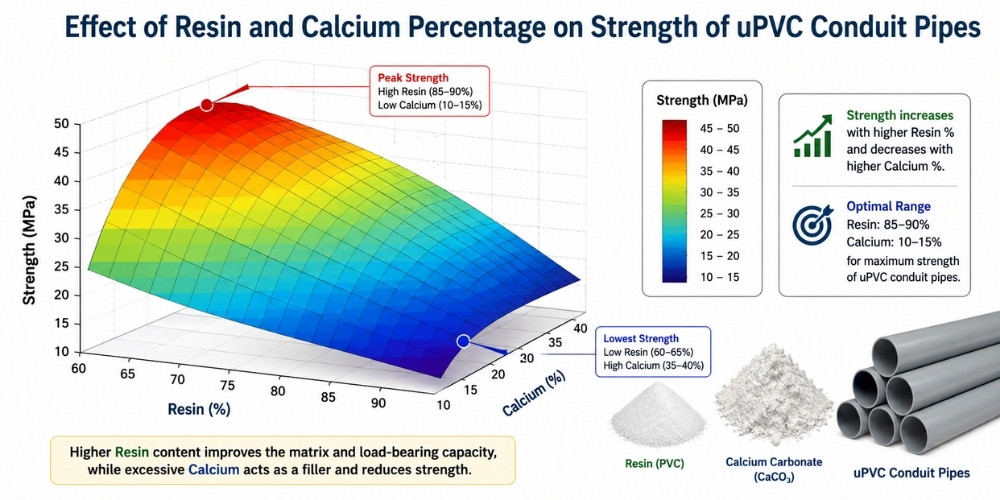
When a contractor specifies uPVC conduit pipes for a large housing project or an industrial wiring job, the decision usually comes down to price, brand, and IS mark. What rarely gets discussed on site, but absolutely should be, is what actually goes inside that pipe during manufacturing. Specifically, the ratio of PVC resin to calcium carbonate (CaCO₃) is the single most decisive factor in determining whether a conduit pipe will last two decades embedded in concrete or crack the first time a worker steps on it.
This is not a minor technical detail. It is the difference between a pipe that passes the IS 9537 Part 3 drop test and one that shatters under normal site handling. For builders, contractors, and procurement teams, understanding this chemistry-level decision helps you buy smarter and avoid costly rework.
What Determines the Strength of uPVC Conduit Pipes?
The strength of a uPVC conduit pipe is primarily determined by two factors: the grade and percentage of PVC resin used (K-value), and the proportion of calcium carbonate filler added during manufacturing. Higher virgin resin content with controlled filler loading produces pipes with superior impact resistance, rigidity, and long service life.
The Role of PVC Resin K-Value in Conduit Pipe Strength
The foundation of any uPVC conduit pipe is the PVC resin itself, and not all resins are equal. The resin's PVC resin K-value, a measure of molecular weight and degree of polymerization, directly controls how strong, rigid, and durable the finished pipe will be.
The two commercially dominant grades in Indian pipe manufacturing are K57 and K67:
- K67 resin has a higher molecular weight, greater tensile strength, superior impact resistance, and better long-term thermal stability. It is the standard for rigid PVC conduit extrusion used across residential and commercial wiring installations in India.
- K57 resin has lower molecular weight, flows more easily during processing, and is typically used for injection-moulded fittings and PVC sheets, not for extruded pipes.
The problem in the Indian market is that some manufacturers quietly substitute K57 or a blend of lower-grade resin into their pipe formulation to cut costs, since K67-grade virgin resin is considerably more expensive. A 2-point variation in K-value alone can create nearly a 20% difference in melt viscosity, and that translates directly into weaker pipe walls with inconsistent mechanical properties.
A quality uPVC electrical conduit pipe must be made with virgin suspension-grade K67 resin. No compromises.
How Calcium Carbonate Affects uPVC Conduit Pipe Performance
Calcium carbonate in uPVC pipe formulations is a legitimate and necessary ingredient. The confusion in the market is not about whether CaCO₃ should be used. It absolutely should be. The real issue is how much of it is used and what grade of particle size is chosen.
The Right Amount: Where CaCO₃ Adds Value

At controlled loading levels, typically 5 to 10 parts per hundred resin (phr), fine-particle calcium carbonate contributes positively to the compound:
- It improves surface finish and gloss during extrusion
- It helps disperse stabilizers and lubricants more uniformly in the PVC blend
- Submicron-grade PCC (precipitated calcium carbonate) can actually enhance impact strength and partially replace expensive impact modifiers
- It reduces raw material cost without significantly compromising structural integrity
This is why responsible manufacturers use CaCO₃ at a balanced loading. It is both a functional additive and a cost-management tool, when done correctly.
Where It Goes Wrong: Excessive Filler Loading
The issue arises when manufacturers push CaCO₃ loading to 20, 25, or even 30+ phr to aggressively replace expensive virgin PVC resin. At these levels, the physics of the compound shifts fundamentally:
Rigidity without resilience: High filler loading makes the pipe stiffer in the short term, but it removes the ductile behaviour that allows uPVC to absorb impact. What you get is a pipe that feels hard but snaps rather than bends.
Impact strength reduction: When CaCO₃ particle size is larger than 2 microns and loading is high, the filler particles act as stress concentration points in the polymer matrix. Drop a heavily filled pipe from a moderate height, and it fractures. A properly formulated pipe with K67 resin and controlled filler loading will flex slightly and survive.
Brittleness under load: Conduit pipes embedded in concrete floor slabs are subject to cumulative compressive and impact loads during construction. A high-filler pipe can develop micro-cracks under this stress, invisible at the time of laying, but leading to moisture ingress and cable failure months or years later.
IS 9537 Part 3: What the Standard Actually Demands
IS 9537 Part 3 is the Bureau of Indian Standards specification governing rigid plain conduits of insulating materials, the standard every legitimate electrical conduit pipe in India must comply with. The BIS Quality Control Order makes this certification mandatory, not optional.
The standard tests for:
- Impact resistance: pipes must survive a standardised drop test without cracking
- Compression strength: the conduit must maintain its cross-section under defined compressive load
- Dielectric properties: electrical insulation performance
- Dimensional accuracy: wall thickness uniformity, outside diameter tolerances
- Thermal stability: behaviour under elevated temperatures
Here is the critical issue: a manufacturer can temporarily produce a batch that passes IS 9537 testing while still using an over-filled formulation. Testing is periodic, not continuous. The pipe that goes to the BIS lab and the pipe that goes to your construction site may not always share the same recipe, especially with smaller or unregulated manufacturers.
Buyers who want verified compliance should look at a manufacturer's full certification portfolio. You can review Trity Pipes' ISI marked conduit pipe certifications and quality credentials as a benchmark for what genuine BIS compliance documentation looks like.
This is why knowing what goes inside matters as much as seeing the IS mark on the surface.
High Filler vs Low Filler: The Real Comparison
| Parameter | Low Filler (5–10 phr CaCO₃) | High Filler (20–30+ phr CaCO₃) |
|---|---|---|
| Resin content | High (70–80% K67 virgin resin) | Low (heavily diluted) |
| Impact strength | High: survives site handling | Low: brittle under impact |
| Tensile strength | Strong polymer chain continuity | Weakened by filler discontinuities |
| Flexibility | Slight ductility retained | Snap fracture behaviour |
| Surface finish | Smooth, uniform | Chalky or inconsistent |
| Pipe weight | Standard | Heavier (CaCO₃ adds density) |
| Long-term durability | 25–50 years in normal installation | Prone to early cracking and failure |
| Cost to manufacturer | Higher (resin is expensive) | Lower (CaCO₃ is cheap) |
| Compliance under load | Reliable IS 9537 conformance | May pass lab test, fails in field |
For contractors and procurement managers: a heavier pipe is not automatically a stronger pipe. Calcium carbonate is denser than PVC resin. A pipe that weighs more per metre could simply contain more filler, which is a warning sign, not a quality indicator.
Cost vs Quality: What the Price Difference Is Really Telling You
In the Indian conduit pipe market, price gaps between brands selling the same nominal size can range from 15% to 35% or more. This gap is almost entirely explained by the resin-to-filler ratio and the quality of raw material inputs.
A pipe priced significantly below market is not offering you a discount. It is offering you less resin, more filler, and a compromised formulation. When a ₹50/metre conduit pipe fails inside a poured slab and requires cable re-pulling, the re-work cost is easily 10 to 20 times the savings you made at purchase.
Experienced site engineers and electrical contractors who have worked on large residential projects, high-rises, township developments, commercial complexes, understand this from hard experience. The cheapest conduit is almost never the most economical choice.
If you are evaluating suppliers, comparing the complete range of uPVC conduit pipes and fittings side by side on raw material specs, not just price per metre, is the right starting point for any serious procurement decision.
Factors Manufacturers Hide: Material Manipulation in the uPVC Pipe Industry
This section is not comfortable to write, but it is important for buyers to understand what actually happens in parts of the Indian pipe industry:
-
Recycled or off-grade resin blending: Some manufacturers blend recycled PVC or lower-grade resin into their compound, reducing molecular weight and long-term strength. The resulting pipe may look identical to a properly formulated one.
-
Calcium carbonate substitution as a resin replacement: CaCO₃ costs a fraction of virgin K67 resin. Every kilogram of resin replaced by filler improves the manufacturer's margin. Beyond 15 phr, the structural trade-off is real and measurable.
-
Particle size manipulation: Coarser calcium carbonate (above 3–5 microns) is cheaper than fine or precipitated grades, but it does significantly more damage to impact strength. A manufacturer using 10 phr of coarse-grade CaCO₃ may produce a weaker pipe than one using 15 phr of ultrafine PCC. The formulation details are never printed on the pipe.
-
Wall thickness variation: Some pipes meet the minimum wall thickness at one measurement point but are deliberately extruded with thin sections elsewhere. Uneven extrusion is partly a process issue, partly an intentional cost-reduction strategy.
-
IS mark misuse: The IS mark printed on a pipe indicates the manufacturer holds a licence. It does not guarantee that every batch leaving the factory has been tested. Surveillance audits are periodic, not continuous.
Buyers dealing with large procurement, government projects, real estate developers, industrial contractors, should insist on third-party lab test reports for tensile strength and impact resistance, not just a product brochure citing IS compliance.
How to Identify Good Quality uPVC Conduit Pipes
For contractors and buyers who are not in a position to run lab tests on every purchase, here are practical field-level indicators:
-
Check the IS 9537 Part 3 mark: It should be printed clearly and repeatedly along the pipe length, not just stamped at one end. Look for the BIS licence number alongside the IS mark.
-
Inspect the pipe ends: A well-formulated pipe with proper K67 resin content will show a consistent, dense cross-section when cut. Chalky white or granular-looking cross-sections often indicate heavy filler loading.
-
The bend test: Gently apply manual bending pressure to a short pipe sample. A properly formulated uPVC conduit will resist deformation and return partially. It will not crack or snap at moderate applied stress. A high-filler pipe is more likely to fracture.
-
Surface quality: The external and internal surface should be smooth and uniform in colour. Rough, chalky, or mottled surfaces suggest processing issues often linked to imbalanced formulations.
-
Weight comparison: Compare weights of pipes of the same nominal size and wall thickness from different brands. Heavier-than-expected weight for the same dimensions may indicate excess CaCO₃.
-
Ask for material test certificates: Reputable manufacturers can provide third-party test reports showing impact resistance, tensile strength, and formulation compliance. If a supplier cannot produce these, that itself is a signal.
-
Buy from established, transparent brands: Manufacturers who publish their formulation philosophy, specifically stating virgin K67 resin and controlled filler levels, are making a verifiable commitment. You can verify it against observed pipe behaviour.
For a reliable reference point on what compliant, well-formulated conduit pipes should deliver, the uPVC electrical conduit pipes and fittings at Trity Pipes cover the raw material standards, IS 9537 compliance, and technical details that serious buyers should be benchmarking against.
What Happens When the Formulation Gets It Wrong
Poor formulation does not always announce itself immediately. The failure patterns are typically delayed, which makes them more dangerous and more expensive.
-
Cracking during installation: On busy construction sites, conduit pipes are walked on, subject to impact from dropped tools, and bent around obstacles. A high-filler pipe with poor impact resistance begins showing hairline cracks at stress points during this phase, before concrete is even poured.
-
Load failure in floor slabs: Once concrete is poured over an embedded conduit, the pipe bears compressive load from above and dynamic load from construction activity overhead. A structurally compromised pipe can collapse its cross-section, blocking cable pulls and requiring invasive repairs.
-
Moisture ingress and cable degradation: A cracked conduit is no longer a sealed system. Moisture enters, cables deteriorate, and insulation resistance drops. In electrical installations, this eventually shows up as earth leakage faults, tripped breakers, or in the worst cases, fire risk.
-
Shortened service life: A quality uPVC conduit should realistically last 25 to 50 years under normal embedded conditions. Heavily filled, under-specified pipes may begin showing structural degradation within 5 to 8 years, especially in environments with thermal cycling or ground movement.
The Buying Decision: What Contractors and Developers Should Prioritise
If you are specifying or procuring uPVC electrical conduit pipes for a project, the following criteria should be non-negotiable in your vendor evaluation:
- IS 9537 Part 3 certification with a verifiable BIS licence number
- Clear declaration of virgin K67 suspension-grade resin as the primary raw material
- Controlled and disclosed CaCO₃ loading (ideally 5–12 phr range)
- Third-party impact and tensile test reports available on request
- Consistent wall thickness across pipe length, verifiable by sampling
- Track record of the brand in large-scale projects with post-installation performance data
The conduit pipe, used on site as a wiring protection pipe embedded in walls and slabs, is the last thing anyone thinks about during project budgeting and the first thing that causes serious problems when it is substandard. In electrical infrastructure, what you cannot see after concrete is poured is what matters most, and that is entirely determined by what went into the pipe during manufacturing.
Resin percentage and calcium loading are not just formulation details for chemists. They are the structural DNA of every uPVC conduit pipe on your project. Choose accordingly.