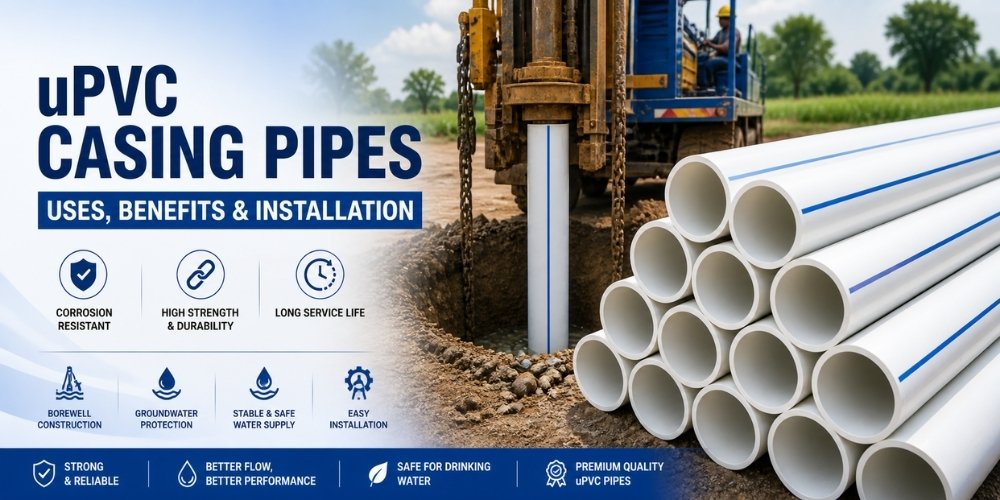
Introduction to uPVC Casing Pipes in Borewell Systems
Water scarcity and groundwater management have made borewell infrastructure a critical investment for farmers, builders, and industrial facilities across India. At the core of every reliable borewell lies one essential component — the casing pipe. uPVC casing pipes have rapidly emerged as the preferred choice for borewell construction, replacing traditional galvanized iron and mild steel options across thousands of installations nationwide.
Their combination of chemical resistance, structural strength, and long service life makes them suitable for both shallow and deep borewell applications in diverse hydrogeological conditions. As groundwater regulations tighten and quality standards rise, understanding the right casing material can mean the difference between a borewell that performs for decades and one that fails prematurely.
Looking for high-quality uPVC casing pipes at competitive prices? Get Best Price Today — Contact Trity Pipes or call +91-9821030072.
What Are uPVC Casing Pipes and How They Work
uPVC, which stands for Unplasticized Polyvinyl Chloride, is a rigid, high-strength thermoplastic material produced without the addition of plasticizers, making it harder and more dimensionally stable than standard PVC. In the context of borewell systems, uPVC casing pipes are inserted into drilled boreholes to line and stabilize the well shaft, preventing soil collapse and ensuring the structural integrity of the well over its operational life.
These pipes create a clean, sealed conduit through which groundwater can be drawn to the surface without contamination from surrounding soil layers or surface runoff. The pipe wall thickness and ring stiffness are engineered to withstand lateral earth pressure at various depths, making them suitable for boreholes ranging from 50 to 500 metres. Unlike metallic pipes, uPVC does not corrode or react with naturally occurring soil chemicals, dissolved minerals, or moderately acidic groundwater — a fundamental advantage in Indian soil conditions.
Why uPVC Casing Pipes Are Used in Borewells
The selection of uPVC as the standard material for borewell casing across India is driven by a convergence of technical, economic, and environmental factors. Groundwater in many regions carries dissolved salts, iron compounds, and naturally acidic pH levels that aggressively attack metal pipes, leading to rapid corrosion, leakage, and eventual structural failure within five to ten years. uPVC casing pipes remain entirely unaffected by these chemical conditions, maintaining their wall thickness and joint integrity even after decades of submersion.
Beyond corrosion resistance, uPVC pipes are significantly lighter than metallic alternatives, reducing both transportation costs and the labour effort required during installation in remote agricultural or construction sites. Their smooth internal bore also minimises friction losses during water extraction, improving pump efficiency and reducing electricity consumption. For contractors and borewell drillers who need materials that are easy to handle, quick to install, and durable enough to justify long-term investment, uPVC casing remains the most technically sound choice available in the Indian market.
Uses of uPVC Casing Pipes in Industrial and Agricultural Applications
The versatility of uPVC borewell casing pipes extends well beyond simple groundwater extraction for domestic use. These pipes serve as the structural backbone of water supply systems across a wide spectrum of sectors in India and globally. Whether it is a deep borewell on a 200-acre farm in Punjab or a municipal water supply project in a tier-2 city, the engineering demands are met by uPVC casing specifications designed for high-pressure, long-duration service. The pipe's inherent material properties make it suitable for environments where chemical exposure, mechanical stress, and temperature fluctuations would degrade inferior materials within a short period.
Key application areas include:
- Agricultural irrigation borewells — supporting submersible pump installations for paddy, sugarcane, wheat, and horticulture irrigation across India's agricultural belts
- Municipal and community water supply — used in government-approved borewell projects for piped water supply schemes in rural and peri-urban areas
- Industrial process water — installed in factory premises, manufacturing plants, and industrial estates where consistent water availability is mission-critical
- Construction dewatering — deployed as temporary or permanent casing in foundation dewatering systems at large infrastructure project sites
- Residential and commercial buildings — used in apartment complexes, hotels, and office buildings to support borewell-based water supply systems independent of municipal networks
- Geotechnical investigation — employed as monitoring well casing in soil investigation, environmental sampling, and hydrogeological surveys
Benefits of uPVC Casing Pipes for Long-Term Water Supply
When evaluated over a 25-to-30-year operational lifespan, uPVC casing pipes deliver measurably superior value compared to galvanized iron, mild steel, or even HDPE alternatives. The material's resistance to biological fouling, chemical attack, and physical deformation ensures that the borewell maintains its designed flow capacity and water quality throughout its service life. For municipalities and industries where water supply continuity directly affects operations and revenues, this reliability translates into significant cost savings from reduced maintenance and pipe replacement cycles.
The non-toxic composition of certified uPVC pipes also means they do not leach harmful substances into groundwater — a critical consideration for drinking water borewells under IS 12235 and BIS regulations.
The primary benefits of uPVC casing pipes include:
- Exceptional corrosion resistance — completely immune to rust, electrolytic corrosion, and chemical degradation from soil acids, alkaline groundwater, or dissolved minerals
- High tensile and compressive strength — engineered to withstand deep borehole pressures without deformation or collapse, ensuring structural stability at depths exceeding 300 metres
- Lightweight and easy handling — approximately one-fifth the weight of equivalent-diameter steel pipes, significantly reducing installation time and labour costs
- Smooth bore for efficient flow — low surface roughness coefficient minimises turbulence and friction, improving pump efficiency and reducing energy consumption
- Non-toxic and food-grade safe — compliant with drinking water safety standards; no leaching of heavy metals or chemical compounds into the water column
- Long service life of 25–50 years — under normal groundwater and soil conditions, uPVC casing pipes outlast metallic alternatives by a factor of three to five times
- Cost-effective total ownership — lower installed cost, minimal maintenance, and extended replacement cycle deliver superior return on investment over the project lifecycle
Technical Features and Specifications of uPVC Casing Pipes
The engineering properties of uPVC casing pipes are precisely defined under Indian and international standards to ensure consistent performance across different borewell conditions. The material is manufactured to achieve a minimum tensile strength of 50 MPa, a Vicat softening point above 79°C, and an impact strength sufficient to withstand pipe handling and lowering operations without cracking.
Pipe wall thickness is calculated based on the nominal diameter and the applicable pressure class, with heavier wall grades used for deep boreholes where hydrostatic and earth pressures are substantially higher. The joint system used in borewell casing — typically a threaded coupling or a coupler-jointed system — is designed to maintain concentricity during lowering and provide a leak-proof seal that prevents grout or gravel invasion into the water column. Surface finish is smooth both internally and externally, with no visible cracks, blisters, or inclusions that could compromise pressure performance or facilitate microbial attachment.
Standard Sizes and Pressure Ratings of uPVC Casing Pipes
uPVC casing pipes for borewell use are available in a range of nominal diameters and pressure classes to match the borehole diameter, pump size, and well yield requirements of each project. The most commonly used sizes in India range from 100 mm (4 inch) to 300 mm (12 inch) nominal bore, with intermediate sizes at 125 mm, 150 mm, 200 mm, and 250 mm also widely available.
Pressure ratings are classified as PN 4, PN 6, PN 8, and PN 10 — corresponding to maximum working pressures of 4 bar, 6 bar, 8 bar, and 10 bar respectively — allowing engineers to select the appropriate pipe class based on the operating depth and anticipated hydrostatic head. Pipe lengths are typically supplied in 3-metre or 6-metre sections to facilitate handling and lowering in the field.
Wall thickness varies from approximately 4.5 mm for small-diameter, low-pressure pipes to over 12 mm for larger-diameter, high-pressure casing used in deep municipal or industrial borewells. Trity Pipes supplies uPVC casing pipes across the full range of standard sizes with consistent dimensional tolerances as per IS 12235 Part 1 and Part 5.
Quality Standards for uPVC Casing Pipes in India
In India, the quality and performance of uPVC casing pipes for borewell use are governed by the Bureau of Indian Standards (BIS) under IS 12235 — a comprehensive standard covering material composition, dimensional tolerances, mechanical properties, hydraulic performance, and joint performance for uPVC pipes used in water well applications. Compliance with IS 12235 is mandatory for pipes supplied under government contracts, public health engineering department (PHED) projects, and municipal water supply tenders.
Pipes bearing the BIS certification mark provide purchasers with documented assurance that each production batch has been tested for tensile strength, impact resistance, vicat softening temperature, hydrostatic pressure endurance, and dimensional accuracy by a third-party accredited laboratory. Additionally, for applications involving potable water supply, pipes should comply with IS 4985 and carry certification confirming that the formulation does not include lead-based stabilizers or other restricted additives that could contaminate drinking water. When sourcing uPVC casing pipes in India, always verify the BIS licence number and request test certificates from the manufacturer to confirm batch-level compliance. You can view Trity Pipes' certifications here.
uPVC Casing Pipes vs Metal Pipes – Complete Comparison
The debate between uPVC and metallic casing materials for borewells has been definitively settled by field performance data accumulated over three decades of widespread uPVC adoption across India. Galvanized iron and mild steel pipes, while historically the default choice, suffer from a fundamental vulnerability — they corrode in the chemically aggressive groundwater environments that characterise large parts of India's alluvial plains, hard-rock aquifer zones, and coastal regions.
Corrosion progressively reduces wall thickness, weakens joints, and eventually causes sections of casing to collapse into the borewell — an irreversible failure mode that requires complete borewell abandonment. uPVC, by contrast, is chemically inert across the pH range of 2 to 12, meaning it performs reliably in virtually all naturally occurring groundwater chemistries without any protective coating, cathodic protection system, or periodic maintenance intervention.
On a per-metre installed cost basis, uPVC casing is typically 30–50% less expensive than equivalent steel casing when the cost of coating, handling equipment, and welding or threading labour is included. Over a 25-year lifecycle, the total cost of ownership advantage of uPVC over metal casing — accounting for replacement frequency, downtime, and remediation costs — is overwhelming, which is why uPVC is now specified as the standard material in virtually all new borewell construction guidelines issued by state governments and national agencies across India.
Ready to upgrade your borewell infrastructure with certified uPVC casing pipes? Request a Quote from Trity Pipes — call 01204142307 or email info@tritypipes.com.
Step-by-Step uPVC Casing Pipe Installation Process
A properly executed uPVC casing pipe installation is the most critical determinant of borewell performance and longevity. Even the highest-quality pipes will underperform or fail prematurely if the installation sequence is not followed correctly, or if shortcuts are taken in gravel packing, grouting, or pipe alignment.
The installation process for uPVC borewell casing pipes follows a systematic sequence that begins well before the first pipe section enters the borehole and continues through final development and pump testing. Each stage has specific technical requirements that must be met to ensure the structural integrity of the well, the hydraulic efficiency of the screen and casing assembly, and the protection of groundwater quality from surface contamination. A trained and experienced borewell contractor will treat each stage as equally important rather than rushing through preparation steps to focus exclusively on pipe lowering.
Borewell Preparation Before Casing Pipe Installation
Before any casing pipe can be installed, the drilled borehole must be properly conditioned and measured to ensure it can accept the casing assembly without obstruction. After rotary or percussion drilling is complete, the borehole should be flushed thoroughly with clean water to remove drill cuttings, clay smear, and loose formation material that could obstruct pipe lowering or compromise gravel pack permeability.
A caliper log or, at minimum, a steel gauge ring of the intended casing diameter should be passed through the full borehole depth to confirm that there are no tight spots, ledges, or collapsed zones that would prevent the casing string from reaching its target depth. The borehole diameter should be at least 50 mm larger than the casing outside diameter to allow adequate annular space for gravel packing around the screened sections and cement grouting in the upper casing zone.
A detailed lithological log prepared during drilling should be reviewed to determine the exact placement of blank casing, slotted screen sections, and the position of the pump intake — information that directly governs the casing string design before pipe is cut or assembled.
Pipe Lowering and Jointing Process
The lowering of uPVC casing pipes into a borehole demands careful attention to joint-making technique, pipe alignment, and lowering speed to prevent mechanical damage to the relatively thin-walled PVC material. Each pipe section should be visually inspected for cracks, deformations, or joint damage before it is connected into the string; damaged sections must be set aside and replaced without compromise.
Threaded coupler joints must be hand-tightened to the specified engagement length and then given a quarter to half turn with a strap wrench — never with pipe tongs or chain wrench — to achieve the correct torque without over-stressing the thread. As the string is lowered using a centralizer guide at the top of the borehole, the pipe must be kept vertical to prevent eccentric loading on the joints and ensure the screen sections remain centred in the aquifer zone.
Lowering speed should be controlled to avoid water hammer effects and dynamic shock loading on joints; in deep boreholes exceeding 150 metres, the cumulative weight of the pipe string requires a properly rated tripod and block-and-tackle system to maintain controlled descent. The total assembled length should be verified against the borehole depth measurement to confirm the screen is positioned correctly in the productive aquifer interval.
Gravel Packing and Final Borewell Setup
Gravel packing is the stage that directly governs the hydraulic performance of the completed borewell and must not be treated as a cosmetic finishing step. Uniformly graded, clean, silica-rich gravel of 2–4 mm particle size is introduced into the annular space between the casing outside diameter and the borehole wall from the bottom of the screen to at least 1.5 metres above the top of the uppermost screen section.
The gravel must be poured slowly and evenly around the casing to prevent bridging — the formation of arched voids in the pack that prevent full settlement and leave unprotected gaps opposite the screen. Above the gravel pack, a 1-metre seal of bentonite pellets or bentonite-cement grout is placed to prevent vertical migration of water between aquifer zones.
The remainder of the annulus from the bentonite seal to ground surface is typically grouted with neat cement or a sand-cement mixture to seal off the surface zone and prevent contaminated surface water from entering the borewell. After grouting has set for a minimum of 24 hours, the borewell is developed by surging and pumping to dislodge fine particles from the gravel pack and formation, stabilise the well yield, and draw the specific capacity to its design value before the permanent pump is installed.
Common Mistakes in uPVC Casing Pipe Installation
Despite the apparent simplicity of pipe installation, borewell failures can almost always be traced back to one or more avoidable errors made during the installation process. Field experience across thousands of borewell installations in India has identified a consistent set of mistakes that shorten well life, reduce productivity, and increase remediation costs.
The most frequent installation errors include:
- Using undersized borehole diameter — insufficient annular space prevents proper gravel packing and grouting, leaving the casing unsupported and the aquifer unprotected
- Improper joint torquing — over-tightening with metal tools cracks the thread profile; under-tightening allows joint separation under pipe weight or water pressure
- Skipping borehole calipering — undetected tight zones or ledges cause pipe jamming during lowering, often cracking sections or pulling joints apart as force is applied
- Using non-graded or dirty gravel — fine-grained or contaminated gravel clogs the pack, reduces well yield, and introduces turbidity into the water supply
- Inadequate borewell development — insufficient pump-and-surge development leaves unstabilised fine material in the formation, causing ongoing sand pumping that damages the pump and reduces yield over time
- Incorrect screen placement — failure to match screen interval to the productive aquifer zone results in poor yield despite an otherwise well-constructed borewell
- Using non-IS-certified pipes — substandard pipe material with inconsistent wall thickness, poor UV stabilisation, or inadequate impact strength fails prematurely under borehole conditions
Why Choose Trity Pipes uPVC Casing Pipes in India
Trity Pipes has established itself as one of India's reliable manufacturers and suppliers of uPVC pipes, casing pipes, and related borewell materials, serving contractors, drilling companies, government agencies, and infrastructure developers across the country. The company's manufacturing facility operates under stringent quality control protocols aligned with BIS certification requirements, ensuring that every pipe delivered to a project site meets the dimensional, mechanical, and chemical performance specifications demanded by IS 12235.
With a product portfolio that spans uPVC casing pipes, SWR pipes, column pipes, and specialised borewell casing solutions, Trity Pipes offers contractors and project managers a single-source supply relationship that simplifies procurement and ensures material compatibility across the well assembly.
Key reasons to choose Trity Pipes for your next project:
- BIS-certified manufacturing — all uPVC casing pipes produced under documented quality management systems with third-party testing compliance
- Full size range availability — stock maintained across all standard diameters from 100 mm to 300 mm with prompt dispatch capability for urgent project requirements
- Technical support — experienced application engineers available to assist with pipe selection, pressure class determination, and installation specification guidance
- Pan-India distribution network — established logistics partnerships ensure timely delivery to project sites in major states including UP, Maharashtra, Rajasthan, Gujarat, Punjab, and Tamil Nadu
- Competitive pricing — direct manufacturer pricing eliminates intermediary margins, delivering better value on large-volume borewell and infrastructure contracts
- Consistent product quality — rigorous in-process quality checks and finished goods inspection prevent dimensional variation and material defects from reaching customers
Partner with Trity Pipes for your borewell or infrastructure project. Contact Our Experts | +91-9821030072 | 01204142307 | info@tritypipes.com
Applications of uPVC Casing Pipes Across Industries
The use of uPVC casing pipes extends well beyond agricultural borewells, finding application in an expanding range of industries that require reliable groundwater access or subsurface pipe infrastructure. As India's industrial and urban development continues at pace, the demand for high-quality casing pipe solutions across multiple sectors is growing correspondingly.
Industry applications include:
- Agriculture and irrigation — deep borewells for submersible pump irrigation supporting food production across arid and semi-arid regions
- Real estate and housing — borewell water supply for residential townships, gated communities, and affordable housing projects in areas with unreliable municipal water supply
- Hospitality and healthcare — hotels, resorts, and hospitals requiring uninterrupted water supply use dedicated borewells with uPVC casing as backup or primary source
- Food and beverage processing — process water borewells in F&B facilities where water purity and chemical non-contamination are regulatory requirements
- Pharmaceutical manufacturing — raw water intake borewells where casing material must be certified non-reactive with the water chemistry
- Infrastructure and civil engineering — dewatering systems for metro rail, tunnels, and deep foundation construction requiring temporary or permanent casing
- Environmental monitoring — groundwater quality monitoring wells at landfill sites, industrial effluent zones, and remediation projects
FAQs on uPVC Casing Pipes and Borewell Installation
What is the lifespan of uPVC casing pipes?
Under typical borewell operating conditions in India — which include groundwater temperatures between 15°C and 35°C, moderate to high total dissolved solids, and neutral to mildly acidic pH — high-quality uPVC casing pipes manufactured to IS 12235 specifications are engineered to deliver a functional service life of 25 to 50 years. This extended lifespan is a direct result of the material's immunity to corrosion, biological fouling, and chemical degradation from common groundwater constituents including iron, manganese, sulphates, chlorides, and carbonates.
The joint system — whether threaded couplings or solvent-welded sockets — maintains its seal integrity over this period provided that installation was carried out correctly and that the pipe was not subjected to mechanical abuse during lowering. Compared to galvanised iron, which typically requires replacement within 8 to 15 years in chemically aggressive groundwater, or mild steel without coating which may fail in as little as 5 years in saline or acidic conditions, the uPVC service life advantage is substantial and directly translates to lower lifecycle costs for borewell owners.
Are uPVC casing pipes better than metal pipes?
For the vast majority of borewell applications in India, uPVC casing pipes offer a technically superior and economically more advantageous solution compared to galvanised iron or mild steel alternatives. The core advantage is corrosion immunity — uPVC does not rust, does not scale, and does not react with the acidic or saline groundwater chemistries present across wide parts of India's agricultural and coastal regions.
In practice, the pipe maintains its original wall thickness, joint strength, and hydraulic capacity throughout its service life, while metal pipes progressively weaken through corrosion and eventually require replacement. uPVC is also lighter, easier to transport and install, and does not require welding, threading with heavy machinery, or protective coating application that adds cost and complexity to metallic installations.
The only application area where metal casing may retain an advantage is in boreholes requiring very high axial load capacity in unstable geological formations, such as fractured hard rock with large diameter casing exceeding 350 mm, though even in these cases, fibre-reinforced uPVC or hybrid casing solutions are available from specialised manufacturers.
What size casing pipe is best for borewells?
The selection of the correct casing pipe diameter for a borewell depends on three primary factors: the planned pump size and flow rate, the anticipated yield of the aquifer, and the drilling rig capability at the project site. As a general guide, domestic borewells for a single residential property typically use 100 mm (4-inch) or 125 mm (5-inch) casing with a matching submersible pump of 0.5 to 1.5 HP capacity.
Agricultural borewells for medium to large farms generally specify 150 mm (6-inch) to 200 mm (8-inch) casing to accommodate higher-capacity submersible pumps of 3 HP to 10 HP. Industrial, municipal, and large-scale irrigation borewells may use 250 mm (10-inch) or 300 mm (12-inch) casing to support high-yield multi-stage pumps delivering 50 to 200+ cubic metres per hour.
Always ensure the pump bowl assembly diameter is at least 25 mm smaller than the casing inside diameter to allow free installation and prevent motor overheating from restricted airflow in the annular space between pump and casing.
Do uPVC pipes affect water quality?
Certified uPVC casing pipes manufactured in compliance with IS 12235 and produced without prohibited additives do not adversely affect the chemical, biological, or organoleptic quality of groundwater passing through them. The uPVC compound used in borewell casing is formulated with non-toxic calcium-zinc or organic tin stabilisers instead of the lead-based stabilisers historically used in some older PVC products, and it does not contain plasticizers that could leach into the water column.
Independent laboratory testing under BIS protocols confirms that compliant pipes do not impart taste, odour, colour, or detectable chemical contamination to water in contact with the pipe inner surface. For potable water applications, always specify pipes that carry explicit BIS certification for drinking water service and request the manufacturer's test certificate confirming the lead-free stabiliser formulation.
Non-certified, unchecked, or counterfeit pipes made with substandard or restricted chemical additives present a potential contamination risk and should be strictly avoided in any borewell serving drinking water purposes.
Conclusion – Get Best Quality uPVC Casing Pipes in India
uPVC casing pipes represent the most technically reliable, economically practical, and environmentally sound solution available for borewell construction across India's diverse geographical and hydrogeological conditions. From paddy farms in the Indo-Gangetic plains to industrial borewells in the Deccan Plateau and municipal water supply projects along the Konkan coast, the superior corrosion resistance, long service life, and consistent performance of BIS-certified uPVC casing make it the material of choice for contractors, hydrogeologists, and infrastructure developers who cannot afford compromises on groundwater infrastructure quality.
As water security becomes an increasingly critical priority for Indian agriculture, industry, and urban development, investing in the right casing pipe material is not merely a technical decision — it is a long-term asset protection strategy that determines the reliability and productivity of one of your most valuable ground-level investments.
Ready to source premium uPVC casing pipes for your next borewell or infrastructure project? Connect with Trity Pipes — India's trusted supplier of uPVC casing pipes, column pipes, and SWR pipes.
Call us: +91-9821030072 | 01204142307 Email: info@tritypipes.com Website: www.tritypipes.com
Request a Quote Now — Our technical team is ready to assist you with product selection, specifications, and delivery timelines tailored to your project requirements.