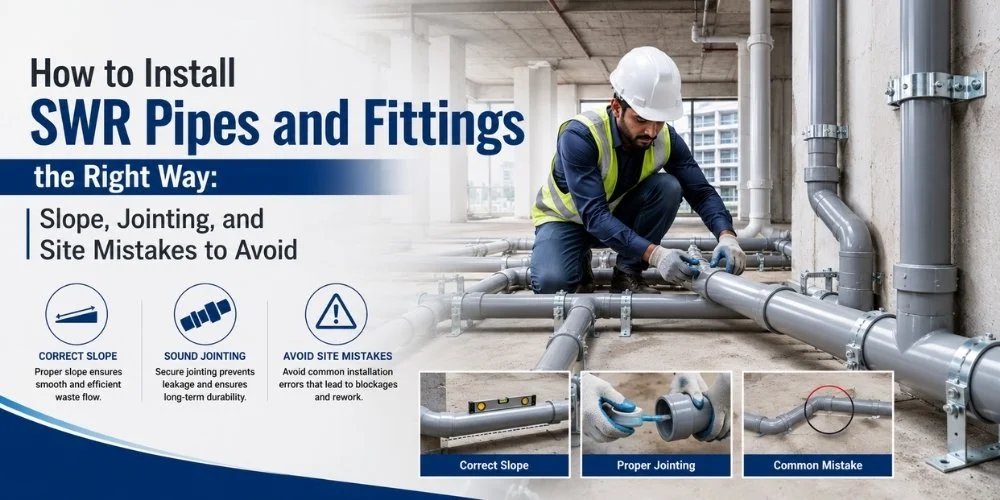
A drainage system rarely fails because the pipe itself was bad. It fails because of how it was installed. Wrong slope, a rushed solvent cement joint, a missing vent stack, and the problem doesn't show up on day one. It shows up six months later as a slow drain, a foul smell near a trap, or worse, a leak inside a wall or ceiling that nobody notices until the damage is already done.
SWR pipes and fittings are forgiving materials to work with compared to old cast iron or concrete drainage systems, but forgiving doesn't mean foolproof. Plumbers and site engineers who get the basics right the first time save themselves a lot of callback visits. This guide covers the installation details that actually matter: gradient, jointing method, support spacing, and the mistakes that show up again and again on Indian construction sites.
Getting the Slope Right
Drainage in an SWR system relies entirely on gravity. There's no pump pushing waste through the pipe, so the slope, or gradient, is what makes the whole system work. Too flat, and solids settle instead of flowing out. Too steep, and liquid rushes ahead of solid waste, leaving it stranded in the pipe.
As a general rule followed on most Indian sites:
- Smaller diameter pipes (75mm-110mm), typically used for individual fixture connections like WCs, wash basins, and floor traps, need a gradient of around 1:40 to 1:60.
- Larger diameter pipes (160mm and above), used for common stacks and main horizontal drainage runs, can work with a slightly flatter gradient, often 1:80 to 1:100, since the larger cross-section and higher flow volume compensate for the reduced slope.
The safest approach on site is to check the gradient with a spirit level and measuring tape at multiple points along the run, not just at the start and end. A pipe that looks sloped correctly over a short visual check can still have a low point or sag in the middle, usually from inadequate support, and that low point becomes exactly where waste collects and blockages start.
Ringfit vs Selfit: Choosing the Right Jointing System
Trity Pipes' SWR range comes in two jointing systems, and picking the wrong one for the application is a common site-level mistake.
Ringfit SWR pipes and fittings use a rubber ring seated in a groove to create the joint. This is a mechanical seal, not a bonded one, which means the joint can flex slightly and can technically be disassembled later if needed. Ringfit systems come in two types: Type A for ventilation and rainwater applications, and Type B for soil and waste discharge. Ringfit is generally the better choice for long vertical stacks and any run where some flexibility is useful, since building movement and thermal expansion won't stress a mechanical joint the way it can stress a rigid bonded one.
Selfit SWR pipes and fittings use solvent cement to fuse the pipe and fitting into a single permanent joint. Once cured, there's no disassembly without cutting the pipe. Selfit is common for concealed runs and shorter connections where a permanent joint is preferred and future access isn't a concern.
A mistake worth flagging here: mixing solvent cement application techniques between the two systems. Applying solvent cement to a Ringfit joint, or trying to dry-fit a Selfit joint expecting it to seal like a rubber ring, both lead to failures. Site teams switching between the two systems on the same project need to be clear on which fitting takes which joint method before work starts, not figuring it out at the point of installation.
Common Installation Mistakes on Site
A few patterns repeat across residential and commercial sites, almost always traceable back to rushed installation rather than bad material.
Inadequate or missing pipe support. SWR pipe runs, especially horizontal ones, need support brackets or clamps at regular intervals, generally not more than 600mm to 1000mm apart depending on pipe diameter. Skipping supports or spacing them too far apart lets the pipe sag under its own weight and the weight of standing water, which flattens the gradient at that point and creates a collection zone for waste.
No allowance for thermal expansion. uPVC expands and contracts with temperature changes more than metal pipe does. Long straight runs, particularly ones exposed to sun or running through unconditioned spaces, need expansion joints or slightly loose fixing at intervals to accommodate this movement. Rigidly fixing a long run at every point can cause the pipe to buckle or pull a joint apart over time.
Skipping the vent stack. Every drainage system needs proper ventilation to let air in behind the flowing waste and to release sewer gases safely above roof level. A missing or undersized vent stack causes trap seals throughout the building to get siphoned dry, which is exactly why some bathrooms develop a persistent bad smell with no visible leak anywhere. This is one of the most common oversights on smaller residential projects where the plumber focuses on getting waste out but treats venting as optional.
Solvent cement applied incorrectly on Selfit joints. The joint surface needs to be clean, dry, and lightly abraded before cement application, and the pipe needs to be inserted and given a quarter turn to spread the cement evenly, then held in place briefly while it sets. Rushing this step, or applying too little cement, leaves a joint that looks sealed but fails under pressure or vibration later.
Wrong fitting for a change in direction. Using a sharp 90-degree bend on a horizontal run instead of two 45-degree bends, or a long-sweep bend, increases the chance of blockage at that point, since solid waste has a harder time navigating a sharp turn under gravity flow alone. This matters more on horizontal runs than vertical stacks.
No access points on concealed runs. Selfit's permanent joints are great for hidden runs, but every concealed drainage system still needs access points, usually through access fittings or rodding eyes, at points where a blockage is most likely to occur, like direction changes or junctions. Skipping these means any future blockage requires breaking into a wall or ceiling to reach the problem.
Testing Before You Close Up the Work
Before any drainage run gets concealed behind a wall, under a floor, or inside a false ceiling, it should be tested. A simple water test, running water through the system and checking every joint for leaks while the pipe is still visible, catches problems while they're a five-minute fix instead of a demolition job.
For larger commercial or institutional projects, a more formal test with plugged sections and a held water column for a set period is standard practice, and many project specifications require documented test results before drainage work is signed off.
What to Check Before You Buy
Not every SWR pipe on the market performs the same way once it's under load and buried behind finished construction. A few things worth confirming with your supplier before ordering in bulk:
- IS 13592 compliance, which is the Indian Standard governing unplasticised PVC pipes for non-pressure drainage applications like SWR systems. Ask for this explicitly rather than assuming a generic "ISI marked" claim covers it.
- Consistent wall thickness across the batch, since variation here is one of the more common quality issues that shows up only after installation, when a thinner section cracks under load that a properly specified pipe would have handled.
- UV stabilisation, if any part of the run, like rainwater downpipes on an exterior wall, will be exposed to sunlight.
- Fitting compatibility, meaning pipes and fittings sourced from the same manufacturer to avoid tolerance mismatches between Ringfit grooves and rubber ring sizing, or Selfit socket depths.
We've covered how SWR pipes compare against alternative drainage materials in more detail in SWR Pipes vs PVC Pipes: What's the Difference?, which is worth a read if you're still deciding on the material itself before getting into installation planning.
Getting It Right the First Time
Most SWR system problems trace back to the installation stage rather than the pipe itself. Correct gradient, the right jointing system for the application, adequate support spacing, proper venting, and a water test before concealment cover most of what separates a drainage system that runs quietly for decades from one that generates callback visits within the first year.
We manufacture SWR pipes and fittings in both Ringfit and Selfit systems, built to IS 13592 with consistent wall thickness across bulk orders. If you're planning a residential, commercial, or industrial drainage project and want technical support on sizing or gradient planning, get in touch for a project quotation.