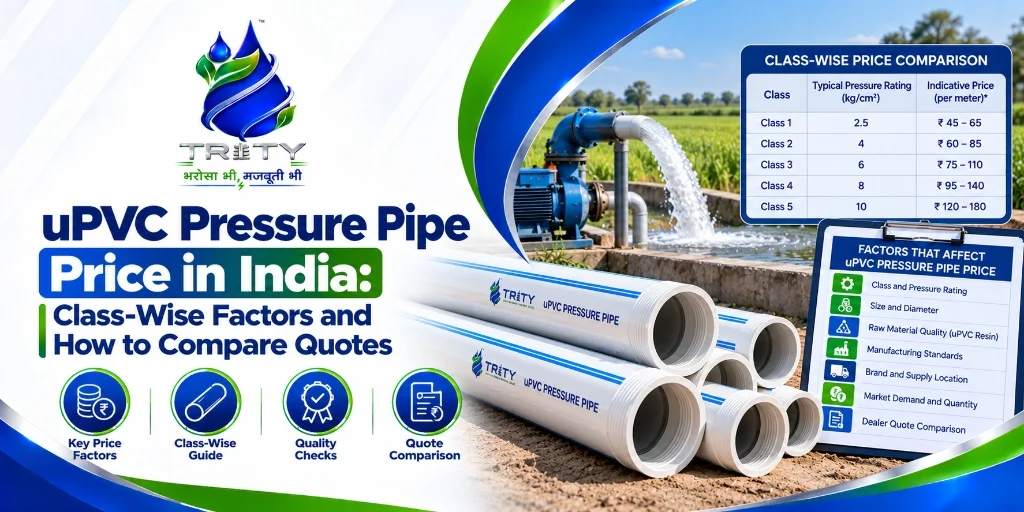
If you have looked up the price of uPVC pipe for a water line, an irrigation main or an overhead tank connection, you will have seen how little the numbers tell you. A rate per metre appears with no class, no standard and no hint of whether it suits your pressure. For pressure pipe that is a serious gap, because the class decides whether the line holds when the pump starts or a valve closes suddenly.
This guide explains what decides uPVC pressure pipe price in India, with a class-by-class look at how the IS 4985 system works, how to compare quotations fairly, why choosing a higher class than you need wastes money while choosing a lower class risks failure, and how to get a clear quotation from Trity Pipes. If you want help choosing the class and diameter first, read our guide on pressure pipe sizing for overhead tank and borewell lines.
We do not print fixed rates here, because resin cost, freight and demand change, and a number published today may be wrong by the time you read it.
How uPVC pressure pipe is classified
uPVC pressure pipe in India is made to IS 4985, which classifies pipe by working pressure at 27\u00b0C. Trity makes the full range, Class 1 to Class 6.
| Class | Working pressure | Typical application |
|---|---|---|
| Class 1 | 2.5 kgf/cm\u00b2 (0.25 MPa) | Low-pressure gravity feed lines |
| Class 2 | 4.0 kgf/cm\u00b2 (0.4 MPa) | Agricultural feeder lines, light irrigation |
| Class 3 | 6.0 kgf/cm\u00b2 (0.6 MPa) | Standard irrigation mains |
| Class 4 | 8.0 kgf/cm\u00b2 (0.8 MPa) | Residential water supply, general plumbing mains |
| Class 5 | 10.0 kgf/cm\u00b2 (1.0 MPa) | High-rise water distribution, high static head |
| Class 6 | 12.5 kgf/cm\u00b2 (1.25 MPa) | Industrial fluid lines, high-pressure pump mains |
A higher class has a thicker wall for the same diameter, so it uses more compound and costs more per metre. The table is the first thing to apply when you read a quote: if the class is not stated, you cannot know what you are paying for.
The main factors that decide uPVC pressure pipe price
Pressure class
This is the largest factor. Moving up a class adds wall thickness, material and cost. The aim is to choose the class your line actually needs, not the cheapest class and not the highest.
Diameter
Price rises with diameter, because larger pipe uses much more compound per metre. Trity manufactures across the standard diameter range used in Indian water supply and irrigation installations, and exact size, class and current stock are confirmed at enquiry.
Raw material
A pressure line needs consistent wall strength along its whole length. Virgin uPVC compound gives that, while recycled or blended compound can introduce inconsistencies that a burst or hydrostatic test eventually finds. Trity uses lead-free virgin uPVC compound, which is also what makes the pipe suitable for potable water.
Testing
Testing adds cost, and it is worth paying for. Under IS 4985, a pipe is tested at 4.19 times its rated working pressure and must hold it for an hour without bursting, puncturing or deforming. Trity tests every batch to that standard before dispatch, along with wall thickness checks and reversion testing, which confirms the pipe has not kept residual stress from extrusion that would cause shrinkage later.
Certification
IS 4985 compliance, a valid BIS licence and ISO 9001:2015 mean regular audits and documentation. Trity's credentials are on the certifications page, and IS 4985 test reports are available on request for tenders and procurement files.
Fittings and solvent cement
A pressure system needs fittings, such as elbows, tees, couplers, reducers and unions, and solvent cement for the joints. Trity pressure pipes are built for solvent cement jointing, which forms a permanent chemical bond. Fittings and cement are often priced separately, and they add to the total.
UV stabilisation
Above-ground mains in sunlight need UV-stabilised compound. Our product page describes our pressure pipes as UV stabilised for surface installations, which is part of the compound cost.
Order quantity
Large irrigation and project orders earn better rates, and some suppliers set minimum quantities. Our guide on buying in bulk explains how volume and phasing affect rates.
Freight and location
Pressure pipe is long and bulky, so freight adds to the landed cost, and distance matters. Trity ships from our Delhi NCR facility to 20-plus states, with delivery time confirmed with each quotation.
GST
Plastic pipes and fittings fall under HSN 3917 and attract 18 percent GST. Check whether a rate includes it.
Choosing too low a class costs more than it saves
It is common on price-driven projects to pick a lower class than the line needs. That usually looks fine until the first surge event. A pressure pipe rarely fails during steady flow. It fails when a pump starts, a valve closes quickly or water hammer occurs, which is exactly when the system needs the pipe to hold.
- Specify on surge pressure, not only static pressure. A line's working pressure and its surge pressure during start-up or valve closure are different numbers.
- Allow for elevated static head on upper floors of tall buildings, where a line may need Class 5 even though ground-floor pressure needs only Class 4.
- Confirm the pump's rated discharge pressure and size the class with margin above it.
The price gap between one class and the next is small compared with the cost of digging up and replacing a failed line. At the same time, choosing the highest class everywhere adds cost with no benefit, so the right answer is a sensible margin above your real pressure.
uPVC compared with GI and DI pipe
Metal pipe was the historical choice for pressure lines. uPVC avoids scaling and pitting, so its smooth bore stays clear, and our pipes carry a Hazen-Williams coefficient of C=150, which means higher flow at lower pumping cost. uPVC is inert to many acids and alkalis, joints are solvent-welded instead of threaded, and the pipe is much lighter, which cuts transport and labour. Over the life of a system, uPVC often works out cheaper than metal even when the per-metre price looks similar at the start.
How to compare uPVC pressure pipe quotations
- Check the class and standard. Every line should state the IS 4985 class and size.
- Check the unit. Convert per-piece rates to per metre, and note the length of each piece.
- Check what is included. Are fittings, cement, GST and freight in the rate?
- Compare the same class only. Never compare Class 4 with Class 3.
- Check terms. Validity, payment terms and delivery period.
- Check documents. BIS licence, ISO certificate and IS 4985 test reports.
A table to line up quotes
| Item | Supplier A | Supplier B | Supplier C |
|---|---|---|---|
| Class and diameter | |||
| Standard (IS 4985) | |||
| Pricing unit and rate | |||
| Fittings and cement included? | |||
| GST included? | |||
| Freight and delivery | |||
| Test reports and certificates | |||
| Validity and payment terms |
Fill every cell, even if you have to call the supplier. Our guide on how to read and compare quotations uses conduit pipe as its example, and the same method works for pressure pipe.
Red flags in a pressure pipe quote
- No class stated, or a class that does not match your pressure
- A rate far below other suppliers for the same stated class
- No IS 4985 marking or test reports
- No validity period, or only a verbal quote
- Mixed brands of pipe, fittings and cement offered as one system
- No batch information, which makes any later claim hard to trace
Where each class is commonly used
- Irrigation mains: Class 2 or Class 3, with higher classes for long runs and high-pressure pumps
- Residential water supply: commonly Class 4
- High-rise distribution: Class 5 where static head is high
- Industrial and high-pressure pump mains: Class 6
Confirm against your own pressure figures. Our guide on uPVC pressure pipes for water supply covers where each application fits.
What a Trity Pipes pressure pipe quotation includes
Trity Pipes manufactures uPVC pressure pipes to IS 4985 in the full Class 1 to Class 6 range, from lead-free virgin uPVC compound, with matching fittings. When you send us your application, working pressure, surge conditions, diameter and quantity, our team can help you calculate the right class, and we prepare a quotation that states the class, size, rate, what is included, the delivery basis and the validity. IS 4985 test reports and ISO 9001:2015 certification are available on request. You can see the uPVC pressure pipes range, and irrigation contractors, builders, plumbing contractors and industrial procurement teams can ask about bulk supply. Dealers can ask about stocking the range.
Frequently Asked Questions
What is the price of uPVC pressure pipe per metre in India?
It depends on class, diameter, brand and the date of the quotation, so a single number would mislead. The reliable way to find the current rate is to request a written quotation for your class, size and quantity.
Which pressure class should I buy?
Choose the class that covers your working pressure plus surge pressure with some margin. Agricultural feeders commonly use Class 2 or 3, residential supply Class 4, high-rise distribution Class 5 and industrial lines Class 6. Share your details with our team for a recommendation.
Why does a higher class cost more?
A higher class has a thicker wall for the same diameter, which uses more compound and gives a higher pressure rating. The extra cost buys safety margin against surges.
Does the pipe rate include fittings and GST?
Usually not. Fittings and solvent cement are normally quoted separately, and GST at 18 percent under HSN 3917 may or may not be included. Ask the supplier to state it clearly.
Are Trity pressure pipes suitable for drinking water?
Our pressure pipes are made from lead-free virgin uPVC compound and are built to IS 4985, which covers potable water supply. Confirm the class and documents you need with our team.
Can I get a bulk quotation from Trity Pipes?
Yes. Send us your class, diameter, quantity and schedule, and our team will prepare a quotation and discuss delivery. Dispatch is from our Delhi NCR facility to 20-plus states.
Planning a water supply or irrigation line? Contact Trity Pipes on +91-9821030072 or +91-9319984755 for a uPVC pressure pipe quotation, class guidance and IS 4985 documents from our Delhi NCR factory.