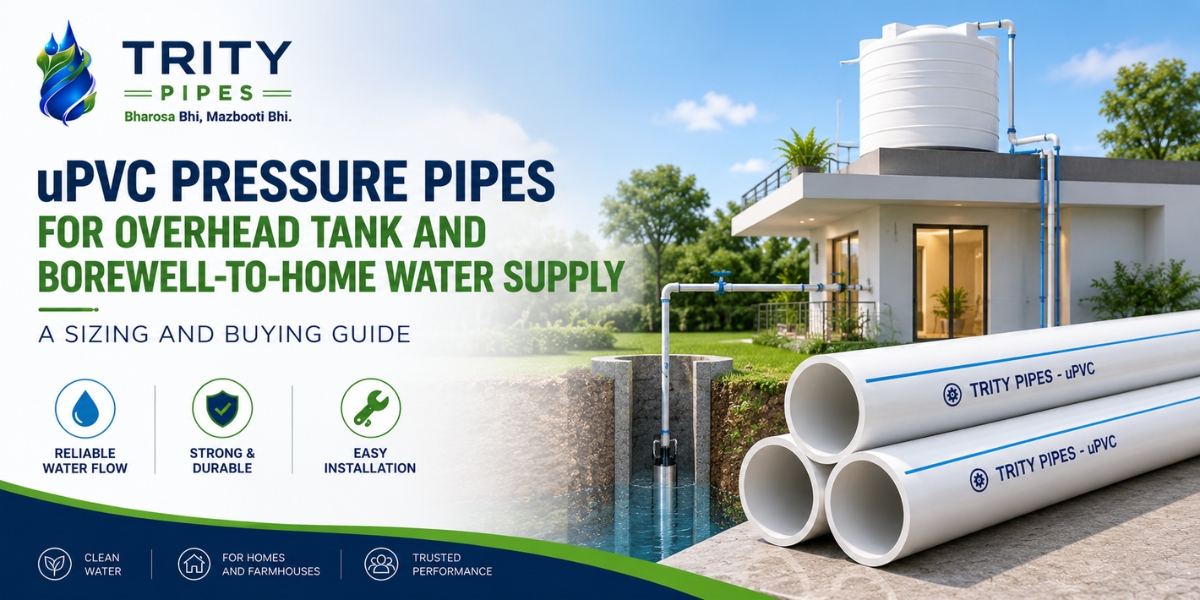
Two of the most common water supply runs in Indian homes, the gravity feed from an overhead tank down to the taps, and the pressurised line from a borewell pump up to the tank or directly into the house, need genuinely different pipe specifications. Treating them the same, or worse, under-sizing either one to save a modest amount on material cost, is one of the most common reasons a otherwise well-built home ends up with weak water pressure on the upper floors.
This guide covers how to choose the right uPVC pressure pipe class for these two specific, common scenarios, how to size the pipe diameter for actual flow rate rather than guesswork, and the sizing mistakes that quietly cause low water pressure complaints months or years after construction. If you want a broader look at where uPVC pressure pipe fits across different applications, our general guide to uPVC pressure pipes covers that ground. This post is deliberately narrower: getting the class and size decision right for these two specific runs.
Understanding the IS 4985 pressure class system
uPVC pressure pipe for water supply in India is manufactured to IS 4985, which classifies pipe by working pressure rating at 27°C, commonly expressed as PN (nominal pressure) in bar or MPa.
| Class | Pressure rating | Typical application |
|---|---|---|
| Class 1 (PN 2.5) | 2.5 bar | Low-pressure gravity distribution, short overhead tank drops |
| Class 2 (PN 4) | 4 bar | General building cold water supply |
| Class 3 (PN 6) | 6 bar | Building risers up to roughly 5 floors |
| Class 4 (PN 8) | 8 bar | Higher-rise risers, moderate pump pressure |
| Class 5 (PN 10) | 10 bar | Pump-fed lines, deeper borewell connections |
| Class 6 (PN 12.5) | 12.5 bar | High-pressure lines, deep borewell, industrial supply |
A higher class number means a thicker pipe wall for the same nominal diameter, giving it a higher pressure rating. The core specification decision for any run is simple in principle: the pipe needs a class rated comfortably above the maximum pressure that specific run will actually see, not just the average operating pressure.
Choosing the right class for an overhead tank gravity line
A line running by gravity from an overhead tank down to taps and fixtures relies purely on the height of water above the point of use for its pressure, with no pump adding extra force.
Why gravity lines generally need a lower class
Static pressure from a typical residential overhead tank height translates to a relatively modest working pressure at the point of use, well within the range Class 1 or Class 2 pipe comfortably handles. Over-specifying a gravity-fed line with a high pressure class doesn't add meaningful safety margin, since the pressure this line will ever see is limited by the tank's height regardless of the pipe's rating.
When to step up the class on a gravity line
- Taller buildings with a tank mounted high above the ground floor see correspondingly higher static pressure at the lowest points of the building, and the line serving those lower floors may warrant Class 2 or 3 rather than the Class 1 that would suffice for a single-storey home.
- Any section of the "gravity" line that also experiences pump pressure, such as a shared riser that sometimes gets boosted by a pressure pump during low-tank-level periods, should be classed for the higher pressure condition, not just the default gravity scenario.
Choosing the right class for a borewell-to-home pumped line
A line fed by a borewell pump, whether pumping up to a rooftop tank or directly pressurising the home's supply, operates under meaningfully higher and more variable pressure than a gravity line.
Why pumped lines need a higher class
A submersible or surface pump generates working pressure well above what gravity alone produces, and pumped systems also experience pressure surges at pump start-up and shutoff that a gravity system never sees. Class 3 or Class 4 is a reasonable starting point for a typical residential borewell-to-tank line, with Class 5 or 6 warranted for deeper borewells or systems where the pump generates higher sustained pressure.
Matching class to actual pump and borewell depth
- Check the pump's rated discharge pressure, not just its power rating, since this is the actual pressure the pipe needs to handle under normal operation, and confirm the chosen pipe class rating comfortably exceeds it.
- Account for surge pressure at start-up and shutoff, which can meaningfully exceed the pump's steady-state operating pressure for a brief moment each cycle, another reason to specify a class with genuine margin above the average operating pressure rather than matching it exactly.
- Deeper borewells generally need a higher class for the vertical column pipe and the horizontal delivery line alike, since pump pressure typically scales with the depth water needs to be lifted.
Sizing for flow rate, not just pressure class
Pressure class determines how much pressure a pipe can safely handle. Diameter determines how much water it can actually deliver at a usable flow rate, and getting this wrong is just as common a cause of poor performance as choosing the wrong pressure class.
Why undersized diameter causes low pressure symptoms
A pipe that's too narrow for the flow it's asked to carry creates significant friction loss along its length, and that friction loss shows up at the tap as reduced pressure and flow, even if the pipe's pressure class rating and the source pressure are both perfectly adequate. This is a genuinely common point of confusion: a "low pressure" complaint is often actually an undersized diameter problem, not a source pressure problem.
Practical diameter sizing guidance
- Size the main supply line for total simultaneous demand, not just one fixture at a time. A line sized only for a single tap running will struggle when a shower, a washing machine, and a kitchen tap all draw simultaneously, which is a realistic scenario in most households.
- Step down diameter progressively as the line branches, similar to how any distribution system tapers, rather than running the same diameter from the main supply all the way to the smallest branch.
- Longer runs need more attention to diameter, since friction loss accumulates over distance. A borewell-to-tank line covering a long horizontal or vertical distance needs a larger diameter than the same flow rate would require over a short run.
- Upper floors in multi-storey homes are the most sensitive to undersizing anywhere earlier in the system, since any friction loss accumulated in the main riser reduces the pressure and flow available by the time water reaches the top, compounding whatever height-related pressure loss already exists at that level.
Common under-sizing mistakes that cause low pressure at upper floors
A few specific mistakes show up repeatedly in homes with persistent upper-floor water pressure complaints, and most trace back to a decision made during initial plumbing design rather than a fault that developed later.
Undersized main riser diameter
The single most common cause. A riser sized adequately for a single-storey home but reused without recalculation for a multi-storey addition or a larger household's fixture count creates friction loss that specifically penalises the floors furthest from the source.
Wrong pressure class causing pipe deformation under surge
A pipe classed too low for a pump's actual surge pressure can deform slightly over repeated cycles, subtly reducing its effective internal diameter over time and worsening flow at upper floors as the pipe ages, even though the problem wasn't obvious when the system was new.
Excessive bends and fittings adding unaccounted friction loss
Every bend, tee, and reducer in a supply line adds friction loss beyond what a straight run of the same length would produce. A design that doesn't account for a genuinely complex routing path, common in renovated or extended homes, can underperform even with correctly sized straight-line pipe.
Insufficient elevation for the overhead tank relative to upper floors
This isn't a pipe specification issue at all, but it's worth ruling out before assuming the pipe is the problem. A tank that doesn't sit sufficiently above the highest fixture it needs to serve will produce weak pressure at that fixture regardless of how well the pipe itself is sized, since gravity pressure is fundamentally a function of height difference.
A practical decision framework
For a typical Indian home, this gives a reasonable starting point, though every project should confirm actual pump specifications and building height before finalising:
- Overhead tank to ground and first floor fixtures: Class 1 or 2, sized for the combined flow of the busiest simultaneous fixture group on those floors
- Overhead tank to upper floors in a taller building: Class 2 or 3, with diameter sized generously given the added sensitivity to friction loss at height
- Borewell pump to overhead tank: Class 3 or 4 as a starting point, confirmed against the specific pump's rated and surge pressure
- Deep borewell or high-pressure pump systems: Class 5 or 6, with the exact class confirmed against the pump manufacturer's specifications rather than assumed
Getting your water supply sizing right
The pipe class and diameter decisions for an overhead tank line and a borewell-to-home pumped line are genuinely different problems, driven by different pressure sources and different failure modes if under-sized. Matching class to actual operating and surge pressure, sizing diameter for real simultaneous demand rather than a single-fixture assumption, and accounting for pipe length, height, and fitting count all combine to determine whether upper floors get reliable pressure or a recurring complaint.
Trity Pipes manufactures uPVC pressure pipes compliant with IS 4985 across the standard pressure class range, suited to both gravity-fed and pump-fed water supply applications. You can review our full uPVC pressure pipes range for the classes and sizes that fit your water supply setup.
Get the right pressure pipe class and size for your water supply setup. Talk to our team with your building height, pump specifications, and fixture count, and we'll help you specify correctly before you install.
Frequently asked questions
What pressure class should I use for an overhead tank line in a two-storey home?
Class 1 or Class 2 is generally adequate for a typical two-storey home's gravity-fed overhead tank line, since the static pressure produced by a standard tank height falls comfortably within these classes' rating. Confirm the tank's actual height above the lowest fixture if you're unsure, since a notably tall installation may warrant stepping up a class.
Why does my borewell pump line need a higher pressure class than my tank line?
A pump generates working pressure well above what gravity alone produces, and pump systems also experience pressure surges at start-up and shutoff that a gravity line never sees. This combination of higher steady-state pressure and surge spikes is why pumped lines generally need Class 3 or higher, compared to Class 1 or 2 for a typical gravity line.
My water pressure is fine on the ground floor but weak upstairs. Is this a pipe problem?
It could be either a pipe sizing issue or a tank height issue, and it's worth ruling out both. If the main riser diameter is undersized for the building's total fixture demand, friction loss accumulates and disproportionately affects the floors furthest from the source. If the diameter is adequate, check whether the overhead tank sits sufficiently above the upper floor fixtures, since gravity pressure depends on that height difference regardless of pipe specification.
How do I know what pressure my borewell pump actually generates?
Check the pump's technical specification sheet for its rated discharge pressure, not just its power rating in HP or kW, since discharge pressure is what the delivery pipe needs to handle. If you don't have this information, your borewell contractor or the pump manufacturer should be able to provide it before you finalise pipe class selection.
Does pipe diameter matter more or less than pressure class for water pressure complaints?
Both matter, but for a different reason. Pressure class determines whether the pipe can safely handle the pressure without failing or deforming. Diameter determines how much friction loss the water experiences travelling through the pipe, which directly affects the flow and pressure actually available at the tap. A pipe can have a perfectly adequate pressure class and still produce weak flow if the diameter is too small for the demand it's serving.
Should I always choose a higher pressure class than I think I need?
Stepping up one class above your calculated requirement is a reasonable, low-cost safety margin, particularly for pump-fed lines where surge pressure is harder to predict precisely. Going several classes beyond what the system will ever see doesn't add meaningful benefit and adds unnecessary cost, so the goal is a sensible margin, not maximum specification.