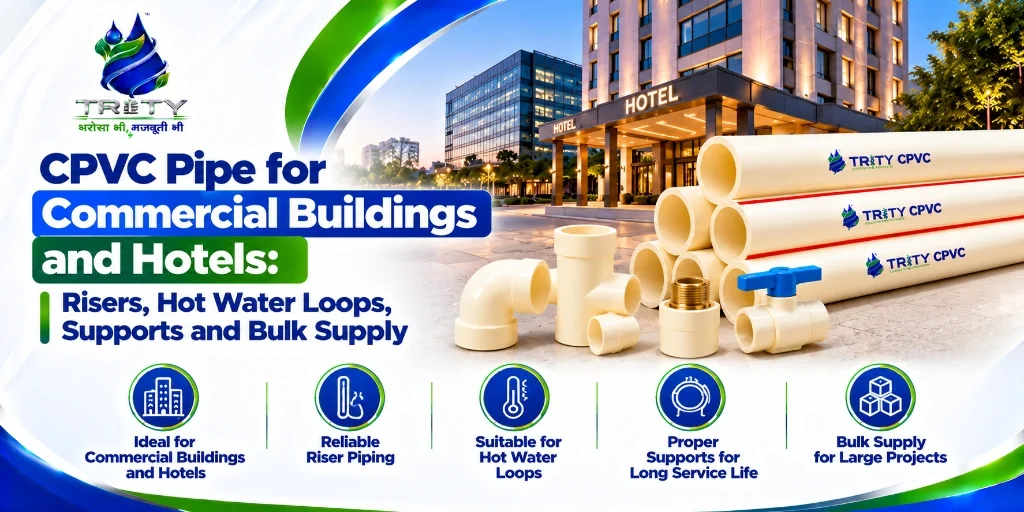
A home has one geyser and a few bathrooms. A hotel has hundreds of bathrooms, a central hot water plant, vertical risers running through every floor and a recirculation loop that keeps water hot around the clock. The pipe has to carry hot water for decades, in walls and shafts that nobody wants to open, and the same design is repeated in every room, so a mistake is repeated too.
CPVC is widely used for these systems because it handles hot water, does not corrode or scale, is light enough to install quickly on tall buildings and costs less than copper. But a commercial system needs more than a home-sized plan. This guide assumes CPVC has already been chosen, and explains how to specify it for hotels, hospitals, offices and apartment towers: which parts of the system need which pressure class, how to handle risers and recirculation loops, how to support and insulate pipe, how to test and commission, how to order for many identical rooms, and how to work with Trity Pipes. For the home-scale version, read our guides on CPVC system design and CPVC pipe for bathroom and kitchen.
How a commercial hot water system differs from a home system
- Scale. Dozens or hundreds of fixtures, long runs and large flows.
- Central plant. One or more boilers, heat pumps or solar loops feed the whole building.
- Vertical distribution. Risers carry hot and cold water through every floor, so static pressure is high at the bottom.
- Recirculation. A return loop keeps hot water moving, so guests do not wait for it and the pipe stays warm all day.
- Repetition. The same bathroom layout is repeated many times, so specification and procurement can be standardised.
- Hard access. Pipes sit in shafts, ceilings and walls that are costly to reopen.
Why CPVC is used in commercial plumbing
Our product page describes Trity CPVC as made to IS 15778 for hot and cold potable water, with a smooth bore that does not scale and a service life described as 40 to 50 years. Compared with copper, CPVC costs less, is much lighter to hang and handle, and does not suffer the pitting and corrosion that metals can in some waters. It joins with solvent cement, so installation is quick, without flames or soldering, which is a safety advantage in occupied buildings and during refurbishments. For the full comparison with uPVC, see our guide to CPVC vs uPVC pipes.
Choosing pressure class by part of the system
IS 15778 CPVC pipes are classified by SDR, and Trity makes SDR 11 and SDR 13.5 in 15mm to 50mm sizes in the CTS system. A lower SDR means a thicker wall and a higher pressure rating.
| Part of the system | Typical consideration | Class to consider |
|---|---|---|
| Connection at the heater or plant | Highest temperature and thermal cycling | SDR 11 |
| Main risers in tall buildings | Higher static pressure at lower floors | SDR 11 |
| Floor branches | Moderate pressure | SDR 13.5 or SDR 11, per design |
| Final connections in rooms | Lower pressure | SDR 13.5 |
This is a starting point. Your MEP consultant sets the final class from the pressure and temperature calculations, and for sizes above 50mm or for central plant connections, discuss the requirement with our technical team.
A note on temperature ratings
Design to the actual operating temperature of your system, and not to the highest number in a catalogue. Under IS 15778, pipe is pressure tested at 82\u00b0C as well as at room temperature, and our product page rates Trity CPVC to about 93\u00b0C. Hot water in buildings should also be managed for safety, because very hot water scalds, and because hot water systems in hotels and hospitals have specific health guidance, so follow your consultant's temperature and control design. Solar water heating loops can reach higher temperatures when there is no draw, so confirm the limits with the solar supplier.
Risers and vertical runs
Vertical risers need more thought than horizontal runs.
- Support them properly. Use supports at suitable spacing, and fix the riser at designated anchor points so that the weight is carried, while allowing the pipe to move between anchors.
- Allow for expansion. A long riser expands noticeably when it heats, so use offsets, loops or expansion arrangements at intervals, as the design requires.
- Sleeve penetrations. Where pipe passes through floor slabs and walls, use sleeves so that the pipe can move freely, and seal around it as the specification requires.
- Respect fire stopping. Where pipes pass through fire-rated floors and walls, the opening must be fire stopped with a suitable system, as set out by your fire consultant. Plastic pipes need particular attention here.
- Protect from damage during construction, since shafts are busy places.
Hot water recirculation loops
A recirculation loop returns unused hot water to the heater, so the pipe stays warm and hot water arrives quickly at the farthest tap.
- Size the loop as a design element of its own, with the right flow and pump
- Insulate the loop and the hot lines to cut heat loss and save energy, using insulation suitable for the pipe and temperature
- Balance the loop so that every branch gets flow
- Include isolation valves and unions so that sections can be serviced without draining the building
- Allow for expansion along the loop
Supports, insulation and expansion in the ceiling and walls
- Support spacing is closer on hot lines than on cold lines, and closer on smaller pipe sizes, so follow the manufacturer's recommendation
- Insulate hot water pipes that run through cool spaces, and prevent condensation on cold lines where required
- Avoid rigid, long, straight runs without offsets or expansion allowance
- Keep pipes clear of heat sources, flues and hot surfaces
- Use clips that do not squeeze or abrade the pipe, and that allow movement
Fittings, unions and valves
A commercial system needs a full fittings set: elbows, tees, couplers, reducers, unions and end caps, which Trity makes to the same dimensional tolerance as its pipe, plus valves, threaded connections and equipment connections that suit CPVC. Ask our team what is available to match your design. Our guide on CPVC fittings explains each fitting and how to count them, which is especially useful when you multiply one bathroom's count by hundreds of rooms.
Solvent cement and jointing at scale
CPVC needs CPVC-specific solvent cement. On a large project, jointing quality is the biggest risk, because many installers work in many places.
- Use only CPVC solvent cement, in the right quantity for the size
- Train the installers on cutting square, deburring, cleaning, applying cement evenly, inserting fully, holding and allowing full cure
- Supervise and record jointing, floor by floor
- Keep cement fresh and stored properly
Testing and commissioning
Pressure testing is non-negotiable in commercial plumbing.
- Fill the system slowly and release air
- Bring it to the test pressure gradually as the specification requires, and hold it
- Inspect every joint and record the result
- Repair and retest any leak
- Flush the system before it goes into service
- Keep the records for handover
Test floor by floor before concealing, because a leak found after ceilings and tiles go in is far more expensive to fix.
Quality checks before you install
On a large project, a defective batch can affect many rooms. Check pipe and fittings as they arrive: marking, wall thickness, finish and fit. Our guide on how to check CPVC pipe quality explains how to verify the BIS licence, judge wall thickness by SDR and ask for test reports.
Procurement for many identical rooms
- Standardise sizes, classes and fittings across room types
- Order from single batches where possible, so that dimensions and finish are consistent
- Plan phased delivery floor by floor
- Order fittings with the pipe, with spares
- Keep batch records for each floor
- Agree the rate and validity at the start of the programme
Our guide on CPVC pipe price explains the factors behind rates, and our guide on buying in bulk explains how to structure a large phased order. Our guide on conduit pipe for hotels and resorts covers the electrical side of the same projects.
Why hotels and commercial projects choose Trity CPVC
Trity Pipes manufactures CPVC pipes and fittings from high-grade, lead-free CPVC compound, to IS 15778, in 15mm to 50mm CTS sizes and SDR 11 and SDR 13.5 classes, with ISO 9001:2015 certification. Our team can help you choose the class for each part of your system, share IS 15778 test reports and certification documents, arrange sample batches for evaluation and prepare a written quotation for bulk or phased supply. We dispatch from our Delhi NCR facility to 20-plus states. See the CPVC pipes and fittings range. Builders, MEP contractors and plumbing contractors can ask about project supply, and dealers can ask about stocking the range.
Refurbishment and phased occupancy
Many hotels and commercial buildings refurbish floor by floor while the rest of the property stays open. CPVC suits this well, because solvent-cement joints need no flame and the pipe is light to carry up service stairs. Isolate each floor with valves, drain only that section, replace or extend pipe, test and recommission before moving on, and keep a record of which batch went where. Because Trity makes pipe and fittings in matching dimensions, a later phase can use the same product as an earlier one, which keeps joints consistent across the building.
Frequently Asked Questions
Which CPVC pressure class should I use for a hotel hot water riser?
SDR 11 is usually considered for main risers and the connection at the heater, where pressure and temperature are highest, and SDR 13.5 for floor branches and room connections, as your consultant's calculations confirm.
Do I need to insulate CPVC hot water pipes in a building?
Insulating hot lines and the recirculation loop reduces heat loss and saves energy, and it keeps water hot at the tap. Follow the specification for insulation type and thickness.
How do I handle expansion in a long CPVC riser?
Support the riser at anchor points, allow it to move between them, and use offsets or expansion arrangements at intervals as the design requires. Do not fix a long straight run rigidly.
Can CPVC pipes pass through fire-rated floors?
They can, with proper sleeves and fire stopping designed for plastic pipe penetrations, as set out by your fire consultant and the applicable rules. Never leave an unsealed opening.
How should I order CPVC for hundreds of identical bathrooms?
Standardise sizes and fittings, order from single batches where possible, phase delivery floor by floor, order fittings with the pipe, and agree rate validity at the start.
Can Trity Pipes supply CPVC for a hotel or hospital project?
Yes. Share your sizes, classes, quantities and programme, and our team will prepare a quotation, share IS 15778 test reports and arrange sample batches and phased delivery from our Delhi NCR factory.
Planning a commercial plumbing project? Contact Trity Pipes on +91-9821030072 or +91-9319984755 for a CPVC pipes and fittings quotation, IS 15778 documents and phased supply from our Delhi NCR factory.