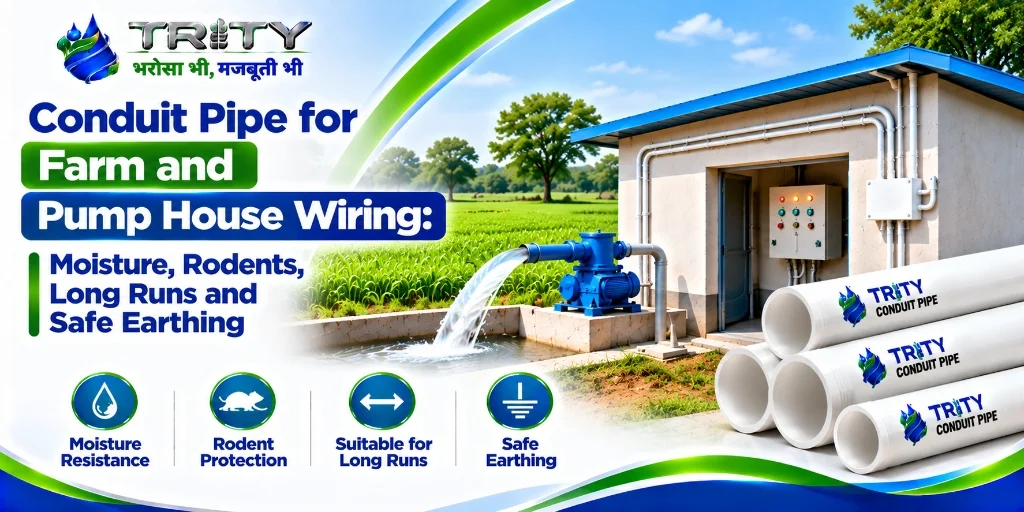
A farm's electrical system is one of the most exposed in the country. The pump house sits beside a borewell or canal, often damp. The supply comes from a transformer or pole hundreds of metres away. The wiring runs across open land, through gates and over irrigation channels. Rats chew cable, monsoon floods fill trenches, lightning strikes tall poles and, in the middle of the sowing season, a failed circuit means a field without water.
Conduit is a simple, economical way to protect that wiring. This guide explains how to plan conduit for farmhouses, pump houses, borewell control panels, farm sheds and field circuits: what a typical farm electrical layout includes, which grade and size to choose, how to protect long underground runs, how to deal with moisture, rodents and lightning, how earthing fits in and how to order supply with Trity Pipes. For poultry and livestock sheds, read our guide on conduit pipe for poultry farms, and for the water side, our guide on uPVC pipe for irrigation mainlines.
What a farm electrical layout includes
- The incoming supply point, often a pole, meter box or small distribution board
- The pump house, with a starter or control panel for the borewell or surface pump
- Submersible pump cable, which runs down the borewell alongside the column pipe
- The farmhouse or farm office, wired like a small home
- Farm sheds, storage and workshops, with lighting and power
- Field lighting, gates and boundary circuits
- Solar pumps and rooftop solar, which are increasingly common
- Irrigation automation, such as timers, controllers and sensors
The routes between these points are long, and most of them are outdoors or underground.
Why conduit helps on a farm
- Protection from rodents. Cable inside a closed conduit is much harder for rats to reach and chew.
- Protection from moisture. Sealed conduit keeps water, mud and condensation away from cable insulation.
- Mechanical protection. Vehicles, ploughs, animals and tools cannot easily damage buried conduit.
- Safety. An enclosed cable reduces the chance of contact with people and animals.
- Easy repair. A damaged cable can be pulled out and replaced without digging up the whole run.
- Low cost. uPVC conduit is economical, light and quick to lay.
Planning the pump house
The pump house is the heart of the farm's electrical system.
- Keep the control panel dry, raised off the floor and inside a weatherproof enclosure. Moisture and dust are the main causes of starter failures.
- Use sealed boxes and glands for all conduit entries, entering from the side or bottom so that water does not run in.
- Protect the cable to the borewell at the point where it leaves the panel and goes to the wellhead.
- Use HMS grade conduit inside the pump house and on exposed runs, because tools, equipment and animals can knock it.
- Seal conduit ends against insects, which like to nest in warm electrical enclosures.
- Provide good ventilation to keep panels from overheating, without letting in rain.
Long underground runs from the supply point
Many farms need a cable run of tens or hundreds of metres from the supply pole to the pump house or farmhouse, and underground is the safest route.
- Dig the trench to a suitable depth, deeper where vehicles, ploughs or farm machinery cross, and follow your electrical consultant's or utility's requirements
- Lay conduit on a smooth bed, free from sharp stones, and backfill with soft soil around the pipe
- Use HMS grade for buried runs and for crossings
- Add warning tape or markers above the conduit, and record the route on a sketch
- Use pull chambers or boxes on long runs and at changes of direction, so that cable can be pulled
- Avoid sharp bends, because they make pulling difficult
- Seal the ends against water and animals
Our guide on underground conduit pipe for cable protection explains depth, bedding and protection in detail.
Voltage drop on long runs
A long cable run loses voltage, and a pump motor that gets too little voltage runs hot and fails early. When a run is long, the conductor size usually has to be increased, and the conduit size should allow for the larger cable. Ask your electrician to calculate the voltage drop for the run, and choose a conduit that lets the cable be pulled without damage. Our conduit pipe size chart helps match conduit size to cable fill.
Moisture, flooding and humidity
Farms are damp places.
- Seal every box and gland. Condensation and splashing are constant in pump houses.
- Keep boxes above likely flood levels where possible
- Choose proper drainage around the pump house so that water does not collect
- Avoid low points in conduit runs where water can collect, or provide a way to drain them
- Check seals regularly, especially after the monsoon
Rodents, termites and animals
Rats will chew through cable insulation, and a chewed cable is a short circuit waiting to happen. Closed, sealed conduit is the best defence, together with sealed ends and sealed boxes. Keep conduit ends capped and avoid leaving gaps where animals can enter. Keep the pump house tidy and free of stored grain or other attractants.
Lightning and earthing
Open land and tall poles attract lightning, and farm installations need good earthing.
- Earth the pump, panel, motor frame and metal parts as the electrical specification requires
- Keep earth conductors continuous and protected, and test the earth resistance periodically
- Use residual current protection at the panel, since moisture raises shock risk
- Consider surge protection for the panel and the control system, particularly in areas with frequent lightning
- Follow the consultant's specification for earthing and lightning protection
uPVC conduit is non-conductive, so conductors inside need their own earth, and any metal fittings, boxes or supports should be bonded as the specification requires.
Sun and weather: exposed conduit
Exposed conduit on poles, walls and pump house roofs sees strong sun. Trity offers UV-stabilised variants for outdoor applications, and our team can confirm the grade and specification for your site. Fix conduit securely, use closer saddle spacing on long horizontal runs, allow for expansion and use sealed fittings. Our guide on UV resistant conduit for outdoor wiring explains what to check.
Solar pumps and farm solar
Solar-powered pumps are growing fast. Panel arrays are outdoors in full sun, with DC cable running to a controller and pump, so conduit must be UV-resistant and secure, and cable runs should be separate for DC and AC. Our guides on conduit pipe for solar panel wiring and rooftop solar installations explain the principles.
The farmhouse and farm buildings
Farmhouses and sheds are wired like small homes and workshops. Concealed MMS conduit suits the house, and surface HMS conduit suits sheds and workshops. Our guide on calculating conduit pipes and fittings for house wiring explains how to estimate quantities, and our guide on concealed and surface wiring helps you choose.
Choosing grade and size
| Area | Typical use | Suggested grade |
|---|---|---|
| Pump house interior | Panel and equipment wiring | HMS |
| Buried runs and crossings | Supply line and field circuits | HMS |
| Exposed poles, walls, roofs | Outdoor | HMS, UV stabilised |
| Farmhouse interior | Concealed wiring | MMS |
| Farm sheds and workshops | Surface | HMS |
Use this as a starting point, with your electrician's and consultant's requirements taking priority. Our LMS, MMS and HMS guide explains the grades.
Common mistakes in farm wiring
- Burying cable without conduit, where rats and ploughs can reach it
- Using indoor boxes in a damp pump house
- Entering boxes from the top, so that water runs in
- Undersizing the cable on a long run, causing voltage drop
- Skipping earthing checks after the monsoon
- Leaving conduit ends open
- Using light grade conduit where it can be knocked
Why farmers, electricians and dealers choose Trity Pipes
Trity Pipes is a manufacturer of uPVC conduit pipes and fittings made from lead-free, high-grade virgin raw materials, certified to IS 9537 Part 3 with ISO certification. For farm and agricultural projects, we offer:
- LMS, MMS and HMS grades with matching fittings, boxes and saddles
- Technical guidance on grade, size and protection for pump houses and buried runs
- Bulk and project quotations for farms, agri-infrastructure contractors and electrification projects
- A Delhi NCR factory with dispatch to 20-plus states and a network of more than 250 distributors and 1,500 dealers, so supply is available close to your farm
- A wider range that serves the rest of the farm, including column pipes, casing pipes and pressure pipes for borewells and irrigation
See the uPVC conduit pipes and fittings range, and ask our team for the Trity Pipes price list. Dealers who serve farmers can read our guide on the borewell pipe dealership.
Frequently Asked Questions
Which conduit grade is best for pump house wiring?
HMS grade is the usual choice for pump house interiors, buried runs and exposed outdoor runs, because of moisture, knocks and animals, with sealed boxes and glands.
Should farm cables be buried with conduit?
Yes. Buried cable inside conduit is protected from rodents, ploughs, vehicles and moisture, and it can be replaced without digging up the whole run.
How deep should conduit be buried on a farm?
Deeper where vehicles, ploughs or machinery cross. Follow your electrician's, consultant's or utility's requirements, and use HMS grade and markers.
How do I stop rats from damaging farm wiring?
Run cable in closed, sealed conduit, cap conduit ends, seal boxes and keep the pump house tidy and free of stored grain.
Does conduit help with voltage drop on a long farm run?
Conduit does not reduce voltage drop, but a long run usually needs a larger cable, and the conduit should be sized so that the cable can be pulled without damage.
Can Trity Pipes supply conduit for an agricultural electrification project?
Yes. Share your sizes, grades, quantities and schedule, and our team will prepare a quotation and discuss delivery from our Delhi NCR factory.
Wiring a farm or pump house? Contact Trity Pipes on +91-9821030072 or +91-9319984755 for a quotation, grade guidance and certification documents for ISO-certified uPVC conduit pipe from our Delhi NCR factory.