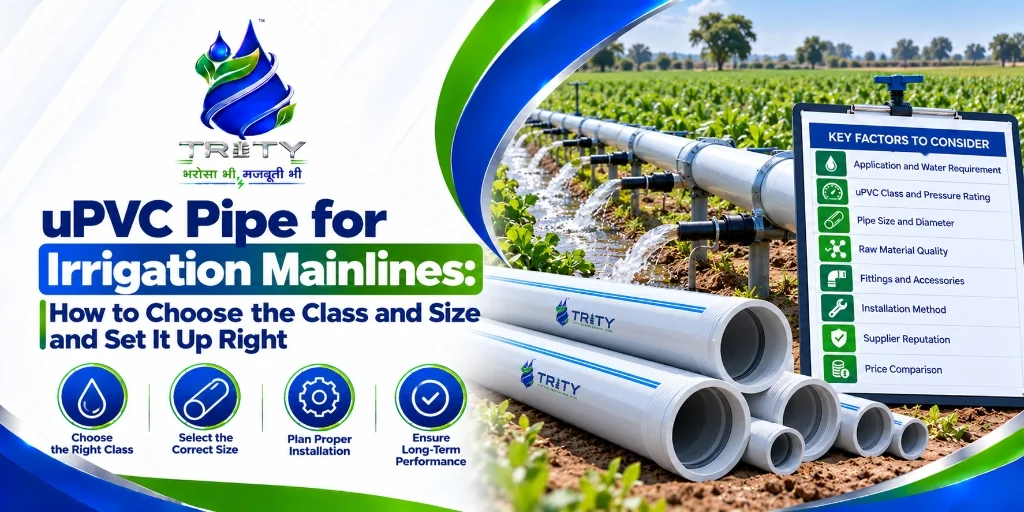
The mainline is the backbone of an irrigation system. It carries water from the pump or source to every field, so it sees the highest pressure on the farm and the sharpest pressure surges when a valve closes or a pump starts. A weak spot in a mainline does not just leak. It cuts water to an entire block, and the repair means digging up a buried pipe in the middle of the season.
uPVC pressure pipe is widely used for irrigation mains and submains because it does not corrode, keeps a smooth bore and is light enough to lay quickly. But it only works well if the class and diameter are right for your pump and layout, and if the line is installed with the right accessories. This guide explains how to choose the IS 4985 class, how to size the diameter, why water hammer and trapped air cause most failures, how to bury and anchor the pipe, and how to get a quotation from Trity Pipes. For general guidance on class and diameter in home water supply, see our guide on pressure pipe sizing.
Where uPVC fits in an irrigation system
uPVC is a rigid pipe, best suited to the parts of a system that are fixed and always pressurised.
- Mainlines and submains: the strongest use, carrying water from the pump to field blocks
- Delivery lines from borewells and tubewells: from the pump outlet to the field or tank
- Cold water conveyance: uPVC is for cold water, not hot
Flexible pipe such as polyethylene is more common for laterals and drip lines, which are moved or laid on the surface, while uPVC is the usual choice for permanent buried mains.
How uPVC pressure pipe is classified
uPVC pressure pipe in India is made to IS 4985, and it is classified by working pressure at 27\u00b0C. Trity makes the full range, Class 1 to Class 6.
| Class | Working pressure | Typical irrigation use |
|---|---|---|
| Class 1 | 2.5 kgf/cm\u00b2 | Low-pressure gravity feed |
| Class 2 | 4.0 kgf/cm\u00b2 | Light irrigation, feeder lines |
| Class 3 | 6.0 kgf/cm\u00b2 | Standard irrigation mains |
| Class 4 | 8.0 kgf/cm\u00b2 | Longer or higher-head mains |
| Class 5 | 10.0 kgf/cm\u00b2 | High-pressure pump mains |
| Class 6 | 12.5 kgf/cm\u00b2 | Highest-pressure lines |
A higher class has a thicker wall for the same diameter. The pipe's working pressure is the pressure it can carry continuously, and short surges above it are what the safety margin is for, which is why the class must be chosen with the surge in mind, not only the steady pressure.
Step 1: Work out the pressure your pipe will see
Start with the pressure your pump delivers and the head the system needs.
- Find the pump's rated discharge pressure from its specification, not its horsepower.
- Add the static head, the vertical lift from the pump to the highest point of the line.
- Add friction losses in the pipe, and in valves and fittings. A common rule is to add about 10 percent of the total for losses in valves and fittings.
- Add a margin for surges, since valve closures and pump starts create pressure spikes above the steady value.
- Choose a class whose working pressure is above that total, and ask your supplier to confirm it.
If your pump delivers high pressure at the start of the line, you can sometimes use a higher class near the pump and a lower class further along, where pressure has dropped, which saves money. Check this with your supplier and design the transitions carefully.
Step 2: Size the diameter for flow, not just pressure
Class sets how much pressure the pipe can carry. Diameter sets how much water it can deliver without wasting energy.
- Calculate the flow the pipe must carry, based on the area irrigated and the water requirement.
- Keep the water velocity within a sensible range. Water moving too fast causes high friction loss and severe water hammer when valves close.
- Use the pipe's smooth bore to your advantage. uPVC has a high Hazen-Williams coefficient, and Trity's pressure pipes carry a value of C=150, so friction loss is low compared with rougher pipe.
- Account for length. Long mains lose more pressure, and a bigger diameter reduces that loss and the pumping energy you pay for.
A slightly larger diameter costs more at purchase and saves on pumping for years, so the cheapest diameter is not always the cheapest system.
Water hammer: the main cause of mainline failures
Water hammer is the pressure surge that occurs when moving water is stopped suddenly, for example when a valve closes quickly or a pump trips off. The surge can be several times the steady pressure for a moment, and it is what bursts pipes that were fine during normal running.
You can reduce the risk in several ways.
- Close valves slowly, and prefer valves that cannot be slammed shut
- Keep velocity moderate by choosing a sufficient diameter
- Choose a class with margin above the steady pressure, so that surges stay within the pipe's capacity
- Use air valves and, where needed, surge control devices
- Start and stop pumps in a controlled way
Air valves at high points
Air collects at high points in a pipeline and acts like a cushion that can produce violent local pressure when it is compressed or pushed through. Install air release valves at the peaks of the line, and at regular intervals along long runs. Some manufacturers suggest roughly every 300 to 400 metres at high points. Air valves also let air in when the line drains, which prevents vacuum collapse. It is one of the most important and most neglected parts of a pipeline.
Thrust blocks and anchoring
When water changes direction at a bend, tee or end, it pushes on the fitting, and at high pressure the force is large enough to pull a joint apart. Fittings that change direction or end a line, and valves, should be anchored with concrete thrust blocks or properly restrained, sized for the pressure and the soil. For surface-laid pipe, anchor and support it so that it cannot move.
Burying the pipe
Buried uPVC is protected from sunlight, damage and temperature swings, and it lasts a long time.
- Dig the trench to a suitable depth for the terrain and traffic, so the pipe is protected from vehicles, ploughing and tools
- Lay the pipe on a smooth bed, free from sharp stones, and backfill with soft soil around the pipe
- Leave joints exposed for testing until the line has passed a pressure test
- Backfill in layers and compact gently
- Mark the route so that it is not damaged later
Surface lines and sunlight
Pipe that stays above ground needs UV protection. Our product page describes our pressure pipes as UV stabilised for surface installations, which is part of what makes them suitable for exposed runs. Even so, support exposed pipe properly, allow for expansion, and avoid leaving it stacked in direct sun for long periods before use.
Joints: solvent cement or ring joints
Smaller pipes are normally joined with solvent cement, which forms a permanent chemical bond, and that is how Trity's pressure pipes are designed to be jointed. Larger sizes often use ring joints, which allow quicker installation. For solvent joints, clean and dry the surfaces, apply the cement evenly, insert fully and allow full cure time before pressure testing.
Test the line before you backfill
Fill the line slowly, release air, bring it to test pressure gradually and hold it. Check every joint, and repair any leak before covering the pipe. A pressure test is cheap compared with digging up a buried main.
What decides the cost of a uPVC irrigation mainline
- Class: a higher class costs more per metre
- Diameter: larger pipe uses more compound
- Length: a mainline of hundreds of metres adds up, so quantity matters
- Fittings and cement: elbows, tees, couplers, reducers and valves
- Accessories: air valves, thrust blocks and gate valves
- Freight: pipe is long and bulky
- GST: plastic pipes and fittings attract 18 percent GST under HSN 3917
Our guide on uPVC pressure pipe price explains how to compare quotes on the same basis, and our guide on buying in bulk shows how order size affects rates, which matters for large farms and contractors.
What a Trity Pipes irrigation quotation includes
Trity Pipes manufactures uPVC pressure pipes to IS 4985 in the full Class 1 to Class 6 range, from lead-free virgin uPVC compound, with matching fittings. Every batch is pressure tested, with wall thickness checks and reversion testing, before dispatch. When you send us your pump specification, line length, diameter and quantity, our team can help you choose the class and prepare a quotation that states the class, size, rate, what is included, the delivery basis and the validity. IS 4985 test reports and ISO 9001:2015 certification are available on request. See the uPVC pressure pipes range.
Farmers, irrigation contractors, pump dealers and agricultural equipment dealers can ask about bulk supply and dealership. We dispatch from our Delhi NCR facility to 20-plus states, with delivery time confirmed with each quotation. If your project also involves a borewell, we make column pipes and casing pipes.
Frequently Asked Questions
Which uPVC pipe class is best for an irrigation mainline?
It depends on the pump's discharge pressure, the static head, friction losses and surge pressure. Class 2 or 3 is common for light and standard irrigation, with higher classes for longer lines and high-pressure pumps. Share your pump details with our team to confirm.
Can I use uPVC pipe for drip irrigation laterals?
uPVC is best for mainlines and submains. Laterals and drip lines are usually flexible polyethylene, because they are laid on the surface and moved. Use uPVC for the fixed pressurised part of the system.
What causes uPVC irrigation pipes to burst?
Most failures are caused by water hammer, trapped air, a class chosen too low for surge pressure, poor joints or lack of thrust blocking at bends. Good design and installation prevent them.
Do I need air valves on a uPVC mainline?
Yes, at high points and at regular intervals on long lines. Air valves release trapped air during filling and let air in when the line drains, which protects the pipe.
Can uPVC pipe be laid above ground in the sun?
Pipe on the surface needs UV-stabilised material and proper support. Trity's pressure pipes are described on our product page as UV stabilised for surface installations. Avoid leaving stacks of pipe in direct sun for long before use.
Can Trity Pipes supply pipe for a large farm project?
Yes. Share your pump specification, line length, diameter and quantity, and our team will prepare a quotation and discuss delivery from our Delhi NCR facility to your state.
Planning an irrigation line? Contact Trity Pipes on +91-9821030072 or +91-9319984755 with your pump and line details for a uPVC pressure pipe quotation, class guidance and IS 4985 documents from our Delhi NCR factory.