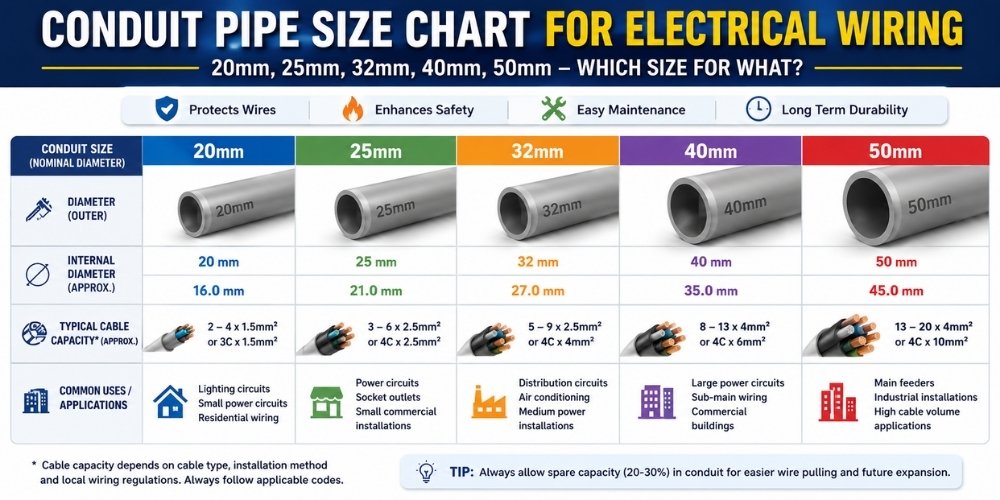
Conduit Pipe Size Chart for Electrical Wiring (Quick Reference Table)
Every electrician, contractor, and builder faces the same question on site: which conduit size goes where? Wrong sizing creates problems that are expensive to fix once walls are sealed and slabs are poured. This quick reference table gives you the answer at a glance.
| Conduit Size | Typical Use | Recommended No. of Wires (2.5 sq mm) | Residential | Commercial | Industrial |
|---|---|---|---|---|---|
| 20mm | Lighting circuits, single switch runs | 3 to 5 | Yes | Limited | No |
| 25mm | Power socket circuits, multi-wire runs | 5 to 8 | Yes | Yes | Limited |
| 32mm | Sub-main feeders, mixed cable runs | 8 to 12 | Large projects | Yes | Yes |
| 40mm | AC circuits, main feeders, large gauge cables | 10 to 15 | Rare | Yes | Yes |
| 50mm | Three-phase runs, multi-circuit industrial wiring | 15 to 22 | No | Large projects | Yes |
| 63mm | Heavy infrastructure, utility cable bundles | 22 and above | No | Data centres | Yes |
What size conduit pipe should be used for electrical wiring in India?
For standard residential wiring in India, 20mm conduit is used for lighting circuits and 25mm for power socket circuits. Commercial installations typically use 25mm to 40mm depending on circuit load. Industrial projects with three-phase wiring or large cable bundles require 40mm to 63mm conduit. Always select the next size up to accommodate future wiring additions and maintain safe conduit fill.
Why Choosing the Correct Conduit Pipe Size Matters
Selecting the right conduit pipe size is not a detail to leave to chance. It directly affects electrical safety, cable longevity, installation quality, and the cost of any future wiring changes.
Cable protection. A conduit that is too small forces cables into tight bends during pulling. The insulation gets scraped against the pipe wall, creating weak points that are invisible until a fault develops. A correctly sized conduit keeps cables moving freely from entry to exit without stress.
Heat dissipation. Wires carrying current generate heat. When too many cables are packed into a small conduit, that heat has nowhere to go. The combined thermal load reduces each wire's safe current-carrying capacity, which can lead to insulation degradation over time. A properly sized conduit gives heat room to dissipate and keeps cables within their rated operating temperatures.
Easier cable pulling. A tight conduit takes far more effort to pull cables through, especially on long runs with multiple bends. On large commercial or industrial projects, this translates directly into lost man-hours and higher labour costs. The right size makes wire pulling straightforward.
Future wiring additions. Buildings rarely remain unchanged for their entire life. Air conditioners get added, office layouts change, solar panels go on rooftops. A conduit sized with 20 to 30 percent spare capacity means new wires can be added without breaking walls or laying new conduit. This is one of the most practical benefits of correct sizing and one of the most frequently overlooked.
Reduced installation damage. Forcing oversized cable bundles into undersized conduit bends creates kinks, insulation cuts, and damaged conductors. These faults are hard to locate and expensive to repair. Correct conduit sizing eliminates this category of damage entirely.
Compliance with good electrical practice. IS 9537 Part 3, the Bureau of Indian Standards specification for rigid uPVC conduit pipes, governs conduit sizing and performance in India. Working within these standards protects contractors from liability and ensures installations pass inspection on government and commercial projects.
Practical example: A 2BHK apartment wired with 20mm conduit throughout may seem adequate on day one. But when the owner adds a 1.5-tonne AC unit, a washing machine, and a water heater two years later, the existing conduit is already at capacity. Re-routing new wiring through walls means chiselling, replastering, and repainting. Sizing 25mm conduit on power circuits from the start would have allowed these additions with no rework at all.
Understanding Standard Conduit Pipe Sizes in India
All standard conduit pipe sizes in India are governed by IS 9537 Part 3. The specifications below are taken from this standard and reflect the outer diameter (OD) and minimum inner diameter (ID) for Medium Mechanical Stress (MMS) grade conduit.
| Conduit Size | OD Min (mm) | OD Max (mm) | MMS Inner Diameter (min, mm) | Approx. Internal Area (sq mm) |
|---|---|---|---|---|
| 20mm | 19.7 | 20.0 | 16.9 | 224 |
| 25mm | 24.6 | 25.0 | 21.4 | 360 |
| 32mm | 31.6 | 32.0 | 27.8 | 607 |
| 40mm | 39.6 | 40.0 | 35.4 | 985 |
| 50mm | 49.5 | 50.0 | 44.3 | 1,541 |
| 63mm | 62.5 | 63.0 | 57.0 (est.) | 2,551 |
63mm specifications are indicative. IS 9537 Part 3 formally covers up to 50mm. Confirm 63mm dimensions with the manufacturer before project specification.
20mm conduit is the most widely used size in Indian residential construction. Its internal space is sufficient for lighting and basic socket circuits with a small number of wires. Most electricians default to 20mm for standard concealed wiring runs in homes.
25mm conduit gives meaningfully more internal space than 20mm and is the right choice wherever multiple wires share a single run, or where future additions are expected. It is the recommended size for power socket circuits and feeder runs from distribution boards to room sub-boards.
32mm conduit is used for heavier feeder runs, electrical risers in multi-storey buildings, and circuits carrying 6 sq mm or larger cables. It is common in commercial buildings and large residential projects where multiple circuits share a single conduit path.
40mm conduit handles the main distribution wiring in commercial buildings, heavy-duty circuits for air conditioning and large motor loads, and any application requiring 10 sq mm or larger cables. It is the standard size for main incoming supply conduit in medium commercial projects.
50mm conduit is an industrial-grade size used for three-phase installations, grouped power circuits in factories, and large cable bundles in infrastructure projects. It provides substantial internal capacity for complex wiring systems.
63mm conduit is used in heavy infrastructure, data centres, utility installations, and underground cable protection for major cable bundles. It is rarely encountered in standard residential or commercial construction but is important for large-scale projects.
To understand how the grade of conduit (LMS, MMS, or HMS) affects the internal diameter and mechanical performance of each size, read our detailed guide: LMS vs MMS vs HMS: Which uPVC Conduit Grade is Right for Your Project?
Expert Summary: Standard IS 9537 Part 3 certified uPVC conduit pipes in India range from 16mm to 63mm. The most widely used sizes in residential projects are 20mm for lighting circuits and 25mm for power socket circuits. Commercial buildings typically specify 32mm to 40mm for distribution wiring. Industrial and infrastructure projects use 50mm and 63mm for high-density cable bundles and three-phase installations.
What is the 40% Conduit Fill Rule?
The 40% conduit fill rule is the most important principle in conduit sizing. Understanding it takes the guesswork out of every wiring project.
What conduit fill means. Conduit fill is the percentage of a conduit's internal cross-sectional area that is occupied by cables. If the total cross-sectional area of all cables inside a conduit equals 40% of the conduit's internal area, the conduit is at its fill limit.
Why the 40% limit exists. There are two reasons. First, heat dissipation. Wires carrying current produce heat. The space around the cables inside the conduit acts as a buffer for that heat to move away. When cables are packed too tightly, heat has nowhere to go and insulation temperatures climb beyond safe limits. Second, cable pulling. Even if cables physically fit at 50 or 60% fill, pulling them through long runs with bends becomes extremely difficult. At 40% fill, cables move through the conduit without binding or excessive friction.
Future maintenance benefit. A conduit filled to 40% leaves 60% of its internal space free. This margin makes it straightforward to pull in additional cables later without disturbing existing wiring. It also makes fault-finding and wire replacement significantly easier over the life of the installation.
Practical example: A 25mm MMS conduit has an internal diameter of 21.4mm. The internal cross-sectional area is approximately 359 sq mm. At 40% fill, the maximum allowable cable area inside is 144 sq mm. A 2.5 sq mm PVC-insulated wire has an approximate outer diameter of 4.5mm and a cross-sectional area of about 15.9 sq mm. Dividing 144 by 15.9 gives approximately 9 wires as the maximum at the fill limit. In practice, planning for 7 to 8 wires leaves a comfortable margin for easy pulling and future additions.
Featured snippet answer: What is the 40% conduit fill rule? The 40% conduit fill rule states that the total cross-sectional area of all cables inside a conduit should not exceed 40% of the conduit's internal cross-sectional area. This limit ensures adequate heat dissipation, prevents insulation damage, allows easy cable pulling, and leaves space for future wiring additions.
Expert Summary: The 40% conduit fill rule is the standard applied in Indian electrical installations to determine how many cables can safely occupy a conduit. It prevents heat buildup, reduces cable pulling resistance, and ensures room for future wiring additions. The fill percentage is calculated by dividing the combined cross-sectional area of all cables by the internal cross-sectional area of the conduit.
How Many Wires Can Fit Inside a Conduit Pipe?
The tables below provide estimated wire capacities based on the 40% fill rule and IS 9537 Part 3 MMS internal diameter specifications. Outer diameter values are approximate for standard PVC-insulated single-core cables commonly used in Indian residential and commercial wiring.
Approximate outer diameters of standard cables used in India:
| Cable Size | Approximate Outer Diameter (mm) | Approximate Cross-Section Area (sq mm) |
|---|---|---|
| 1.5 sq mm | 3.8 mm | 11.3 |
| 2.5 sq mm | 4.5 mm | 15.9 |
| 4 sq mm | 5.2 mm | 21.2 |
| 6 sq mm | 6.0 mm | 28.3 |
| 10 sq mm | 7.5 mm | 44.2 |
Wire capacity by conduit size at 40% fill (MMS grade):
| Conduit Size | Internal Area (sq mm) | 40% Fill Area (sq mm) | 1.5 sq mm wires | 2.5 sq mm wires | 4 sq mm wires | 6 sq mm wires | 10 sq mm wires |
|---|---|---|---|---|---|---|---|
| 20mm | 224 | 90 | 8 | 5 | 4 | 3 | 2 |
| 25mm | 360 | 144 | 12 | 9 | 6 | 5 | 3 |
| 32mm | 607 | 243 | 21 | 15 | 11 | 8 | 5 |
| 40mm | 985 | 394 | 34 | 24 | 18 | 13 | 8 |
| 50mm | 1,541 | 616 | 54 | 38 | 29 | 21 | 13 |
| 63mm | 2,551 | 1,020 | 90 | 64 | 48 | 36 | 23 |
Direct Answer: How many wires can fit inside a conduit pipe? The number of wires depends on conduit size and cable cross-section. A 20mm MMS conduit holds up to 5 wires of 2.5 sq mm at the 40% fill limit. A 25mm conduit holds up to 9 wires of 2.5 sq mm. A 32mm conduit holds up to 15 wires of 2.5 sq mm. A 50mm conduit holds up to 38 wires of 2.5 sq mm. Always stay within the 40% fill limit for safe, code-compliant wiring.
Disclaimer: The figures above are calculated estimates based on IS 9537 Part 3 MMS internal diameters and approximate cable outer diameters. Actual capacity depends on the specific cable manufacturer's outer diameter specification, the number and angle of bends in the conduit run, the cable insulation type, and applicable local electrical requirements. Always verify with the cable manufacturer's datasheet before finalising conduit sizing on site.
20mm Conduit Pipe Use
20mm is the most common conduit pipe size in Indian residential wiring. Walk through any apartment under construction in Delhi NCR and 20mm conduit will account for the majority of pipes embedded in the walls and slabs.
Primary applications:
Residential lighting circuits are the natural home for 20mm conduit. A typical lighting circuit in a room carries two to four wires of 1.5 sq mm, which sits comfortably within 20mm's capacity. Switch legs, fan connections, and ceiling light runs all work well here.
Switchboard wiring behind modular switch plates uses 20mm conduit to route wires from the distribution board to individual switch locations. The short runs and low wire count make 20mm the correct choice.
Small home wiring projects, including single-phase power outlets in rooms with modest electrical loads, are commonly wired through 20mm conduit where only two or three wires are involved.
Typical wire capacity: 5 to 8 wires of 1.5 sq mm, or 4 to 6 wires of 2.5 sq mm, at the 40% fill limit.
When 20mm becomes too small:
20mm conduit reaches its limit when a circuit needs to carry more than five or six wires, when cables of 4 sq mm or larger are specified, or when a feeder run from a distribution board needs to serve multiple circuits. Using 20mm conduit for main power socket circuits that will carry 2.5 sq mm wiring and may need future additions is one of the most common sizing mistakes in residential wiring. The correct choice in those situations is 25mm.
25mm Conduit Pipe Use
25mm conduit is the right choice wherever the wire count exceeds the comfortable capacity of 20mm, or wherever future rewiring flexibility is a design priority.
Primary applications:
Power socket circuits in residential buildings are the core application for 25mm conduit. A standard 15A socket circuit runs 2.5 sq mm wiring. Where a run needs to carry the live, neutral, earth, and possibly a loop wire, 25mm provides the right capacity with space to spare.
Main feeder runs from the distribution board to room-level sub-boards carry grouped wires from multiple circuits. These runs need the capacity of 25mm to handle the combined wire count without exceeding fill limits.
Larger residential projects including villas, row houses, and duplex apartments often specify 25mm throughout power circuits to allow convenient additions for air conditioners, geysers, or additional outlets without rework.
Small commercial installations such as offices, clinics, and retail shops use 25mm for their general power wiring where load density is moderate.
Typical wire capacity: 9 to 12 wires of 2.5 sq mm at the 40% fill limit, or 6 to 8 wires of 4 sq mm.
32mm Conduit Pipe Applications
32mm conduit moves into the zone of commercial and heavy residential wiring. It handles cable loads that 20mm and 25mm cannot manage and is the starting point for multi-circuit feeder runs.
Distribution circuits running from a main distribution board (MDB) to multiple floors or zones carry grouped cables of varying sizes. 32mm conduit provides the internal space for these mixed loads without overfilling.
Commercial buildings including office towers, hotels, and hospitals use 32mm for horizontal cable routes in cable management routes between riser shafts and local distribution points.
Larger cable runs using 6 sq mm wiring for high-capacity circuits, such as three-pin outlets with 20A ratings, water heater circuits, or motor starter wiring, are well suited to 32mm conduit.
Multi-circuit installations where a single conduit carries cables for several circuits simultaneously need 32mm to stay within fill limits while maintaining adequate space for pulling.
40mm Conduit Pipe Applications
40mm conduit is specified wherever heavy-duty wiring, large cable sizes, or main distribution routing is involved.
Heavy-duty wiring for loads above 20A, including large air conditioning units, industrial-grade equipment, and direct online motor circuits, typically uses 10 sq mm or 16 sq mm cables that require the internal space 40mm provides.
Air conditioning circuits in commercial buildings are a consistent application for 40mm conduit. A 2-tonne or larger AC unit running on a dedicated circuit needs appropriately sized conduit for both the power cables and the control wiring.
Main distribution wiring from the main LT panel to sub-distribution boards in medium-sized commercial buildings commonly uses 40mm conduit to accommodate grouped large-gauge cables.
Large commercial projects including shopping malls, hospitals, and multi-wing office buildings use 40mm for the primary horizontal distribution runs that serve multiple DB locations on each floor.
50mm and 63mm Conduit Pipe Applications
50mm and 63mm are industrial-scale conduit sizes. Their applications involve high cable density, large conductor sizes, or complex multi-circuit installations that would overwhelm smaller conduit.
Industrial installations in factories, manufacturing plants, and processing facilities route multiple power cables together in shared conduit runs. A 50mm conduit can handle the large cable bundles that industrial panels distribute to machinery and control systems.
Three-phase systems require separate conduit for each phase group plus neutral and earth conductors. 50mm conduit accommodates the larger conductors used in three-phase distribution without requiring multiple smaller conduit runs for the same circuit.
Large cable bundles in data centres, substation buildings, and utility infrastructure combine power, control, and communication cables in shared conduit routes. 50mm and 63mm conduit provide the capacity for these complex arrangements.
Underground cable protection for main service entry cables, distribution cables crossing roads or open ground, and cables buried under floors in industrial facilities commonly uses 50mm or 63mm conduit as a protective sleeve.
Infrastructure projects including metro rail facilities, airport installations, highway lighting distribution, and smart city electrical infrastructure regularly specify 50mm and 63mm conduit for their main cable runs.
Practical example: A 500 KVA substation serving a large commercial complex will have three-phase outgoing feeders running to multiple distribution boards. Each feeder carries cables of 25 sq mm to 95 sq mm cross-section. These cables are routed through 63mm conduit from the LT panel to the cable tray system, providing mechanical protection and keeping the wiring organised through the substation room.
Which Conduit Size Should You Use for Different Applications?
Use this table as a quick reference for conduit sizing across the most common application types encountered in Indian residential, commercial, and industrial projects.
| Application | Recommended Conduit Size |
|---|---|
| Lighting circuits (residential) | 20mm |
| Power socket circuits (residential) | 25mm |
| Kitchen circuits (dedicated appliance) | 25mm |
| Air conditioner wiring (1 to 1.5 tonne) | 25mm |
| Air conditioner wiring (2 tonne and above) | 32mm |
| Water pump wiring (residential submersible) | 25mm |
| Solar panel installation wiring | 25mm to 32mm |
| Commercial office general wiring | 25mm to 32mm |
| Retail store wiring | 25mm to 32mm |
| Apartment building riser conduit | 32mm to 40mm |
| Hotel or hospital main distribution | 40mm to 50mm |
| Industrial panel feeder runs | 40mm to 50mm |
| Three-phase installations | 40mm to 63mm |
| Data and communication cables | 20mm to 25mm (separate from power) |
| Security system wiring | 20mm |
| Fire alarm system cables | 20mm to 25mm |
Direct Answer: Which conduit size is best for house wiring in India? For house wiring in India, use 20mm conduit for lighting circuits with 1.5 sq mm cables, and 25mm conduit for power socket circuits with 2.5 sq mm cables. The main supply conduit from the meter board to the distribution board should be 32mm. Specifying 25mm on all power circuits from the start avoids costly rewiring later as electrical loads grow.
Residential vs Commercial vs Industrial Conduit Sizing
The table below summarises how conduit sizing requirements differ across the three primary project types.
| Parameter | Residential | Commercial | Industrial |
|---|---|---|---|
| Typical conduit sizes | 20mm, 25mm | 25mm, 32mm, 40mm | 40mm, 50mm, 63mm |
| Wiring density | Low to medium | Medium to high | High |
| Future expansion need | Moderate | High | Very high |
| Cable quantity per run | 3 to 8 | 6 to 15 | 10 and above |
| Primary cable size | 1.5 to 4 sq mm | 2.5 to 10 sq mm | 6 to 95 sq mm |
| Installation complexity | Low to medium | Medium | High |
| IS grade typically used | MMS (walls), HMS (slabs) | HMS throughout | HMS throughout |
| Conduit fill concern | Moderate | High | Critical |
Residential projects in India follow a predictable wiring pattern. Lighting circuits use 20mm conduit with 1.5 sq mm cables. Power socket circuits use 25mm with 2.5 sq mm cables. The main incoming supply conduit from the meter board to the DB is typically 32mm.
Commercial projects increase wiring density significantly. Multiple circuits share conduit runs, cable sizes are larger, and the need for future additions is much higher. 32mm and 40mm conduit are standard here, with 50mm used for main distribution.
Industrial projects deal with three-phase power, large motors, variable frequency drives, and complex control wiring. Cable sizes and conduit dimensions are substantially larger, and conduit fill management becomes a critical design consideration rather than an afterthought.
Expert Summary: Conduit sizing requirements differ significantly by project type in India. Residential wiring uses 20mm and 25mm conduit for lighting and power circuits respectively. Commercial buildings typically specify 25mm to 40mm depending on circuit density and future expansion needs. Industrial facilities dealing with three-phase power, large motors, and grouped cable bundles require 40mm to 63mm conduit. In all cases, the 40% fill rule and IS 9537 Part 3 compliance apply.
For guidance on selecting the correct conduit grade (LMS, MMS, or HMS) for each project type, see our uPVC conduit grade comparison guide.
Common Mistakes When Selecting Conduit Pipe Size
These errors appear consistently across residential and commercial projects in India. Each one increases the cost of the installation over its lifetime.
Mistake 1: Choosing conduit based only on current wires. Sizing a conduit to fit exactly the cables needed on day one leaves no room for future additions. When electrical loads increase over time, as they always do, the only option is breaking open walls and laying new conduit. Size up from the start.
Mistake 2: Ignoring future expansion. A 25mm conduit used for a power circuit at 90% fill cannot accept a single additional wire. Planning for 40 to 50% fill on day one means the conduit can accept new wires for the next 10 to 20 years without rework.
Mistake 3: Overfilling conduit. Packing more wires than the 40% fill limit allows creates heat buildup, damages insulation during pulling, and makes future maintenance extremely difficult. It also reduces the current-carrying capacity of each wire, which can trip protective devices or cause faults under full load.
Mistake 4: Using undersized bends. A 20mm conduit bend paired with a 25mm pipe creates a restriction at every direction change. Cables have to be forced through the narrowed section, scraping insulation and increasing pulling tension dramatically. Always use fittings that match the conduit size exactly.
Mistake 5: Not considering cable outer diameter. Different cable manufacturers use different insulation thicknesses for the same conductor size. A 2.5 sq mm cable from one manufacturer may have an outer diameter of 4.2mm while another's measures 4.8mm. This difference affects fill calculations significantly when multiplied across many cables. Always check the actual outer diameter from the cable datasheet.
Mistake 6: Ignoring conduit fill guidelines. Some contractors in India still use a rule of thumb based on wire count without calculating actual fill percentages. This results in inconsistent and often unsafe outcomes. Using the 40% fill rule as a calculated value, not an estimate, ensures consistent results across every project.
How Electricians Calculate Conduit Size
Here is the step-by-step process that experienced electricians and MEP engineers use to select the correct conduit size for any wiring run.
Step 1: Count cables. List all cables that will run through the conduit. Include every phase conductor, neutral, earth wire, and any control or signal cables sharing the same route.
Step 2: Check cable outer diameter. Refer to the cable manufacturer's datasheet for the outer diameter of each cable type. Do not use approximate values for final calculations on large projects.
Step 3: Calculate cable cross-sectional area. For each cable, calculate the cross-sectional area using: Area = (outer diameter / 2)^2 x 3.14159. Add up the areas of all cables to get the total cable area.
Step 4: Apply the 40% fill rule. Divide the total cable area by 0.40. The result is the minimum internal cross-sectional area required from the conduit.
Step 5: Select the next suitable conduit size. Compare the calculated minimum internal area against the IS 9537 Part 3 internal diameter values for available conduit sizes. Select the smallest conduit whose internal area equals or exceeds the calculated minimum.
Practical example: A wiring run carries 4 cables of 2.5 sq mm (OD 4.5mm) and 2 cables of 1.5 sq mm (OD 3.8mm).
Cable areas: 4 x 15.9 = 63.6 sq mm, plus 2 x 11.3 = 22.6 sq mm. Total = 86.2 sq mm.
Applying 40% fill: 86.2 / 0.40 = 215.5 sq mm required internal area.
A 20mm MMS conduit has an internal area of approximately 224 sq mm, which is marginally above the required 215.5 sq mm. However, for a comfortable margin and to allow one future wire addition, a 25mm conduit with an internal area of approximately 360 sq mm is the better professional choice.
Direct Answer: What conduit size is used for three-phase wiring? Three-phase wiring in India requires 40mm to 63mm conduit depending on cable size. A standard three-phase circuit carries five conductors (R, Y, B phase, neutral, and earth). With 10 sq mm cables, a 40mm conduit accommodates this comfortably. Industrial three-phase installations with 25 sq mm or larger cables need 50mm or 63mm conduit to stay within the 40% fill limit under IS 9537 Part 3.
Expert Summary: Conduit sizing for any electrical wiring project follows a five-step process: count cables, check cable outer diameters from manufacturer datasheets, calculate total cable cross-sectional area, apply the 40% fill rule to find the minimum required conduit internal area, then select the next available conduit size above that minimum. For professional installations, always select one size above the calculated minimum to allow for future wiring additions without disturbing existing cables.
Available Conduit Pipe Sizes from Trity Pipes
Trity Pipes manufactures IS 9537 Part 3 certified uPVC conduit pipes in standard sizes from 20mm to 50mm, covering the full range of residential, commercial, and industrial wiring requirements.
Residential applications are covered by the 20mm and 25mm range, available in LMS, MMS, and HMS grades. MMS is standard for wall-embedded wiring, HMS is required for conduit embedded in RCC slabs and underground applications.
Commercial applications use the 25mm, 32mm, and 40mm sizes. Trity Pipes supplies these in MMS and HMS grades for distribution wiring, feeder runs, and main incoming supply conduit in commercial buildings.
Industrial applications require the 40mm and 50mm sizes where cable bundles are large, conductor sizes are heavy, and conduit fill management is a critical design parameter.
All Trity Pipes conduit is manufactured using virgin-grade uPVC resin, precision-extruded for consistent wall thickness, smooth inner bore, and accurate outer dimensions that match fittings from the same range. This matters practically because mismatched conduit and fitting dimensions create loose joints that allow concrete ingress during slab pours.
The full conduit system from Trity Pipes includes matching fittings for every diameter and grade. For selection guidance on conduit fittings including bends, couplers, junction boxes, and saddle clips, refer to our complete uPVC Conduit Pipe Fittings Guide. For government, infrastructure, and institutional procurement requiring documentation, view our ISI and ISO certifications.
Related Questions Electricians Frequently Ask
These questions reflect what electricians, contractors, and homeowners across India search for most often when selecting conduit pipe sizes for wiring projects.
Which conduit size is best for a 2BHK home?
A 2BHK home in India typically requires 20mm conduit for all lighting circuits and 25mm conduit for all power socket circuits. The main supply conduit from the meter board to the distribution board should be 32mm. Using 25mm instead of 20mm on power circuits from the start is the single most valuable sizing decision in a residential project, as it accommodates future AC units, geysers, and additional outlets without rework.
Can 20mm conduit be used for AC wiring?
For a 0.75 or 1-tonne split AC unit running a short dedicated circuit with 2.5 sq mm cables, 20mm conduit is physically adequate. However, 25mm is the recommended minimum for any dedicated AC circuit because it provides capacity for control wiring alongside the power cables and leaves room if a larger unit replaces the current one. For 1.5-tonne units and above, specify 25mm or 32mm conduit depending on cable size.
How many 2.5 sq mm wires fit inside a 25mm conduit?
A 25mm MMS conduit (IS 9537 Part 3) has a minimum internal diameter of 21.4mm and an internal cross-sectional area of approximately 360 sq mm. At the 40% fill limit, the maximum allowable cable area is 144 sq mm. A 2.5 sq mm PVC-insulated wire has an approximate outer diameter of 4.5mm and cross-sectional area of 15.9 sq mm. This gives a maximum of 9 wires of 2.5 sq mm at the fill limit. For easy pulling and future additions, plan for 7 to 8 wires in practice.
Can power cables and data cables share the same conduit?
No. Power cables and data cables should always run in separate conduit. Power cables generate electromagnetic interference (EMI) that degrades data signal quality and can cause false triggers in fire alarm or security systems. Good electrical installation practice in India requires separate conduit routes for power and low-voltage signal wiring, with adequate physical separation maintained throughout the installation.
What conduit size is best for solar panel wiring?
Solar panel DC wiring from rooftop panels to an inverter typically uses 4 sq mm to 10 sq mm cables. For runs with up to 5 cables, 25mm conduit is suitable. For larger cable bundles or longer rooftop-to-inverter runs with 10 sq mm cables, 32mm conduit provides a better fill margin and easier pulling. AC output wiring from the inverter to the distribution board follows the same sizing rules as any standard power circuit.
What is the difference between conduit pipe size and conduit pipe grade?
Conduit pipe size refers to the outer diameter (20mm, 25mm, 32mm, etc.) and determines how many cables can fit inside. Conduit pipe grade (LMS, MMS, HMS) refers to the mechanical strength classification under IS 9537 Part 3 and determines wall thickness and crush resistance. Both size and grade must be specified correctly. For RCC slab wiring, specify HMS grade in the appropriate diameter. For wall-embedded wiring, MMS grade is typically used.
Which conduit is used for underground wiring in India?
Underground wiring in India uses HMS grade uPVC conduit pipe as the protective sleeve for buried cables. HMS grade provides maximum wall thickness and crush resistance to withstand soil pressure, compaction loads, and ground movement. The conduit size depends on the cable bundle inside, but 32mm to 63mm is commonly used for underground feeder runs. The conduit is bedded in sand and covered before backfilling.
What size conduit is used for distribution board wiring?
The main supply conduit feeding a residential distribution board from the meter board is typically 32mm for a standard home. Outgoing circuit conduits from the DB to rooms are 20mm for lighting and 25mm for power circuits. For a commercial DB serving multiple circuits across a floor, the main incoming conduit may be 40mm or 50mm depending on the number and size of outgoing feeders.
Conduit Pipe Size Quick Selection Guide
Use this table as a field reference for rapid conduit size selection. It consolidates the key sizing decisions for the most common wiring applications across residential, commercial, and industrial projects in India.
| Conduit Size | Primary Application | Max Wires (2.5 sq mm) at 40% Fill | Project Type |
|---|---|---|---|
| 20mm | Lighting circuits, switch wiring | 5 | Residential |
| 25mm | Power sockets, AC circuits (up to 1.5T), solar wiring, DB feeders | 9 | Residential, Small Commercial |
| 32mm | Sub-main feeders, AC circuits (2T+), multi-circuit runs, risers | 15 | Large Residential, Commercial |
| 40mm | Main distribution, heavy AC, motor circuits, commercial DB feeders | 24 | Commercial, Industrial |
| 50mm | Three-phase circuits, factory wiring, grouped industrial feeders | 38 | Industrial, Infrastructure |
| 63mm | Heavy infrastructure, utility cable bundles, large substation feeders | 64 | Industrial, Data Centres |
Grade selection quick reference:
| Installation Location | Recommended Grade |
|---|---|
| Surface-mounted wiring | LMS |
| Wall-embedded concealed wiring | MMS |
| RCC slab, underground, heavy mechanical load | HMS |
IS 9537 Part 3 MMS internal specifications:
| Conduit Size | Min Internal Diameter (mm) | Internal Area (sq mm) | 40% Fill Area (sq mm) |
|---|---|---|---|
| 20mm | 16.9 | 224 | 90 |
| 25mm | 21.4 | 360 | 144 |
| 32mm | 27.8 | 607 | 243 |
| 40mm | 35.4 | 985 | 394 |
| 50mm | 44.3 | 1,541 | 616 |
| 63mm | 57.0 (est.) | 2,551 | 1,020 |
All figures based on IS 9537 Part 3 MMS grade specifications. Verify cable outer diameters from manufacturer datasheets before finalising conduit size on site.
Frequently Asked Questions
What is the best conduit pipe size for house wiring in India?
For standard house wiring in India, 20mm conduit is used for lighting circuits with 1.5 sq mm cables, and 25mm conduit is used for power socket circuits with 2.5 sq mm cables. The main supply conduit from the meter board to the distribution board should be 32mm. Using 25mm instead of 20mm for power circuits from the start allows easier additions later.
How many wires fit in a 20mm conduit?
A 20mm MMS conduit (internal diameter approximately 16.9mm, internal area approximately 224 sq mm) can accommodate up to 8 wires of 1.5 sq mm, or 5 wires of 2.5 sq mm, at the 40% fill limit. In practice, planning for 5 to 6 wires of 1.5 sq mm allows easy pulling and space for future additions.
How many wires fit in a 25mm conduit?
A 25mm MMS conduit (internal diameter approximately 21.4mm, internal area approximately 360 sq mm) can accommodate up to 12 wires of 1.5 sq mm, or 9 wires of 2.5 sq mm, or 6 wires of 4 sq mm at the 40% fill limit. For practical installation, plan for 7 to 8 wires of 2.5 sq mm to maintain pulling ease.
Can I use 20mm conduit for power circuits?
20mm conduit can be used for power circuits with a small number of 2.5 sq mm cables (typically 3 to 4 wires). However, for standard residential power socket circuits that may be extended in future, 25mm is the recommended size. 20mm reaches its capacity limit quickly and leaves no margin for additional wiring.
What is the 40% conduit fill rule?
The 40% fill rule states that the combined cross-sectional area of all cables inside a conduit must not exceed 40% of the conduit's internal cross-sectional area. This limit ensures proper heat dissipation, prevents insulation damage during cable pulling, and maintains space for future wiring additions.
Which conduit size is best for air conditioners?
For a 1 to 1.5-tonne split AC unit, 25mm conduit is sufficient for the dedicated power circuit. For 2-tonne units and above running on larger cable sizes, 32mm conduit is recommended. Commercial central AC systems with larger cable sizes and grouped control wiring may require 40mm conduit.
What conduit size is used for three-phase wiring?
Three-phase wiring uses 40mm to 63mm conduit depending on cable size and the number of conductors. A standard three-phase installation carries at least four conductors (R, Y, B, N) plus an earth conductor. With 10 sq mm cables, a 40mm conduit can accommodate this comfortably. Larger industrial three-phase installations with 25 sq mm or larger cables require 50mm or 63mm conduit.
What is the difference between 32mm and 40mm conduit?
32mm conduit is suited for multi-circuit feeder runs in commercial buildings, sub-main distribution, and runs with 6 sq mm cables. 40mm conduit is used for heavier distribution wiring, dedicated AC circuits with large cable sizes, and main incoming supply conduit for medium-sized commercial projects. The internal area of 40mm is approximately 62% larger than 32mm, giving significantly more capacity for large cable bundles.
Can I pull additional wires through existing conduit later?
Yes, if the conduit was sized with adequate spare capacity. A conduit installed at 40% fill or less can accept additional wires without disturbing existing wiring, provided the fill limit is not exceeded. This is why professional electricians always size conduit with future capacity in mind rather than fitting it exactly to current requirements.
Which conduit size is most commonly used in India?
20mm is the most commonly used conduit size in India by volume, primarily because it covers the high quantity of lighting circuit runs in residential construction. 25mm is the second most used size for power circuits. In terms of value, 32mm and 40mm account for a significant portion of commercial project procurement.
Can different cable sizes be mixed inside the same conduit?
Yes. Different cable sizes can share the same conduit, provided the combined cross-sectional area of all cables stays within the 40% fill limit. The total fill is calculated by adding the individual cross-sectional areas of all cables regardless of size. This is common in feeder runs where a neutral conductor may be a different size from the phase conductors.
Should data cables and power cables share the same conduit?
No. Data cables, communication cables, and fire alarm wiring should always run in separate conduit from power wiring. Power cables generate electromagnetic interference that degrades signal quality in data cables and can cause false signals in alarm systems. Run power and data cables in separate conduit runs with adequate physical separation wherever possible.
Conclusion
Choosing the correct conduit pipe size is one of the most important decisions in any electrical installation. Get it right and the wiring system delivers decades of safe, reliable performance with the flexibility to adapt as electrical loads change. Get it wrong and the consequences appear gradually, in overheating cables, difficult fault diagnosis, and expensive rewiring work that could have been avoided.
The key takeaways from this guide:
20mm conduit is the standard for residential lighting circuits. 25mm is the professional choice for power socket circuits in homes and small commercial spaces. 32mm handles sub-main feeders and commercial distribution. 40mm is used for heavy-duty and main distribution wiring. 50mm and 63mm serve industrial and infrastructure applications.
Always apply the 40% fill rule. Always check cable outer diameters from manufacturer datasheets. Always size conduit for future additions, not just current requirements. And always specify the correct grade, MMS for standard concealed wiring, HMS for RCC slabs and underground applications.
These principles do not change across project types. What changes is the scale and the cable sizes involved. A well-sized conduit system is one where an electrician returning five years later can pull in a new circuit without cutting a single wall.
Trity Pipes offers a complete range of IS 9537 Part 3 certified uPVC electrical conduit pipes and fittings in 20mm, 25mm, 32mm, 40mm, and 50mm sizes for residential, commercial, and industrial projects across India. Need guidance on which size and grade suits your project? Contact our team for technical support and bulk project requirements.