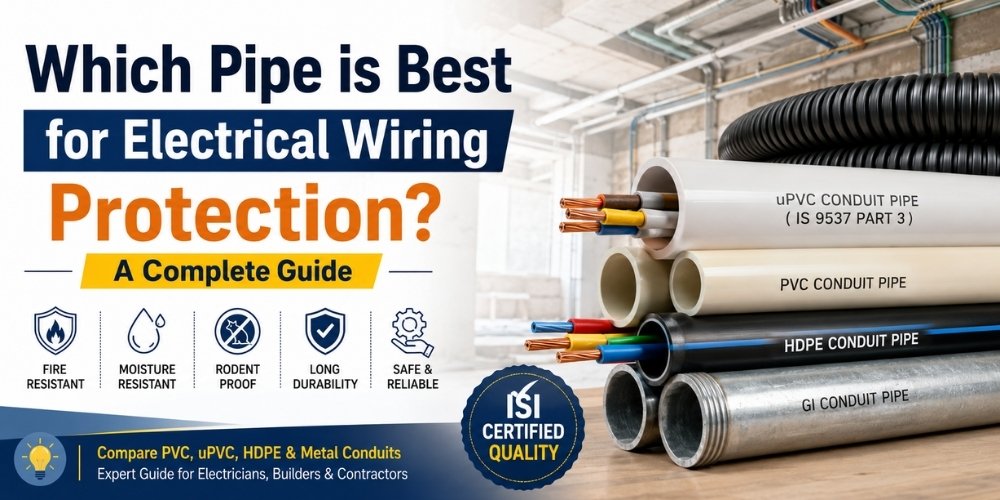
Every electrical system is only as safe as the protection surrounding its wires. You can install the best-quality cables from the most reputed brands, but if the conduit housing them is substandard, brittle, or non-compliant, the entire installation is at risk. Fire hazards, moisture ingress, rodent damage, and insulation breakdown don't announce themselves; they build quietly inside walls and ceilings, often going unnoticed until something goes wrong.
Choosing the right pipe for electrical wiring protection is one of the most consequential decisions on any construction project, residential, commercial, or industrial. And yet, it's a decision that's frequently rushed, reduced to price comparison, or left entirely to whoever is buying material that day.
This guide is written for people who want to get it right: electricians, contractors, project managers, builders, and procurement teams who understand that the conduit pipe running through your structure will outlast most other materials in the building. Let's talk about what you're actually choosing between, what the trade-offs look like in practice, and which pipe consistently delivers the best performance across Indian construction environments.
Why Electrical Wiring Protection Matters More Than Most People Realise
Wiring doesn't fail instantly. It degrades. And the speed of that degradation depends almost entirely on what's protecting it.
In India, electrical wiring faces a range of stresses that most people underestimate. Monsoon humidity works its way through wall cavities. Rodents chew through unprotected cables in false ceilings and under-floor ducts. Heat from high-load circuits raises ambient temperatures inside walls. On coastal and industrial sites, chemical fumes and saline air corrode both cables and conduits from the outside.
A good electrical conduit pipe acts as the first and last line of defence against all of these. It provides:
- Fire containment, A fire-retardant conduit won't actively fuel a flame, buying critical time for evacuation and preventing localised short circuits from becoming building-wide disasters.
- Moisture resistance, Wiring that stays dry lasts decades longer. Even minor moisture ingress can degrade insulation over time, leading to increased leakage current and eventual faults.
- Physical protection, During construction, cables are vulnerable. Properly selected conduit pipes protect them from impact, crushing, and abrasion during and after installation.
- Rodent and pest protection, Rigid conduit creates a barrier that rodents simply can't chew through. This alone prevents a disproportionate number of wiring failures in residential and commercial settings.
- Long-term maintenance savings, Wiring enclosed in quality conduit doesn't need to be replaced nearly as often. For large projects, this translates to significant cost savings over a 20–30 year building lifecycle.
None of these benefits materialise if you've chosen the wrong pipe, or a cheap one that cracks under pressure, becomes brittle with age, or fails to meet Indian Standards.
Types of Pipes Used for Electrical Wiring: What You're Choosing Between
There are five main types of conduit pipes used in Indian electrical installations. Each has its own set of properties, and understanding them helps you make the right call for your specific application.
1. PVC Conduit Pipes
Standard PVC (polyvinyl chloride) conduit pipes are the most widely recognised option in the market. They're affordable, lightweight, and reasonably easy to install. You'll find them in most hardware shops across India, which partly explains their popularity.
Features: Lightweight, non-conductive, corrosion-resistant, easy to cut and join.
Advantages: Low upfront cost, widely available, adequate for basic indoor applications.
Disadvantages: Regular PVC can become brittle over time, especially with prolonged UV exposure or heat fluctuations. It may not offer the same wall thickness consistency or fire-retardant properties as higher-grade alternatives.
Applications: Light residential wiring, surface mounting in low-risk environments.
Cost: Lower end, though total lifecycle cost may be higher if replacement is needed earlier.
Important note: There's a significant difference between standard PVC and uPVC in conduit applications, and it matters more than most buyers realise.
2. uPVC Conduit Pipes (Unplasticised PVC)
This is where the conversation gets serious. uPVC, unplasticised polyvinyl chloride, does not contain plasticising additives, which makes it fundamentally harder, dimensionally more stable, and considerably more durable than regular PVC.
uPVC electrical conduit pipes manufactured to IS 9537 Part 3 are the most widely recommended option for both residential and industrial electrical installations in India, and there are several good reasons for that.
Features: Rigid, high compressive strength, non-conductive, fire-retardant, chemically resistant, dimensionally stable.
Advantages:
- Self-extinguishing in the presence of flame, doesn't sustain combustion
- Resistant to moisture, chemicals, and UV degradation
- Smooth inner bore reduces friction during wire pulling, cutting labour time
- Compatible with a comprehensive range of fittings (bends, couplers, junction boxes) for complete cable management systems
- Long service life, 25 to 50 years under normal conditions
Disadvantages: Slightly higher initial cost compared to standard PVC, though this is more than recovered through durability and lower maintenance requirements.
Applications: Concealed wiring in residential buildings, commercial complexes, industrial facilities, outdoor conduit systems, underground cabling with appropriate bedding.
Cost: Moderate, with strong ROI over project lifetime.
For a deeper technical breakdown, the detailed guide on safe electrical wiring solutions using uPVC conduit pipes is worth reading before finalising your specifications.
3. HDPE Pipes (High-Density Polyethylene)
HDPE pipes are most commonly used for underground cable protection rather than structural in-wall electrical conduit. They're highly flexible and offer excellent resistance to soil chemicals and groundwater.
- Features: Flexible, chemically resistant, UV stabilised, smooth bore.
- Advantages: Excellent for underground duct systems, telecom and power cable protection in trenches, able to handle ground movement without cracking.
- Disadvantages: Not suitable for concealed in-wall wiring or exposed surface applications. Requires different jointing methods and fittings.
- Applications: Underground cable ducting, telecommunication cable protection, solar farm cable routing.
- Cost: Moderate to high, depending on grade and wall thickness.
4. Metal Conduit Pipes (GI / MS)
Galvanised iron (GI) and mild steel (MS) conduit pipes were the industry standard for decades, particularly in industrial applications. They offer excellent mechanical strength and are still specified for heavy-duty environments.
- Features: High tensile strength, impact resistant, grounding capability.
- Advantages: Can handle extreme physical loads, suitable for explosive or hazardous environments where earthed metallic conduit is required by regulation.
- Disadvantages: Susceptible to corrosion in humid, coastal, or chemically aggressive environments. Heavier, more difficult to install, requires threading and specialised fittings. Significantly more expensive than polymer alternatives. In standard residential and commercial projects, they're largely been replaced by uPVC systems.
- Applications: Hazardous industrial zones, petrochemical facilities, heavy manufacturing environments.
- Cost: High material and labour cost.
5. Flexible Conduit Pipes
Flexible conduits, whether PVC-coated or metal-core, are used specifically for the final connection run to equipment, motors, or junction points where rigid conduit cannot accommodate movement or vibration.
- Features: Flexible, available in various sizes, can be metal-core or polymer.
- Advantages: Ideal for connecting machinery, accommodating vibration, and navigating tight corners where rigid bending isn't practical.
- Disadvantages: Not suitable as a primary conduit run, used as a supplementary element within a larger rigid conduit system.
- Applications: Machine connections, motor terminal boxes, panel entry points.
Which Pipe is Best for Electrical Wiring Protection?
Let's be direct: for the vast majority of electrical installations in India, residential buildings, commercial complexes, IT parks, hospitals, schools, industrial facilities, and infrastructure projects, ISI-certified uPVC electrical conduit pipes are the best choice.
This isn't a marketing claim. It's the consistent recommendation of electrical engineers, project consultants, and experienced contractors who've worked across different conduit types and seen how each performs over time.
Here's why uPVC conduit pulls ahead of every alternative in normal-to-demanding Indian construction environments:
Fire Resistance That Actually Matters
A conduit pipe sitting inside a concrete wall may seem far removed from fire risk. But short circuits, overloaded circuits, and arcing faults all generate localised heat. The conduit's fire behaviour determines what happens next. Fire resistant conduit pipes made from uPVC are self-extinguishing, they don't sustain combustion once the ignition source is removed. Standard PVC conduits don't always share this property. Metal conduits don't burn, but they conduct heat and, in corrosive environments, fail structurally.
Non-Conductive by Nature
uPVC doesn't conduct electricity. This gives it a built-in safety advantage over metal conduits, an accidental contact between live wiring and the conduit wall doesn't create an electrocution risk. For residential projects and institutional buildings where concealed wiring is common, this matters enormously.
Corrosion and Chemical Resistance
Moisture, coastal air, chemical fumes, and high humidity are realities across large parts of India. uPVC is completely unaffected by these. It doesn't rust, doesn't swell, doesn't degrade chemically. GI conduit, by contrast, begins corroding from the inside as soon as humidity levels rise in enclosed spaces, a problem that's invisible until the conduit itself starts failing.
Long Service Life with Zero Maintenance
Once uPVC conduit is installed and properly connected, it essentially requires nothing. No painting, no galvanising, no periodic inspection for surface degradation. Quality conduit pipes and fittings from a reliable manufacturer will comfortably last the lifecycle of the building they're installed in.
ISI Certification Under IS 9537 Part 3
ISI-marked uPVC conduit pipes have been tested and certified to Bureau of Indian Standards specifications covering dimensional accuracy, impact resistance, fire propagation behaviour, and bending capacity. Specifying ISI-certified pipes is not bureaucratic box-ticking, it's the only way to ensure the pipe you're buying actually performs the way it's supposed to. The best uPVC electrical conduit pipes in India will always carry this certification.
Cost-Effectiveness Over the Project Lifetime
uPVC conduit costs more than the cheapest PVC options available in the unorganised market. But it costs significantly less than GI conduit, installs faster (reducing labour cost), and doesn't need replacement or remediation during the building's lifetime. When you evaluate total cost of ownership, material plus installation plus maintenance, uPVC consistently delivers the best return on investment.
Key Factors to Consider Before Buying Electrical Conduit Pipes
Whether you're sourcing for a single project or establishing a supply relationship with a conduit pipe manufacturer, these are the factors that separate a smart purchase from an expensive mistake.
Wall thickness: Conduit pipes are specified by their outer diameter, but wall thickness determines compression strength. Thin-wall conduit saves a few rupees per metre and may fail under concrete placement loads. Always verify the wall thickness against IS 9537 requirements for your application.
ISI certification: Non-negotiable. An ISI mark tells you the product has been independently tested against a defined standard. Unmarked conduit has no verifiable quality baseline, regardless of what the seller claims.
Compression strength: Critical for concealed wiring in slabs and walls. The conduit must withstand the weight of wet concrete during slab pours without collapsing or deforming. Ask for the rated impact and compression resistance.
UV resistance: For outdoor or exposed surface installations, UV resistance determines how long the conduit remains structurally sound. Standard PVC yellows and becomes brittle under prolonged sunlight. Stabilised uPVC formulations maintain their properties significantly longer.
Fire-retardant classification: Check whether the conduit meets the fire-retardant requirements under IS 9537. The pipe should be self-extinguishing and not propagate flame.
Brand reputation and manufacturer reliability: In the conduit pipe market, product consistency across batches matters as much as peak product quality. An experienced electrical conduit pipe manufacturer in India with documented processes and quality testing will deliver consistent products. Smaller unbranded suppliers often can't guarantee batch-to-batch uniformity.
Availability of compatible fittings: A conduit system is only as good as its fittings, bends, couplers, junction boxes, saddles, and locknuts all need to be dimensionally compatible. Buying pipes and fittings from a single manufacturer with a matched product range eliminates dimensional mismatch and installation complications.
Indoor vs outdoor usage: Indoor and outdoor conduit applications have different requirements for UV stability, weathering resistance, and IP ratings for any associated enclosures. Match your specification to the actual installation environment.
Best Pipe for Different Applications: Quick Reference
| Application | Recommended Conduit Type | Why |
|---|---|---|
| Residential concealed wiring | uPVC (IS 9537 Part 3, ISI marked) | Fire retardant, non-conductive, long life, easy installation in slabs and walls |
| Commercial buildings | Heavy-duty uPVC | Higher compression strength for multi-storey structures; consistent performance across large installations |
| Industrial wiring | Heavy-duty uPVC or GI (hazardous zones) | Chemical and heat resistance; GI for explosive-risk areas only |
| Underground cable ducting | HDPE or uPVC with appropriate bedding | Resistance to ground moisture and soil chemicals |
| Outdoor surface installation | UV-stabilised uPVC | Weather resistance, no corrosion, minimal maintenance |
| Solar projects | UV-stabilised uPVC | Long-term UV and weathering resistance essential for 25-year project timelines |
| High-moisture / coastal areas | uPVC (chemical and corrosion resistant) | Completely unaffected by humidity, saline air, and moisture exposure |
Why Builders and Contractors Prefer uPVC Electrical Conduit Pipes
Spend time with any experienced electrical contractor working on mid-to-large projects in India and they'll tell you the same thing: uPVC conduit is simply easier to work with, and the results are more consistent.
Faster installation is the most immediate advantage. uPVC conduit is light, easy to cut with standard tools, and bends predictably with a spring bender or heat source. Compared to threading and connecting GI conduit, the time savings on a full building project are substantial.
Reduced labour cost follows directly. Faster installation means fewer man-hours per metre of conduit installed. On large residential or commercial projects, this can meaningfully affect the total electrical installation budget.
Wire pulling is smoother. The smooth inner bore of quality uPVC conduit reduces friction during cable pulling, especially in long runs. This matters on commercial and industrial projects where cable runs can exceed 20–30 metres between junction points.
Long-term reliability means fewer callbacks. A contractor's reputation depends partly on how their work holds up after handover. ISI marked conduit pipes installed correctly don't cause problems down the line, no corrosion, no moisture ingress, no structural failure.
Multiple sizes and grades available. From 20mm to 63mm diameter and available in both light and heavy-duty grades, a comprehensive uPVC conduit range covers every application from residential switch loops to heavy industrial cable runs.
For contractors and project owners looking to source in bulk, established manufacturers like Trity Pipes can supply consistent quantities across project timelines with technical documentation and compliance certification.
How to Choose a Reliable Conduit Pipe Manufacturer
The conduit pipe market in India includes a mix of organised manufacturers and unorganised suppliers. The gap in quality between them is significant and often invisible until products are already installed.
Here's what to evaluate when shortlisting a manufacturer:
Manufacturing standards and certifications. Any serious conduit pipe manufacturer should be ISO certified and produce pipes that carry the ISI mark under IS 9537. Ask for batch test certificates, a credible manufacturer will have them readily available.
Raw material quality. Virgin uPVC resin produces harder, more consistent, more durable conduit than recycled or blended material. Ask manufacturers directly about their resin sourcing. The difference in performance between virgin and recycled-blend conduit is measurable and significant.
Quality testing infrastructure. In-house testing for dimensional accuracy, impact resistance, heat deflection, and fire behaviour is a sign of a manufacturer that takes product quality seriously. Manufacturers without testing capability rely entirely on supplier specifications, with no independent verification.
Product range. A manufacturer who offers only pipes without a matched fittings range creates sourcing headaches on-site. Look for conduit pipes and fittings from a single manufacturer, consistent dimensions, assured compatibility, and a single point of accountability.
Bulk supply capability and delivery. For large residential, commercial, or infrastructure projects, reliable supply scheduling is as important as product quality. Ask about lead times, minimum order quantities, and distribution reach, particularly relevant for projects outside metro areas.
Technical support. A manufacturer with technical knowledge can help you specify the right product for unusual or demanding applications, underground installations, high-temperature environments, solar projects. This is valuable expertise that commodity suppliers typically can't provide.
Industry experience. Experience translates to process refinement, product consistency, and a track record you can verify. Request reference projects and speak to contractors who've used the product on similar applications.
Dealers and distributors looking to expand their product portfolio can reach out to established manufacturers for distributor pricing, territory arrangements, and bulk supply terms.
Common Mistakes to Avoid When Selecting Electrical Conduit Pipes
Even experienced contractors sometimes make costly mistakes in conduit selection. Here are the ones that come up most often:
Buying on price alone. The cheapest conduit pipe on the market is cheap for a reason, thinner walls, inferior resin, inconsistent dimensions, no testing. The difference in cost per metre is small. The difference in performance over 20 years is not.
Using non-ISI products. An unmarked pipe has no independently verified quality baseline. You have no way to know whether it will hold up under concrete loads, maintain its properties in heat, or behave safely in the presence of flame. Don't risk it.
Choosing the wrong wall thickness for the application. Light-duty conduit is fine for surface wiring. In a reinforced concrete slab, you need heavy-duty conduit that won't deform under the weight of wet concrete and the vibration of a concrete vibrator.
Ignoring fitting compatibility. Pipes from one manufacturer and fittings from another often don't mate correctly, even at nominally identical diameters. This creates installation problems, potential weak points in the conduit run, and moisture ingress risks.
Overlooking environmental conditions. A conduit specified for indoor use installed outdoors will degrade under UV exposure. A standard uPVC conduit without chemical resistance specified for a fertiliser plant or chemical processing facility will fail prematurely. Match the product to the environment.
Skipping the moisture consideration in slab work. During concrete placement, conduit joints must be tight. Loose or mismatched joints allow concrete slurry into the conduit during pouring, which then sets solid, making future cable replacement impossible.
Conclusion: Get the Foundation Right
The conduit pipe running through your walls, ceilings, and floors is one of the few building materials that truly cannot be revisited without significant cost and disruption. Unlike paint, tiles, or even fixtures, electrical conduit that's been poured into concrete or embedded in masonry is there for the life of the building.
That's exactly why the decision deserves more than a quick price comparison. For most applications across India, residential, commercial, and industrial, ISI-certified uPVC electrical conduit pipes represent the best combination of safety, durability, ease of installation, and long-term value. They're fire-retardant, non-conductive, corrosion-resistant, and built to last.
Specifying and sourcing from a trusted pipe manufacturer in India with documented quality systems, ISI certification, and a complete product range isn't just good practice, it's risk management for your project and your reputation.
If you're planning a project and want to evaluate uPVC conduit specifications, get a product catalogue, or discuss bulk supply requirements, speak to the team at Trity Pipes, a trusted conduit pipe manufacturer supplying projects across India with quality-assured uPVC electrical conduit systems.
Frequently Asked Questions
Q1: Which pipe is best for house wiring in India?
For house wiring, ISI-certified uPVC conduit pipes are the best choice. They are fire-retardant, non-conductive, moisture-resistant, and durable enough to last the lifetime of the building. They comply with IS 9537 Part 3 and are suitable for both concealed and surface wiring applications.
Q2: Is PVC pipe safe for electrical wiring?
Standard PVC conduit offers basic protection, but not all PVC products are equal. ISI-certified uPVC conduit pipes, a rigid, high-strength form of PVC, are significantly more reliable. They are fire-retardant, dimensionally stable, and independently tested to Indian Standards, making them considerably safer than generic or uncertified PVC products.
Q3: What is the difference between PVC and uPVC conduit pipes?
Standard PVC contains plasticising additives that make it softer and more flexible, but also less dimensionally stable over time. uPVC (unplasticised PVC) contains no plasticisers, making it harder, more rigid, more chemically stable, and better suited to load-bearing concealed wiring applications. For electrical conduit use, uPVC consistently outperforms standard PVC.
Q4: Which conduit pipe is fire resistant?
uPVC conduit pipes manufactured to IS 9537 Part 3 are inherently fire-retardant. They are self-extinguishing, they do not sustain combustion once the ignition source is removed. Always verify that your conduit supplier provides ISI-certified fire-retardant conduit pipes rather than standard PVC, which may not carry this property consistently.
Q5: Which conduit pipe lasts the longest?
ISI-certified uPVC conduit pipes offer the longest service life under normal construction conditions, typically 25 to 50 years. They resist UV degradation, moisture, chemicals, and physical wear without requiring any maintenance after installation.
Q6: Are uPVC conduit pipes waterproof?
Yes. uPVC is inherently resistant to moisture. It does not absorb water, swell, or degrade in humid or wet environments. When correctly installed with compatible fittings and properly sealed joints, uPVC conduit systems provide effective moisture protection for enclosed cables.
Q7: Which size conduit pipe is best for home wiring?
For standard residential wiring in India, 20mm and 25mm diameter uPVC conduit pipes cover most applications. Power circuit runs may use 25mm or 32mm conduit, while multi-cable sections may require 32mm to 40mm. Always size conduit to allow cable fill of no more than 40% of the internal cross-section, leaving room for heat dissipation and future cable additions.
Q8: Why are ISI marked conduit pipes important?
ISI certification under IS 9537 means the product has been independently tested against Bureau of Indian Standards specifications, including dimensional accuracy, compression strength, fire behaviour, and impact resistance. An ISI mark is your assurance that the pipe will actually perform as specified. Non-ISI conduit carries no verifiable quality guarantee.
Q9: Which conduit pipe is best for concealed wiring?
Heavy-duty ISI-certified uPVC conduit pipes are the standard recommendation for concealed wiring in slabs, walls, and ceilings. Their high compression strength means they won't deform under the weight of wet concrete during slab pours. Their smooth inner bore makes cable pulling easier, and their dimensional consistency ensures fittings connect properly.
Q10: Are heavy-duty conduit pipes better for industrial wiring?
Yes. Industrial environments often involve higher physical loads, chemical exposure, higher ambient temperatures, and more demanding mechanical conditions. Heavy-duty uPVC conduit pipes, and in specific hazardous zones, GI conduit, provide the additional wall thickness and mechanical resistance required for safe and reliable industrial cable protection.
Q11: Can uPVC conduit be used for outdoor installations?
Yes, with appropriate product selection. UV-stabilised uPVC conduit pipes are specified for outdoor and exposed surface installations. They maintain their structural and physical properties under prolonged sunlight and weathering, unlike standard PVC, which can become brittle and discoloured with extended UV exposure.
Q12: How do I identify a genuine ISI-marked conduit pipe?
Look for the ISI mark (the BIS certification mark) along with the licence number and the relevant Indian Standard (IS 9537 Part 3 for rigid conduits). Reputable manufacturers can provide batch test certificates and their BIS licence documentation on request. If a supplier cannot provide this documentation, treat the product as uncertified regardless of any markings on the pipe.