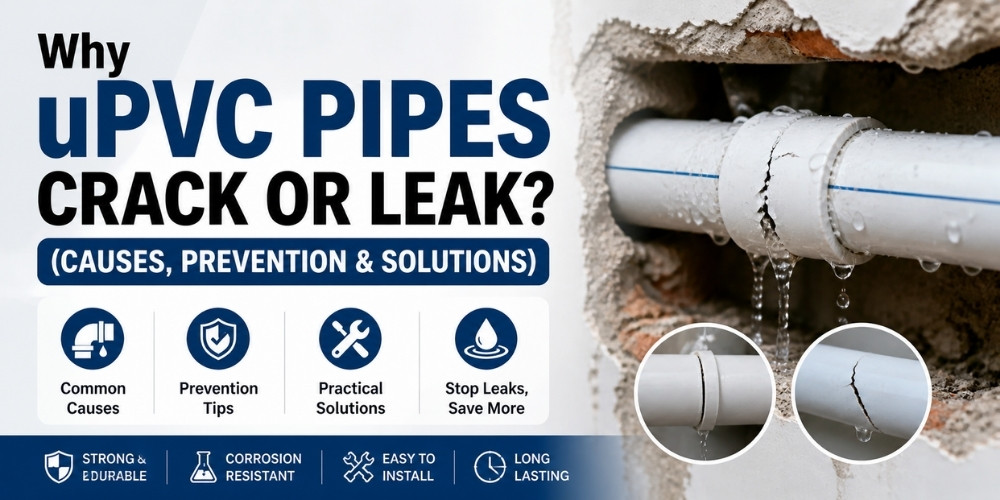
Understanding Common uPVC Pipe Leakage Problems in India
It usually starts with a small patch of dampness on the wall. You ignore it for a week, thinking it is just the monsoon. Then the stain spreads, the plaster starts peeling, and one morning you find a visible crack running along the pipe inside your bathroom wall. By the time you call a plumber, the damage is already done.
This is not an unusual story. Pipe leakage issues in India affect thousands of homes and commercial buildings every year. And more often than not, the pipe involved is uPVC, simply because uPVC is the most widely used material in modern plumbing systems across the country.
The real question is not whether uPVC pipes can crack or leak. Under the right set of circumstances, any pipe can fail. The question is why it happens and what you can do about it before it turns into a costly repair job.
What Are uPVC Pipes and Why Are They Used Everywhere in India
uPVC stands for unplasticised polyvinyl chloride. In simple terms, it is a rigid plastic material that does not contain the softening additives found in regular PVC. This makes it harder, more chemically stable, and much better suited for plumbing and drainage applications where strength and hygiene both matter.
In India, uPVC pipes and fittings became the standard replacement for older galvanised iron pipes over the past two decades. The reasons are practical. They do not rust. They do not react with water. They are lightweight, easy to install, and cost significantly less than metal pipes over the long run. Builders, contractors, and individual homeowners across Delhi NCR, Mumbai, Bengaluru, and every major city in between have shifted to uPVC as the go-to material for internal plumbing, drainage, and water supply lines.
But uPVC pipes are not indestructible. When they fail, there is almost always a specific reason behind it.
Quick Answer: Why Do uPVC Pipes Crack or Leak?
If you are looking for a fast answer, here are the most common reasons uPVC pipes develop cracks or leaks:
- Poor installation with incorrect joint curing or inadequate pipe support
- Use of substandard or recycled material instead of virgin-grade uPVC
- High water pressure or repeated water hammer shockwaves in the pipe
- UV degradation from prolonged direct sunlight exposure on outdoor pipes
- Chemical attack from strong solvents or industrial cleaning agents
- Age-related wear in buildings that are 20 years old or more
- Faulty joints assembled with incompatible or low-quality solvent cement
Each of these causes has a clear fix. The sections below explain them in detail.
Why uPVC Pipes Crack or Leak: The Real Causes
Understanding uPVC pipe leakage problems is the first step toward preventing them. Most failures do not appear overnight. They develop over time because of one or more of the following reasons.
Poor Installation Practices
This is the single most common cause of uPVC pipe failure in Indian buildings. A pipe that is not supported properly will flex and vibrate during use. Over time, that movement creates stress at the joints and fittings, which is exactly where cracks tend to appear first.
Using the wrong adhesive, applying too little solvent cement, or not allowing joints to cure before running water through the system are all installation errors that lead to leaks within months of completion. Many builders and contractors rush through the plumbing stage to meet project deadlines, and the building occupants pay for that shortcut years later.
Low Quality or Substandard Pipe Material
Not all uPVC pipes sold in India meet the same standards. Pipes manufactured using recycled or blended material instead of virgin-grade uPVC tend to have inconsistent wall thickness, hidden micro-cracks, and lower impact resistance than they should. These pipes may look identical to a quality product on a shelf but behave very differently under real operating conditions.
A housing society in Noida that replaced its entire internal plumbing twice within eight years is a real pattern seen across Indian buildings. In both cases, investigation revealed the originally installed pipes were made from blended material that failed well before their rated service life. The few hundred rupees saved on cheaper pipes translated into lakhs spent on repairs, wall damage, and water wastage.
High Pressure and Water Hammer
Every plumbing system in India operates under pressure. But when that pressure exceeds what the pipe is rated for, or when sudden changes in flow direction create pressure spikes known as water hammer, the pipe wall takes the hit.
Water hammer happens when a valve is closed abruptly. The sudden stop in water movement sends a shockwave back through the pipe. In older buildings with poor pressure regulation, this is a daily occurrence. Over time, repeated pressure spikes weaken the pipe wall at its most vulnerable points, particularly near elbows, tees, and reducer fittings.
UV Exposure and Sunlight Damage
uPVC is not naturally UV stable. When uPVC pipes are installed outdoors or in areas with direct sunlight exposure, the material gradually degrades at the surface. You will typically notice this as a colour change first. The pipe turns from white to yellowish or chalky. Underneath that visible change, the material is becoming brittle and losing its impact resistance.
In Indian conditions, where rooftop water tanks, external drainage lines, and outdoor plumbing are common, UV degradation is a genuine and frequently overlooked cause of uPVC pipe cracking.
Chemical Exposure
uPVC handles most household chemicals without any problem. But strong solvents, certain industrial cleaning agents, and concentrated chemicals used in some manufacturing environments can attack the pipe surface over time. In drainage systems that carry chemical waste, using standard uPVC without understanding its chemical resistance limits is a setup for premature pipe leakage issues.
Aging and Long-Term Wear
A quality uPVC pipe installed correctly will last decades. But nothing lasts forever. In buildings that are 20 to 30 years old with original plumbing still in place, age-related degradation is a legitimate cause of why uPVC pipes fail. The material becomes less flexible, joints dry out, and the combination of thermal cycling across hundreds of seasons gradually stresses the pipe at its weakest points.
Faulty Joints and Fittings
The joint is almost always the weakest point in any pipe system. In uPVC plumbing, poorly fitted couplings, incompatible fittings, or joints assembled with substandard solvent cement will eventually show up as a leak. This is especially true in concealed plumbing inside walls, where the early signs of joint failure are invisible until the damage reaches the surface.
For drainage systems specifically, using the right SWR pipes and fittings with proper joint design makes a significant difference in preventing long-term leakage at connection points.
Early Warning Signs You Should Not Ignore
Most uPVC pipe failures give you some warning before they become a serious problem. Knowing what to look for can save you significant repair costs.
- Unexplained dampness or dark patches on walls, ceilings, or floors near plumbing lines
- A sudden and unexplained drop in water pressure at taps or outlets
- Water marks or white mineral deposits forming around a joint or fitting
- Gurgling sounds in drainage pipes that did not exist before
- Slow drainage or recurring blockages in the same section of the line
- Foul or damp smell near walls or floor junctions close to plumbing runs
- Visible yellowing or chalking of outdoor uPVC pipes exposed to sunlight
None of these signs should be left for later. Catching a pipe problem at this stage keeps the repair cost small.
Practical Solutions: What to Do When a uPVC Pipe Cracks or Leaks
For minor surface cracks and pin hole leaks, a temporary fix is possible using waterproof pipe repair tape wrapped tightly around the affected area. This buys you time but it is not a permanent repair. Epoxy putty applied around a small crack can also hold the pipe until a proper replacement is arranged.
For joint leaks, the most effective fix is to cut out the damaged section, clean both ends thoroughly, and re-join using fresh, compatible solvent cement. Make sure the joint is dry before applying the cement and allow adequate curing time before putting the system back under pressure.
For pipes that have cracked along the length, the only proper solution is to replace that section entirely. Attempting to patch a structural crack with tape or sealant will not hold under sustained water pressure.
For concealed pipe failures inside walls, engage a licensed plumber who can use a leak detection method to locate the exact point of failure before opening the wall. Opening a large section of wall to find a small crack is both expensive and avoidable.
Prevention: How to Make Sure This Does Not Happen Again
The best time to prevent uPVC pipe problems is during installation, not after.
- Always insist on ISI marked pipes and fittings from a recognised manufacturer
- Verify that the pipes carry the correct pressure rating for your system
- Use only compatible solvent cement and allow full curing time before pressurising
- Protect all outdoor and rooftop uPVC pipes from direct sunlight with UV stabilised pipes or an opaque covering
- Install pressure regulators in buildings where municipal supply pressure is irregular or high
- Ensure proper pipe support at the correct spacing to prevent sagging and joint stress
- Never allow the plumbing stage of a construction project to be rushed to meet deadlines
Following these steps during installation eliminates the majority of causes behind uPVC pipe failures before they ever get a chance to develop.
Why the Quality of the Pipe You Choose Actually Matters
There is a tendency in the Indian construction market to treat plumbing pipes as a commodity where the cheapest option on the shelf is as good as any other. This thinking is responsible for a significant share of the uPVC pipe leakage problems that contractors and homeowners deal with every year.
A pipe made from 100% virgin-grade uPVC with consistent wall thickness, correct pressure ratings, and ISI certification will behave predictably across its entire service life. A pipe made from blended or recycled material will not. The difference is not always visible from the outside but it shows up clearly over time in the form of cracks, leaks, and failed joints.
Choosing a manufacturer with documented quality standards and a reputation built through consistent on-site performance is not about paying a premium. It is about avoiding the far larger cost of repairing what a cheaper product will eventually break. If you want to understand how different pipe materials compare for your specific application, this guide on types of pipes used in plumbing in India is a useful reference before making any purchase decision.
Conclusion
uPVC pipes crack and leak for reasons that are almost always preventable. Poor installation, substandard materials, pressure issues, UV exposure, and aging are the main culprits behind most pipe failures in Indian buildings. The good news is that each of these causes has a clear solution.
If you catch the problem early, the fix is straightforward. If you build your plumbing system right from the start using quality materials and correct installation practices, most of these problems simply never happen.
The next time you see that damp patch on the wall, do not wait. Act early, find the source, and fix it properly. A small leak ignored today will always become a bigger and more expensive problem tomorrow.
When it is time to replace or install new pipes, choose a manufacturer that uses 100% virgin-grade uPVC, holds valid ISI certification, and has a track record of consistent performance on real projects. The pipe you select today will be inside your walls for the next several decades. It is worth getting that decision right.