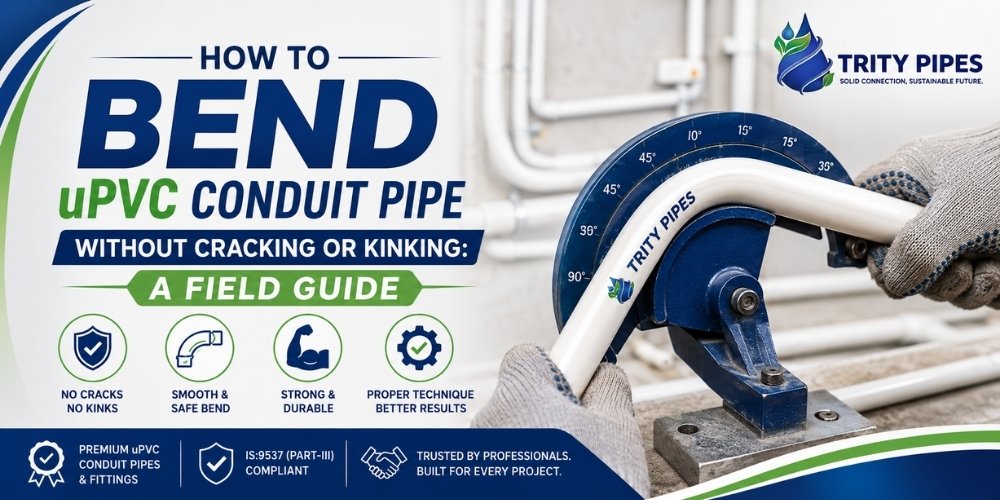
Why Bending Technique Matters More Than It Looks
Every electrician who has spent time on an Indian residential or commercial site has a bend gone wrong story: a kinked pipe, a cracked elbow, or worse, a bend so tight that cable simply won't pull through it. Bending conduit looks like a simple mechanical task, and for the most part it is, but small technique errors compound into real problems once wiring is pulled and walls are closed up.
This field guide covers the practical side of bending uPVC conduit pipe correctly: why bend radius matters, the three common bending methods used on Indian sites, minimum bend radius values by pipe size, how kinking actually happens, when to skip site-bending altogether, and how flexible PVC bending differs from rigid uPVC. It's written the way an experienced site supervisor would explain it to an apprentice, based on what actually goes wrong in the field.
Why Bending Matters: Too Tight a Radius Restricts Wire Pulling
A conduit bend isn't just about changing direction. It has to preserve enough internal clearance for cable to be pulled through smoothly, both during initial installation and years later when new wiring needs to go in.
When a bend radius is too tight:
- Cable insulation scrapes against the inner wall of the bend during pulling, creating stress points that can develop into insulation failures over time
- Pulling resistance increases sharply at the bend, which means more force is needed, and more force means a higher chance of damaging the cable or the conduit itself
- Multiple tight bends in a single run compound this resistance, sometimes to the point where cable simply can't be pulled through without cutting the conduit open
- Heat dissipation from current-carrying cables is reduced at a tight bend, since airflow inside the conduit gets restricted right at the point where the cable is under the most physical stress
This is why bend radius isn't a cosmetic detail. It directly affects whether the finished installation performs safely for the life of the building, and whether future rewiring is even possible without breaking open walls.
Three Methods of Bending Conduit on Site
Spring Bender
A spring bender is a coiled metal spring inserted into the conduit before bending. It supports the pipe wall from the inside, distributing the bending force evenly so the pipe curves rather than kinking at a single point. This is the most common method for site bends on smaller diameter conduit, typically 20mm and 25mm, and works well for both rigid and semi-rigid uPVC.
The technique: insert the spring to the point where the bend will start, apply steady pressure over your knee or a fixed edge, and bend gradually rather than in one sharp motion. Overbending slightly and easing back to the target angle helps compensate for the slight spring-back that uPVC exhibits after release.
Heat Bending
Heat bending softens the pipe wall with controlled heat, usually from a hot air gun or a heating box, so it can be shaped by hand or over a form. This method is typically used for larger diameter conduit or for bends with a radius too tight for a spring bender to manage cleanly.
The pipe needs to be heated evenly around its circumference. Uneven heating is one of the most common causes of failure with this method: one side softens and stretches while the other stays rigid, resulting in wall thinning or an oval cross-section at the bend rather than a clean curve. Once the bend is formed, the pipe needs to cool fully before any load or further handling, since uPVC is still moldable for a short window after heating.
Factory Elbows
Factory-manufactured elbows (typically available in 45 degree and 90 degree angles) are pre-formed to the correct bend radius and wall consistency under controlled manufacturing conditions. They're solvent-welded into the conduit run rather than bent on site.
For any bend that needs to meet a precise, code-compliant radius consistently across a large project, factory elbows remove the variability that comes with manual bending. This is covered in more depth in the section below on when to choose a factory elbow over a site bend.
Correct Bending Radius by Pipe Size
IS 9537 Part 3 specifies minimum bend radius requirements to ensure conduit maintains adequate internal clearance for cable pulling after bending. As a practical field reference:
| Conduit Size | Minimum Bend Radius (approx.) |
|---|---|
| 20mm | 75-80mm |
| 25mm | 90-100mm |
| 32mm | 115-125mm |
| 40mm | 150-160mm |
| 50mm | 190-200mm |
These figures are general field guidance based on standard industry practice for rigid uPVC conduit; always cross-check against the specific product's technical datasheet, since minimum radius can vary slightly by grade and manufacturer. As a rule of thumb, the minimum bend radius should be roughly four to five times the conduit's outer diameter. Going tighter than this risks wall thinning at the outer curve and cable-pulling difficulty, even if the pipe doesn't visibly crack.
How to Avoid Kinking: The Common Causes
Kinking happens when the pipe wall buckles inward on the compression side of a bend instead of curving smoothly. On Indian sites, the most common causes are:
- Bending without internal support. Attempting a tight-radius bend on rigid uPVC without a spring bender or heat, essentially forcing the pipe by hand, almost always produces a kink rather than a clean curve.
- Bending too quickly. Applying force in a single sharp motion rather than a gradual, controlled curve concentrates stress at one point instead of distributing it along the bend.
- Using the wrong grade for the application. LMS-grade conduit, designed for lighter mechanical stress, is more prone to kinking under bending force compared to MMS or HMS grades, particularly at tighter radii.
- Bending in cold weather without adjusting technique. uPVC becomes more brittle and less pliable at lower temperatures, which increases kinking risk if the same bending force used in warm conditions is applied without added heat or a wider radius.
- Reusing a spring bender that no longer fits snugly. A worn or slightly undersized spring doesn't provide even internal support, allowing localized buckling even with correct bending technique otherwise.
When to Use a Factory Elbow Instead of Site-Bending
Site-bending has its place, particularly for gentle direction changes on straightforward runs. But there are situations where a factory elbow is clearly the better choice:
- Tight-radius bends, especially anything approaching the minimum IS 9537 radius for the pipe size, where the margin for error in manual bending is small
- High-visibility or inspection-critical work, such as government, hospital, or commercial projects where installation quality gets audited against code
- Larger diameter conduit (32mm and above), where heat bending becomes more time-consuming and harder to execute evenly on site
- Repetitive identical bends across a large project, where consistency matters more than the marginal time saved by bending on site
- Coastal or high-corrosion environments, where any wall thinning from an imperfect bend becomes a longer-term weak point under sustained humidity exposure
For a full breakdown of elbow types, angles, and how they compare to other fitting categories, this complete guide to uPVC conduit pipe fittings is a useful reference when specifying materials for a project.
Bending uPVC vs Flexible PVC: Different Techniques
Rigid uPVC and flexible PVC conduit are not interchangeable in how they're bent, and using rigid-conduit technique on flexible pipe (or vice versa) usually produces poor results.
Rigid uPVC holds its shape once bent and needs either a spring bender or heat to form a clean curve without kinking, as covered above. It's the standard choice for permanent concealed and embedded wiring, where a fixed, code-compliant bend radius matters.
Flexible PVC conduit is designed to bend by hand without tools, since its corrugated or reinforced wall construction allows it to flex without kinking in the way rigid pipe does. It's typically used for short connections, such as linking to a junction box on equipment that vibrates or shifts slightly, or navigating an unusually tight space where a rigid pipe run isn't practical. Because flexible conduit is inherently more pliable, it doesn't need heat or a spring bender, but it also isn't rated for the same mechanical stress as rigid uPVC, so it shouldn't be used as a substitute for rigid conduit in embedded or load-bearing applications.
Understanding this distinction matters at the specification stage more than at the bending stage: the mistake usually isn't bending flexible pipe incorrectly, it's using flexible pipe somewhere rigid uPVC was actually required.
Temperature Effect: Bending in Winter vs Summer in India
Ambient temperature has a real, measurable effect on how uPVC behaves during bending, and this is often overlooked on Indian sites where the same technique gets applied year-round regardless of season.
Summer bending (high ambient temperature): uPVC is naturally more pliable in warmer conditions, which makes spring bending easier and reduces the risk of kinking at a given radius. The trade-off is that pipe can soften slightly if left in direct sun before bending, which can lead to inconsistent results if the pipe isn't handled carefully.
Winter bending (low ambient temperature): In North Indian winters, where site temperatures can drop into single digits, uPVC becomes noticeably more brittle. Bending without additional heat in these conditions significantly increases the risk of cracking or kinking, even at radii that would be safe in warmer weather. Best practice in cold conditions is to warm the pipe slightly (even ambient warming from a heat gun on low setting, well short of full heat-bending temperature) before attempting a spring bend, and to bend more gradually than usual.
Site supervisors managing projects that span both seasons should factor this into planning: a bending technique that worked reliably on a summer job may need adjustment before the same crew starts a winter project.
Getting Bends Right the First Time
Correct bending comes down to matching the method to the pipe size and radius required, respecting IS 9537 minimum bend radius values, and adjusting technique for grade and ambient temperature rather than applying the same force regardless of conditions. When a bend approaches the tight end of what's mechanically safe for site bending, or when consistency across many identical bends matters more than time saved, a factory elbow is the more reliable choice.
Pre-formed elbows from Trity Pipes eliminate site-bending risk entirely and are available in 45 degree and 90 degree angles across the standard conduit size range, manufactured to consistent wall thickness and bend radius under controlled conditions. Browse the full uPVC conduit pipes and fittings range to find the right elbow for your next project.