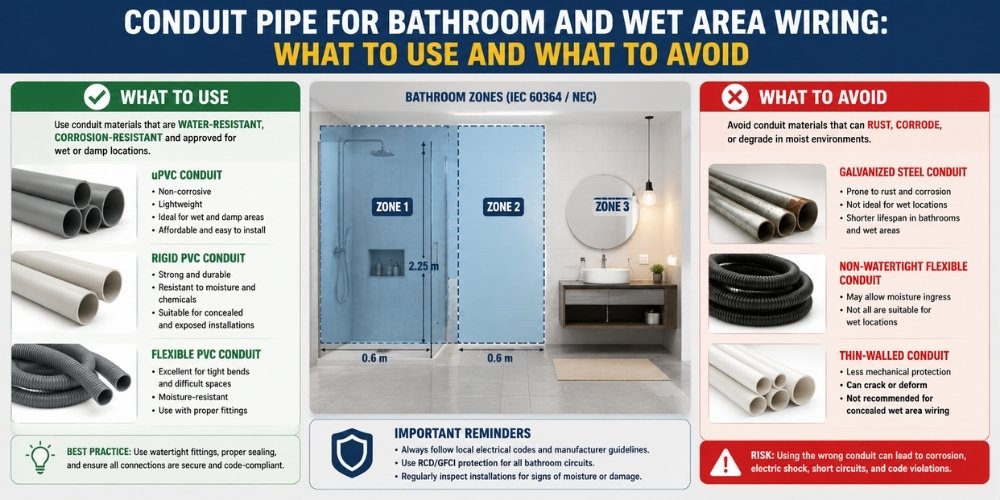
Bathrooms are the one room in an Indian home where water, electricity, and confined spaces meet every single day. A geyser above the shower, an exhaust fan pulling humid air, a light switch just outside a splash zone: every one of these circuits is a small risk if the wiring underneath isn't protected properly. This is exactly why "which conduit pipe for bathroom wiring" is one of the most searched electrical questions among Indian homeowners and contractors, and why getting it wrong is far more common than most people realize.
This guide walks through why moisture is the real enemy in wet-area wiring, what IP ratings actually mean for your bathroom, why uPVC conduit consistently outperforms GI (galvanized iron) conduit in humid conditions, how to seal junction boxes correctly, which fittings to use, common mistakes to avoid, and the right conduit sizes for typical bathroom circuits.
Why Moisture Is the Primary Threat to Bathroom Wiring
Electricity and water don't mix, that much is obvious. But the real danger in bathroom wiring isn't a bucket of water falling on a wire. It's the slow, invisible damage that humidity causes over months and years.
Indian bathrooms are humid almost by design. Hot showers, geysers, wet floors, and poor ventilation combine to create a micro-climate where moisture is present in the air even when no water is visibly splashing. Over time, this moisture:
- Seeps into any gap in a wiring conduit or junction box
- Condenses inside metal conduits, especially where temperature differences exist between the pipe and surrounding wall
- Accelerates corrosion in metal fittings, screws, and boxes
- Degrades insulation on cables that sit inside a conduit not designed for wet conditions
- Creates a path for leakage current, which is what actually causes shocks and short circuits, not direct water contact
This is why a conduit pipe for bathroom wiring in India needs to be evaluated not just on whether it can survive a splash, but on how it performs against sustained ambient humidity, day after day, for the 15–20 year lifespan of a typical home's wiring.
Understanding IP Ratings for Wet Areas
IP (Ingress Protection) ratings tell you how well an enclosure, a conduit, box, or switch, resists solids and liquids. The rating is written as IP followed by two digits, for example IP44 or IP65. The first digit indicates protection against solid objects and dust; the second indicates protection against water.
For Indian bathrooms, electrical codes and safety practice typically divide the room into zones based on proximity to the shower or bathtub:
- Zone 0 (inside the tub or shower itself): Only low-voltage, fully waterproof fittings are allowed here. Standard conduit and switches have no place in this zone.
- Zone 1 (directly above the bath/shower up to 2.25m): Requires at minimum IP44-rated fittings; splash-proof accessories are mandatory.
- Zone 2 (extending 0.6m beyond the shower area): IP44 is still recommended given the humidity.
- Outside zones: Standard fittings can be used, but conduit runs and switch boxes should still favor moisture-resistant materials given the overall humidity of the room.
The practical takeaway: don't just check the IP rating of your switches and sockets. Check the material and sealing of the conduit pipe carrying the wiring behind them. A splash-proof switch plate connected to a poorly sealed metal conduit still leaves your circuit vulnerable.
Why uPVC Conduit Outperforms GI Conduit in Humid Environments
For decades, GI (galvanized iron) conduit was the default choice for Indian electrical wiring, largely because of its mechanical strength. But strength against impact isn't the same as resistance to moisture, and this is exactly where GI conduit falls short in bathrooms and other wet areas.
GI conduit problems in humid conditions:
- The zinc coating that protects GI pipe from rust is a thin layer. Once nicked during installation, which happens routinely during threading, cutting, and bending, the underlying steel is exposed directly to moisture.
- Corrosion inside a sealed conduit is a slow, hidden process. By the time rust becomes visible, the cable insulation inside may already be compromised.
- Metal conduit is electrically conductive. If insulation fails and a live wire contacts the pipe, the entire conduit run becomes energized unless earthing is flawless, a serious shock hazard in a room where people are frequently barefoot and wet.
- GI conduit joints rely on threading, which is harder to seal completely against moisture ingress compared to solvent-welded plastic joints.
uPVC conduit advantages for bathrooms and kitchens:
- uPVC (unplasticized polyvinyl chloride) does not rust, corrode, or oxidize, regardless of how long it's exposed to humidity or direct moisture.
- It is naturally non-conductive, which removes the risk of the conduit itself becoming a shock path if internal wiring is ever damaged.
- Solvent-cemented uPVC joints create a genuinely watertight seal when installed correctly, something threaded metal joints struggle to match.
- uPVC is lightweight and easier to route around plumbing lines, tile work, and false ceilings common in Indian bathroom layouts.
- Quality uPVC conduit manufactured to IS 9537 Part 3 standards is also engineered for consistent wall thickness and impact resistance, so durability isn't traded away for moisture resistance.
If you're comparing conduit materials for a full home wiring project, it's worth reviewing this detailed breakdown of which pipe material is best for electrical wiring protection across PVC, uPVC, HDPE, and metal options before finalizing your choice.
For bathrooms, kitchens, and any wet or semi-outdoor area, uPVC conduit is now the standard recommendation among electricians and interior contractors across India, and it's what most municipal electrical codes implicitly favor by requiring corrosion resistance in wet locations.
Proper Sealing at Junction Box Entry Points
A conduit pipe is only as moisture-resistant as its weakest joint, and in most bathroom wiring failures, that weak point is the junction box, not the pipe run itself.
Junction boxes in bathrooms should be:
- Positioned outside splash zones wherever possible. If a junction box must sit inside Zone 1 or Zone 2, it needs an IP44 or higher rated enclosure.
- Sealed at every conduit entry point. Every place where a conduit pipe enters a junction box is a potential moisture entry path. Use proper grommets, sealing washers, or solvent cement (for uPVC-to-uPVC connections) rather than leaving gaps around the entry hole.
- Fitted with a gasket or rubber seal on the lid, especially for surface-mounted boxes in humid zones.
- Oriented so that any moisture that does collect can't pool inside. Downward-facing or side-entry conduit connections are safer than upward-facing ones that can collect condensation.
- Checked for tight solvent-welded joints on every uPVC coupler, bend, and box connector along the run. A loose joint defeats the purpose of choosing moisture-resistant pipe in the first place.
This last point matters more than most homeowners realize: even premium uPVC conduit will let moisture through if the installer skips solvent cement or doesn't apply it correctly at each joint.
Which Conduit Fittings Are Suitable for Bathrooms
Not every fitting in a standard conduit fittings catalogue is appropriate for a wet area. For bathroom and kitchen wiring, prioritize:
- Solvent-weld couplers and bends over push-fit or friction-fit connectors, since welded joints seal far more reliably
- PVC junction boxes with gasketed lids, particularly in or near Zone 1/Zone 2
- Saddle clamps for surface conduit runs, spaced closely enough to prevent sagging that could stress joints over time
- Bushed conduit entries wherever a pipe enters a metal enclosure (for example, a geyser's isolator switch box), to prevent sharp edges from damaging cable insulation
- Corrosion-resistant screws and clamps (avoid untreated steel hardware, even if the conduit itself is uPVC)
A full breakdown of fitting types and how to choose between them is covered in this complete guide to uPVC conduit pipe fittings, which is useful reference material when you're finalizing a bill of materials for a bathroom wiring job.
Common Mistake: Using Open Wiring in Bathrooms
Despite conduit being inexpensive relative to the overall cost of a bathroom renovation, open or "loose" wiring (cables run without any conduit protection, sometimes just clipped along a wall or hidden under tile without a casing) is still a common shortcut, particularly in budget renovations and older homes.
This is one of the most dangerous mistakes in residential electrical work for several reasons:
- Open cables have no barrier against moisture at all; insulation is left to do all the work, and PVC-insulated cable insulation is not designed to be a standalone waterproofing layer over years of humidity exposure.
- Any accidental nail, screw, or drill hit during future renovation work directly damages the cable with no conduit to absorb the impact first.
- Rodents and insects, common in Indian homes, can damage exposed cable insulation far more easily than cable protected inside a sealed pipe.
- Open wiring makes future repairs or rewiring far more disruptive, since there's no channel to pull new cable through. The wall often has to be broken open again.
If you're deciding between concealed and surface wiring approaches for a full home or bathroom-specific circuit, this comparison of concealed wiring versus surface wiring lays out the safety, cost, and durability trade-offs in more detail. Either way, the wiring should always run inside proper conduit. Open cable is never an acceptable practice in a wet area, regardless of budget constraints.
Recommended Conduit Sizes for Bathroom Circuits
Bathroom electrical loads vary significantly by circuit, and conduit size should be matched to the number and gauge of cables it needs to carry, with room for heat dissipation and future additions. As a general guide for Indian residential bathroom wiring:
| Circuit Type | Typical Cable | Recommended Conduit Size |
|---|---|---|
| Lighting point (single point, 1.5 sq mm) | 1–2 cables | 20mm |
| Exhaust fan | 1.5 sq mm, 2–3 cables | 20mm |
| Bathroom socket/switch wiring | 1.5–2.5 sq mm | 20–25mm |
| Geyser (dedicated circuit) | 4 sq mm, 2–3 cables | 25mm |
| Combined/looped circuits with multiple points | Mixed gauge | 25–32mm |
These are general starting points; actual sizing should always account for the number of cables being pulled through a single run and local load calculations. For a more detailed reference across all standard sizes, see this conduit pipe size chart for electrical wiring, which breaks down 20mm, 25mm, 32mm, 40mm, and 50mm applications.
A geyser circuit deserves particular attention: since it typically draws a higher load than lighting or fan points, it should ideally run on its own dedicated conduit rather than being bundled with other bathroom circuits, both for heat management and to simplify future troubleshooting.
Coastal and High-Humidity Areas: Why Corrosion Resistance Matters Even More
Everything covered so far about bathroom wiring applies with even greater force in coastal cities and high-humidity regions across India, think Mumbai, Chennai, Kochi, Goa, and parts of coastal Andhra Pradesh and Odisha. In these locations, the ambient air itself carries salt and moisture year-round, not just inside bathrooms but throughout the home, including exterior walls, balconies, and outdoor wiring runs.
In coastal conditions:
- GI conduit corrodes noticeably faster due to airborne salt accelerating oxidation, sometimes showing visible rust within a few years of installation.
- Metal switch boxes, screws, and clamps need to be checked and potentially replaced more frequently if not corrosion-resistant.
- uPVC conduit's complete immunity to rust and salt-driven corrosion becomes a decisive advantage rather than just a convenience, since there's no metal substrate for salt air to attack in the first place.
- Outdoor wiring for exterior lights, geysers on balconies, or wall-mounted ACs should also use uPVC conduit with properly sealed joints. Kitchen and outdoor wiring face many of the same moisture challenges as bathrooms.
For homeowners and contractors working in these regions, choosing ISI-marked, IS 9537 Part 3 compliant uPVC conduit isn't just a best practice. It's the difference between wiring that lasts the life of the building and wiring that needs premature replacement.
Getting Bathroom Wiring Right the First Time
Bathroom and wet-area wiring isn't a place to cut corners, and it's also not an area where the right choice costs significantly more. The price difference between quality uPVC conduit and lower-grade alternatives is small relative to the cost of a bathroom renovation, but the safety and longevity difference is substantial.
The checklist to follow is straightforward: use uPVC conduit rather than GI or open wiring, match IP ratings to the bathroom zone, seal every junction box entry point properly, choose fittings designed for wet-area use, size the conduit correctly for each circuit, and pay extra attention to corrosion resistance if you're in a coastal or high-humidity region.
Trity Pipes manufactures ISI-marked, IS 9537 Part 3 certified uPVC electrical conduit pipes and fittings built for exactly these conditions: corrosion-resistant, non-conductive, and designed for reliable, long-term performance in bathrooms, kitchens, and outdoor wiring across Indian homes. If fire safety is also a consideration for your project (it should be, in any residential or commercial build), this guide on fire safety and electrical conduit pipes is worth reading alongside this one.