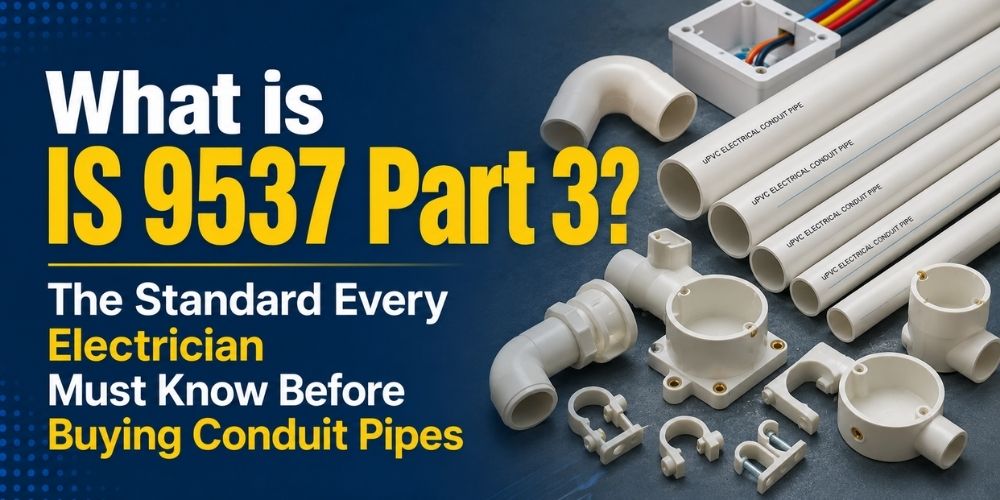
Most buyers ask two questions when sourcing conduit pipes: what size do I need, and what is the price per bundle? These are valid questions. But they skip the question that determines whether the pipe will actually perform in a building, survive a government audit, or pass a quality inspection on a commercial project.
That question is: does the conduit comply with IS 9537 Part 3?
IS 9537 Part 3 is the Bureau of Indian Standards specification that governs rigid plain conduits of insulating materials used in electrical installations. It defines what a conduit pipe must be made of, how thick its walls must be, what mechanical loads it must survive, and how it must behave in a fire. Without compliance with this standard, a conduit pipe is not a certified electrical product. It is simply an unverified plastic tube.
For electricians, contractors, builders, government procurement teams, and MEP consultants, understanding IS 9537 Part 3 is not optional. It is the foundation of every compliant electrical conduit installation in India.
What is IS 9537 Part 3?
IS 9537 Part 3 is an Indian Standard published by the Bureau of Indian Standards (BIS) that specifies the requirements and test methods for circular, rigid, non-flame propagating, non-threadable, plain-ended and socket-ended conduits made from insulating materials, used in electrical installations.
The full designation of the standard is IS 9537 (Part 3). It superseded the earlier IS 2509 and has been revised and updated over the years, with the current version incorporating amendments that align with IEC 60614-2-2, the international equivalent.
The standard sits within a broader multi-part framework. IS 9537 Part 1 covers general requirements applicable to all conduit systems. IS 9537 Part 2 covers rigid metal conduits. IS 9537 Part 3 applies specifically to rigid conduits made from insulating materials, which in practice means rigid PVC and uPVC conduit pipes.
The Bureau of Indian Standards is India's national standards body, operating under the Ministry of Consumer Affairs. BIS formulates, maintains, and enforces Indian Standards across industries. For conduit pipes, BIS certification under IS 9537 Part 3 is the official mechanism through which a manufacturer demonstrates that its product meets the standard's requirements.
Scope of IS 9537 Part 3
The standard covers conduit pipes used in residential, commercial, industrial, institutional, and infrastructure electrical installations. This includes:
- Concealed wiring inside RCC slabs and brick masonry walls in apartments and villas
- Surface wiring in factories, warehouses, and industrial plants
- Wiring in hospitals, schools, airports, and government buildings
- Underground cable protection in site roads, infrastructure corridors, and service ducts
- Cable routing in commercial buildings, data centres, and retail complexes
- Smart city, metro rail, and public infrastructure projects
Both plain-ended and socket-ended conduits fall within the scope of IS 9537 Part 3. The standard covers conduit diameters in the range of 16mm to 50mm, addressing the full range of residential and commercial wiring requirements.
Why IS 9537 Part 3 Matters More Than Most Electricians Realise
The conduit pipe is the last line of defence between live electrical wiring and the external environment. Once concrete is poured, walls are plastered, or trenches are backfilled, the conduit is inaccessible for decades. What is inside that conduit must be protected reliably for the entire service life of the building.
A conduit that fails mechanically will collapse under concrete load, blocking cable routes and requiring expensive remediation. A conduit that fails fire propagation testing will accelerate flame spread inside a wall, turning an electrical fault into a building fire. A conduit made from substandard material will crack, deform under heat, and allow moisture ingress that corrodes wiring insulation.
IS 9537 Part 3 addresses all of these failure modes through specific requirements and tests.
Electrical Safety: Conduits made from insulating material must not conduct electricity. If a live cable develops a fault and contacts the conduit wall, the conduit must not create an earth path. IS 9537 Part 3 specifies dielectric properties that verify this.
Mechanical Protection: Cables inside a conduit face compressive loads from concrete, vibration from machinery, and point loads from building movement. The standard defines compression resistance and impact resistance requirements that ensure the conduit maintains its cross-section and protects the cable.
Fire Safety: In the event of a fire, the conduit must not contribute to flame spread. IS 9537 Part 3 mandates non-flame propagating characteristics, verified through a specific fire propagation test.
Compliance on Government and Institutional Projects: Central and state government projects, PSU-funded works, CPWD specifications, PWD contracts, and most commercial project tenders require ISI-marked conduit pipes. Supplying non-certified material on such projects creates grounds for rejection, tender disqualification, and legal liability.
Long-term Durability: Buildings in India operate for 40 to 60 years. The wiring system inside those buildings must perform reliably over that period. A conduit pipe that meets IS 9537 Part 3 has been verified to resist heat, mechanical load, and environmental stress across its expected service life.
A practical example: on a mid-size residential project in Delhi NCR, a contractor sourced conduit pipes from a local supplier offering a significantly lower price. The pipes carried no ISI mark and no visible BIS certification. After the concrete pour, several conduit runs in the roof slab collapsed under compaction load. The entire ceiling wiring had to be re-routed through surface conduit, adding both cost and aesthetics problems to a project that had already been handed over to the developer. IS 9537 Part 3 compliance would have prevented this entirely.
What Does IS 9537 Part 3 Actually Cover?
The standard sets out requirements across several technical parameters. Each parameter serves a specific purpose in the performance of the conduit.
Conduit Dimensions
IS 9537 Part 3 specifies precise outer diameter (OD) limits and minimum inner diameter (ID) requirements for each conduit size. The OD is controlled by a gauge test: a no-go gauge of defined diameter must not pass over the conduit in any orientation. This ensures the pipe does not exceed the maximum permitted outer size, which matters for compatibility with conduit boxes, fittings, and saddles.
The inner diameter determines the cable fill capacity. A minimum ID ensures that the cable bundle specified for that conduit size can be pulled through without excessive friction or damage to insulation.
| Size | OD Min (mm) | OD Max (mm) | LMS ID Min (mm) | MMS ID Min (mm) | HMS ID Min (mm) |
|---|---|---|---|---|---|
| 16mm | 15.7 | 16.0 | 13.7 | 13.0 | 12.2 |
| 20mm | 19.7 | 20.0 | 17.4 | 16.9 | 15.8 |
| 25mm | 24.6 | 25.0 | 22.1 | 21.4 | 20.6 |
| 32mm | 31.6 | 32.0 | 28.6 | 27.8 | 26.6 |
| 40mm | 39.6 | 40.0 | 35.8 | 35.4 | 34.4 |
| 50mm | 49.5 | 50.0 | 45.1 | 44.3 | 43.2 |
Wall Thickness Requirements
Wall thickness is the primary determinant of mechanical strength. IS 9537 Part 3 classifies conduits into three mechanical stress grades based on wall thickness:
- Light Mechanical Stress (LMS): Lowest wall thickness, suitable for surface wiring, false ceilings, and partition wall applications where the pipe faces no compressive concrete load.
- Medium Mechanical Stress (MMS): Intermediate wall thickness, used in wall-chased installations, brick masonry embedment, and moderate-load applications.
- Heavy Mechanical Stress (HMS): Maximum wall thickness, required for RCC slab embedment, underground cable routing, industrial floors, and any application where the conduit must survive concrete compaction loads.
The ID values above reflect how wall thickness varies between grades for the same outer diameter. To understand which grade is right for your specific project, refer to our detailed comparison guide on LMS, MMS, and HMS conduit pipe differences.
Impact Resistance
IS 9537 Part 3 specifies an impact test conducted at a defined temperature. A weighted hammer is dropped from a specified height onto a conduit sample. The conduit must not crack, split, or show visible fracture after the impact. This test simulates the accidental mechanical impacts a conduit faces on a construction site, from material drops, compaction equipment, and installation handling.
A conduit that fails the impact test will crack under site conditions, exposing cables and creating safety hazards.
Compression Resistance
The compression test applies a sustained compressive load across the diameter of a conduit sample. After the load is removed, the conduit must recover to within a defined percentage of its original diameter. This test directly simulates the load imposed by concrete pouring and compaction.
An undersized wall thickness or inferior material will cause permanent deformation under this test, replicating exactly the conduit collapse seen in poor-quality products on site.
Bending Performance
Conduits are bent on site to route cables around corners and obstacles. IS 9537 Part 3 specifies that a conduit sample must be bent to a defined radius without cracking and without the internal diameter reducing beyond a permitted limit. After bending, a mandrel must pass through the conduit to confirm the bore remains clear for cable pulling.
Fire Propagation Characteristics
The fire propagation test is one of the most critical requirements under IS 9537 Part 3. A conduit sample is exposed to a defined flame for a specified duration. After the flame is removed, the conduit must self-extinguish within a set time. The conduit must not continue burning independently.
This requirement is why IS 9537 Part 3 conduits are described as non-flame propagating. In a building fire, the conduit system must not act as a fuel source that spreads flame through walls and ceilings.
Electrical Insulation Properties
The standard specifies tests for dielectric strength, insulation resistance, and the material's ability to withstand high-voltage conditions without breakdown. These tests confirm that the conduit material provides effective electrical isolation between the cables inside and any external metallic or structural element.
Surface Finish and Workmanship
IS 9537 Part 3 requires that conduit pipes have a smooth internal bore to allow cables to be pulled through without resistance. The external surface must be free from cracks, blisters, pinholes, and other visible defects. The socket end, where used, must provide a secure mechanical connection.
Summary Table: IS 9537 Part 3 Parameters
| Parameter | Standard Requirement | Why It Matters |
|---|---|---|
| Outer Diameter | Within defined min-max limits per size | Ensures fitting compatibility |
| Inner Diameter | Minimum per grade (LMS/MMS/HMS) | Determines cable fill capacity |
| Wall Thickness | Varies by grade; determines mechanical class | Defines crush and impact resistance |
| Impact Resistance | No visible crack after hammer drop test | Protects against site handling damage |
| Compression Resistance | Recovery within defined percentage | Survives concrete pour and compaction |
| Bending Performance | No crack; bore remains clear after bending | Allows site bending without blockage |
| Fire Propagation | Self-extinguishes within defined time | Prevents fire spread through conduit system |
| Electrical Insulation | Dielectric strength and insulation resistance | Maintains electrical isolation |
| Surface Finish | Smooth bore; defect-free exterior | Allows cable pulling; visual quality |
| Marking | IS number, manufacturer details, CM/L number | Traceability and certification verification |
What Tests Must a Conduit Pipe Pass Under IS 9537 Part 3?
Certification under IS 9537 Part 3 is not based on declarations. It requires physical testing at a BIS-recognised laboratory. The following tests are central to the certification process.
Impact Test
Objective: Verify that the conduit can withstand mechanical impact without cracking.
Method: A conduit sample is conditioned at a low temperature. A defined mass is dropped from a specified height onto the sample.
Requirement: No visible crack or fracture on the sample after impact.
Consequence of Failure: Conduit is susceptible to cracking during site handling, concrete vibration, or thermal shock. Cracked conduit allows moisture and contaminants to reach cable insulation.
Compression Test
Objective: Confirm that the conduit retains its circular cross-section under compressive load.
Method: A compressive force is applied across the diameter of the conduit sample and held for a defined period. The force is then released and the recovery diameter is measured.
Requirement: Diameter recovery must meet the minimum percentage specified for the relevant mechanical stress grade.
Consequence of Failure: Permanent deformation blocks cable pulling and creates stress points in cable insulation. Collapsed conduits require slab breakage to remediate.
Heat Resistance Test
Objective: Verify that the conduit does not deform excessively under thermal load.
Method: Conduit samples are exposed to elevated temperature for a defined period and checked for deformation against a straightness gauge.
Requirement: The conduit must remain within defined straightness limits after heat exposure.
Consequence of Failure: Conduit sagging or deforming in high-temperature environments, common in Indian summer conditions and roof slab installations, blocks cables and creates mechanical stress.
Bending Test
Objective: Confirm that the conduit can be bent on site without cracking or blocking.
Method: A conduit sample is bent to a defined radius using a prescribed device. A mandrel of defined diameter is then passed through the bent section.
Requirement: No cracking visible; mandrel must pass freely through the bent section.
Consequence of Failure: Conduits that crack when bent or close their bore at a bend create dead ends in wiring routes, requiring rework.
Fire Propagation Test
Objective: Verify that the conduit does not sustain or spread flame.
Method: A conduit sample is exposed to a defined flame for 30 seconds. The flame is removed and the extinguishing time is recorded.
Requirement: The sample must self-extinguish within 30 seconds after the flame is removed.
Consequence of Failure: A conduit that fails this test will propagate fire through wall cavities and ceiling voids, dramatically increasing fire damage and endangering life.
Dimensional Verification
Objective: Confirm that the conduit meets the specified OD and ID requirements.
Method: Go and no-go gauges are used to verify OD limits. Internal diameter is measured using calibrated instruments.
Requirement: OD must fall within specified min-max range; ID must meet the minimum for the declared mechanical stress grade.
Consequence of Failure: Non-conforming dimensions create fitting incompatibility, cable fill problems, and indicate that the declared wall thickness is not being maintained.
Marking Verification
Objective: Confirm that the pipe carries the required markings for traceability.
Requirement: Each conduit must carry the IS number, the mechanical stress grade, the nominal diameter, the manufacturer's name or trademark, and the CM/L licence number.
Consequence of Failure: Unmarked conduit cannot be traced to a licensed manufacturer. It cannot be verified as compliant and should not be accepted on any certified project.
Test Summary Table
| Test | Purpose | Risk if Failed |
|---|---|---|
| Impact Test | Resistance to mechanical shock | Cracking on site; moisture ingress |
| Compression Test | Resistance to crushing load | Collapsed conduit; blocked cable routes |
| Heat Resistance | Dimensional stability at temperature | Sagging; deformation in slab or roof |
| Bending Test | Site bending without cracking or blockage | Dead-end wiring routes; rework |
| Fire Propagation | Non-flame propagating confirmation | Fire spread through wall and ceiling cavities |
| Dimensional Check | OD and ID accuracy per grade | Fitting incompatibility; incorrect cable fill |
| Marking Verification | Certification traceability | Cannot verify compliance; rejected on audits |
Understanding BIS Certification and the ISI Mark
BIS and ISI are two different concepts that are closely related and frequently confused.
BIS (Bureau of Indian Standards) is the national standards body of India, established under the Bureau of Indian Standards Act, 1986. BIS formulates Indian Standards, operates product certification schemes, and conducts surveillance of certified manufacturers to ensure ongoing compliance.
The ISI Mark (Indian Standards Institution mark) is the certification mark issued by BIS. When a manufacturer receives a BIS product certification licence for a product category, it is authorised to print the ISI mark on products manufactured to that standard. The ISI mark on a conduit pipe means that BIS has audited the manufacturing facility, tested samples from that facility at a recognised laboratory, and issued a licence confirming that the product meets the specified Indian Standard.
The difference: BIS is the body that certifies. The ISI mark is what appears on the certified product.
BIS certification is not a one-time approval. It is an ongoing compliance commitment. Licensed manufacturers undergo:
- Initial factory audit and product testing before the licence is granted
- Periodic surveillance inspections by BIS officers to verify that manufacturing conditions remain as approved
- Product sample collection from the market and factory for independent testing
- Licence renewal at defined intervals
If a licensed manufacturer fails a surveillance inspection or market sample test, BIS can suspend or cancel the licence. This ongoing compliance mechanism means that the ISI mark on a conduit pipe represents not just a past test result but a continuously monitored manufacturing system.
Buyers and procurement teams can verify Trity Pipes' active BIS certification status on our certifications and quality standards page.
Is the ISI Mark Mandatory for Conduit Pipes in India?
BIS certification and the ISI mark have been made mandatory for conduit pipes in India through Quality Control Orders (QCOs) issued under Section 14 of the Bureau of Indian Standards Act, 1986. These orders are issued by the Ministry of Commerce and Industry through the Department for Promotion of Industry and Internal Trade (DPIIT).
Under the applicable QCO for conduit pipes, all manufacturers of rigid plain conduits of insulating material as per IS 9537 (Part 3) must obtain BIS certification and carry the ISI mark on their products. Manufacturers who sell conduit pipes without the ISI mark after the QCO notification are in violation of statutory requirements.
For government procurement, the requirement is even more explicit. CPWD specifications, PWD tender documents, defence procurement guidelines, and smart city project specifications routinely specify ISI-marked conduit pipes as a mandatory requirement. Supplying non-certified material on government contracts is grounds for rejection of the material, cancellation of supply orders, and blacklisting of the supplier.
Institutional projects including hospitals, universities, airports, railway stations, and metro infrastructure typically mirror government procurement standards and specify certified conduit pipes as a baseline requirement.
Buyers are strongly advised to verify the current regulatory status of the QCO and the specific applicability to their product size and type before finalising procurement. Regulatory requirements can be updated, and the BIS website at bis.gov.in carries the most current notifications.
How to Verify Whether an ISI Mark is Genuine
The ISI mark alone is not sufficient verification. Counterfeit and non-certified products frequently carry printed ISI marks with no underlying BIS licence. The following step-by-step process allows any buyer to verify a genuine ISI mark.
Step 1: Locate the ISI Mark on the Conduit Pipe
On a genuine IS 9537 Part 3 conduit pipe, the ISI mark must be printed or embossed at regular intervals along the pipe. Look for the ISI logo alongside the IS number (IS 9537 Part 3), the mechanical stress grade (LMS, MMS, or HMS), the nominal diameter, and the manufacturer's name or trademark.
Step 2: Identify the CM/L Licence Number
The CM/L number is the BIS product certification licence number. It appears on the pipe alongside the ISI mark. This number is the unique identifier linking the product to a specific manufacturer and a specific BIS licence. Without a CM/L number, the ISI mark cannot be traced and should be treated as suspect.
Step 3: Visit the BIS Verification Portal
Go to the BIS online portal at bis.gov.in. Navigate to the product certification section and access the licensed manufacturer database. The portal allows you to search by IS number, product category, or CM/L licence number.
Step 4: Verify Manufacturer Details
Enter the CM/L number from the pipe into the portal. The system will display the licensed manufacturer's name, factory address, the IS standard covered by the licence, and the current status of the licence (active or cancelled).
Step 5: Match the Certified Product Category
Confirm that the licence covers the specific product you are purchasing. A BIS licence is specific to a product category and standard. A licence for one product does not extend to other products manufactured by the same company.
Verification Checklist
| Verification Step | What to Check | Red Flag |
|---|---|---|
| ISI Mark Present | Printed or embossed on pipe at regular intervals | No mark, or mark only on packaging |
| IS Number Visible | IS 9537 Part 3 printed on pipe | Missing IS number |
| Mechanical Grade Marked | LMS, MMS, or HMS clearly identified | Grade not stated |
| CM/L Number Present | Specific licence number on pipe | No CM/L number |
| BIS Portal Verification | CM/L number matches active licence | Licence suspended or not found |
| Manufacturer Details Match | Name and address match portal records | Mismatch between pipe marking and portal |
| Product Category Covered | Licence covers this specific conduit type | Licence for different product |
How to Read a BIS Licence Number on a Conduit Pipe
The BIS licence number for product certification follows the format: CM/L XXXXXXXXXX
CM/L stands for Certification Mark Licence. The alphanumeric string that follows is the unique identifier for that specific manufacturer's licence for that specific product under that specific Indian Standard.
On a conduit pipe, this number is typically printed at regular intervals, often every metre or at a defined spacing. It appears alongside the IS number, the manufacturer's trade name, and the mechanical stress grade.
A typical marking sequence on a compliant conduit pipe would read:
IS 9537 PART 3 | HMS | 25mm | [Manufacturer Name] | CM/L XXXXXXXXXX
Common buyer mistakes in reading licence numbers:
- Accepting a licence number on the packaging or wrapper without verifying it appears on the pipe itself
- Not cross-checking the CM/L number against the BIS portal
- Assuming that a visible ISI logo is sufficient without verifying the CM/L number
- Failing to confirm that the licence is currently active (licences can be suspended or cancelled after renewal failure)
- Confusing the manufacturer's internal batch or production code with the CM/L number
Risks of Using Non-Certified Conduit Pipes
The decision to buy non-certified conduit to save a small amount per bundle carries risks that far exceed the procurement saving.
Project Rejection: On any government, institutional, or professionally specified project, materials without valid ISI certification can be rejected during quality inspection. Material rejection after installation means removal, rework, and delay costs.
Tender Disqualification: Contractors who supply non-certified material on tendered projects face disqualification from the current project and potential blacklisting from future bids.
Electrical Safety Hazards: Non-certified conduit may not provide the required dielectric strength. A fault in the cable could energise the conduit and create an electrocution risk in metallic or partially conductive non-compliant materials.
Fire Risks: A conduit that fails the fire propagation test will carry flame through wall and ceiling cavities. This is among the most serious safety risks in any building system, and it is entirely invisible until a fire occurs.
Audit Observations: On projects subject to third-party audit or statutory inspection, use of non-certified conduit generates formal observations that can hold up project completion certificates.
Increased Maintenance Costs: Substandard conduit that deforms, cracks, or fails under mechanical load will need to be supplemented or replaced over the building's life, often requiring destructive access to embedded installations.
Legal and Contractual Liability: Contractors and builders who supply non-certified material in violation of contract specifications face legal liability for resulting damage, whether from fire, electrical fault, or structural failure of the wiring system.
A practical example: on a state government hospital project in Uttar Pradesh, a non-certified conduit batch was rejected after the BIS officer on a routine market surveillance visit identified products without valid ISI marks at the project site. The contractor faced material rejection, project delay, and a show-cause notice from the procurement authority. Using ISI-marked conduit from a verified manufacturer would have entirely prevented this outcome.
How Contractors, Builders, and Consultants Should Select a Compliant Conduit Pipe
The following checklist provides a practical procurement framework for selecting a compliant IS 9537 Part 3 conduit pipe.
Pre-Purchase Verification:
- ISI mark present on the pipe itself, not just on the packaging
- CM/L licence number visible and legible on the pipe
- IS 9537 Part 3 designation printed on the pipe
- Mechanical stress grade (LMS, MMS, or HMS) clearly marked
- Nominal diameter marked and consistent with specification
Manufacturer Verification:
- CM/L number verified as active on the BIS portal
- Manufacturer's name on pipe matches BIS portal records
- Manufacturer can supply current BIS licence copy on request
- ISO certification or other quality system certification available
Technical Documentation:
- Test reports from a BIS-recognised laboratory available
- Technical data sheets confirming wall thickness per grade
- Material specification confirming virgin-grade raw material use
- Compliance documentation available for project submission
Supply Chain:
- Consistent branding and identification on every pipe in every bundle
- Batch-level traceability available from manufacturer
- Clear labelling on packaging with IS number and manufacturer details
- After-sale support and documentation assistance available from manufacturer
To review the complete IS 9537 Part 3 specifications for uPVC conduit pipes and fittings manufactured by Trity Pipes, including dimensional tables for all grades and sizes, visit our product page.
Frequently Asked Questions
1. What is IS 9537 Part 3?
IS 9537 Part 3 is an Indian Standard published by the Bureau of Indian Standards (BIS) that specifies the requirements and test methods for rigid plain conduits made from insulating materials, used in electrical installations. It covers dimensions, wall thickness, mechanical properties, fire propagation characteristics, and electrical insulation requirements for uPVC conduit pipes.
2. What types of conduit pipes are covered under IS 9537 Part 3?
IS 9537 Part 3 covers circular, rigid, non-flame propagating, non-threadable conduits made from insulating materials such as uPVC. Both plain-ended and socket-ended conduits in sizes from 16mm to 50mm are covered. The standard classifies these conduits into three mechanical stress grades: Light (LMS), Medium (MMS), and Heavy (HMS).
3. What is the difference between BIS certification and the ISI mark?
BIS (Bureau of Indian Standards) is the national standards body that grants product certification licences. The ISI mark is the physical certification mark printed on products by manufacturers who hold a valid BIS licence. BIS certifies. The ISI mark indicates that a product is manufactured under a valid BIS certification.
4. How can I verify a BIS licence number?
Locate the CM/L licence number printed on the conduit pipe. Visit the BIS website at bis.gov.in, navigate to the product certification database, and search for the CM/L number. The portal will display the licensed manufacturer's name, address, standard covered, and current licence status. If the number cannot be found, the ISI mark on that product is not verifiable.
5. Why is wall thickness important in conduit pipes?
Wall thickness determines the mechanical stress grade of the conduit. A heavier wall (HMS grade) resists the compressive loads from concrete pouring and compaction. A thinner wall (LMS grade) is suitable only for surface or partition applications. Using an LMS conduit in an RCC slab application will result in conduit collapse. IS 9537 Part 3 specifies minimum wall thickness requirements for each grade and size.
6. What tests are required under IS 9537 Part 3?
Conduit pipes must pass impact resistance, compression resistance, heat resistance, bending, fire propagation, dimensional verification, and marking verification tests to obtain and maintain BIS certification. Testing is conducted at BIS-recognised laboratories and forms the basis of the certification licence. Ongoing surveillance testing is also required throughout the licence period.
7. Can government projects use non-certified conduit pipes?
No. Government and public sector projects in India require ISI-marked conduit pipes as specified by CPWD guidelines, PWD tender conditions, and the applicable Quality Control Order under the BIS Act. Using non-certified conduit on government projects is a violation of procurement specifications and can result in material rejection, contract termination, and blacklisting of the contractor.
8. What happens if a conduit pipe fails compliance testing?
If a conduit fails testing during BIS certification, the manufacturer cannot obtain the licence and cannot legally carry the ISI mark on that product. If a conduit fails during market surveillance or factory inspection after the licence is issued, BIS can suspend or cancel the licence. Products in the market from that licence can be recalled. The manufacturer may face penalties under the BIS Act.
9. How do I identify a genuine ISI marked conduit pipe?
Verify that the IS 9537 Part 3 designation, the mechanical stress grade, the nominal diameter, the manufacturer's name, and the CM/L licence number are all printed on the pipe at regular intervals. Then confirm the CM/L number is active on the BIS portal. A genuine ISI mark will always have a traceable CM/L number linked to an active licence from an audited manufacturer.
10. Why should contractors insist on certified conduit pipes?
Certified conduit pipes protect contractors from material rejection on project sites, reduce the risk of costly rework due to pipe failure during concrete pours, protect against legal liability if an electrical fault or fire occurs due to conduit failure, and ensure that installations pass quality audits and compliance inspections on government, institutional, and commercial projects. The cost difference between certified and non-certified conduit is marginal compared to the cost of a single remediation event.
Conclusion
IS 9537 Part 3 is not a bureaucratic checkbox. It is the technical specification that defines what a rigid insulating conduit pipe must do to protect electrical wiring reliably over the lifetime of a building.
For electricians, the standard defines the product specifications and grades that govern every electrical conduit installation. For contractors, it is the compliance basis for government and commercial project approvals. For builders and developers, it is the assurance that the wiring system inside their buildings will perform safely and durably. For procurement teams, it is the minimum technical standard for any conduit pipe specification.
Compliance with IS 9537 Part 3, verified through a valid BIS certification licence and the ISI mark, is not a mark of premium quality. It is the baseline that every conduit pipe sold in India must meet.
Choosing non-certified conduit to save cost on a material that will be embedded in concrete for 50 years is a trade-off that does not hold up under any engineering, safety, or commercial analysis.
The standard exists because conduit pipe performance directly determines electrical safety. Understanding and enforcing it on every project is the responsibility of every professional in the supply chain, from the manufacturer to the consultant to the electrician on site.
Source Compliant Conduit Pipes Directly from a Certified Manufacturer
Trity Pipes manufactures IS 9537 Part 3 certified uPVC conduit pipes designed for residential, commercial, industrial, and government projects. Our products are BIS-certified, ISI-marked, manufactured from virgin-grade uPVC resin, and available across LMS, MMS, and HMS grades in sizes from 16mm to 50mm.
If you require compliance documentation, BIS certification details, technical specifications, or project procurement support, contact our team today.
Review our IS 9537 Part 3 certification and quality documentation for full details of our compliance status.
Explore the complete range of uPVC conduit pipes and fittings manufactured by Trity Pipes.