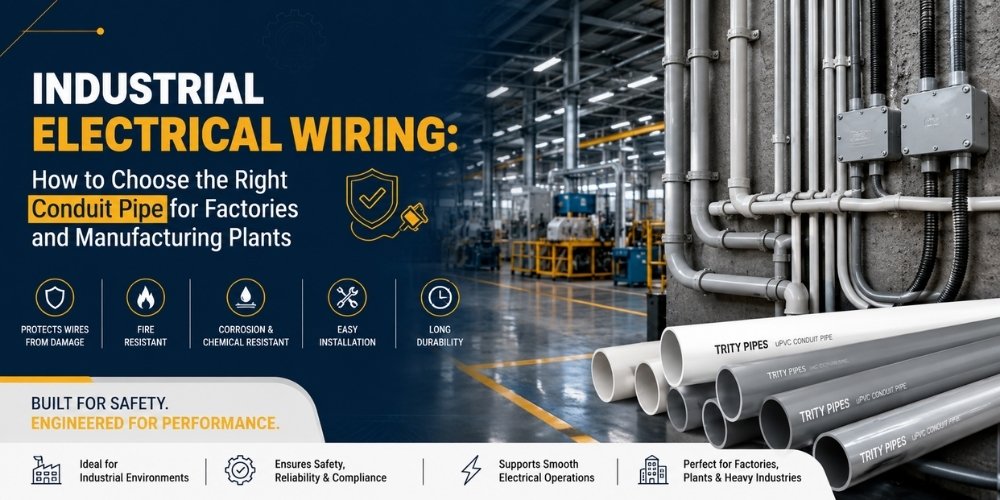
Most conduit specifications in India are still written for residential and light commercial jobs. A 20mm LMS pipe behind a false ceiling, a 25mm run to a socket board, done. Industrial wiring doesn't work that way, and plant engineers who treat it the same way usually find out the hard way, six months after commissioning, when a conduit run near a furnace has gone soft or a buried line in the fertiliser section has started leaching chemicals through a cracked wall.
Factories and manufacturing plants put conduit through conditions residential buildings never see: sustained heat from furnaces and motors, chemical vapour, constant vibration from heavy machinery, and cable loads that are an order of magnitude higher than a house circuit. Choosing conduit for this environment is a specification exercise, not a shopping exercise. This guide walks through what actually matters when you're speccing conduit for a factory floor, a chemical plant, or a manufacturing unit in India.
Why Standard Residential Conduit Fails in Industrial Environments
Standard light and medium gauge uPVC conduit, the kind used in 90% of residential and office wiring, is built for a controlled environment: stable temperature, no chemical exposure, minimal mechanical load, and wiring that's rarely touched once it's installed. Industrial plants break every one of those assumptions.
Three failure patterns show up repeatedly on factory sites when someone specifies residential-grade conduit for an industrial run:
- Softening and sagging near heat sources. Standard LMS or MMS conduit rated for normal ambient conditions starts to deform when it sits too close to a furnace, boiler, or a motor housing running hot for hours at a stretch. Once the pipe sags, the cables inside lose support and start to chafe at the joints.
- Cracking under vibration. Conduit clipped near compressors, presses, or rotating machinery takes constant low-level vibration. Light gauge pipe and undersized clips work loose over months, and the conduit eventually cracks at the fitting joints, exposing the cable.
- Chemical attack on unsuitable material. In chemical and fertiliser plants, vapour and spillage attack conduit material that wasn't chosen for the specific chemical environment. Mild steel corrodes fast in acidic atmospheres, and even some plastics degrade faster than expected depending on the chemical group involved.
The fix isn't a completely different product category. It's specifying the right grade, material, and installation method for the actual conditions on that section of the plant, which is exactly what the rest of this guide covers.
Heat Exposure: Conduit Near Furnaces, Motors, and Boiler Rooms
Heat is the most underestimated factor in industrial conduit selection, mainly because the danger isn't obvious until the pipe has already started to fail.
Electrical-grade uPVC conduit manufactured to IS 9537 Part 3 is engineered with heat stabilisers that give it a working range of roughly -15°C to 60°C in continuous service, with higher short-term tolerance. That's more than enough for the vast majority of factory floor wiring, including areas near standard motors and switchgear. Where uPVC starts to struggle is sustained proximity to genuine high-heat sources: furnace walls, boiler rooms, kilns, and equipment that radiates heat continuously above the pipe's rated range.
A few practical rules that plant engineers and MEP contractors use on-site:
- Maintain physical clearance. Route conduit away from direct radiant heat wherever the layout allows. A few hundred millimetres of clearance from a hot surface often makes the difference between a stable installation and a slowly deforming one.
- Use HMS grade, not MMS or LMS, in warm zones. Heavy gauge uPVC has thicker walls and holds its shape better under sustained warmth than lighter grades. If you haven't nailed down which grade applies to which part of the plant, the difference between LMS, MMS, and HMS conduit is worth reviewing before finalising the BOQ.
- Switch to GI conduit for direct high-heat exposure. For conduit runs that genuinely sit close to furnaces, boiler rooms, or continuously hot equipment casings, galvanised iron conduit is the correct choice over any uPVC grade. Metal simply tolerates sustained heat that plastic can't.
- Don't rely on fire-retardant properties as a heat-exposure substitute. Fire retardance and heat tolerance are two different specifications. A fire resistant conduit pipe self-extinguishes if it catches fire from an electrical fault; it isn't designed to sit against a hot surface all day.
Chemical Resistance: uPVC vs GI in Chemical Plants and Fertiliser Units
Chemical and fertiliser plants are where the choice between uPVC and GI conduit stops being a cost decision and becomes a survival decision for the installation.
Galvanised iron looks tough on paper, but the zinc coating that protects it is exactly what acidic and alkaline vapours attack first. Once the coating breaks down, in chemical processing areas this can happen faster than most people expect, the base steel underneath starts corroding from the outside in. The corrosion is often invisible until a conduit run fails structurally or a moisture path forms inside the pipe.
uPVC conduit doesn't have this vulnerability. It's chemically inert to the acids, alkalis, and salts commonly encountered in Indian chemical and fertiliser plants, and it doesn't rely on a coating that can wear off. This is one of the clearer material breakdowns available in the full comparison of GI, uPVC, and other conduit materials, including where GI still makes sense despite the corrosion risk.
That said, chemical resistance isn't automatic just because a pipe is labelled uPVC. The compound formulation matters. Conduit made with proper heat stabilisers and controlled additive systems holds up to chemical exposure far better than conduit made with substandard or recycled compound, which is a genuine risk in a market where price-driven procurement is common. For plants specifying conduit for chemical-adjacent areas, it's worth understanding what actually goes into the manufacturing compound before approving a vendor.
The practical rule for most chemical and fertiliser plant projects: uPVC for general chemical exposure and vapour zones, GI only where mechanical protection needs outweigh the corrosion risk, and never GI in areas with direct acid or alkali contact without additional protective coating.
Conduit in Classified Hazardous Zones: IS 5571 Requirements
Areas of a plant where flammable gases, vapours, or combustible dust can accumulate, tank farms, paint booths, solvent storage, certain sections of chemical and fertiliser units, fall under classified hazardous area requirements. In India, the selection of electrical equipment and wiring systems for these zones is governed by IS 5571, which classifies areas by the type and probability of hazardous atmosphere present, broadly similar in structure to the Zone-based classification used internationally.
Conduit specification in a classified zone isn't a material choice made in isolation. It has to work as part of a certified installation:
- The zone classification of the specific area (determined by a hazardous area classification study, not guessed on-site) drives which wiring methods are even permitted there.
- In many classified zones, threaded rigid metal conduit with certified sealing fittings is specified precisely because it can maintain flame-path integrity if installed and sealed correctly.
- Where non-metallic conduit is used in or near a classified zone, it has to be part of a system that's been evaluated for that use, not a standard uPVC run repurposed without review.
- Sealing at zone boundaries and at every fitting where gas migration could occur is not optional. This is usually where hazardous area installations fail inspection, not the conduit material itself.
This is one part of the specification where "check with the electrical safety consultant on the project" is the correct answer more often than a generic product recommendation. Hazardous area classification is site-specific, tied to the actual gas or dust group present, and it needs sign-off from someone qualified to make that call. What a conduit supplier can control is supplying certified, correctly rated material once the classification and wiring method have been decided.
Vibration and Mechanical Impact Protection
Factory floors move. Presses, compressors, conveyors, and rotating machinery all transmit vibration into anything mounted nearby, including the conduit run overhead or along the wall. Over months, that vibration does two things: it works fasteners and clips loose, and it fatigues the conduit at its weakest points, typically the fitting joints.
A few specification points that hold up on real industrial sites:
- Grade up, not just for load, but for fatigue resistance. Heavy gauge uPVC or GI conduit tolerates cyclical vibration better than light gauge pipe, which can develop hairline cracks at joints over time.
- Space supports closer together in high-vibration zones. The standard support spacing used for office or residential runs is usually too wide for conduit mounted near heavy machinery. Reducing the interval between clips and saddles keeps the pipe from flexing enough to fatigue.
- Use flexible conduit at connection points to moving or vibrating equipment. Rigid conduit run straight into a motor terminal box on a vibrating machine transfers stress directly into the joint. A short flexible connection absorbs that movement instead.
- Protect exposed runs from mechanical impact, not just vibration. Conduit at floor level or along walkways in a factory is exposed to forklift traffic, dropped tools, and general foot and material movement in a way office conduit never is. Route around high-traffic paths where possible, or add physical protection (trunking, guards) where it can't be avoided.
Heavy-Duty uPVC vs GI: Which One, When
This is the question that comes up on nearly every industrial project, and the honest answer is that it depends on which failure mode you're protecting against.
uPVC (heavy duty / HMS grade) is the right call when:
- The primary risk is moisture, chemical exposure, or general corrosion rather than extreme heat or heavy impact
- The installation is embedded, buried, or in a humid or chemically active atmosphere
- Cost and installation speed matter, since uPVC is lighter and faster to install than GI
- The run isn't in a classified hazardous zone requiring metallic conduit
GI conduit is the right call when:
- The conduit is exposed to sustained high heat near furnaces, boilers, or hot equipment
- The area is a classified hazardous zone where certified metallic conduit with sealed fittings is required
- Mechanical impact risk is severe (heavy machinery areas, exposed floor-level runs in high-traffic zones)
- Local electrical inspection or client specification explicitly calls for metallic conduit
Most industrial plants end up using both, GI in furnace rooms, hazardous zones, and high-impact areas, uPVC everywhere else including general process areas, chemical-adjacent zones, and standard distribution runs. Specifying one material across an entire plant almost always means over-speccing (unnecessary GI cost and installation time in low-risk areas) or under-speccing (uPVC in a zone that genuinely needed metallic protection). A section-by-section review of the plant layout against actual conditions, not a blanket standard, gets the specification right.
Multi-Cable Industrial Distribution Runs: Sizing for Three-Phase and Large Motors
Industrial conduit sizing has a different starting point than residential sizing. A house circuit runs two or three cables. An industrial distribution run to a large motor or a three-phase panel can carry six, eight, or more cables of significant gauge through a single conduit, and getting the size wrong means either an impossible pulling job on-site or an overfilled conduit that overheats in service.
The same 40% fill principle used in residential and commercial wiring applies here, but the numbers involved are larger and the margin for error is smaller. For industrial and infrastructure projects, 50mm and 63mm conduit is standard for high-density cable bundles and three-phase installations, compared to the 20-32mm range typical of residential circuits. The full breakdown of fill calculations and standard sizes by application is covered in the conduit pipe size chart for electrical wiring in India, which is worth cross-checking against actual cable schedules before finalising conduit sizes for a distribution run.
A few things specific to industrial multi-cable runs:
- Size for the panel schedule, not just today's motor load. Plants add machinery over their lifecycle. A conduit sized exactly for current cable count leaves no room for expansion without breaking into finished areas later.
- Separate power and control cabling where the layout allows. Running high-current power cables and low-voltage control or instrumentation cables in the same conduit invites interference issues, even where it's not a code violation.
- Account for derating on long horizontal runs with multiple bends. Heavily loaded conduit with several 90-degree bends over a long distance affects both pulling tension and thermal performance. This is a cable engineering calculation as much as a conduit sizing one, and it's worth involving the electrical design engineer rather than defaulting to a standard size.
Surface vs Concealed Wiring in Industrial Settings
Residential and office projects lean heavily toward concealed wiring for appearance. Factories and manufacturing plants generally go the other way, and for good reason.
Surface-mounted conduit is the default preference in most industrial settings because:
- Maintenance access matters more than appearance. Plant electricians need to inspect, repair, and modify wiring without breaking into structural walls. Surface conduit on trays, racks, or wall-mounted runs keeps every joint accessible.
- Layouts change. Machinery gets moved, added, or replaced far more often on a factory floor than in a finished building. Surface conduit can be extended, rerouted, or modified without civil work.
- Concealed conduit in industrial structures often means embedding in areas with heavy structural loads or future retrofitting, which is expensive and disruptive compared to residential slab embedding.
Concealed or buried conduit still has its place in industrial projects: underground distribution between buildings, cabling below floor level in process areas, and runs where surface mounting genuinely isn't practical. But as a general design preference, industrial MEP contractors default to surface-mounted, well-supported conduit runs precisely because factories are working environments that get modified constantly, not finished spaces meant to stay untouched.
Getting the Specification Right
Industrial conduit selection isn't one decision, it's a set of section-by-section decisions across the plant: material choice by zone, grade by mechanical and thermal load, sizing by actual cable schedule, and installation method by maintenance need. Getting each of those right on a large industrial project takes more than a generic product spec sheet.
Trity Pipes manufactures IS 9537 Part 3 certified uPVC conduit pipes and fittings in the LMS, MMS, and HMS grades used across industrial distribution, chemical-adjacent areas, and general plant wiring. For a project-specific recommendation, whether that's grade selection for a particular zone, sizing for a distribution run, or clarifying where uPVC is appropriate against where GI is the safer call, reach out to the Trity Pipes team for a consultation on your project specification.