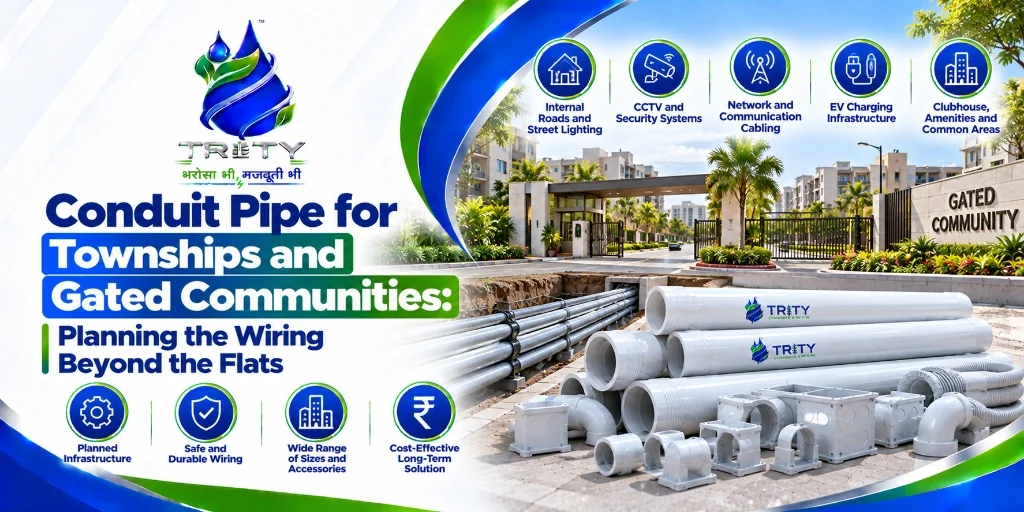
When a developer builds a gated community, buyers see towers, gardens and a clubhouse. Underneath, there is another project: kilometres of buried ducts for street lights and power, wiring for the clubhouse and gym, cabling for security gates and cameras, power for water pumps and sewage treatment, charging points for electric cars, and supply to common areas, parks and boundary walls. This common-area electrical work is large, it is built in stages across several years, and it is the part that the residents' association has to live with and maintain after the builder leaves.
Conduit is central to all of it, and mistakes are expensive, because ducts are buried under roads and landscaping that are hard to dig up. This guide explains how to plan conduit for township and gated community infrastructure: what the common-area scope includes, how to design underground duct networks, which grade and size to use, how to plan for phased development, what to document for handover and how to organise supply with Trity Pipes.
What the common-area electrical scope includes
A modern township or gated society usually has some or all of the following.
- Internal roads, street lighting and pathway lighting
- Boundary wall, gate and landscape lighting
- Entrance gates, boom barriers, security cabins and access control
- CCTV cameras around the perimeter, at gates and in common areas
- Clubhouse, gym, swimming pool, indoor games and community halls
- Water pumps, overhead and underground tanks, sewage treatment plant and rainwater systems
- Basement and surface parking lighting and ventilation
- EV charging points in parking areas
- DG sets, transformers and electrical substations
- Lifts and common-area power for each tower
- Rooftop solar for common loads, increasingly common in new societies
Each of these needs cable routes, and many are outdoors or underground.
Underground ducts: the backbone
For roads, lighting and services between buildings, underground duct banks are the standard approach. A well-designed duct network lets you add or replace cable without digging up the road.
Design principles
- Plan routes along roads and green strips, not under buildings, with enough depth and clearance from other utilities
- Lay ducts with spare ways, often more than the initial requirement, because loads and services grow
- Use inspection or pull chambers at regular intervals, at junctions and at changes of direction, so that cables can be pulled and joints made
- Protect crossings. Where ducts cross roads and driveways, use HMS grade, with additional protection as the specification requires
- Use warning tape or markers above the ducts, and record the routes on drawings
- Keep power and low-voltage separate, so that street lighting, power and data cables do not share a duct
Our guide on underground conduit pipe for cable protection explains depth, bedding and protection in detail.
Choosing grade and size
| Area | Typical use | Suggested grade |
|---|---|---|
| Road crossings and heavy traffic | Underground ducts | HMS |
| Street and pathway lighting | Underground and pole feeders | HMS |
| Landscape and garden lighting | Shallow underground, exposed | HMS, UV stabilised where exposed |
| Security gates, CCTV, access control | Underground and exposed | HMS, UV stabilised where exposed |
| Clubhouse, gym, halls | Concealed | MMS |
| Pump rooms, STP, plant rooms | Surface and concealed | HMS where exposed |
| Parking and basements | Surface | HMS |
| Tower common areas | Concealed | MMS |
Use this as a starting point, with your specification and consultant's requirements taking priority. Our LMS, MMS and HMS guide and conduit pipe size chart help with grade and size.
Outdoor exposure
Townships are largely outdoors. Exposed conduit on poles, walls, gates and landscape structures sees sun, rain, dust and temperature swings. Use UV stabilised conduit, sealed boxes and proper glands, and fix conduit securely with expansion allowance on long runs. Our guide on UV resistant conduit for outdoor wiring explains what to confirm with the manufacturer.
Clubhouse, pool and amenity buildings
Amenity buildings combine many kinds of load: lighting, air conditioning, kitchens, pumps, sound and AV. They are wired like commercial buildings, with concealed MMS conduit in walls and slabs, and HMS in back-of-house and service areas. Pool and wet areas have specific safety requirements, so follow the consultant's specification closely. Our guide on conduit pipe for hotels and resorts covers the hospitality-style amenity spaces that many clubhouses resemble.
EV charging and parking
New societies increasingly plan charging points in parking areas, and buyers ask about them. Lay spare conduit capacity during parking construction, since adding it later means breaking finished surfaces. Our guide on conduit pipe for EV charging stations explains sizing for continuous load and outdoor exposure.
Security, CCTV and smart-home provisions
Gated communities are marketed on security. Plan conduits for gate automation, boom barriers, access control, perimeter cameras and intercoms in the common-area design, and consider smart-home provisions inside the flats. Our guide on conduit pipe for smart home and CCTV wiring explains how to plan low-voltage routes, separation and pull boxes.
Planning for phased development
Townships are built in phases over years, and electrical planning has to allow for that.
- Design the master duct network for the full build-out, even if only the first phase is built now
- Lay trunk ducts and spare ways early, while roads are open, rather than excavating completed roads later
- Standardise sizes and grades across phases, so that pipe and fittings always match
- Keep records of what was laid in each phase, with accurate drawings
- Plan material supply by phase, with consistent product from one manufacturer, so that later phases match earlier ones
Our guide on riser shaft conduit for multi-storey buildings covers the vertical distribution inside each tower, which should be coordinated with the site duct network.
Documentation and handover
When the builder hands over to the residents' association, the electrical records matter.
- As-built drawings showing every duct route, chamber, depth and spare way
- Conduit grade, size and batch records for each area
- Certification documents for the material used
- Test records for earthing and insulation
- Maintenance guidance for the association
Good records save the association money for years, and they protect the developer's reputation. Our guide on material approval submittals for conduit pipe explains the documents consultants usually expect.
Estimating and ordering
A township's conduit quantity is large and made of many different lines. Measure routes from the site plan, group them by size and grade, add allowances for cutting loss and spare ways, and estimate fittings by counting chambers, bends, junctions and terminations. Our guide on estimating conduit pipe for a BOQ explains the method, and our guide on buying conduit pipe in bulk explains how to structure a phased order.
Why developers choose Trity Pipes
Trity Pipes is a manufacturer of uPVC conduit pipes and fittings made from lead-free, high-grade virgin raw materials, certified to IS 9537 Part 3 with ISO certification. For township and society projects, we offer:
- LMS, MMS and HMS grades so that each part of the development gets the right strength
- Matching fittings from one manufacturer, so that joints fit across phases
- Project quotations with rate validity and phased delivery
- Certification documents on our certifications page and on request
- A Delhi NCR factory, close to some of the largest township markets in the country, with dispatch to 20-plus states
- A broader range, including CPVC, SWR, pressure and other pipes, so that conduit, water supply and drainage for a development can come from one manufacturer
See the uPVC conduit pipes and fittings range, and read our overview of what Trity Pipes makes for the full range. Our team can prepare a combined quotation for your project.
Working with Trity Pipes on a township project
Township projects usually involve several parties: the developer, the electrical consultant, the infrastructure contractor and the building contractors for each tower. We work with each of them. At the design stage, our team can discuss grade and size for the master duct network and for amenity buildings. At procurement, we prepare quotations that cover the full range of conduit and fittings, with rate validity and phased delivery. During construction, we help with documents and site questions, and after handover, we remain available for the residents' association if they need matching material for repairs and additions. For developers who build several communities, we can discuss a standard specification and repeat supply.
Questions developers should ask before choosing a conduit supplier
- Can the supplier match product across phases that are built years apart?
- Will certification documents be available for every batch?
- Can deliveries be phased to follow construction?
- Is there a manufacturer behind the product who can answer technical questions?
- What happens if a delivery is short, damaged or the wrong size?
Our guide on how to read and compare conduit pipe quotations helps you compare offers on the same basis.
Lessons from completed townships
Developers who have finished large communities often say the same things. Lay more spare ducts than you think you need, because the cost of an extra duct in an open trench is tiny compared with digging up a finished road. Mark and record every route, because the person who maintains the system in ten years will not be the person who built it. Keep the same product across phases, because mixed material creates fit and finish problems. And talk to the residents' association's electrician before handover, because they know which questions will come up first. Trity Pipes is happy to review a township conduit plan at the design stage and share what we see across projects in the region.
Frequently Asked Questions
What conduit grade should I use for township street lighting?
HMS grade is the usual choice for underground and exposed runs for street and pathway lighting, with UV stabilised compound for sections in the open and additional protection at road crossings.
How many spare ducts should a township lay?
It depends on the project, but laying spare ways beyond today's requirement is standard practice, because adding ducts later means breaking finished roads. Your consultant should specify the number for each route.
How do I plan conduit for a township built in phases?
Design the master duct network for full build-out, lay trunk ducts and spare ways early, standardise sizes and grades across phases, and keep accurate records of each phase.
What documents should a developer hand over to the residents' association?
As-built drawings with duct routes, depths and spare ways, material grade and batch records, certification documents, test records and maintenance guidance.
Can Trity Pipes supply conduit for a township in phases?
Yes. Share your sizes, grades, quantities and phasing plan, and our team will prepare a quotation with rate validity and a phased delivery schedule from our Delhi NCR factory.
Should a gated community plan for EV charging?
Yes. Laying spare conduit capacity for charging points during parking construction is far cheaper than retrofitting later, and buyers increasingly expect it.
Planning a township or gated community? Contact Trity Pipes on +91-9821030072 or +91-9319984755 for a phased project quotation, certification documents and matched supply of ISO-certified uPVC conduit pipe from our Delhi NCR factory.