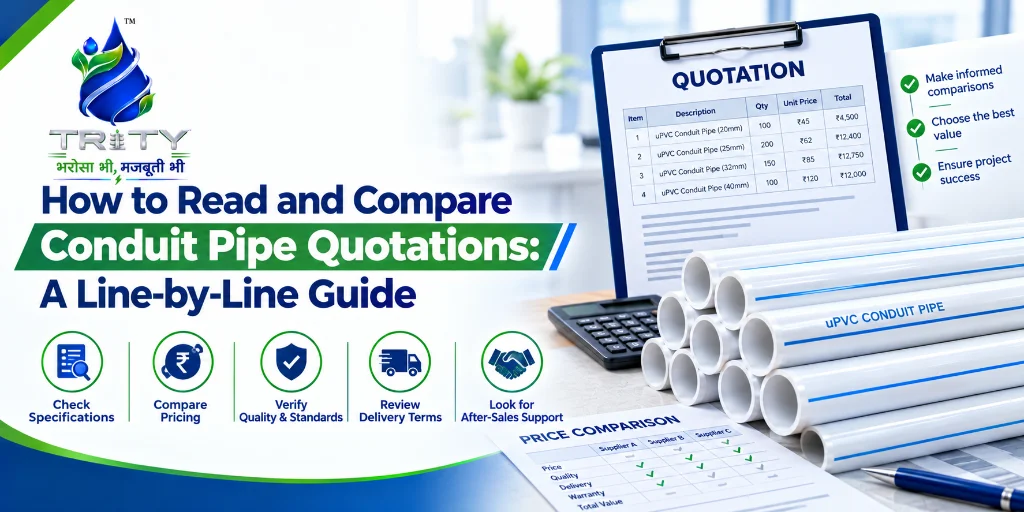
Search for conduit pipe prices online and you will find listings from a few rupees a metre to several hundred, all under the same product name. Nothing in those numbers tells you the size, grade, wall thickness, standard or whether the price includes tax and delivery. A conduit pipe quotation is only useful when you can read it properly and compare it with another on equal terms.
This guide explains each line of a typical quotation, the traps that make a cheap quote expensive, how to convert quotes to a common basis, and how to ask for a quotation you can trust. If you want background on what drives the numbers, our guide on uPVC conduit pipe pricing in India covers the cost factors. This post is about reading what is on the page.
Why per-metre rates alone mislead
A rate per metre is the number everyone looks at first, and it hides more than it shows. Two suppliers can quote the same figure for different products.
- One quote may be for LMS grade and another for HMS, which have very different wall thickness and material content
- One may be priced per metre, another per piece of a different length, a third per kilogram
- One may include tax and delivery, another may not
- One may be for pipe certified to IS 9537 Part 3, another for unmarked material
- One may hold for a week, another for a month
Comparing the headline rate without checking these is how buyers end up paying more for a worse product.
Anatomy of a conduit pipe quotation
A complete quotation should state the following.
Product description
- Size (nominal diameter) of each item
- Grade or class: LMS, MMS or HMS
- Standard: IS 9537 Part 3, with the BIS licence number if an ISI mark is claimed
- Colour and finish
- Length per piece: commonly 3 metres, but confirm
- Brand or manufacturer name
Commercial terms
- Unit of pricing: per metre, per piece or per kilogram
- Rate for each line
- Packing: pieces or metres per bundle, which affects how you order
- GST: whether the rate is inclusive or exclusive. Plastic pipes and fittings fall under HSN 3917 and attract 18 percent GST
- Freight and loading: included, extra or ex-factory
- Delivery period: days from order or from advance payment
- Payment terms: advance, credit days, milestones
- Validity: how long the rate holds
- Minimum order quantity, if any
Supporting information
- Certification references and documents available
- Warranty or replacement terms
- Contact person and order process
If any of these is missing, ask. A quotation that leaves out grade, standard or validity is incomplete.
A table to line up quotes side by side
Put each supplier's offer in one table before you compare rates.
| Item | Supplier A | Supplier B | Supplier C |
|---|---|---|---|
| Size and grade | |||
| Standard and BIS licence number | |||
| Pricing unit | |||
| Rate | |||
| GST included or extra | |||
| Freight terms | |||
| Packing | |||
| Delivery period | |||
| Payment terms | |||
| Validity | |||
| Warranty and documents |
Fill every cell, even if it means calling the supplier. The empty cells are where the surprises are.
How to convert quotes to a common basis
Once the table is filled, convert each quote into the same landed cost per metre.
- Convert the unit. If one quote is per piece, divide by the piece length to get a per-metre figure. If one is per kilogram, ask for the weight per metre and convert. Note that per-kilogram pricing makes it important to confirm wall thickness, because a thinner pipe weighs less and costs less per metre at the same rate per kilogram.
- Add tax where it is excluded, so every rate includes GST.
- Add freight and loading where they are extra, based on your delivery location.
- Add the cost of payment terms if one supplier asks for advance and another gives credit, since credit has a real value.
- Compare the same grade and standard only. Do not compare an HMS quote with an LMS quote.
The result is a landed rate per metre for equivalent material. That is the number to compare.
Red flags in a conduit pipe quotation
- No grade stated. "PVC conduit pipe, 25mm" could mean anything.
- ISI claimed but no licence number. Check any licence number on the BIS database before you trust it.
- Pricing per kilogram without a weight per metre. It is easy to hide thin walls this way.
- No validity period, or a very short one that pressures you to decide quickly.
- Verbal quotes only. Ask for something in writing.
- A rate far below others for the same stated grade. Our guide on identifying fake or substandard conduit pipe explains why unusually low prices are usually explained by thin walls, recycled material or missing certification.
- Extra charges that appear later, such as loading, packing or unspecified handling.
- Vague delivery promises with no date or conditions.
Extra items that change the real cost
Some items rarely appear in the first quotation but affect your total.
- Fittings. If pipe and fittings come from different suppliers, check that sizes match. Our guide on choosing uPVC conduit fittings explains what you need alongside pipe.
- Spare quantity. Allow for cutting loss and site changes when you decide how much to order.
- Documentation. If your project needs material approval, confirm that the supplier will provide certificates, datasheets and test records. See our guide on material approval submittals.
- Rate protection. For phased orders, ask whether the rate holds across the whole schedule.
How to ask for a quotation that is easy to compare
A precise request gets a precise answer. Send every supplier the same information.
- Sizes and grades, with quantities for each
- Standard required, and whether an ISI mark is mandatory
- Fittings needed, with quantities
- Delivery location and timeline, with phases if any
- Payment terms you can offer
- Documents you need for approval
- Date by which you need the quotation
If you are bidding for a tender, our guide on estimating conduit pipe in a tender BOQ explains how to prepare your quantities first, and our guide on buying conduit pipe in bulk explains how to structure the enquiry and negotiate.
What a Trity Pipes quotation includes
Trity Pipes is a manufacturer of uPVC conduit pipes and fittings made from lead-free, high-grade virgin raw materials, certified to IS 9537 Part 3 with ISO certification. When you send us your requirement, our team prepares a quotation that states the size and grade of each item, the rate, the delivery basis, the validity and the terms, so that you can compare it with other offers on the same basis. We can also share the certification documents you need alongside it.
You can see our credentials on the certifications page and browse the uPVC conduit pipes and fittings range. Dealers and wholesalers who want a price list for resale should read our guide on wholesale pricing factors and then speak to our team about tiers for your volume.
A short checklist before you accept any quote
- Is the grade, size and standard stated for every line?
- Is the BIS licence number given and verified?
- Is the pricing unit clear, and have I converted it to per metre?
- Are GST, freight and loading clearly included or excluded?
- Is the validity long enough for my decision and order?
- Are delivery and payment terms written?
- Do I have the documents and warranty terms I need?
- Have I compared landed cost for the same grade across suppliers?
A worked method for a typical comparison
Imagine you need three sizes of MMS conduit with fittings, and you have received three quotations. Here is how to compare them without relying on any single number.
- Write down the items and quantities you asked for, so you can check that each supplier quoted all of them.
- Mark every quote with its pricing unit. If one is per piece, note the piece length. If one is per kilogram, ask for the weight per metre.
- Convert each rate to a per-metre figure and add tax if it was excluded.
- Add freight to your site, using the supplier's figure if given and a transporter's estimate if not.
- Check the grade and standard on each line. If a supplier quoted a lighter grade to reach a lower rate, remove that quote from the comparison or ask for a revised one.
- Look at the terms. Note advance requirements, credit days, delivery period and validity.
- Score the non-price factors: documentation, warranty terms, technical support and references.
- Pick the best overall offer, which is not always the lowest number.
This method takes an hour, and on a large order it routinely saves far more than that.
Questions to ask each supplier after you receive the quote
- Which batch or production run will my order come from?
- Can I see the BIS licence and ISO certificate, and a recent batch test record?
- What is the wall thickness and weight per metre of each size and grade?
- Will fittings in the same quotation match the pipe dimensions?
- What happens if a delivery is short, damaged or the wrong size?
- Can the rate be held across phased deliveries?
- Who is my contact for the order, and how quickly do you respond?
Suppliers who are confident in their product answer these quickly and in writing. Those who are not tend to avoid specifics.
Why contractors and dealers ask Trity Pipes for a quotation
Buyers who have compared many quotes tell us the same thing: they want a supplier who states everything clearly and holds to it. At Trity Pipes we manufacture our conduit in our own plant in Ghaziabad, so the person quoting you can speak about the product, the production and the delivery from first-hand knowledge. We offer LMS, MMS and HMS grades with matching fittings, we can discuss phased delivery for larger projects, and we are happy to share certification documents with your quotation. Dealers and distributors can also ask about volume tiers. When you request the Trity Pipes price list, tell us the size, grade, quantity and location, and we will respond with a quotation that you can place beside any other.
Frequently Asked Questions
What should a conduit pipe quotation include?
It should state the size, grade, standard and brand of each item, the pricing unit and rate, GST treatment, freight terms, packing, delivery period, payment terms, validity and the documents available. A quote without grade or validity is incomplete.
Why do conduit pipe prices differ so much between suppliers?
Prices differ because the products differ in grade, wall thickness, raw material, certification and what the price includes. A low rate often reflects thinner walls, recycled material or exclusions such as tax and freight, not a better deal.
How do I compare quotes quoted per piece, per metre and per kilogram?
Convert each to a landed rate per metre. Divide per-piece prices by the piece length, convert per-kilogram prices using the weight per metre, add tax and freight where excluded, and compare only the same grade and standard.
How long should a quotation be valid?
It should cover the time you need to decide and place the order, and for tenders, at least the bid validity period. Always ask for the validity in writing.
Can I get the Trity Pipes price list?
Yes. Contact our team with your sizes, grades and approximate quantity, and we will share a quotation or price information for your requirement, along with the terms and documents you need.
Is GST included in the conduit pipe rate?
It depends on the supplier, so ask. Plastic pipes and fittings are generally charged at 18 percent GST under HSN code 3917. Confirm current rules with your chartered accountant.
Ready to compare? Contact Trity Pipes on +91-9821030072 with your requirement to get a clear, written quotation for ISO-certified uPVC conduit pipe and fittings from our Ghaziabad factory.