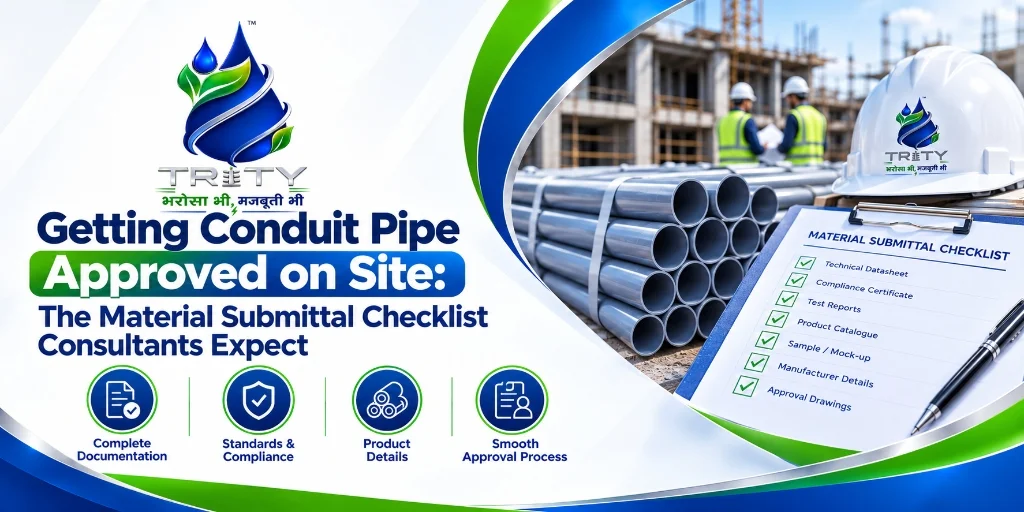
On most commercial, institutional and infrastructure projects, a contractor cannot simply buy conduit pipe and install it. The material has to be approved first, through what is variously called a Material Approval Request (MAR), a material submittal or a product submittal. The consultant or client reviews the documents, compares the product with the specification, and responds with an approval, a comment or a rejection.
When the package is incomplete, the cycle repeats, and a week lost on approval can become a month lost on the programme. This guide explains what a conduit pipe submittal should contain, how to present a clean compliance statement, why submittals get rejected, and how Trity Pipes helps contractors prepare a complete package.
What a material approval submittal is
A material approval submittal is a formal package prepared by the contractor to prove that the proposed material meets the project specification and applicable standards. It is submitted before procurement and installation, and the consultant records a decision on it.
Most projects use approval codes such as:
- Approved: proceed with procurement
- Approved with comments: proceed after incorporating the comments
- Revise and resubmit: the package needs changes before approval
- Not approved: the material is rejected
No material should be purchased in bulk or installed before approval, because a rejection after delivery means returns, delay and cost.
Why conduit pipe approvals are rejected
Most rejections come from a few avoidable causes.
- No clear comparison with the specification. The reviewer has to work out whether the product complies instead of seeing it in one table.
- Missing or expired certificates. A BIS licence or ISO certificate that has lapsed is an immediate problem.
- Test reports that do not match the product. A report for a different size or grade does not prove compliance for the one being submitted.
- Catalogue pages that do not state the standard or grade.
- Dealer submissions without manufacturer authorisation. The reviewer cannot confirm the supplier is authorised.
- No sample when the project requires one.
Fixing these before you submit is faster than answering comments afterwards.
The core documents for a conduit pipe submittal
Submittal cover sheet
State the project name, contract number, contractor, consultant, material description, manufacturer, intended location of use and submission date. Use a unique reference number and keep revisions clearly numbered.
Technical datasheet and catalogue
Provide the manufacturer's datasheet showing size, wall thickness, grade (LMS, MMS or HMS), standard, material and dimensions. Highlight the exact items you are proposing so the reviewer does not have to search.
Compliance statement against the specification
This is the most useful document in the package. It is a table with the specification requirement on one side and the proposed product's compliance on the other, with a reference to the supporting document for each row.
BIS licence and certification
Include a copy of the current BIS licence for the relevant product standard, along with the manufacturer's ISO certificate. Make sure the licence number matches what is marked on the pipe. Our guide to IS 9537 Part 3 explains what the standard covers, which helps you cross-reference the specification.
Test certificates and batch test reports
Submit test reports from the manufacturer's quality control and, where required, from an independent laboratory. Reports should relate to the same size, grade and product line being submitted. Batch records also help later at the inspection stage.
Manufacturer authorisation letter
If you are a dealer, distributor or contractor buying from the manufacturer, include a letter confirming you are authorised to supply the product for this project.
Previous supply references
List similar projects where the product has been supplied, with client names and approximate quantities. Consultants use this to judge track record.
Sample
Where the specification requires a physical sample, send one labelled with the project name and the MAR number. Our guide on how to identify fake or substandard conduit pipe lists the basic checks reviewers often apply to a sample, such as wall thickness, weight and surface finish.
Warranty and handling information
Add any warranty terms and storage and handling guidance, which some consultants ask for on larger packages.
A sample compliance statement layout
The exact content depends on your project specification. This layout shows the structure, and you should fill it with your own project requirements and the manufacturer's verified data.
| Specification requirement | Proposed product | Supporting document |
|---|---|---|
| Standard: IS 9537 Part 3 | Rigid uPVC conduit to IS 9537 Part 3 | BIS licence copy |
| Material: virgin uPVC compound | Virgin raw material | Manufacturer declaration |
| Grade: as specified (LMS, MMS or HMS) | Grade stated per item | Datasheet and catalogue |
| Size range: as per BOQ | Sizes listed in the BOQ | Datasheet |
| Quality system | ISO certified manufacturer | ISO certificate |
| Test requirements | Tested as per standard | Test certificates and batch reports |
| Marking | Marked as per standard | Sample and catalogue photo |
Add a column for remarks where the product exceeds the requirement or where a deviation exists. Always declare deviations openly, because consultants find undeclared deviations on their own and trust the rest of the package less.
Material approval and inspection are two different steps
Approval of the submittal is not the end of the process. After approval, material delivered to site is checked through a material inspection request, where the delivery is compared with what was approved. The consultant may match the delivered pipe against the approved sample and review batch documents.
To avoid problems at this stage:
- Deliver exactly the product that was approved, not a similar alternative
- Keep batch and test documents with each delivery
- Store material correctly and label it by size and grade
- Keep the approved submittal and sample on file at site
Our guide on why uPVC conduit pipes break also helps site teams handle and install the material properly after it is approved.
Tips for faster approval
- Read the specification first and build the compliance table from it, not from the catalogue.
- Use clear labelling for every attachment and cross-reference it in the cover sheet.
- Submit early. Approval cycles take time, so start well before procurement is due.
- Highlight the proposed items in the datasheets.
- Declare deviations and explain them.
- Track the status and respond to comments quickly.
- Keep a revision log so nothing is lost between cycles.
How Trity Pipes supports your submittal
Trity Pipes is a manufacturer of uPVC conduit pipes and fittings made from lead-free, high-grade virgin raw materials, certified to IS 9537 Part 3 with ISO certification. When you plan a submittal, our team can discuss the documents you need, including certification details, technical datasheets, test records and a sample where required. Our certifications page shows our certification information, and the uPVC conduit pipes and fittings range lists the sizes and grades you can propose.
If you are the contractor's procurement team, our guide on how EPC contractors select conduit pipe suppliers explains how supplier evaluation and material approval fit together, and our article on conduit pipe manufacturer vendor registration covers the vendor side of the process.
Preparing the package step by step
A calm, ordered process beats a rushed one.
- Collect the specification and BOQ items for conduit, fittings and accessories.
- List every requirement from the specification in a working table.
- Request documents from the manufacturer early, including certificates, datasheets and test records.
- Check dates and numbers. Licence numbers, certificate validity and product details should all match.
- Build the compliance statement and attach supporting documents in the same order.
- Review the package as if you were the consultant and ask what you would still need to know.
- Submit and track the approval, and keep a log of comments and replies.
Allow time for the consultant's review in your programme. A package that is approved on the first cycle saves far more time than any shortcut in preparation.
Why contractors choose Trity Pipes for material approval support
A submittal is only as strong as the manufacturer behind it. Trity Pipes helps contractors and dealers prepare packages that reviewers can approve with confidence.
- Verifiable certification. Our uPVC conduit pipes and fittings are made to IS 9537 Part 3 under ISO certification, and we publish our certification information openly.
- Documents on request. Our team can discuss certification copies, technical datasheets, test records and samples for your project.
- Consistent product. Lead-free, high-grade virgin raw materials and in-process quality control support the batch-to-batch consistency consultants look for at the inspection stage.
- Full range. Pipe in LMS, MMS and HMS grades, with fittings, from a single manufacturer keeps the submittal simple.
- Supply you can plan around. A plant in Delhi NCR and a network across 20-plus states helps you commit to delivery dates after approval.
To see what you can propose, review the uPVC conduit pipes and fittings range, and ask for the Trity Pipes price list and submittal documents when you send us your specification.
Handling comments and resubmissions
A comment is not a rejection. Read each comment carefully, reply to every point in writing, update the affected documents and mark the revision number. If you disagree with a comment, support your position with the relevant standard or test record, and keep the tone factual. Resubmitting quickly shows the consultant you are organised, and it keeps the programme on track.
Frequently Asked Questions
What documents are needed for a conduit pipe material approval?
Usually a cover sheet, technical datasheet and catalogue, compliance statement against the specification, BIS licence and ISO certificate, test certificates or batch reports, manufacturer authorisation if you are a dealer, previous supply references and a sample where required.
How long does material approval take?
It depends on the consultant and the quality of the submission. A complete, clearly organised package is usually approved faster than one that needs several rounds of comments, so submit early and respond quickly.
Why was my conduit pipe submittal rejected?
Common reasons are an unclear comparison with the specification, expired or missing certificates, test reports that do not match the product, a missing manufacturer authorisation, or a catalogue that does not state the standard and grade.
Can I order conduit pipe before the approval comes?
It is better not to place a bulk order before approval, because a rejection after delivery causes returns and delay. You can discuss pricing and lead time with the supplier while the approval is in progress.
Can Trity Pipes provide documents for my material approval?
Yes. Our team can discuss certification details, datasheets, test records and samples for your submittal. Contact us with your project specification so we can confirm what is needed.
Do I need a new submittal for each size or grade?
Many projects accept one submittal covering several sizes of the same product line, but each grade and size must be clearly listed with matching documents. Check with your consultant how they prefer items to be grouped.
Preparing a material approval for conduit pipe? Contact Trity Pipes with your specification and BOQ to discuss the documents, samples and certification details your submittal needs from an ISO-certified uPVC conduit pipe manufacturer.