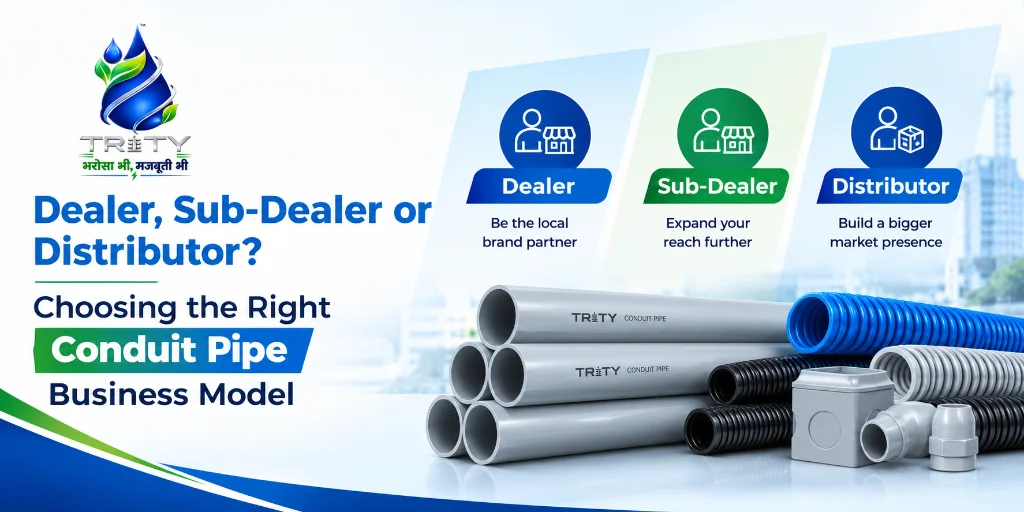
People who want to enter the pipe trade often ask the same question: should I become a dealer, a sub-dealer or a distributor? The three terms get used loosely, and the answer changes your capital, your risk, your margins and the kind of customers you serve. Choosing the wrong model is one of the most common reasons a new pipe business struggles in its first year.
This guide explains what each model means in the conduit pipe trade, compares them side by side, shows who each one suits, and explains how Trity Pipes works with dealers and distributors across Delhi NCR, Uttar Pradesh and more than 20 states.
What each model actually means
Sub-dealer
A sub-dealer is a small local reseller who buys from a distributor or a larger dealer, not directly from the manufacturer. Sub-dealers usually serve a town, a market area or a set of local electricians and contractors. They keep modest stock and sell in small quantities.
Authorised dealer
An authorised dealer buys from the manufacturer, or from the manufacturer's nominated distributor, under a recognised arrangement with the brand. Dealers hold a fuller range, serve contractors, builders and retailers in a city or part of a district, and often deliver to sites.
Distributor
A distributor buys in volume, usually directly from the manufacturer, holds substantial stock in a larger godown, and supplies dealers and sub-dealers across a district or region. A distributor is part wholesaler and part logistics operator, and carries the most inventory and credit exposure of the three.
The three models compared
| Factor | Sub-dealer | Authorised dealer | Distributor |
|---|---|---|---|
| Buys from | Distributor or dealer | Manufacturer or distributor | Manufacturer directly |
| Typical territory | A town or local market | A city or part of a district | A district or region |
| Stock held | Small, fast-moving sizes | Wide range of sizes and grades | Full range in volume |
| Capital needed | Lowest | Moderate | Highest |
| Customers | Local electricians, small shops | Contractors, builders, retailers | Dealers, sub-dealers, large projects |
| Credit exposure | Limited | Moderate | Highest, since many dealers buy on credit |
| Storage space | Small | Medium godown | Large godown |
| Growth path | Move up to dealer | Move up to distributor | Add product lines and territories |
The exact figures vary by manufacturer and region, which is why we avoid fixed numbers here. For typical investment ranges, read our guide on conduit pipe dealership investment and returns.
Which model suits you
Choose sub-dealer if
- You are new to the pipe trade and want to learn the market with limited capital
- You already run a small shop and want to add conduit without a large commitment
- Your area is small and a distributor already serves it well
Choose authorised dealer if
- You already have customers among electricians, contractors or builders
- You can hold a reasonable range of stock and deliver to sites
- You want direct support and pricing from the manufacturer or its distributor
Choose distributor if
- You have a large godown, transport and the cash flow to carry stock and extend credit
- You already supply other dealers or retailers in your region
- You want to build a larger business serving an entire district or more
Risk and cash flow in each model
Capital is only part of the picture. Each model carries a different kind of risk.
- Sub-dealers have low capital risk but depend on their supplier for availability. If the distributor runs short, they have no other source.
- Dealers carry moderate stock risk and some credit risk. They must manage slow-moving sizes and contractors who pay late.
- Distributors carry the largest exposure. A distributor can hold a lot of inventory and a lot of unpaid invoices at the same time, so cash flow discipline matters more than anything else.
Whatever you choose, set clear credit limits from the first sale and track receivables weekly. A pipe business that looks profitable on paper can struggle if too much cash is locked up in credit.
How pricing and margins differ
Margins in the pipe trade are usually structured in tiers. The further up the chain you buy, the better your purchase price, but the more stock and credit you must carry. A distributor earns a smaller margin per unit than a retailer but moves much larger volume, while a sub-dealer earns more per unit on small quantities.
Fittings often carry better margins than pipe, which is a reason to stock a full fittings range at every level. Margin percentages differ between manufacturers, so ask for the structure in writing and compare it with your own cost of storage, transport and credit.
The growth path from one model to the next
Most successful pipe businesses move up gradually.
- Start as a sub-dealer or small dealer and learn which sizes and grades your market buys.
- Build a base of repeat contractors by delivering on time and answering technical questions.
- Upgrade to a full dealer with a wider range and direct manufacturer support.
- Become a distributor once you supply other dealers and have the space and cash flow to carry volume.
Moving up works best when each step is earned through sales, not forced by capital. A manufacturer that supports this progression is more valuable than one that only wants a large first order.
How Trity Pipes works with dealers and distributors
Trity Pipes supplies conduit pipes, fittings and other pipe lines through more than 250 distributors and over 1,500 dealers across 20-plus states. That means the model works at several levels, and we talk to applicants about where they fit best instead of pushing everyone toward the same arrangement.
- If you want to start small: We can discuss working through an existing distributor in your region.
- If you want to become a dealer: Our guide on how to become a Trity Pipes dealer explains eligibility, documents and the application steps.
- If you want distributorship for a district or region: You can apply through the Become a Distributor form, and our team will review territory availability with you.
Our uPVC conduit pipes and fittings range is manufactured from lead-free, high-grade virgin raw materials to IS 9537 Part 3 with ISO certification, and our plant in Uttar Pradesh gives North India partners a freight and delivery advantage. Dealers can also add CPVC, SWR and pressure pipes from the same manufacturer.
A decision checklist
Answer these honestly before choosing:
- How much capital can I commit without straining my cash flow?
- How much space do I have, and is it suitable for storing pipe?
- Do I already have customers, or do I need to build them?
- Can I deliver to sites, and do I have transport?
- How much credit can I afford to extend?
- Is my area already served by a strong distributor?
- Am I looking for a quick start or a larger long-term business?
If most answers point to limited capital and a small customer base, start smaller. If you already supply other businesses and have space and cash flow, a direct dealership or distributorship makes more sense.
Common mistakes when choosing a model
- Jumping to distributor too early: Large stock and credit exposure without an established customer base is a risky combination.
- Staying a sub-dealer too long: Depending on one supplier for availability limits growth once your sales build.
- Ignoring territory: Without clear territory terms, another dealer may sell the same brand in your area.
- Ignoring documentation: Not checking BIS licence details and batch records can damage your name when a customer questions quality.
- Neglecting fittings: Selling pipe without a full fittings range sends customers elsewhere.
Frequently Asked Questions
What is the difference between a dealer and a distributor in the pipe trade?
A dealer sells to contractors, builders and retailers in a city or part of a district, while a distributor buys in volume directly from the manufacturer and supplies dealers and sub-dealers across a larger region. A distributor carries more stock, more credit exposure and needs more storage space.
Is it better to start as a sub-dealer or an authorised dealer?
A sub-dealer needs less capital and is a safer way to learn the market, while an authorised dealer gets direct support and a wider range but needs more investment. If you already have customers and space, a dealership is often the better starting point.
Can a sub-dealer become a Trity Pipes dealer later?
Yes. Many businesses start small and move up as their sales grow. If you build a base of repeat contractors and can hold a wider range, you can apply for a dealership through the Become a Distributor form.
How do I apply for a Trity Pipes distributorship?
Use the Become a Distributor form on the Trity Pipes website or contact our team. We will discuss your region, existing business, storage and expected volumes, and confirm whether the territory is available.
Does a distributor earn more than a dealer?
A distributor earns a smaller margin per unit but moves much larger volume, and also carries more stock and credit risk. Profitability depends on how well you manage inventory, receivables and costs, not just on the title.
Who gets better prices, a dealer or a distributor?
The further up the chain you buy, the better the purchase price, which is why distributors buy at lower rates than dealers. That advantage only pays off if you can sell the volume and collect payments on time.
Ready to choose your model? Talk to the Trity Pipes team about dealership or distributorship in your territory, and see how an ISI-compliant conduit pipe manufacturer with a network across 20-plus states can support your business.