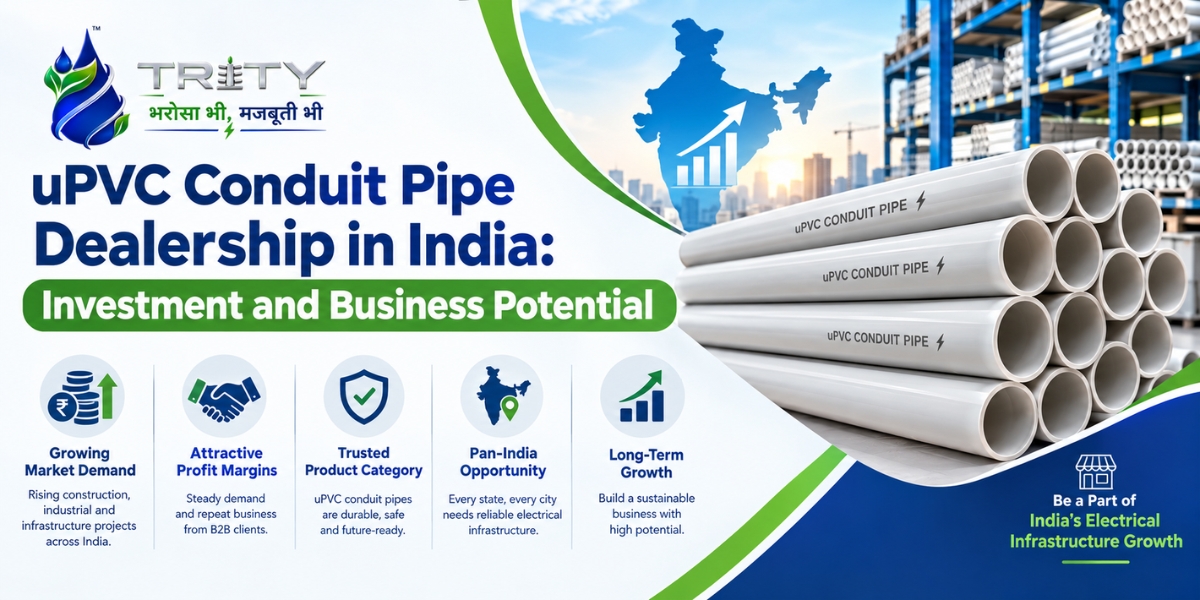
If you're evaluating a conduit pipe dealership as a business, the real question isn't whether the category has demand, it clearly does, but whether the numbers work for your specific situation: how much capital you actually need, how long before you see a return, and what realistic margins look like once stock, storage, and transport are accounted for. Our guide to the best uPVC conduit pipes in India covers the operational side of running the business. This post focuses specifically on the investment and financial picture.
Dealership vs distributorship: different investment tiers
The plastic pipe trade in India generally has two tiers of business entry, and the investment required differs significantly between them.
| Tier | Typical investment | Territory | Sourcing |
|---|---|---|---|
| Sub-dealer / local dealer | Roughly ₹3–7 lakh | Localised, a town or city area | Through a regional distributor |
| Regional distributor | Roughly ₹8–20 lakh | Larger district or region | Direct from the manufacturer |
These figures vary by manufacturer, region, and the specific product range carried, and should be confirmed directly with any manufacturer you're evaluating rather than treated as fixed numbers. A direct manufacturer dealership, where you source straight from the plant rather than through an intermediate distributor, generally sits toward the higher end of this range given the larger minimum stock commitment typically involved.
What the investment actually covers
Understanding where the capital actually goes helps set realistic expectations before committing.
- Opening stock, typically the largest single cost, often 60 to 70 percent of total initial investment, since you need enough inventory across sizes and grades to credibly serve your territory from day one
- Storage infrastructure, a godown or warehouse space, generally 400 to 600 square feet for a local dealer and 1,000 square feet or more for a regional distributor
- Transport, either a small commercial vehicle or a tie-up with local logistics providers for delivery to retailers and job sites
- Working capital for ongoing operations, since contractors and retailers commonly buy on credit terms tied to their own billing cycles, and a dealership needs cash flow cushion to extend reasonable credit while still restocking
Realistic margin structure
Dealer margins in the plastic pipe trade vary by manufacturer, product category, and volume tier, but a few general patterns hold across the industry. Margins are generally structured in tiers, with higher volume commitments earning better per-unit margins, and fittings typically carry a meaningfully higher margin than pipe itself, which is one reason stocking a complete fittings range alongside pipe matters for overall profitability, not just customer convenience. GST registration is mandatory to operate, and Input Tax Credit can meaningfully reduce effective input costs for a registered dealer, which is worth factoring into your actual margin calculation rather than looking at headline dealer pricing alone.
ROI and break-even timeline
Industry figures commonly cited for the broader PVC pipe dealership category suggest full investment recovery within roughly 18 to 24 months for a reasonably well-run operation, though this depends heavily on territory demand, how quickly you build a reliable contractor and retailer customer base, and how disciplined your inventory and credit management are from the start. A dealership that stocks a complete range from day one (reducing the chance of losing a sale to a competitor over a missing size) and builds relationships with repeat contractor customers rather than relying on one-off walk-in sales tends to reach break-even faster than one competing primarily on price with an incomplete range.
Factors that change the numbers for your situation
- Local construction activity is the single biggest driver of realistic revenue potential; a territory with active residential and commercial construction will support a dealership's numbers far better than a stagnant market, regardless of how well the business itself is run
- Existing dealer density in your target area affects how quickly you can build market share; an underserved territory reaches profitability faster than one with several established, well-stocked competitors already serving it
- Product range breadth affects both the investment required and the revenue ceiling; a dealership carrying conduit, plumbing, and SWR pipe from one manufacturer can serve a wider range of customer needs than one carrying conduit alone, though this also raises the initial stock investment
- Credit discipline has an outsized effect on actual cash-in-hand returns, since generous credit terms extended to slow-paying contractors can make a dealership that looks profitable on paper feel cash-strained in practice
Getting started
Before committing capital, speak directly with the manufacturer you're considering about current dealer and distributor terms, territory availability, and minimum stock requirements, since these details change and vary enough between manufacturers that generic industry figures are only a starting reference point, not a substitute for a direct conversation.
Trity Pipes works with dealers and distributors across Delhi NCR, Uttar Pradesh, and 20-plus states, with a structured onboarding process covering territory, stock requirements, and margin tiers. Review our full uPVC conduit pipes and fittings range to see what you'd be stocking, then get in touch to discuss dealership terms for your target territory.
Hidden costs new dealers often underestimate
The opening stock figure gets most of the attention, but several smaller costs add up quickly and are easy to leave out of an initial plan.
- Handling and damage losses. Pipe is bulky, and some loss through handling, cutting for customers, and storage damage is normal. Budget for it rather than treating it as an exception.
- Credit exposure. Contractors commonly pay after their own client pays them. Every week of credit you extend is working capital that is not available for restocking.
- Transport on small orders. Delivering a few lengths to a job site costs almost as much in time and fuel as delivering a full load, so small orders can quietly erode margin.
- Compliance and accounts. GST filing, bookkeeping, and basic licences carry a recurring cost in time or professional fees.
- Slow-moving sizes. A few sizes and grades will sit longer than others. Stock that does not move ties up cash just as surely as stock that sells.
Ways to reduce your initial investment risk
A dealership does not have to start at full scale. There are practical ways to limit exposure while you learn what your territory actually buys.
Start with the fast movers
Begin with the sizes and grades that sell most in your area, typically the common residential and commercial diameters, and add slower lines only once you can see real demand. This keeps opening stock lean and cash available.
Negotiate staged stock commitments
Ask the manufacturer whether the initial stock commitment can be phased, with a smaller first order and agreed top-ups as sales build. Manufacturers who want a long relationship are often open to this.
Keep credit disciplined from day one
Set clear credit limits and terms for contractors before the first sale, and follow them consistently. A dealer who starts with loose credit rarely tightens it later without losing customers.
Use the manufacturer's support
Product training, marketing material, and technical help are part of what you are paying for in the margin. Use them, because a dealer who can answer a contractor's sizing question confidently wins repeat business that price alone does not.
Thinking about the first year realistically
The first year is usually about building a customer base and learning your territory, not about full returns. Most of the early effort goes into getting electricians and contractors to try you once, then making that experience reliable enough that they return. A sensible plan assumes slower early months, tracks which sizes and customers drive repeat sales, and adjusts stock accordingly. Dealers who treat the first year as a learning period, with controlled spending and honest tracking, tend to be in a stronger position in year two than those who expected immediate full returns.
Questions to ask a manufacturer before you commit capital
A conversation with the manufacturer is the most valuable step in your planning. Ask what the minimum opening stock is, and whether it can be staged. Ask how territory is defined and protected, and what happens if another dealer approaches the same area. Ask what margin applies at different volume levels, and how often rates are reviewed. Ask about credit terms for you, and about payment terms that apply as your volumes grow. Ask what training, marketing material, and technical support come with the relationship. Finally, ask to speak with one or two existing dealers about their experience. Honest answers to these questions will tell you more about the opportunity than any brochure.
Matching the dealership model to your own situation
The right structure depends on your starting point. Someone with an existing hardware or electrical shop and customer relationships can often start as a dealer with modest capital and grow into broader distribution. Someone entering the trade fresh may be better served by a sub-dealer arrangement through a regional distributor, learning the market with lower exposure. A business with strong logistics and storage capability, and appetite for a larger territory, may consider direct distribution. Being realistic about your capital, your local network, and your tolerance for risk is more important than choosing the model with the biggest headline potential.
Building customer relationships that drive repeat sales
Sustained revenue in this trade comes from repeat customers rather than one-off buyers. Electricians and contractors return to dealers who have the sizes they need in stock, who deliver when promised, and who answer technical questions confidently. Make a habit of knowing your top contractors by name, tracking what they typically buy, and letting them know when new stock or a new range arrives. Reliable service in the first few months sets the pattern for the years that follow.
Frequently Asked Questions
How much does it cost to start a conduit pipe dealership in India?
A local sub-dealer operation typically requires roughly ₹3–7 lakh, while a regional distributorship sourcing directly from a manufacturer typically requires ₹8–20 lakh, covering opening stock, storage, and working capital. Exact figures vary by manufacturer and region.
How long does it take to recover the initial investment?
Industry figures for the broader PVC pipe dealership category commonly cite 18 to 24 months for full investment recovery, though this depends significantly on local construction demand and how the business is run.
Is a sub-dealer or a direct distributor a better entry point?
A sub-dealer model requires less capital and sources through an existing regional distributor, making it a lower-risk entry point, while a direct distributorship requires more investment but offers better margins and more control over territory. The right choice depends on your available capital and risk tolerance.
Does stocking fittings alongside pipe actually improve profitability?
Yes, generally. Fittings typically carry higher margins than pipe itself, and a complete fittings range alongside pipe reduces the chance of losing a full project sale to a competitor over a missing item.
Is GST registration compulsory to start a conduit pipe dealership?
For a business trading in pipes above the applicable turnover threshold, registration is generally required, and it also lets you claim input tax credit on purchases. Confirm current thresholds and requirements with a chartered accountant, since rules and limits can change.
Can I start small and scale up later?
Yes, and many dealers do. Starting with fast-moving sizes and a lean opening stock, then expanding the range as customer demand becomes clear, is generally lower risk than stocking a full range from the first day.