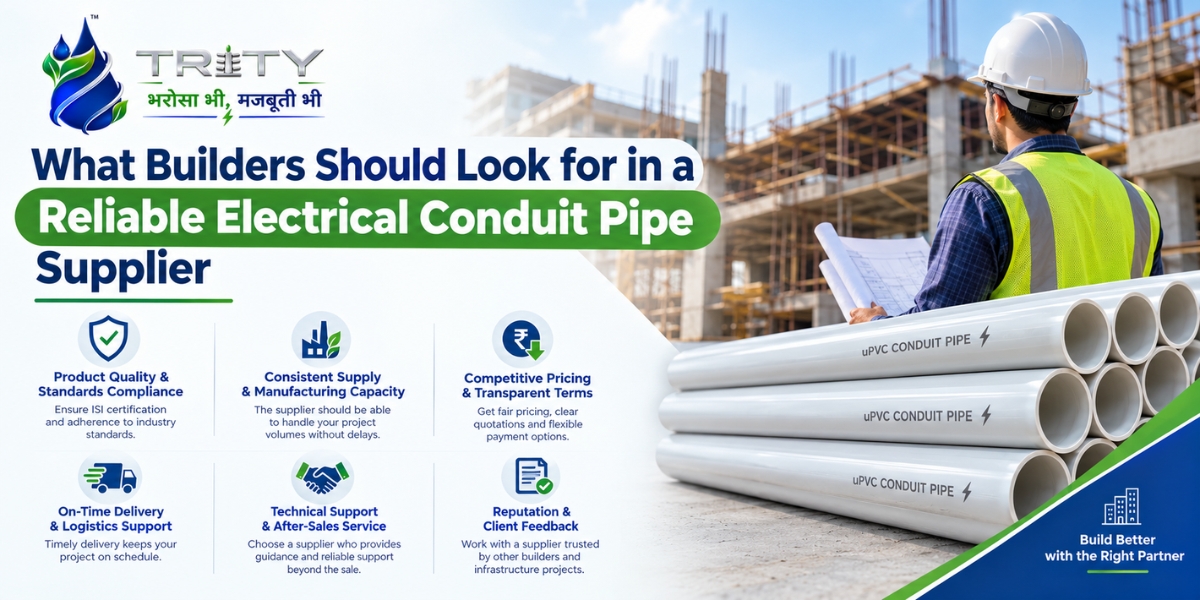
A builder's relationship with a conduit supplier looks different from a single contractor's or a homeowner's. A builder is buying repeatedly, across multiple projects, often over years, and a supplier relationship that breaks down mid-project doesn't just cost money, it costs schedule, which on a construction project tends to cost considerably more than the material itself.
Why builders need a different evaluation than one-off buyers
A homeowner or small contractor evaluates a conduit purchase largely on price and immediate availability. A builder managing multiple sites, phased construction, and a long project timeline needs to evaluate a supplier relationship, not just a transaction, since the same supplier will likely be called on repeatedly over months or years across different projects.
Supply reliability across project phases
Construction rarely consumes material in one lump sum. A building's electrical conduit requirement gets used in phases, rough-in at structural stage, fit-out closer to completion, and sometimes additional quantities for change orders or late-stage modifications.
- Confirm the supplier can reliably fulfil smaller, more frequent orders against your construction schedule, not just a single large upfront purchase
- Ask how the supplier handles urgent, smaller top-up orders when a site runs short mid-phase, since this happens on nearly every project regardless of how carefully the original quantity was calculated
- Evaluate whether the supplier's delivery reliability holds up during peak construction season, when demand across their whole customer base increases simultaneously
Documentation and compliance support
Builders, more than most buyers, need paperwork that holds up to inspection, client scrutiny, and in some cases, statutory approval processes.
- ISI/BIS certification documentation that's readily available and verifiable, not just a logo on the packaging
- Batch test records the builder can reference if a quality question arises during construction or after handover
- Consistent documentation format across orders, so a builder managing multiple projects isn't dealing with different paperwork standards from the same supplier depending on which order it came from
Site-level technical support
A supplier who only takes orders and ships material provides less value than one who actively helps avoid specification mistakes before they become expensive on-site problems.
- Technical support for grade and sizing decisions, particularly on more complex projects like multi-storey risers or mixed commercial-residential developments
- Willingness to review a project's electrical conduit specification and flag potential issues, such as a grade mismatch for the intended application, before the order is placed rather than after installation
- Responsiveness to on-site questions during construction, not just during the initial sales conversation
Consistency across multiple projects and sites
A builder working on several projects simultaneously, or across a portfolio of developments over time, benefits significantly from a supplier who delivers the same quality and service standard regardless of which specific project or site team is placing the order.
- Ask whether pricing, quality, and service terms are consistent across the builder's full account, or negotiated separately project by project
- Confirm the supplier can coordinate deliveries to multiple active sites without quality or service dropping at smaller or more remote locations compared to flagship projects
Accountability when something goes wrong
Every long-term supplier relationship eventually encounters an issue, a wrong delivery, a quality question, a timing problem. What separates a reliable supplier from a risky one is how they handle it when it happens, not whether it ever happens at all.
- A clear, documented process for raising and resolving a quality or delivery issue, rather than an ad hoc, inconsistent response depending on who picks up the phone
- A track record you can actually verify, ideally through other builders or contractors who've worked with the supplier across a comparable project scale
A builder's supplier evaluation checklist
- Demonstrated ability to fulfil phased orders against a real construction schedule
- Readily available, verifiable certification and batch documentation
- Technical support for specification decisions, not just order fulfilment
- Consistent quality and service across multiple projects and sites
- A clear, documented process for resolving issues when they arise
Trity Pipes works with builders managing multiple active projects, with phased order support and consistent documentation across every site. Our full uPVC conduit pipes and fittings range covers every grade and size a builder's portfolio typically needs. Talk to our team about setting up a supplier relationship built around your project pipeline, not just a single order.
Questions to ask a supplier's existing builder clients
References are most useful when you ask specific questions rather than general ones. If a supplier gives you the name of another builder they work with, a short call can tell you more than any brochure.
- Did deliveries arrive on the dates agreed, and what happened when they did not?
- Was the material consistent from the first delivery to the last, in dimensions, finish, and packaging?
- How did the supplier respond when a quality or quantity issue came up, and how long did resolution take?
- Did the supplier help with sizing or grade questions during construction, or only take orders?
- Would they use the same supplier again on their next project?
A supplier who is confident in their record will usually offer references without hesitation. One who deflects the request is giving you information too.
How supplier selection differs between residential and commercial projects
The priorities shift depending on what you build, and a good supplier should understand the difference.
Residential developments
Residential projects typically involve many repeated units, so consistency matters most. The same size and grade will be installed hundreds of times, and any variation in dimensions shows up as fitting problems across floors. Phased delivery against tower or block progress is usually the main logistical requirement.
Commercial and mixed-use projects
Commercial projects tend to have a wider mix of grades and sizes, more documentation requirements, and closer scrutiny from consultants and inspectors. Here, technical support and certification paperwork carry more weight, and our guide to conduit pipe for commercial buildings explains how specification differs once a building moves beyond standard residential wiring.
Managing supplier risk across a project portfolio
A builder running several projects at once is exposed to supplier risk in a way a single-project contractor is not. A delivery failure on one site can ripple into others if the same supplier serves them all.
Practical ways to manage that risk
- Keep a clear record of which sites are served by which supplier, and what stock is in transit or on site at any time
- Agree a minimum buffer stock on active sites, so a short delivery delay does not stop work
- Identify a backup supplier you have already vetted, even if you rarely use them, so you are not starting a supplier search during a crisis
- Review supplier performance at the end of each project, not only when something goes wrong, and use that to decide how the relationship should evolve
None of this means distrusting your main supplier. It simply means treating supply as part of project risk management rather than an assumption.
Turning supplier evaluation into a repeatable process
Many builders evaluate suppliers informally, relying on memory and personal relationships. A short written process makes decisions more consistent and easier to defend if a project is reviewed later.
A simple scorecard
Score each supplier against the criteria that matter to your projects: delivery reliability, quality consistency, documentation, technical support, responsiveness, and commercial terms. Weight them according to your priorities. A builder with tight construction schedules may weight delivery most heavily, while one working on institutional projects may weight documentation more. Review scores after each project and record the reasons, so the next decision builds on real experience.
Involving the site team
Site engineers and store managers see supplier performance first. Ask them for feedback on delivery condition, labelling, and how problems were handled. Their observations often reveal issues that never reach the purchasing desk.
Keeping the relationship constructive
A supplier relationship works best when feedback goes both ways. Share your forward schedule early, give clear specifications, and pay as agreed. Suppliers prioritise customers who make their planning easier, and builders who communicate well often see it reflected in service during busy periods.
What good technical support looks like in practice
Technical support is easy to promise and harder to deliver. In practice, it means a named person who can answer sizing questions, review a conduit schedule, and confirm which grade suits which application. It means a response within a working day rather than a week. It also means honesty: a supplier who tells you a specification is not suitable for the intended use is protecting your project, even if it means a smaller order. Ask existing clients whether support was genuinely useful when they needed it, because this is where reliable suppliers separate themselves from those who simply take orders.
Planning for the unexpected on site
Even well-run projects face surprises: a design change, a sudden shortage, a damaged consignment. Builders who have agreed in advance how urgent top-up orders will be handled, what minimum quantities apply, and who to call, resolve these situations in hours instead of days. Discuss this with your supplier at the start of the relationship, not in the middle of a crisis.
A short checklist before you finalise a supplier
Before signing off on a conduit supplier, confirm a few practical points. Check that the BIS licence number is valid and matches the manufacturer named on the pipe. Ask for a sample batch record and a written delivery schedule for your first phase. Confirm who your day-to-day contact will be and how urgent top-up orders are handled. Agree the process for rejected or damaged material in writing. Finally, speak to at least one other builder who has used the supplier on a project of similar size. These steps take a day or two and prevent months of problems.
Frequently Asked Questions
How is evaluating a supplier different for a builder versus a single contractor?
A builder typically needs a longer-term, repeatable relationship across multiple phases and projects, which means reliability, consistency, and documentation matter more than they would for a single, one-off purchase.
What documentation should a builder expect from a conduit supplier?
Readily verifiable ISI/BIS certification, batch test records, and consistent paperwork formatting across orders, so the builder can reference the same standard of documentation regardless of which specific order or project it relates to.
Should a builder use the same supplier across all their projects?
Generally, yes, where the supplier can reliably support the builder's full portfolio, since this builds a consistent quality and service relationship over time. It's worth periodically reassessing whether the supplier still meets the builder's needs as project scale or requirements change.
What's the biggest red flag in a conduit supplier relationship for a builder?
Inconsistent service or quality across different orders or sites from the same supplier, since this suggests the supplier's reliability depends on factors outside the builder's control rather than a dependable, repeatable process.
Should a builder keep a backup conduit supplier?
It is sensible to have one vetted in advance, even if most volume goes to a primary supplier. A backup relationship means a delivery failure becomes an inconvenience rather than a project delay.
How often should a builder review their conduit supplier's performance?
At least at the end of each project, and during longer projects at agreed intervals. Reviewing delivery reliability, quality consistency, and responsiveness on a schedule catches slow declines that day-to-day work can hide.