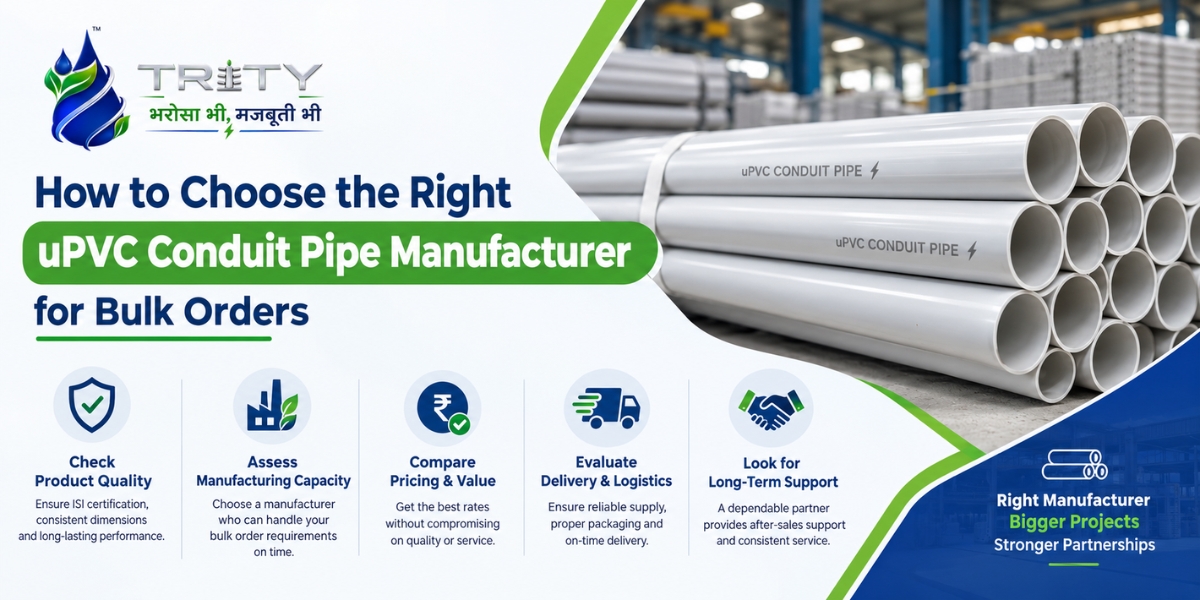
A bulk conduit order changes the risk profile entirely. A small purchase that goes wrong costs you a return trip to the dealer. A large order that goes wrong, wrong grade, inconsistent batches, or a manufacturer that can't actually deliver the full quantity on schedule, can stall an entire project. This guide covers what changes specifically when you're buying at scale, beyond the general manufacturer-quality questions covered in our guide to the best uPVC conduit pipes in India.
Why bulk orders need a different evaluation
Most manufacturer-selection advice focuses on certification, raw material, and general reliability, the right starting point for any order. A bulk order adds a second layer of questions entirely: can this specific manufacturer actually produce, maintain quality across, and deliver this specific quantity, on this specific timeline, without the compromises that often creep in when a supplier takes on more volume than their operation comfortably handles.
Verifying real production capacity, not just willingness to quote
Almost any manufacturer will quote a large order. Far fewer can actually deliver it without subcontracting part of the volume to a third party (often without telling you) or stretching their production schedule well past what the project needs.
What to actually check
- Ask for the manufacturer's rated production capacity per month for the specific size and grade you need, not their total plant capacity across all products, since a plant's headline capacity figure often spans dozens of SKUs.
- Ask how much of that capacity is already committed to existing orders during your required delivery window, since a manufacturer quoting your full volume without accounting for existing commitments is setting up a delay.
- Request a production schedule for your order specifically, not just a delivery date, so you can see whether the quantity and timeline are actually realistic against their stated capacity.
- Be cautious of a manufacturer who accepts any volume without qualifying questions about your timeline. A manufacturer confident in their capacity will ask you detailed questions about your schedule before committing, not just confirm a date to close the sale.
Batch-to-batch consistency at scale
A small order typically comes from one production run. A large order, especially one delivered in phases over weeks or months, may span several production batches, and this is where quality can quietly drift if the manufacturer doesn't have real process discipline.
- Ask whether your full order will come from a single continuous production run or multiple separate batches, and if multiple, how the manufacturer ensures consistency across them
- Request batch test records for a bulk order, not just a general quality certificate, so any variance can be traced back to a specific production run if a problem does appear later
- For very large orders, consider requesting a sample inspection at intervals during production rather than only checking the finished goods at the point of dispatch
Logistics capability for large, phased deliveries
Bulk orders are rarely a single truckload. Most large projects need deliveries phased against construction progress, and a manufacturer's logistics capability matters as much as their production capability here.
- Confirm the manufacturer's capacity to handle multiple large dispatches to your site or sites, not just a single big shipment
- Ask about their track record on delivery reliability for projects of comparable scale, ideally with a reference you can actually call
- For multi-location projects, confirm whether the manufacturer can coordinate deliveries to different sites from the same order, or whether this needs to be managed as separate orders
Contract terms that protect a bulk buyer
A bulk order justifies more formal terms than a routine purchase, and a manufacturer experienced with large accounts will generally have no issue agreeing to reasonable protections.
- A fixed rate for the full order duration, protecting you from mid-project price increases, is reasonable to request for any order spanning more than a few weeks
- Clear penalty or remedy terms for late delivery, particularly where your project has a hard construction schedule dependency on the conduit arriving on time
- Defined quality acceptance criteria, so both sides agree upfront what constitutes an acceptable delivery versus a rejectable one, rather than discovering a disagreement after goods have already been installed
Dedicated account support for large accounts
A bulk buyer benefits from a single point of contact at the manufacturer who understands the full scope of the order, rather than routing every question through a general sales line. Ask whether a large order comes with a dedicated account contact, and what their role is in resolving issues if something goes wrong mid-project.
India's major conduit manufacturers: a brief landscape
India's plastic pipe industry includes several large, established players, Supreme Industries, Finolex Industries, Astral, Prince Pipes, and Ashirvad among the most recognised names, alongside numerous regional and specialist manufacturers. Scale alone isn't the deciding factor for a bulk order; a large national brand and a focused regional manufacturer can both be genuinely capable of fulfilling a bulk order well, and both can also fall short if their current capacity doesn't match your specific timeline. The questions above matter more than brand size alone.
A bulk order evaluation checklist
- Confirmed production capacity for your specific size, grade, and timeline
- Clear batch consistency process across a phased order
- Demonstrated logistics capability for multi-delivery or multi-site dispatch
- Fixed-rate, documented contract terms for the order duration
- A dedicated contact for the account, not a general sales line
Trity Pipes works directly with contractors, developers, and dealers placing large and phased conduit orders, with production planning and a dedicated account process built around project-scale requirements. Browse our full uPVC conduit pipes and fittings range across LMS, MMS, and HMS grades, then get a bulk order quote with your project's quantity, timeline, and grade requirement, and our team will confirm capacity before anything is committed.
Red flags that suggest a manufacturer cannot handle your volume
Some warning signs show up early in the conversation, long before an order is placed. Spotting them saves you from a delivery crisis three months into a project.
Quoting without asking about your schedule
A manufacturer who confirms any quantity and any date without a single question about your project phasing is probably not planning production at all. A capable plant wants to know your size and grade split, your delivery sites, and how your construction schedule moves, because those answers decide how they sequence production.
Vague answers about where the pipe will be made
For very large orders, ask directly whether the full quantity will be produced at the plant you are visiting or in part by another unit. Subcontracted production is not automatically a problem, but it changes who is accountable for quality, and you should know about it before you sign.
No written commitment on dispatch dates
If a supplier is happy to talk about timelines verbally but resists putting a dispatch schedule in writing, treat that as a signal. Written schedules force a manufacturer to check their own capacity honestly.
Reluctance to share batch records
Batch test records are routine for a plant with real process discipline. A supplier who struggles to produce them for a bulk order is telling you something about how those records are kept the rest of the time.
Running a pilot order before committing the full quantity
For a large project, a smaller pilot order is one of the cheapest ways to test a new supplier. It lets you check dimensions, wall thickness, finish, and packaging, and it lets you see how the manufacturer handles dispatch and paperwork at a scale where mistakes are still affordable.
How to structure a useful pilot
- Order a meaningful but limited quantity across the actual sizes and grades the project will use, not just one convenient size
- Treat the pilot like a real order, with a written purchase order, an agreed delivery date, and the same documentation you would expect at full scale
- Inspect the delivery properly, using the on-site checks covered in our guide to identifying substandard conduit, and record what you find
- Agree in advance what a successful pilot looks like, so the decision to proceed to the full order is based on criteria rather than impressions
A pilot also tells you something softer but just as important: how quickly the supplier responds when you raise a question, and whether the person you speak to actually knows the answer.
Questions to ask during a factory visit for a bulk order
If the order justifies a visit, go with a short list rather than a general look around. Ask to see the extrusion line running the size you plan to buy, and ask how often wall thickness is checked during a run. Look at how finished stock is stored and labelled, because mixed or unlabelled stacks make batch traceability difficult. Ask where raw material is stored and how it is tracked. Finally, ask to meet the person who would manage your account, since that relationship will matter more than any sales presentation once production starts.
Documents to collect before releasing a bulk purchase order
Before the purchase order goes out, gather a short document set from the supplier: the current BIS licence details, the quality certificate, a sample batch test record, the agreed dispatch schedule, and the written rate with its validity date. Keeping these together gives you a clear reference if a delivery is later questioned, and it shows the supplier that you run a disciplined procurement process.
Frequently Asked Questions
What's the difference between a bulk order and a standard order for a manufacturer?
A bulk order typically requires a dedicated or prioritised production run, phased delivery planning, and often formal contract terms, compared to a standard order fulfilled from existing stock or a routine production cycle.
How do I verify a manufacturer's claimed production capacity?
Ask for their capacity specifically for your size and grade, not total plant capacity, and request a production schedule for your order rather than just a delivery date. A factory visit, where feasible, is the most reliable way to see actual capacity in person.
Should I split a very large order across multiple manufacturers?
This can reduce supply risk but introduces its own challenge: ensuring dimensional and quality consistency across two sources. For most projects, a single capable manufacturer with verified capacity is simpler to manage than splitting the order, unless the total quantity genuinely exceeds what one supplier can reliably produce in your timeline.
Does a bigger, more well-known manufacturer always mean better bulk order reliability?
Not automatically. Brand size doesn't guarantee that a specific manufacturer has uncommitted capacity available for your specific timeline. Verifying actual current capacity and production schedule matters more than brand recognition alone.
What is a reasonable lead time for a large conduit pipe order?
It depends on the quantity, the number of sizes and grades involved, and the manufacturer's current order book. A credible supplier will give you a production and dispatch schedule specific to your order rather than a single generic number, and will explain what could move it.
Should I pay an advance on a bulk conduit order?
Some advance is common for large production orders, since the manufacturer commits raw material and capacity. Keep it proportionate, tie further payments to dispatch milestones, and make sure the terms are written into the purchase order rather than agreed verbally.