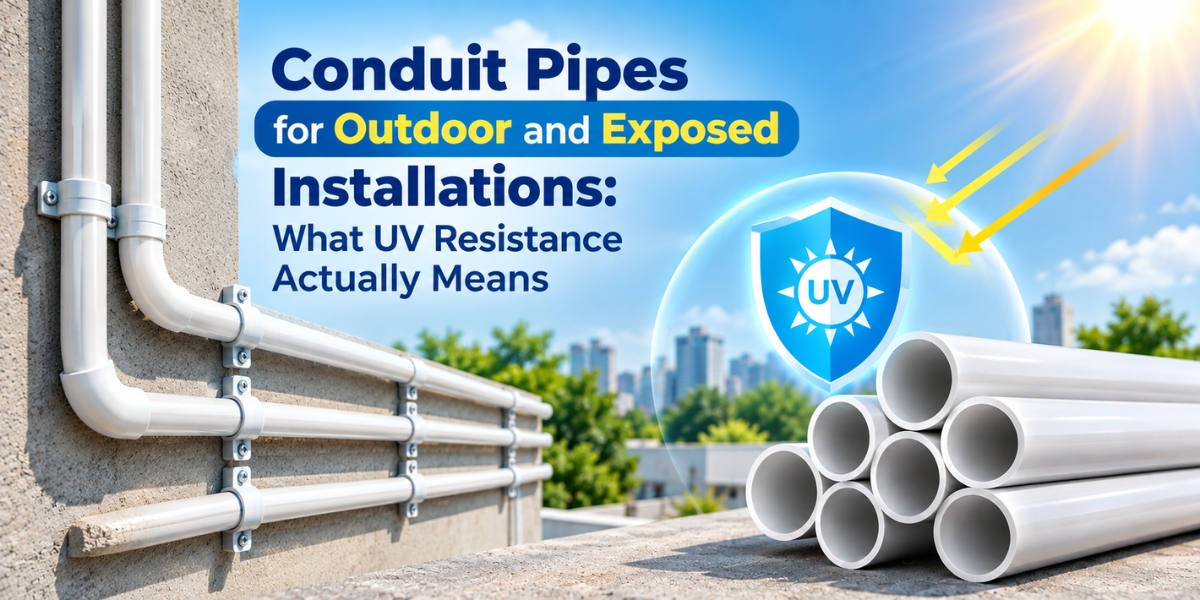
"UV resistant" appears on almost every conduit pipe catalogue in India, printed next to the ISI mark as if it were just another standard feature. It is not. UV resistance is a specific compound formulation decision made during manufacturing, and a conduit pipe that lacks it will behave very differently outdoors than one that has it, even if both look identical on the day they are installed.
This matters more than ever right now. Rooftop and ground-mounted solar installations, industrial facilities with surface-mounted wiring, telecom towers, and outdoor lighting and CCTV runs all put conduit pipe in direct, sustained sun exposure for years at a time. This guide covers what UV exposure actually does to conduit, how manufacturers protect against it, and what to check before specifying conduit for any exposed installation.
What UV degradation actually does to standard PVC conduit
Sunlight does real, measurable chemical damage to unprotected PVC, and the process follows a fairly predictable sequence.
Colour change first
UV radiation breaks down the polymer chains at the pipe's surface. The earliest visible sign is a shift in colour, often a dulling or yellowing on white conduit, or a chalky, faded appearance on the sun-facing side of the pipe. This is not just cosmetic. It is evidence that degradation is already underway beneath the surface.
Surface chalking
As degradation continues, the surface begins to chalk, a fine, powdery residue that rubs off on contact. This is the breakdown product of the polymer and additives at the surface, and it is a reliable early warning sign that the compound was not adequately UV stabilised for outdoor duty.
Brittleness
The mechanical consequence of UV exposure is a steady loss of impact resistance and flexibility. A pipe that could take a firm knock without damage when newly installed becomes progressively more brittle, sometimes within one to three years of continuous sun exposure if the compound had little or no UV protection.
Cracking
Brittleness eventually shows up as actual cracking, typically starting on the sun-facing surface where UV exposure and thermal cycling are most intense. Once a crack forms, water gets in, insulation gets exposed to moisture, and a system meant to last 25 years starts failing within a few seasons.
The damage happens gradually and is easy to miss until a crack appears, which is why UV degradation causes so many outdoor conduit failures that get blamed on "bad luck" rather than traced back to a compound that was never suited for the job.
UV stabilisers in uPVC: how they work and how to verify them
Genuine outdoor-rated uPVC conduit resists degradation because of stabiliser additives blended into the compound during manufacturing, not because of anything inherent to PVC as a base material. Standard indoor-grade uPVC and UV-stabilised outdoor-grade uPVC can look identical off the shelf while behaving completely differently after a year in the sun.
The two main types of stabiliser:
- Titanium dioxide — used both as a whitening pigment and a UV blocker, it reflects and scatters UV radiation before it can penetrate and degrade the polymer beneath the surface
- Hindered amine light stabilisers (HALS) — these neutralise the free radicals that UV exposure generates inside the polymer, before those radicals can break down the plastic's structure
Many outdoor-grade compounds combine both for stronger protection than either provides alone.
What to ask a manufacturer before specifying conduit for outdoor use:
- Written confirmation that this specific product line, not just their general range, is formulated and tested for outdoor UV exposure
- Accelerated weathering test data, if available, since manufacturers serious about outdoor performance typically test their compound under simulated UV exposure
- Whether the stabiliser loading is suited to sustained tropical sun exposure, since Indian UV intensity runs considerably higher than the temperate climates some international compound standards were originally developed for
None of this is visible by looking at the pipe. The only reliable way to know is to ask directly and get a specific answer, not a general assurance.
Indian climate zones and different UV loads
India's geography creates genuinely different UV exposure conditions across regions. A conduit installation that performs well in one climate zone can fail faster in another if the specification does not account for local conditions.
Coastal regions
High UV intensity combines with salt-laden air and consistently high humidity. Salt exposure accelerates surface degradation on top of UV damage, and heat-and-moisture cycling adds thermal stress that UV exposure alone does not create. Conduit near ports, coastal industrial facilities, or beachfront properties needs both UV stabilisation and good resistance to the corrosive atmosphere.
Desert and high-plains regions
Parts of Rajasthan, Gujarat, and central India see some of the highest ambient UV intensity in the country, combined with extreme surface temperatures on exposed conduit during summer. This combination accelerates chemical degradation significantly, making adequately stabilised compound especially important for solar and industrial installations in these areas.
High-altitude regions
UV intensity increases with elevation due to thinner atmosphere, even where ambient air temperature is lower. This is commonly underestimated. A hill station or high-altitude industrial site can face UV exposure comparable to or exceeding a plains installation, while also cycling through wider daily temperature swings that add mechanical stress from repeated expansion and contraction.
"Outdoor rated" is not a single uniform requirement across India. A project in a coastal or desert location, or at high altitude, deserves a direct conversation with the manufacturer about whether the standard outdoor grade is sufficient or a higher stabiliser loading is warranted.
Grey vs white conduit: does colour actually determine UV stability
This question comes up often, partly because grey conduit has a reputation in some international markets as the outdoor-rated colour, with white reserved for indoor use. In practice, colour alone is not a reliable indicator of UV performance.
What actually determines UV resistance is the stabiliser package in the compound, not the pigment used to colour it:
- A white conduit compounded with an adequate titanium dioxide and HALS loading for outdoor duty will perform well in sun exposure
- A grey, or any other coloured conduit, compounded without proper UV stabilisation will degrade just as readily as an unstabilised white pipe, regardless of how the colour looks
The safer approach is to ask the manufacturer directly whether the specific product is formulated and tested for outdoor UV exposure, rather than relying on colour as a shortcut.
IP rating requirements for outdoor conduit and fittings
Conduit pipe itself does not typically carry an IP rating the way an enclosure or junction box does. But the fittings and enclosures used with an outdoor conduit system need proper IP ratings to keep the installation genuinely weatherproof.
- IP65 — suitable for most outdoor and exposed installations in India; protects against dust ingress and low-pressure water jets from any direction, covering typical monsoon rain and wind-driven spray
- IP66 — recommended for more severe exposure, such as coastal sites with driving rain or industrial washdown areas, offering stronger protection against powerful water jets
An IP rating on a system is only as strong as its weakest connection point. A well-sealed IP65 junction box connected with a poorly fitted or unsealed conduit entry gland defeats the purpose of the rating entirely. Every entry point where conduit meets an enclosure needs a proper sealing gland or grommet matched to the conduit size, not just a snug mechanical fit.
How to install conduit on external walls
Outdoor conduit installation on external walls has a few requirements that indoor concealed wiring does not need to consider.
Fixing and saddle spacing
Exposed conduit needs more frequent mechanical support than concealed conduit, since it is not held rigid by surrounding wall material. Space saddle clamps closely enough to prevent sagging between fixing points, particularly for larger diameters, and fix them securely enough to resist wind loading in exposed, elevated, or coastal locations.
Expansion gaps
uPVC has a meaningfully higher coefficient of thermal expansion than the masonry or steel it is typically mounted on, so long straight runs of exposed conduit expand and contract noticeably with daily and seasonal temperature swings. Long horizontal or vertical runs should incorporate expansion couplers at intervals recommended by the manufacturer, allowing the pipe to move slightly within the fitting rather than transferring stress to a rigid solvent-welded joint.
Sealing and orientation
Every fitting exposed to weather should be oriented to shed water rather than collect it:
- Enter junction boxes from the side or bottom rather than directly from the top, to reduce water pooling working past a seal over years of exposure
- Give solvent-welded joints adequate cure time before exposing the installation to rain, since a joint compromised during curing becomes a permanent weak point
Maintenance-free vs maintenance-required outdoor systems
A properly specified outdoor conduit system, genuine UV-stabilised compound, correctly rated fittings, and installation practices that account for expansion and water shedding, is designed to run effectively maintenance-free for decades.
A system built on an inadequately stabilised compound, standard indoor-grade fittings, or installation shortcuts becomes maintenance-required whether anyone planned for that or not. That typically shows up as:
- Periodic repainting or covering to protect degrading conduit from further sun exposure
- Replacement of cracked sections discovered during routine inspection
- Resealing of joints that have failed as thermal cycling worked its way into inadequately accounted-for expansion stress
The cost difference is not close. A genuinely UV-stabilised system costs modestly more at the point of purchase and installation. An inadequately specified system costs considerably more over its working life, in repeated repair labour, in the risk of an electrical fault from water ingress, and in the disruption of reworking exposed runs that were never designed to last outdoors in the first place.
Frequently asked questions
Does ISI certification under IS 9537 Part 3 mean the conduit is automatically UV resistant?
No. IS 9537 Part 3 covers dimensions, bending, compression, impact, collapse resistance, heat resistance, and resistance to burning, but it does not include a dedicated sunlight or weathering test as part of its standard requirements. A conduit can carry a fully genuine ISI mark and still not be formulated for outdoor UV exposure. UV stabilisation is a separate compound decision that needs to be confirmed with the manufacturer directly, not assumed from the ISI mark alone.
Can I use standard indoor conduit outdoors if I paint or cover it?
Painting can slow surface degradation to some extent by blocking direct UV exposure, but it is not a substitute for a properly UV-stabilised compound. Paint wears, chips, and needs reapplication, and any exposed or unpainted section, joints, fitting entries, the underside of clamps, will degrade at the normal rate. For any installation expected to last years outdoors, specifying genuinely UV-stabilised conduit from the start is more reliable than relying on a maintenance routine to compensate for an indoor-grade material.
How long should UV-stabilised conduit actually last outdoors in Indian conditions?
A properly formulated, correctly installed outdoor conduit system is designed to perform for the working life of the installation, generally in line with the 20 to 25 year service expectations common for building electrical systems and solar installations. Actual performance depends on the specific climate zone, installation quality, and whether fittings and sealing were done correctly, which is why climate-specific specification matters more in India's high-UV regions than in more temperate conditions.
Does UV-resistant conduit cost significantly more than standard conduit?
The additional cost comes from the stabiliser additives in the compound, and it is generally a modest premium relative to the base pipe cost rather than a dramatic price jump. Given that the alternative is premature cracking, water ingress, and rework on an outdoor installation, this premium is one of the more cost-effective decisions in the entire electrical specification.
Can UV-damaged conduit be repaired, or does it need replacement?
Once a conduit has visibly chalked, discoloured, or cracked from UV exposure, the degradation has already reduced the material's mechanical strength throughout the affected section, not just at the visible crack. Repair in the form of patching or sealing a crack is, at best, a temporary measure. The reliable fix is replacing the affected length with properly UV-stabilised conduit rather than attempting to extend the life of degraded material.
Does UV resistance matter for underground or fully concealed conduit?
UV stabilisation matters specifically for conduit exposed to direct or indirect sunlight. Fully concealed conduit inside walls, slabs, or backfilled trenches has no sun exposure and does not need UV-stabilised compound on that basis alone, though other factors like soil chemistry and moisture still apply underground. The relevant question for any run is simply whether any section of it, including the transition point where it emerges from the ground or wall into open air, will see sunlight at any point in its life.
Specifying the right conduit for your outdoor project
UV resistance in conduit pipe is a compound formulation decision, not a visual or colour distinction. The only reliable way to confirm it is to ask the manufacturer directly and get a specific, written answer about the product's outdoor rating.
For solar installations specifically, our complete guide to conduit pipe for solar panel wiring covers the additional requirements around DC wiring and 25-year system life that make UV stabilisation especially critical for that application. For industrial facilities with surface-mounted exposed runs, our industrial conduit guide covers related environmental exposure considerations for factory and plant settings.
Trity Pipes manufactures uPVC conduit with UV stabiliser formulations suited to sustained outdoor exposure across Indian climate conditions, backed by our IS 9537 Part 3 BIS licence and consistent batch quality. You can review our full uPVC conduit pipes and fittings range for specifications across sizes and grades.
UV-stabilised conduit for outdoor projects. Request specifications for your project's climate zone and application, and our technical team will help you confirm the right grade before you order.