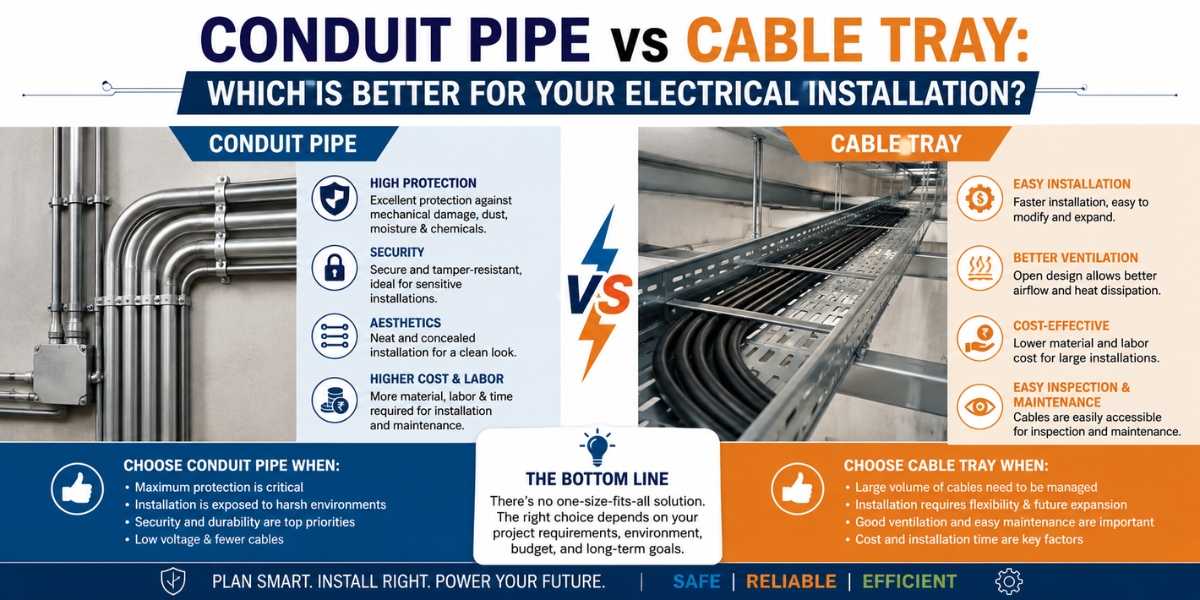
Every MEP engineer runs into this decision at some point on a large project: does this cable run go into a conduit, or onto a tray? It looks like a simple choice on paper, but get it wrong and you end up with either an over-engineered, expensive installation or a system that fails inspection and needs rework mid-project.
The honest answer is that conduit pipe and cable tray are not competing products. They solve different problems, and most real buildings end up using both. This guide breaks down what each system actually does, where each one belongs, and how to make the call when a project genuinely could go either way.
What is a conduit pipe
A conduit pipe is a fully enclosed tube, typically uPVC in Indian construction, that individual cables or small cable groups are pulled through. In India, rigid uPVC conduit is governed by IS 9537 Part 3, which specifies wall thickness, mechanical strength, and fire propagation behaviour for the pipe itself. The cable sits completely inside the pipe, protected on all sides from impact, moisture, and rodent damage, and hidden from view once installed in a wall, slab, or underground trench.
Conduit is a point-to-point protection system. You size it, run it from a source to a destination, pull the cable through, and close it up. Adding capacity later means either accepting the existing fill limit or running an entirely new conduit line.
What is a cable tray
A cable tray is an open or partially enclosed support structure, usually fabricated from perforated steel, ladder-style rails, or wire mesh, that cables are laid onto rather than pulled through. In India, cable tray systems are typically specified against IS 12427, with many manufacturers also referencing the international IEC 61537 standard for load capacity, corrosion resistance, and mechanical performance testing.
Unlike conduit, a tray does not enclose the cable. Multiple cables run side by side along an open channel, supported at intervals, and dressed with cable ties or cleats. This makes a tray fundamentally a bulk distribution system rather than a point protection system.
The core application difference
This is the distinction that actually drives every decision on this list: conduit protects, tray distributes.
Conduit pipe is the right choice when a small number of cables need to travel through a wall, slab, or underground path where physical protection, concealment, or a fully enclosed route is required. Think of a single circuit running from a distribution board to a light point, a socket, or a piece of equipment.
Cable tray is the right choice when a large volume of cables need to travel together along a common route, such as the main run from a transformer room to distribution panels on multiple floors, or the backbone routing through a factory floor or a data centre's raised access void. A tray lets dozens of cables run in parallel without the impractical cost and labour of pulling each one through its own separate conduit.
Trying to force one system to do the other's job is where projects run into trouble. Running forty cables through individual conduits when a tray would have handled them in one continuous open channel adds enormous material and labour cost. Running a single circuit on open tray through a residential wall cavity, on the other hand, leaves that cable with none of the mechanical protection a concealed installation actually needs.
Where each system belongs on a project
Conduit pipe fits:
- Concealed wiring inside walls, RCC slabs, and false ceilings in residential and commercial buildings
- Individual circuits from a distribution board to lighting points, switches, and sockets
- Underground cable protection for site lighting, boundary wiring, or utility feeds
- Any location where the installation must be fully hidden and inspection is not expected after commissioning
- Wet, corrosive, or chemically exposed environments where an enclosed non-conductive tube outperforms open metal
Cable tray fits:
- Main cable risers running vertically between floors in commercial and institutional buildings
- Horizontal bulk cable runs above false ceilings, in service corridors, or along factory floor perimeters
- Plant rooms, electrical rooms, and switchgear areas where many cables converge and need to stay organised and accessible
- Data centres and telecom facilities with high cable density and frequent additions or changes
- Any route where future cable additions, removals, or troubleshooting need to happen without breaking open a wall or ceiling
Mixed systems: why most large projects use both
On any project past a certain scale, the real answer to "conduit or tray" is usually "both, in different zones." This is standard practice, not a compromise.
Hospitals typically run cable tray for the main distribution backbone through service corridors and risers, connecting the main electrical room to floor-level distribution boards. From each distribution board, individual circuits then branch off into conduit for the final run to patient room outlets, nurse call points, and medical equipment, where concealed, protected, single-circuit wiring is required.
Factories and manufacturing plants commonly use tray for the primary power and control cable runs from the main panel across the shop floor or along overhead structural steel, since this is where cable volume is highest and access for future rerouting matters. Conduit then takes over for the final connection from the tray drop point to individual machines, motors, and control panels, where the cable needs full mechanical protection in a working industrial environment. Our guide to industrial conduit selection covers this final-connection scenario in more detail, including heat and chemical exposure considerations specific to factory floors.
Data centres almost always separate power and data cabling onto dedicated trays running above racks, since density and airflow management make tray the only practical option for that volume of cabling. Conduit is still used for point drops into individual racks, for underfloor power whips in some designs, and for any run that needs to be sealed against dust or fire-rated compartmentalisation.
Recognising this pattern early in design avoids the common mistake of specifying one system for an entire project when the actual cable density and protection requirements vary significantly from zone to zone.
Cost comparison per linear metre, including labour
Material cost alone is a misleading way to compare these two systems, because installation labour changes the total cost picture substantially depending on cable volume.
For a small number of cables, conduit is typically the more economical option overall. A single or double circuit run in appropriately sized uPVC conduit costs less in material than a section of cable tray sized for the same job, and installation is a well understood, fast process for electricians: cut, join, mount, pull cable.
As cable count on a single route increases, the economics shift. Running twenty or thirty cables would require either an impractically large conduit or multiple parallel conduit runs, each needing its own fittings, saddles, and pulling labour. A single tray section handles the same cable volume with one continuous support structure, and cables are laid in rather than pulled through, which is faster labour per cable at volume even though tray material itself often costs more per metre than a comparable conduit.
The other factor procurement teams often miss is total system cost beyond the pipe or tray itself. Conduit needs matching fittings (bends, couplers, boxes, saddles) sized correctly for the run, which our guide to commercial and residential conduit sizing covers for getting this right at the specification stage. Cable tray needs supports, hangers, covers where exposure or code requires them, and bonding and earthing hardware across every section, all of which add to the installed cost beyond the base tray price.
In practice, the crossover point where tray becomes more economical than multiple conduits is usually somewhere between eight and fifteen parallel cables on a single route, though this varies with cable size, run length, and site labour rates. For any run below that range, conduit is generally the simpler and more cost-effective choice.
Maintenance access comparison
This is where the two systems differ most sharply, and it is often the deciding factor on projects expected to see changes over their working life.
Cable tray offers open, continuous access along its entire length. Adding a new cable, removing a decommissioned one, or troubleshooting a fault means walking the tray and physically accessing the cable, with no demolition involved. This is precisely why data centres, plant rooms, and any facility expecting frequent electrical changes favour tray wherever the installation does not need to be concealed.
Conduit pipe, once cable is pulled and the run is closed into a wall or slab, offers essentially no access without cutting into the structure. Any additional circuit beyond what the original conduit fill allows for means either an entirely new conduit run or accepting that future changes will involve wall or ceiling work. This is an acceptable and often necessary tradeoff for concealed wiring, since the alternative of visible tray running through a finished living or office space is rarely wanted, but it is a real limitation that should factor into capacity planning at the design stage rather than being discovered later.
The practical middle ground many projects use is sizing conduit with headroom for foreseeable future circuits, since the cost of one size larger conduit at installation is minor compared to reopening a finished wall two years later.
Fire safety standards for each system
Both systems have a role to play in fire safety, but the requirements are different in nature.
Conduit pipe under IS 9537 Part 3 must meet non-flame propagating requirements, verified through a specific fire propagation test on the pipe material itself. This means the conduit is designed not to actively spread fire along its length even if exposed to flame, which matters significantly in concealed installations where a fire inside a wall cavity would otherwise be difficult to detect or contain early.
Cable tray fire performance works differently, since the tray itself is typically metal and non-combustible, but open cable runs are more exposed to flame and smoke spread along the cable insulation rather than the tray structure. This is why tray installations in critical facilities, hospitals, high-rise buildings, and industrial plants with fire risk typically specify low smoke zero halogen (LSZH) cable jacketing on tray runs, along with fire-rated barriers or fire-stop compounds wherever a tray passes through a fire-compartment wall or floor. For time-rated fire performance in critical circuits, purpose-built fire-rated tray systems and fire-rated cable are specified separately, since general-purpose tray on its own carries no fire rating.
The practical rule for a project specification: concealed conduit runs rely on the pipe's own non-flame propagating compliance under IS 9537 Part 3, while open tray runs rely primarily on the cable jacketing choice and proper fire-stopping at every structural penetration, since the tray itself is not the fire barrier.
Decision guide: conduit or tray?
Use this as a quick working checklist when specifying a route:
Choose conduit pipe when:
- The run is a small number of individual circuits, generally under eight to ten cables
- The installation must be concealed inside a wall, slab, or underground
- The environment is wet, corrosive, or requires full enclosure for protection
- Future access to the run is not expected or acceptable to plan for
Choose cable tray when:
- The run carries a large volume of cables travelling the same path
- The route is in a false ceiling void, riser shaft, plant room, or similar accessible space
- Future cable additions, removals, or reconfiguration are expected over the building's life
- Open visual routing is acceptable or the space is not a finished occupied area
Plan for both when:
- The project has a clear split between bulk distribution zones and final point connections, which describes nearly every hospital, factory, commercial tower, and data centre of meaningful size
Getting the specification right from the start
Choosing between conduit and tray is not a one-time decision made once for an entire project. It is a zone-by-zone call based on cable volume, protection requirement, and future access needs, and getting it right at the design stage avoids costly rework later.
Trity Pipes manufactures ISI-certified, IS 9537 Part 3 compliant uPVC conduit pipes and a full matching range of fittings for the concealed and point-connection side of any cable management design, across Light, Medium, and Heavy Duty grades to suit residential, commercial, and industrial applications. If you are working through a project specification and want guidance on where conduit fits into your overall cable management plan, browse our complete uPVC conduit pipes and fittings range or get in touch with our technical team for project-specific recommendations.