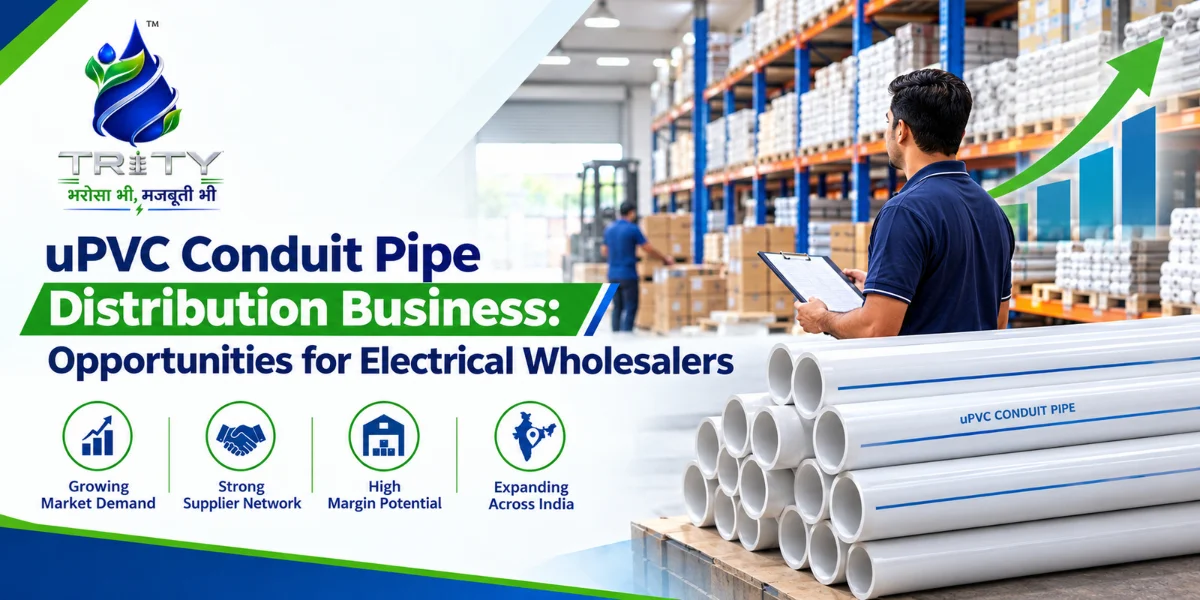
If you already run an electrical wholesale business, cables, switchgear, fixtures, accessories, conduit pipe is one of the more natural product line extensions available to you. Your existing customer base, electricians and contractors, already buys conduit for nearly every job they do. The question is whether adding it to your range is worth the shelf space, capital, and supplier relationship it requires.
Why conduit is a natural fit for an existing electrical wholesale business
Conduit pipe and the cable it protects are bought together on nearly every electrical job, residential, commercial, or industrial. An electrical wholesaler not currently stocking conduit is sending a share of every customer's basket to a separate supplier, often a hardware or building materials dealer rather than another electrical specialist, simply because the product category sits slightly outside their traditional range.
Adding conduit lets an existing electrical wholesaler capture that full basket from customers they already serve, without needing to build a new customer base from scratch, which is the single biggest advantage this expansion has over starting a standalone conduit dealership.
What changes compared to starting a standalone conduit business
The economics and operational considerations differ meaningfully from a from-scratch conduit dealership.
- Lower customer acquisition cost, since your existing electrician and contractor customers are already the target market for conduit, and you're not building a new relationship base
- Additional storage and SKU management, since conduit pipe takes up different storage space (lengths and bulkier packaging) than typical electrical wholesale stock like cable reels and switchgear boxes
- A different supplier relationship to establish, since your existing cable and switchgear suppliers are unlikely to also manufacture conduit pipe, meaning this is a genuinely new vendor relationship even if the customer base overlaps with your existing business
Evaluating the opportunity for your specific business
A few questions help determine whether this expansion makes sense for your specific operation:
- How much of your current customer base's conduit purchases are you currently losing to other suppliers? If most of your electrician and contractor customers already buy conduit from you by habit or convenience, the incremental opportunity may be smaller than if they're routinely sourcing it elsewhere.
- Do you have the storage capacity for conduit's bulkier packaging, typically full-length pipe bundles, without compromising space for your existing core inventory?
- Is there a nearby conduit-capable manufacturer or distributor willing to work with an electrical wholesaler as a new product line, rather than requiring you to build an entirely separate supply relationship from an unfamiliar industry segment?
What to look for in a manufacturer partner for this expansion
An electrical wholesaler adding conduit benefits from a manufacturer who understands this specific expansion scenario, not just a standard new-dealer onboarding process designed for a from-scratch conduit business.
- A manufacturer willing to support a smaller initial stock commitment, recognising that an existing electrical wholesaler is adding a line to a functioning business, not launching from zero
- Technical product training for your sales staff, since your team likely knows cable and switchgear well but may need a briefing on conduit grade, sizing, and fitting compatibility to sell it confidently
- Marketing and point-of-sale support that helps you communicate the expanded range to your existing customer base effectively
Getting started
The lowest-risk way to evaluate this expansion is typically a modest initial stock commitment in your highest-volume sizes and grades, LMS and MMS in common residential and commercial diameters, paired with communicating the new range clearly to your existing customer base, rather than committing to a full product range and large storage investment before confirming genuine customer uptake.
Trity Pipes works with electrical wholesalers adding conduit to an established business, with flexible initial stock options and product training support for expanding businesses. Take a look at our full uPVC conduit pipes and fittings range, then get in touch to discuss adding conduit to your existing range.
How to introduce conduit to your existing customers
Your advantage as an electrical wholesaler is that the customers already trust you. The introduction should build on that trust rather than treat conduit as a new product that needs a big launch.
Start with the conversation at the counter
When an electrician buys cable or accessories for a job, ask what they are using for conduit. Many will say they buy it elsewhere. Telling them you now stock it, and that it can go on the same bill and the same delivery, is often all it takes to start moving volume.
Make the range easy to understand
Keep your initial range simple and clearly labelled by size and grade. A short sizing reference near the counter, based on the sizes electricians use most, helps people choose quickly. Our conduit pipe size chart is a useful starting reference for training your counter staff.
Bundle with what they already buy
Offering conduit alongside the cables and accessories for a job, with consistent availability, makes your shop the easier option. Convenience is often a stronger reason to switch suppliers than a small price difference.
Inventory planning for a new conduit range
Conduit takes more space than most electrical stock, so planning matters.
- Store lengths flat and supported so they do not bow, and keep them away from direct sun and heat
- Separate by grade and size with clear labels, so staff can pick the right pipe quickly
- Hold fittings alongside pipe, since customers will ask for both together and a missing fitting can lose the whole sale
- Track what sells in the first three months, and use that to adjust sizes and quantities rather than guessing
Start with the common residential and light commercial sizes in the grades your customers use most, and widen the range only when you see demand for it.
Common mistakes electrical wholesalers make when adding conduit
- Stocking only pipe and no fittings. Customers who cannot buy the complete set from you will buy all of it elsewhere.
- Buying on price alone. A cheap source with inconsistent quality creates complaints that damage the trust you have built with your existing customers.
- Not training counter staff. If your team cannot answer a basic grade or sizing question, customers will assume you are not a real conduit supplier.
- Over-ordering at the start. A large first order locks up space and cash before you know what your customers will actually buy.
- Ignoring documentation. Contractors on larger jobs need certification paperwork. Being able to provide it quickly sets you apart from general hardware sellers.
Why quality consistency matters more for a wholesaler's reputation
When you sell a product under your own roof, your reputation is attached to it. An electrician who has a problem with conduit you supplied will not separate the pipe from your shop. That makes manufacturer choice a reputation decision as well as a pricing one. A supplier with genuine certification, consistent batches, and a reliable support process protects the relationships you have spent years building.
Pricing and margin thinking for a new product line
Pricing conduit as an add-on requires a different approach from pricing core electrical stock. Understand your landed cost, including freight and handling, before setting a selling rate. Look at the margin structure the manufacturer offers at different volume levels, and recognise that fittings often carry better margins than pipe. Avoid undercutting the local market to win volume, because lower margins on a bulky product with higher handling cost can make the line unprofitable even when sales look healthy.
Using your existing delivery and credit relationships
Wholesalers already have customer credit terms, delivery routes, and billing systems. Adding conduit to existing deliveries spreads the logistics cost across more products and increases the value of each trip. Keep credit policies consistent with your existing practice, and watch exposure on larger contractors who may begin to purchase conduit in bigger quantities. Existing relationships are an asset, and the same discipline that protects your current business should apply to the new line.
Measuring whether the expansion is working
Set simple measures from the beginning. Track monthly conduit sales by size and grade, the proportion of existing customers who have bought conduit from you, stock turnover for each size, and any returns or complaints. Review these after three and six months. If the line is performing, widen the range. If specific sizes are not moving, reduce them. Treat the first six months as a test with clear criteria, rather than a permanent commitment.
Working with the manufacturer as a long-term partner
Your relationship with the manufacturer will shape how well the new line performs. Share your sales trends so they can help you plan stock. Ask for product training for your counter team, and for sales material you can use with contractors. Use their technical team when customers ask difficult questions, since quick, accurate answers build your credibility. Raise any quality or delivery concern promptly and in writing. A manufacturer who sees you as a serious partner will usually respond with better support, and over time that support is as valuable as the margin itself.
Looking ahead
Once conduit is established, many wholesalers add complementary lines such as fittings, junction boxes, and accessories, building a complete wiring solution under one roof. Each addition deepens customer loyalty and increases the value of every order. The first step is a controlled, well-planned entry, and the rest can follow from what your customers tell you through their purchases.
Seasonal planning for conduit stock
Construction activity rises and falls through the year, and your conduit sales will follow it. Watch how your existing electrical sales move across seasons, since conduit demand tends to track the same pattern. Build stock ahead of busy periods, and avoid heavy buying just before slower months. Keeping a simple month-wise record of conduit sales in your first year gives you a reliable basis for planning the next one.
Frequently Asked Questions
Does an electrical wholesaler need a separate storage area for conduit pipe?
Generally yes, given conduit's bulkier, longer packaging compared to typical electrical wholesale stock like cable and switchgear. Evaluating your existing storage capacity before committing to a full product range is a sensible first step.
Is adding conduit pipe to an electrical wholesale business lower risk than starting a standalone conduit dealership?
Generally yes, since you're adding a product line to an existing customer base and operating business rather than building customer relationships and a business from scratch, which reduces the customer acquisition risk considerably.
What size range should an electrical wholesaler stock when first adding conduit?
Starting with the highest-volume sizes and grades commonly used in residential and commercial wiring, typically 20mm to 32mm in LMS and MMS grades, lets a wholesaler test genuine customer uptake before committing to a full size and grade range.
Do existing electrical product suppliers typically also supply conduit pipe?
Not usually. Conduit pipe manufacturing is generally a separate industry segment from cable and switchgear manufacturing, so adding conduit typically means establishing a new supplier relationship even though the end customer base overlaps significantly with an existing electrical wholesale business.
How much working capital does adding conduit usually require for an existing wholesaler?
It depends on the size range and depth of stock you choose. Starting with fast-moving sizes and a modest first order keeps the commitment manageable, and you can expand as sales data builds. Discuss staged ordering with your manufacturer.
Will conduit sales cannibalise my existing electrical products?
Generally no. Conduit is bought alongside cable, switchgear, and accessories rather than instead of them, so it tends to increase the value of each customer order rather than shift sales between products.