India is building data centres at a pace that few other markets match. Industry trackers put operational capacity at roughly 1.6 to 1.8 GW in mid-2026, heading towards about 2 GW by the end of the year, with a development pipeline of close to 3.9 GW through 2030. Mumbai leads, Chennai is the second major hub, and Delhi NCR, with Noida and Greater Noida campuses, is a growing third. Hyderabad, Pune, Kolkata and other cities are adding capacity too.
Every one of these campuses is also a very large electrical and cabling project, and conduit pipe is part of it. But a data centre is not an ordinary building, and the honest answer to "where do I use uPVC conduit?" is "in a lot of places, but not everywhere". This guide explains which parts of a data centre suit uPVC conduit, which parts use cable tray, busway or metal systems, how fire safety and redundancy change the design, and how to plan material supply for a campus build.
What a data centre electrical system is made of
A data centre has three broad zones, and each has different wiring needs.
- The data hall or white space, where racks of servers sit. Power and data are distributed here in dense, high-capacity systems, usually on overhead cable tray, busways, raised floors or underfloor trays, designed for easy change.
- The power and cooling plant, including transformers, generators, UPS rooms, battery rooms, switchgear and chillers. These carry heavy feeders and are built for high current and fire resilience.
- Support and site areas, such as offices, network operations centres, security, lighting, general power, loading docks, parking, landscaping and perimeter systems.
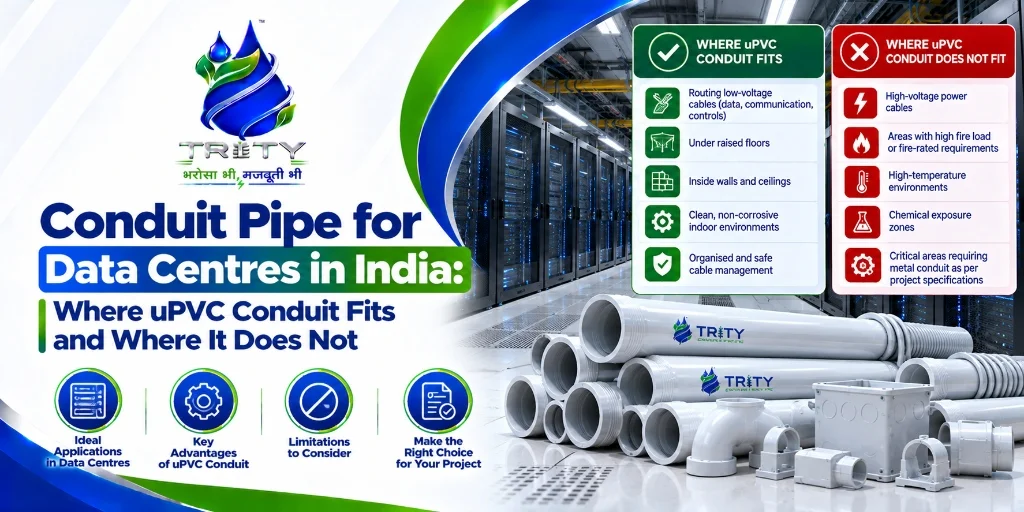
uPVC conduit is a strong fit for the third zone and for parts of the site beyond the building. In the first two zones, other systems do most of the work, and uPVC conduit plays a supporting role.
Where uPVC conduit fits well
Offices, NOC, security rooms and meeting spaces
These areas are wired like a commercial building, with concealed conduit in walls and slabs for lighting, sockets, small power, data and access control. MMS grade is the usual choice, with HMS where conduit is exposed or at higher risk. Our guide on conduit pipe for commercial buildings covers this kind of specification.
Underground ducts between buildings
A campus has many buried routes: from the substation to the main building, between buildings, to generator yards, to cooling plant and to gatehouses. Underground duct banks with spare ways are standard practice, and uPVC conduit is widely used for the ducts that carry power, fibre and control cables. Plan depth, mechanical protection and markers, and use HMS grade where the route crosses roads. See our guide on underground conduit pipe for cable protection.
Perimeter security, CCTV and lighting
Fences, gates, cameras, boom barriers, access control and perimeter lighting all need protected cable routes, much of it outdoors. Exposed runs need UV stabilised conduit and sealed boxes. Our guide on UV resistant conduit for outdoor wiring explains what to confirm with a manufacturer.
Branch circuits in support and utility areas
Lighting, small power, fan, pump and equipment circuits in plant rooms, stores, workshops and loading areas are standard conduit work. Use HMS grade where there is mechanical risk.
EV charging and parking
Data centre campuses increasingly include staff and fleet EV charging. See our guide on conduit pipe for EV charging stations for continuous-load sizing.
Rooftop solar
Many operators add rooftop or carport solar to reduce energy cost and meet sustainability goals. See our guide on conduit pipe for solar panel wiring.
Where other systems do the job
It would be a disservice to suggest that uPVC conduit does everything in a data centre. It does not, and good designers specify the right system for each job.
- Data hall power and data distribution uses cable tray, ladder rack, wire mesh trays, busways and underfloor systems, because they offer open access, high capacity and easy change. Our guide on conduit pipe vs cable tray explains where each system suits.
- Main power feeders between transformers, switchgear, UPS and generators are typically on heavy-duty cable tray, in cable trenches or in busways, often with fire-rated provisions.
- Critical life safety circuits may need fire-resistant cable and routing that preserves circuit integrity in a fire, which is specified separately from ordinary conduit.
- Some areas use metal conduit or trunking where the specification calls for it, for example for electromagnetic shielding or where a rigid metal system is required.
Your consultant's specification decides which system goes where, and our role is to supply certified uPVC conduit for the parts of the project where it is specified.
Redundancy and separation
Data centres are designed so that no single failure takes the facility down. That affects how conduit and cable routes are planned.
- Separate routes for A and B feeds. Redundant power feeds are usually routed apart, so a single event does not damage both. Plan separate underground ducts and separate risers.
- Separate power from data. Keep power and low-voltage data in different conduits or compartments, with spacing that follows the project specification.
- Label every route. Clear, durable labels and accurate as-built drawings make maintenance and fault-finding quick.
- Leave spare capacity. Campuses grow in phases, and a few spare ducts laid now are far cheaper than excavating later.
Fire safety and codes
Fire safety is a first-order concern in a data centre, because of the value of equipment and the cost of downtime. In India, fire and life safety requirements sit within the National Building Construction Standards 2026 (NBCS 2026), Part F, which replaced NBC 2016 Part 4 and includes an annexure for data centres. NBCS 2026 is advisory until a state adopts it, so confirm with your fire consultant and authority which framework and which edition apply to your project. Our guide on NBCS 2026 and conduit pipe explains what changed and what did not.
In practice, for conduit this means:
- Flame retardant, low-smoke conduit as a baseline. Our guide on fire resistant conduit pipe explains how this is judged.
- Fire stopping at every penetration through fire-rated floors and walls. See our guide on riser shaft conduit, which covers fire stopping in vertical shafts.
- Compliance documents to prove that the material meets the specification.
Sizing and grade by area
| Area | Typical use | Suggested grade |
|---|---|---|
| Offices, NOC, meeting rooms | Concealed walls and slabs | MMS |
| Plant and utility rooms | Exposed or concealed branches | MMS, HMS where exposed |
| Loading dock, parking, service roads | Exposed or buried | HMS |
| Underground duct banks | Power, fibre, control | HMS, with spare ways |
| Perimeter, CCTV, lighting | Outdoor, exposed | HMS, UV stabilised |
| Rooftop solar and EV | Outdoor | HMS, UV stabilised where exposed |
Use this as a starting point, and let your specification take priority. Our LMS, MMS and HMS guide and conduit pipe size chart help with grade and sizing.
Planning material supply for a campus build
Data centre campuses are built fast and in phases, and delays are expensive.
- Finalise the conduit specification early, and complete material approval before the programme depends on it. Our guide on material approval submittals for conduit pipe explains what consultants expect.
- Estimate quantities by building and phase. See our guide on estimating conduit pipe for a BOQ.
- Order matching material in single batches where possible, so that pipe and finish are consistent across buildings.
- Plan phased delivery that follows construction, with a buffer of common sizes for changes.
- Order fittings with the pipe, including bends, couplers, boxes and saddles.
Why data centre projects choose Trity Pipes
Trity Pipes is a manufacturer of uPVC conduit pipes and fittings made from lead-free, high-grade virgin raw materials, certified to IS 9537 Part 3 with ISO certification. For campus projects, we offer:
- LMS, MMS and HMS grades so each area gets the right strength
- Matching fittings from one manufacturer
- Certification documents and technical data for consultant approvals, on our certifications page and on request
- Project quotations with rate validity and phased delivery
- A Delhi NCR factory, close to the Noida and Greater Noida data centre belt, with dispatch to 20-plus states
Our regional guide on conduit pipe in Delhi NCR explains how supply works in the region, and you can see the uPVC conduit pipes and fittings range for sizes and grades.
Questions to ask a conduit supplier on a data centre project
Data centre buyers tend to ask sharper questions than most, and they are right to. When you evaluate a supplier, ask for the BIS licence number and verify it, ask for batch test records, confirm that the material in each delivery will match the approved submittal, ask how quickly the supplier can respond to a change order, and ask who will answer your questions during a fast build. Our guide on how to choose a conduit pipe manufacturer for bulk orders lists the checks that matter at campus scale.
How Trity Pipes works with campus projects
Campus builds run on tight schedules, so the supplier relationship needs to be simple. Our team works with contractors and consultants from the specification stage, helps match grade and size to each area, prepares a written quotation with the rate validity and delivery basis, and shares the documents your approval process needs. For multi-phase campuses, we can plan deliveries building by building, and for repeat projects we can discuss a standard specification so that every site receives the same product. If you are a contractor who regularly works with data centre developers, ask us about supply terms for your pipeline.
Frequently Asked Questions
Can uPVC conduit be used inside a data hall?
Data halls usually use cable tray, ladder rack, busways and underfloor systems for power and data distribution, and uPVC conduit is typically used in support areas, underground ducts, perimeter systems and branch circuits. Follow your consultant's specification for each zone.
Which conduit grade is best for data centre underground ducts?
HMS grade is the usual choice for buried duct banks, especially where the route crosses roads or service areas, with spare ways laid for future capacity and warning markers above the ducts.
Does data centre conduit need to be fire resistant?
Flame retardant, low-smoke wiring and fire stopping at penetrations are expected in data centres, and NBCS 2026 Part F includes provisions for them. Confirm exact requirements with your fire consultant and authority.
How should I plan conduit for A and B power feeds?
Route redundant feeds in separate ducts and risers, so that one event cannot damage both, label every route clearly and keep accurate as-built drawings.
Can Trity Pipes supply conduit for a large campus in phases?
Yes. Share your sizes, grades, quantities and phasing, and our team will prepare a quotation with rate validity and a phased delivery plan from our Delhi NCR factory.
Does Trity Pipes provide documents for data centre approvals?
Our team can discuss certification details, datasheets and test records for your consultant's approval. Contact us with your specification so we can confirm what you need.
Planning a data centre project? Contact Trity Pipes on +91-9821030072 or +91-9319984755 for a project quotation, certification documents and a phased supply plan for ISO-certified uPVC conduit pipe from our Delhi NCR factory.